Life Lines
Reflections on my Story
By Tim Murray
What indeed was that summer if not recalled? That journey? That act of love? So any bits of warm life preserved by the pen are trophies snatched from the dark, are branches of leaves fished out of the flood, are tiny arrests of immortality.
(LAURIE LEE: I Can't Stay Long)
***
I dedicate Life Lines with much love
to Anne
to Caitlin and Ross
to Lisa, Ewan, Griffin and Essi
to Andy, Claire, Arno and Iris
***
I have put Life Lines together in the hope that it may be of some interest to the family - my children and grandchildren and perhaps even great grandchildren for whom I will simply be the name of someone long gone. As we get old there are many questions we ponder about our parents and grandparents and we wish we had asked them so much more. At the time we were simply getting on with life and looking forward and that was just as it should be. Perhaps Life Lines will answer some of the unasked questions.
I have chosen this title because it occurred to me that there have been a number of pillars or lifelines that have provided the foundations for my life. Together they provide a unique combination and I am very grateful for all the forces and influences that have come together to account for my story. As I have written about them I have come to think of them as LIFE LINES.
Essentially I think there are seven:
1. Family and Friends
Five generations of family and many friends in Australia and overseas.
2. Christian Tradition
The tradition and values and example that informed my upbringing in both home and school.
3. Education and Schools
The schools I attended, the schools at which I taught and the two schools of which I was Head.
4. Drama and Theatre
Performer, teacher, director and audience member.
5. Words and Music
Writer, reader, speaker and listener.
6. Cricket
Player, coach, watcher and follower.
7. Art
Latecomer to painting and drawing.
These seven Life Lines are reflected in a whole variety of ways in my story. It's a story that divides readily enough into a number of stages and I have made each of those stages a Chapter. Essentially Life Lines is based on things remembered and half remembered although sometimes I have referred to things that were written at the time and collected either by me or by my brother, Michael. I have listed these in a Bibliography at the end, while at the end of each Chapter I have included an Appendix with words that further develop the theme of the Chapter.
***
Adelaide and Melbourne
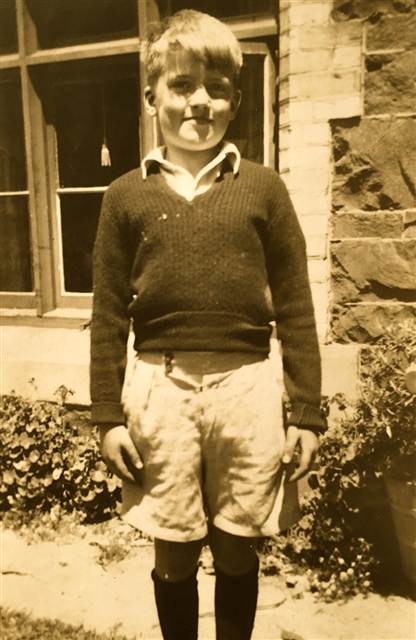
1935 – 1943
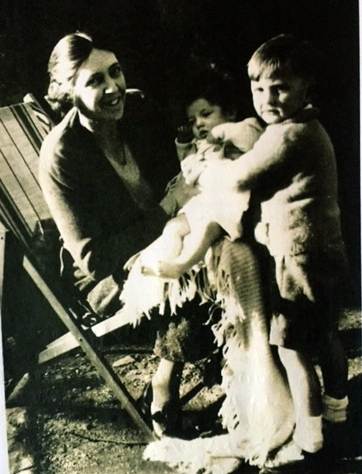
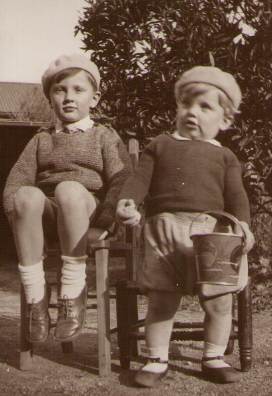
In September 1932 my parents and eight-months-old Michael Frederick moved from Melbourne to Adelaide where my father took up his appointment as Vicar of Christ Church, North Adelaide. I was born there on 3 March 1935. Thirty seven years later my mother started keeping a diary and her first entry reflects on that day in March 1935 and the happy years that followed it in Adelaide. That diary entry is Appendix 1 at the end of this chapter. I was only three when my father moved on to be Vicar of Christ Church, South Yarra, late in 1938. I have no memories of Adelaide (except a vague image of the back stairs) which I find interesting because as I write this in the first half of 2018 my grandson, Essi, is four and my granddaughter, Iris, is three and I wonder what memories they will have of the life they have lived so far. They seem so alert and interested it is hard to imagine that they will not retain some memories of these early years. When Anne died in January 2012 Griffin was two years and nine months, much younger than I was when I left Adelaide. Griffin loved Anne and they had a special bond. He still has many memories of her but I suppose they are fading and in the fullness of time he will probably find it hard to distinguish between what he actually remembers and what he was told.
It was in September 1938 that our father wrote in the Parish Magazine that he was resigning the parish on October 31st. September days in 1938 were very tense times internationally. I still have in my possession the Adelaide Newspaper The News for 30 September that year. The paper cost 'Three halfpence'. The Headline was
Pact signed at Munich - Full Terms
Peace for Europe now Assured
News Hailed With Joy
Czechs to Quit Sudeten Area, Oct. 1 - 10
Despite all the joy and confidence reflected on the front page the Stop Press in red was ominous with the words
CAPITULATION TO HITLER.. London. The Munich agreement is regarded as almost a complete capitulation to Hitler. A panic among the Czechs in Sudeten territory is feared, says the "News Chronicle's" correspondent.
Chamberlain's 'Peace in our Time' proved not to be worth the paper it was written on. War was declared on 1 September 1939 and lasted until 2 September 1945. My Melbourne memories are all in the context of war or the threat of war. Those memories are, of course, from a child's perspective and from a part of the country that didn't see any actual combat. Nevertheless war informed much of our activity and attitude to life.
For my first two or three years I attended Miss Gregory's Kindergarten which was in Shipley Street off Punt Road to the right as you went up the hill before going down to the river and the bridge which was, of course, originally a punt. The one boy I can remember from that Kindergarten is Ian Donaldson. We played together and we both remember slipping into wedding photographs at Christ Church on a Saturday and even throwing fireworks at the bride. Shame! Ian and I were contemporaries at Trinity College where he was senior student in our final year. He was a brilliant academic and became a distinguished Professor of English. One year he was Guest of Honour at Speech Day at Canberra Grammar School and he made reference to the bahaviour of two naughty boys at Christ Church!
After Miss Gregory's I joined Michael at Wadhurst. I remember that the triangular section of the MGS property where Domain Road meets St Kilda Road was a Junior School playground with equipment that would not pass today's health and safety standards. Mr Caffin was the Headmaster of Wadhurst and I also remember I liked Mr Plummer. The three Houses were Deakin, Cuming and Cain - three very famous Melbourne Grammar family names. In typical schoolboy fashion we chanted 'Deakin's coming for the cane', but only if we weren't in Deakin. In retirement I often stopped to chat with an old man struggling along the Mathoura Road footpath on a frame. He played his cards close to his chest. Only later did I discover he worked with ASIO. One day I introduced myself and he said his name was Alfred. "My grandfather's name was Alfred" I said, rather unnecessarily, "Alfred Wheeler." "My grandfather's name was Alfred as well," he said, "Alfred Deakin." Ah!
I used to go to Wadhurst by tram - up Toorak Road, right into Park Street, left into Domain Road and off just before St Kilda Road opposite the path up to the Shrine of Remembrance. The Shrine seemed to have been there forever but in fact it had only been officially opened on Remembrance Day 1934. At 11am that day a ray of sunlight would have shone through an aperture in the roof for the first time and shone upon the word 'love' in the inscription on the ground 'Greater love hath no man'. The tram ride cost me a penny. Tram conductors - there was a driver and there was a 'conductor'- had big leather bags hung around their necks full of different coloured tickets and change. Once a pad of tickets was empty the conductor stuck the 'butt' into the edge of one of the advertisements up above the windows. They were prizes that we all wanted. We always asked the conductor 'Any butts?" If I had spent my penny on a bag of mixed lollies I had to walk home - aged seven.
That year, 1942, saw a massive escalation and re-focus of the war for Australia. On 7 December 1941 the Japanese had attacked Pearl Harbour and America had entered the war. On 15 February 1942 Singapore fell to the Japanese army. Four days later Darwin was bombed. The American Air Force took over Wadhurst and in April we were evacuated to Golf House, Healesville, so for much of 1942 at the tender age of seven I was a boarder. I wrote many letters home. Doubtless that was part of our weekly routine. Happily my parents kept many of those letters and a few years ago my brother presented them back to me typed up in a volume he called Childhood Revisted. My parents would have been reassured by those letters - not by my spelling but by the happiness that I shared with them. 'I am very well. It is lovely to be in the country.' 'I had fun last night. We have some tadpoles in a jar.' 'I went to the Sanctuary yesterday all the boys went in the bus. I had a lovely time. The cocky said 'Got a pea nut.' 'I have a good time up here and so duzz Mike.' 'I have good fun up here.' The impact of the war was reflected even by a seven year old. 'We saw three army trucks full of soldiers.' 'Mr Grant wants B coupons 1 to 7 for sugar.' 'There were soljers here practersing and we herd them shooting.'
I shared a room with Robert Newton and John Carroll. We were friends but I remember having to box John Carroll and his giving me a blood nose. Boxing was part of a 'manly' education and loomed again later in my life. John Carroll was son of Garnett H Carroll, the affluent theatrical entrepreneur. Many plays were presented by Garnett H Carroll, generally at the Comedy Theatre. I remember visiting the Carrolls in their apartment in Park Street, South Yarra, just round the corner from Toorak Road.
An unhappy memory that I never mentioned in my letters is often wetting my bed and trying to get rid of the wet sheets in the middle of the night rather than face the shame of being found out. They must have known. I guess many boys faced the same problem and had their own 'secret' way of trying to deal with it.
At the end of the year it was deemed safe to live in Melbourne with our parents again and we went to Grimwade House since Wadhurst was still otherwise occupied. I remember taking the bus down Punt Road and then the tram along Balaclava Road. I remember one day seeing Michael being carried out of the school with suspected appendicitis. Mr Down was in charge at Grimwade, or was it the Golf House at Healesville, or both? I can't remember. He certainly visited us regularly at Golf House and told us stories that I liked. 'Mr Down told us all about the talking brick and he brart the brick with him.' ' Mr Down came over to day and he told us a-nother fox story. Did you know that a fox will bite out a lambs tongue?' I can remember that we called him Fluff and we called his wife Ida! Schoolboys of our generation loved inventing nicknames for staff and for each other. I'll come back to that later. I wonder if it happens nowadays. Given the emphasis on calling each other by first names the age of nicknames may be over. Mr Grant was in charge of Athletics: I can't remember his nickname. It was at Grimwade that I won my only award for running - a certificate for coming second in the Under Seven 75 yards handicap! I must have been given a big start because I know that my sandshoe came off during the race and I stopped to put it on again!
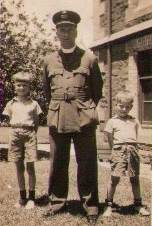
In Michael's A Family Story: The People and the Walnut Trees on page 159 there are two photographs of Michael and me with our father. Both are in front of the vicarage. One is of us in 'civies' and our father is in his Chaplain's Air Force uniform. The other is of our father in a suit holding our dog 'skeater' and Michael and me seated wearing our Melbourne Grammar School uniforms. My father had several curates in succession. One was Mr Eyres (Fred) who did conjuring tricks and later became a monk - Father Laurence Eyres, living to the age of 102! The other was Mr Cuttriss (Frank) who went to New Guinea as an Army Chaplain and sent us both large coconuts through the mail.
Every night we were expected to kneel by our beds and say our prayers. We always said
Jesus Tender Shepherd hear me. Bless this little lamb tonight. God bless Daddy. God bless Mummy. God bless Michael and Timmy. God bless Mr Cuttriss. God bless Mr Eyres. God bless Skeater. God bless everyone. Thank you God for a nice happy day. Amen
I remember mum saying years later that when she was a child she had to kneel and say her prayers too each night and the words included 'Bless her in her simple city' which she never understood until she finally realised they were 'Bless her in her simplicity'. Maybe it was the routine and the general habit that counted. But I digress!
We must have liked Melbourne Grammar School and its motto Ora et Labora and its school song Play together Dark Blue Twenty. Our parents were great friends of Miss Dorothy Ross, legendary Headmistress of Melbourne Church of England Girls Grammar School (Merton Hall) just round the corner in Anderson Street. Our father served as Chaplain there and Chaplain at Christ Church Grammar School and Air Force Chaplain. I don't know how he found the time to do everything.
On weekends Michael and I loved going down Fawkner Park to watch the American Servicemen playing baseball. We asked for baseball bats and balls and were sometimes lucky. We roamed free in the park and we had our bicycles and our billycarts. I remember careering down the bitumen footpath in the park in my billycart one day and losing control and getting my hand jammed between the steel wheel and the bitumen. The hand looked a mess. I could see the scar for many years but it's now wrinkled over.
So much of our life was determined by the war. An air raid shelter was dug in our back garden near the lane and the back of Christ Church Grammar School. It was well provisioned and became the centre of play for Michael and me and our friends. We invented our own secret codes and passwords and rituals. Many homes had air raid shelters. I was very envious of Tony Hewison's which was far superior to ours with a proper roof and its own green door. So conditioned were we to have an underground house to play in that one of the first things we did when we went to live in Hay in 1944 was dig an air raid shelter! The Vicarage, the Church and Christ Church Grammar School were all on the same property on the corner of Punt Road and Toorak Road. The School Hall was often used by patriotic women to support the war effort, particularly in stitching up the calico wrapping of food parcels and making camouflage nets. The women plied their bobbins of twine making the nets and Michael and I replenished the twine on the bobbins as our contribution to allied victory. We learnt the technique and made our own string bags at home. I still remember how to make the knots and ensure against making a slipknot. There was a lot of unpicking if a slipknot slipped in towards the top of the bag! It's a pity we don't use string bags nowadays for our shopping instead of the plastic that is so detrimental to the environment.
The war made itself felt at home, particularly after Darwin had been bombed in February 1942, and there were fears that Melbourne might be next. Searchlights often speared upward through the dark night. Our windows had to be taped vertically and horizontally with brown sticky tape to minimise the prospect of shattering glass and there were also blackout curtains. Under the stairs we had a little well-stocked refuge as an escape hatch for when the house might be bombed. The only item I think I remember was a collection of corks so that we would be able to put one in our mouth. I'm not sure why - perhaps to stop us biting our tongues. Fortunately the Japanese never targeted Melbourne although doubtless much of the city is owned by Japanese now and we are 'invaded' by great numbers of Japanese tourists.
The Vicarage was a big bluestone house. It still stands but is church offices and reception space nowadays. Some years ago Michael and I gave the Vicar two pictures of Christ Church which had been on the walls when we lived there. It is good to think of them on the walls there again.
Michael and I shared a big bedroom, first room on the right at the top of the stairs. We shared a bedroom in Hay and in Fairfield. It was not until we lived in Croydon, by which time we were 17 and 20, that we had separate rooms. I have many memories of living in that lovely house at Christ Church South Yarra. It had a Victorian spookiness about it and I wasn't keen to go upstairs on my own. It was probably there that I first established the habit of pulling the lavatory chain and rushing back to be with the family before the sound of the flush stopped. I continued that practice in Hay!
Half way through 1943 I had Jaundice and I must have written to my Godfather, Percy Dicker, at the Cathedral Rectory, Wangaratta, because I received this letter from him dated 6 July 1943:
What a splendid letter you wrote to me, but I was awfully sorry to hear that you have Jaundice. That is the way some people spell it, but for a change I like your way, jornders. I remember when I had them, a long while ago. Yellow almost all over, and especially the white parts of the eyes. But you seem to be getting better very quickly.....
I remember when Michael was sick with scarlet fever. I still slept in the same room (I think) and I remember when he was sucking a sweet I was keen to have one too so he took the one he was sucking out of his mouth and gave it to me. Fortunately I didn't get scarlet fever too. It had its long-term consequences for Michael and contributed to the fact that he had to have a new heart valve aged 70. I remember our putting out pillowslips at the end of the bed on Christmas Eve and the thrill of Christmas morning. I think we often received board games which took up a lot of room in the pillowslips. We could store them in our large upstairs playroom which opened onto a varandah overlooking Fawkner Park.
Downstairs there were two large rooms inside the front door on the right connected by folding doors. The first was the Drawing Room reserved for the best furniture and guests and more formal occasions. We didn't go in there much. That was for adults. The second was the Sitting Room which the family used. It was there that a big item of furniture about a metre tall was the focal point for listening to the radio and 78 records. The long silver needle had to be replaced often and it was quite an art lowering it onto the right spot on the edge of the record which crackled its way through about three minutes of Gracie Fields or Eine Kleine Nachtmusik and then kept on turning and scratching until you got up and did it all again. The remote control is one of the great revolutions of my lifetime!
That Sitting Room had a narrow door that opened onto our verandah which was open to the Park. The verandah regularly became the temporary refuge of various lost souls, often the worse for drink. I remember - or was I merely told - when a woman rushed into the house clutching a naked baby, thrusting it into my mother's arms shrieking "Take it! Take it!" hotly pursued by another woman screaming "It's mine! It's mine!" I'm not sure what happened then but my father headed off on a peace-keeping mission soon afterwards.
Our parents had virtually no money but they did have help - of a sort. We had a nurse and I don't recall regularly having dinner with our parents at South Yarra. We probably ate early with the nurse who prepared us for bed and then our parents could come and perhaps read us a story, check that we had cleaned our teeth and said our prayers, and kiss us goodnight. We had domestic help (May?) and we had a gardener (Bert) who, if I remember rightly, had rotten teeth and was often the worse for booze.
I remember Dr Day, our family doctor, and a loyal churchwarden. My memory even tells me that the Days lived at 227 Toorak Road in a house long since bulldozed by the ubiquitous developer. My first bicycle was a hand-me-down from Dr Day's son Arthur. It was a little black bike and perfect for riding down the front path from the drive around the church to our front door. Later I had a bike called an Ixion. It was lethal with fixed wheel so when your legs couldn't keep pace with the bike's speed downhill you had to take your feet off the pedals which kept rotating at great pace. Michael had a more civilised Malvern Star. I seem to remember their advertising slogan was 'You'll be better on a Malvern Star.' That was certainly true in comparison to the deadly Ixion.
I remember going to St Ives Hospital where Dr Shaw took out my tonsils and postnasals also known as adenoids (I think!). It was all worthwhile because the operation was followed by a diet of ice cream and I was visited by Lady Dugan, wife of the Governor of Victoria, Sir Winston Dugan, and she gave me a book full of stories about the circus. I loved it and I read some of the stories many times knowing some by heart. I guess it was one of the many books that were despatched when we left our house in Hay in June 1950. Pity!
Michael and I went to church with our mother every Sunday. Mercifully our parents didn't send us to Sunday School. I wonder why that was. We had our own pew in the church and entered through the door on the vicarage side. We had to sit respectfully through our father's sermon each week. Happily he tended to be short. How interesting it would be to hear some of those sermons now. What would we think of them? One morning I must have been less than my respectful best because I remember (I think I remember!) my father chastising me from the pulpit. After church we would kneel down at our places around the breakfast table for prayers and then, could it be, that Michael or I said grace? The conversation at the table tended to be between mother and father and I don't think the children were given much of a say. Seen and not heard? Sunday mornings were quiet times. We weren't allowed out to play. In the evening it tended to be family Sunday tea and an appropriate reading from the bible. At Christmas time we set up the ceramic crib to remind us what Christmas is about. Michael may well still have it.
Ours was a happy, harmonious home. I have no memory of our parents ever having an argument or raising their voices at each other. Cynthia and Charlie were a happily married couple and proud parents. I remember his loud laugh and warm smile. Of course our father was always very busy. His study door, just inside the front entrance on the left, was naturally shut a good deal of the time. When he had time we played drafts and chess and cards and monopoly together and sometimes he would help the little engineers with their constructions with minibricks and meccano. Minibricks, the lego of the times, were made of rubber. Michael still has what is left of them.
Our parents took us to Wirth's Circus which was situated where the Arts Centre now is. There is a tile mosaic on the outside wall of the Arts Centre marking the spot. Those were the days of the 'traditional' circus - a band high up, performing animals galore including lions in the hastily constructed cage in a circle round the circus ring and the intrepid lion tamer having the lions perform leaps through hoops and sit on giant tubs, trapeze artists high above the safety net, tightrope walkers, and clowns whose trousers always fell down in the end. Wirth's Circus was magic. In my retirement I wrote a short story inspired by Wirth's circus and that mosaic. That story is Appendix 2 at the end of this chapter.
Our parents also took us to the zoo - cages rather than environmentally friendly big spaces in those days. I remember going to a performance at the zoo where a man stood with his horse and claimed that his horse was hugely intelligent. He asked the horse various questions and the horse would nod or shake his head. I remember the horse being asked questions about who was the naughtiest-looking boy in the crowd. He finally narrowed it down to the boy with the blue handkerchief on his knees. It was me! That was the day I greedily bought two ice blocks (square and a penny) and put one in my pocket for later. Oh dear!
I was still only eight when we left Melbourne, a year younger than Griffin is as I write this, and I marvel at the freedom and independence we were allowed by our parents. Were they enlightened, naive, trusting, simply conforming to the practices of the day, derelict in their duty of care - or was it simply a sign of simpler days? We could roam free in Fawkner Park. We travelled to and from school on our own. We could cross Punt Road alone before there were traffic lights even though the sound of metal on metal as cars collided at the intersection was a fairly regular thing. We often used to cross to visit the little sweet shop next to the hotel on the corner. I remember (or perhaps I was told later by my parents) that one day I rifled the box in the vestry or my father's study where he kept the proceeds from the Sunday collection and I left a note 'I have taken a threepence for a ice cream'. Honesty among thieves! I would have crossed Punt Road to spend that next to the hotel. My inclination was to spend. Michael's inclination was to save!
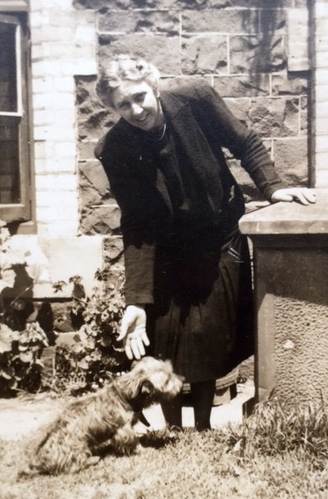
I don't much remember the grandparent dimension to Melbourne life. I remember my father's mother but my memory of grandfather Murray is very vague. He died in 1942. 'Old Mrs Murray' always seemed a dour, 'matter-of-fact' lady always dressed in black. Little did I know of the tragedies she had had to endure - the death of a child in infancy, the death of her first husband by drowning and the death of her oldest son in the First World War. We visited her from time to time as a duty rather than a pleasure. I don't remember my father ever mentioning his brother Frederick after whom my brother was named. Perhaps he did not think such things should be shared with the young. Perhaps it was too painful for him. Perhaps it was just the mentality of the times - stiff upper lip and get on with it.
My father's half-sister, Annie Rademacher, seemed very much her mother's daughter, equally dour and matter-of-fact, but she was practical and kindness itself and her husband was a lovely man and we escaped to the back garden of their home 'Bruthen' in Hillcrest Avenue Kew E4 to enjoy Lud's beautiful birds and discover chocolate frogs hidden conspicuously for us to find around the fish pond. I guess we visited my mother's parents at 10 Stephen Street Newtown although my memories of them tend to be from the few years after we went to live in Hay. Lovely warm people to whom I will return.
All my memories of South Yarra days are happy ones - happy family, happy school (apart from the boxing and the wet bed), happy times with friends, happy holidays at Mount Martha or Point Lonsdale. Of course I had no concept of what was going on in the world and the stresses and strains of so many people's lives in those war years. I know my father was highly respected in the parish and further afield. He and my mother were very happy there together and in the work they were doing and the friends that they made. It would be a wrench to leave. Inevitably it would not take long for overtures to be made to my father to take on further responsibilities within the Anglican Church in Australia. Was it ambition or a sense of responsibility or a hair shirt mentality that led him to accept the 'call' to be Bishop of Riverina? I don't know but accept it he did and at the time he was the youngest Bishop in Australia - just 44. Michael and I were very sad to leave MGS and our friends and we hoped that we would return to MGS as boarders for our secondary education. So off we drove in January 1944 into the next stage of our lives.
***
Appendix to Chapter 1
Appendix 1
For five months starting in March 1972 my mother kept a diary while she was living in Power Street Hawthorn. This is the first entry she made and it is dated Saturday 4 March.
The day after my darling younger son's birthday. Thirty seven years since that early morning in Adelaide when Charles set off with his huge wife (and I was huge!) for the Memorial Hospital North Adelaide, very early in the morning. What a sunrise that was! Only those who had the good fortune to live facing that magnificent view of the Lofty Ranges can know how beautiful they are with the sun rising behind them. The whole world was rosy indeed and not least for us with our lovely new healthy baby now born to us. The woman in the next room to mine gave birth to a son almost at the same moment. Word came in to me by one of the nurses that her first words on knowing it to be a boy were "Hurrah, we shall soon have a family cricket XI." Adelaide is a beautiful peaceful city - or it was 37 years ago, having parks all around the city with tree-lined terraces surrounding each park gives an impression of spaciousness and unhurriedness. Colonel Light looks down proudly from the hill of N Adelaide, viewing, I am sure, with pride his handiwork. He was indeed a man of vision.
It was a happy five years for us with our two little boys just beginning to take notice and be interested in everything. The old Vicarage of Christ Church N. Adelaide is an ideal place for children with its many rooms and intriguing nooks and crannies and odd staircases here and there. What fun those two little boys had - and they were doubly lucky for the Kindergarten training School was just across the small park and they were able to go across on their scooters and tricycles or sometimes holding their nurse's hand. There again we were lucky. Margaret was one of the old school - a very pleasant girl, spotlessly clean and devoted to those two children. She did all their washing and ironing as well as generally bathing them and taking them to school. She also delighted in knitting their woollies. Where could we find such faithfulness in 1972 I wonder. I have rather "gone on" (!) in this my first effort in writing a diary - and all inspired as the result of the birth of one baby on that morning of splendour, 1935.
***
Appendix 2
One Man In His Time (A Short Story by Tim Murray)
Slowly he set his fumbling feet on the edge of the kerb. He clutched a stick beneath his left hand, the carved lion’s head surveying the urban jungle between the bars of his arthritic fingers, while the rounded knob of a second stick lent some smooth comfort to the moist palm of his right hand.
‘There you are, Sir,’ encouraged his driver as he steadied the old man, giving time for any dizziness to pass before gradually withdrawing his supporting arm. He hovered discretely, then eased back.
‘Thank you, Charles,’ piped the old man.
The perfect gentleman, Charles mused. Always was.
‘Would you like your scarf, Sir? There’s a chill in the air.’
No reply. Charles knew that the master’s mind was preoccupied with the task at hand. The real journey was about to begin as the mid-morning traffic pulsed its impatient way towards bridge and spire and city blocks and angular cranes swinging the future into place. Brakes squealed, engines revved, trams screeched, sirens wailed.
Charles had asked his question about the scarf so it was time. He had to come, just once more, although perhaps if…. No. Foolish thoughts. He knew that. Jan would be angry, of course. She had extracted his promise.
‘You’ll have a fall, grandad,’ she had said, ‘and then where will you be?’
Underneath a bus, probably, he had thought to himself, and no harm done either, except perhaps to the bus.
‘Alright, I promise,’ he had said while imagining two stiff fingers to have crossed just a little. He knew Charles would allow his final pilgrimage. Charles understood.
Good of Jan to bring the baby yesterday, or was it the day before? Just like her mother. Jan that is. He could remember Jan’s mother as a baby too, of course. How many generations was that? Enough anyway. He had brought them all to this very spot. So changed. So changed. He tried to take a deep breath to drink in the atmosphere of this sacred place, but he wheezed and spluttered in the cool air and the fumes of gasoline.
‘Right on cue,’ thought Charles and resisted the impulse to intrude.
Gradually the old man tried to focus his gaze. It wasn’t far. Just a few youthful bounds or a couple of catherine-wheels and – bingo – a safe landing at the very spot! What a dizzy thought! He set his chin, steadied his sticks and inched into the first short stage of his shuffling passage. He knew the pavement pattern well, every square stone of it. The occasional bands of grey cobbles served as milestones for his marathon crossing and resting points along the way.
As he paused at the second grey band, propped precariously like a praying mantis, chattering young voices and familiar-coloured uniforms brushed by in front of him. Happy sounds. Happy memories. Those uniforms hadn’t changed much since he wore them…how long ago? Never mind. Too long. They wouldn’t have had their socks down in his day, nor their shirt-tails flapping about like wayward washing. They wouldn’t have been out of school at all at this hour: they would have had their noses down in their Latin prose. He gazed in the direction of the disappearing schoolboys. Come to think of it, he had played truant on occasions when a penny tram-ride had transported him from the doldrums of the schoolroom to the magical delight of another world. He was punished for his wickedness, of course, but it was worth it. The marks of the cane disappeared with time but the marks of the magic never dimmed. Never! He smiled, and the memory drew him forward again.
A further foot of painful progress, then another. Steady. Keep balanced. The blurred passing parade pressed on giving no backward glance to this slippered relic of yesterday’s world. Five, six, seven paving stones. A further grey band. Time to pause.
He sighed and caught his breath as best he could. Who was that ahead? Elizabeth? A foolish thought. But how like Elizabeth. Uncanny. Seventy years ago of course. And the young man with her? No restraint these days. When he and Elizabeth were courting they were hardly ever alone together. Think of that! No chance to express your feelings in those days – not something you did in public. Come to think of it there were times when….but not like these young things today. He didn’t like to stare, not that they would have noticed. Their eyes were for each other only as they held close, feeding their youthful passion, feeling the stir and pulse of young love. Soon they moved as one to the nearby lawns and out of sight. Probably just as well, he thought, as he took a little gulp of air and steadied himself again.
It was a few minutes before eleven. He set himself the target of the next grey paving band, a little more than a yard or twenty shuffling feet away. He prodded and inched forward: he wanted to be there at the first stroke of the hour.
As he stopped, Charles eased in beside him. Not many people paused in the streets nowadays for these few moments in eternity. Once a year. Two minutes. He let Charles take his arm, and there they stood as two stones propped against the flow of time and tide.
He hadn’t been a hero. He had been more bent on keeping the spirits of his friends alive than seeing to the death of his enemies. Enemies? He had no enemies. He hoped he had never killed a man. War was a fiend, and in the darkest depths of the trenches on the Western Front he had made a vow. If his life was spared he would devote it to the healing power of laughter. And so it proved…..and so he came to pay his last respects – to those who fought and died, and to those who lived and laughed.
‘Are you alright, Sir?’
Charles’ voice sounded blurred and distant.
‘Are you alright, Sir?’
‘Thank you, Charles. Yes. Yes. What time is it?’
‘Ten past eleven, Sir.’
Ten past, he thought. Oh well, that’s a bit of credit in heaven….or the other place. Four years worth: a good start! He could vaguely discern the various colours and patterns on the wall ahead. One further effort and it would all come into focus. The final purpose and meaning of his life would sharpen into focus again here, where it had unfolded all those years ago.
At last. Yes, there were the two elephants trumpeting the good news and hauling the great vans. ‘Transports of Delight’ he had called them! And there, in tails and top hat with whip held aloft, was the master of the ring. He could hear the mighty crack and the familiar signature tune of the band high up in the big top. He smoothed the top of the cane in his right hand at the memory. He could smell the sawdust and sense the excitement as his eyes settled on the glamorous rider high and proud on the bare back of the prancing white horse. What a great artist she was, even as a child. Her fame had spread across the world. Yes, a great lady. Gone now, of course, but alive in his mind and memory as if it were yesterday.
And there was the sign – large white mosaic letters standing out against the red background. Oh yes. No doubt about that. It was The Greatest Show On Earth alright. He could hear again the clang of the bars as they were locked into place, and the gasp of desperate delight as the lions were released into the circle and centre of show business where they trod the king-sized tubs and leaped through the flaming hoops.
The fingers of his left hand instinctively fondled the carved folds of the flowing mane and the great jaw. Imperious creatures. It was they who allowed him to share their space. He knew that. Not for a second did he forget it. It was a privilege extended to him and few others. ‘The ridiculous accepted by the sublime’ he thought with an inward smile. He was more grateful than words could express. His carving of the head was his tribute to their majesty – Their Majesties!
As he edged closer he could see again the monkeys with their cheeky urchin faces riding their little bicycles and getting into all sorts of mischief, and sometimes sitting smugly on the backs of the ponies as they trotted through their tricks and paces.
The square patterns of the framework above the footpath cast their shadows on the ground about him, and he saw again the net that formed a giant hammock beneath the dazzling world high inside the vast circus tent; and there were the lurching ladders and tiny platforms and the single wire which he had trod so often with such concentrated abandon, feigning falls and juggling balls and balance; and higher still the two great swinging trapeze bars and the deafening sound of spine-tingling silence followed by gasps of relief and delight as two sets of strong hands and wrists gripped like vices, and two bodies became one, swinging their graceful arcs of honour before returning to platform and ladder and the adulation of the earthlings.
And now it was time. He had saved the final image until he was close enough to touch. He lifted the lion-headed stick and Charles was by his side to take it. He groped forward with the fingers of his left hand until they touched the familiar coloured patterns of the mosaic. From the points of the white neck-ruffle the fingers began to move with assurance – across the great grinning mouth deliciously larger than life, over the red bulbous nose and the white and red saucer eyes, up to the jaunty blue triangular hat with the three bright orange baubles down the front.
His fingers stopped and for a few moments he was totally still except for his lips which shaped some silent words. Then he lowered his arm and fumbled towards the pocket of his bulky jacket. He pulled at the edge of a faded piece of cloth which soon came away in his clutching hand. Very gently Charles eased the blue hat from the proud fingers and slowly, reverently, he placed it on the Master’s head. He adjusted the hat a little to ensure that the three faded baubles were in the very centre.
It was then that the old man felt a faint breeze about his legs, yet the air was still. Those sturdy legs had given such strength and spring and balance for all those years. Spring, yes – the spring of his youth and the high summer of his heyday. Summer’s lease, he thought, so short….
Slowly he looked down.
‘Oh no,’ he whistled as the cool air fanned the flesh of his shrunk and wasted thighs. ‘Oh no. Oh bloody hell.’ He hovered helplessly, frail and fettered.
And then he heard that sound. The echoes of the years filled his head and his heart and his whole being. Great waves of laughter and screams of delight washed over him and through him and he was transported again into the midst of the big top. The band was blazing and the coloured lights were flashing as Bingo and Charlie rollicked and frolicked through their famous routine. The master and the apprentice squeezed every ounce out of their antics, and, just when further laughter seemed physically impossible, down came those baggy old trousers to reveal the famous red shorts emblazoned with silver stars. As the children squealed and clapped and called for more, the magic caught him in its spell once again and he began to laugh too. A high-pitched chuckle soon gave way to a fuller sound, and then he was laughing uproariously as the sweet memory of his clowning glory merged with the delicious irony of his present absurdity.
At his side his faithful apprentice began to laugh too until together, with arms linked and heads high, these two great artists of the golden days of the circus were teamed again in their final curtain call, as tears of joy streamed down the Master’s face.
***
The siren faded as the ambulance attendants picked their way through the crowd to where the old man lay. One bystander said he had seen the other man mockingly place a silly hat on the old man’s head. Another said the old man was crying uncontrollably as he stood transfixed with his trousers about his ankles. A third said that his companion was laughing cruelly at the old man’s pitiful predicament just moments before he died.
Charles wanted to explain – to let them know that it wasn’t like that at all. But how could he begin to make them understand?
No, he alone knew the truth, and the truth was safe with him. That was all that mattered.
***
The mosaic on the wall of the Arts Centre in Melbourne on the site where Wirth's Circus stood until it was destroyed by fire in 1953.
***
Riverina and School
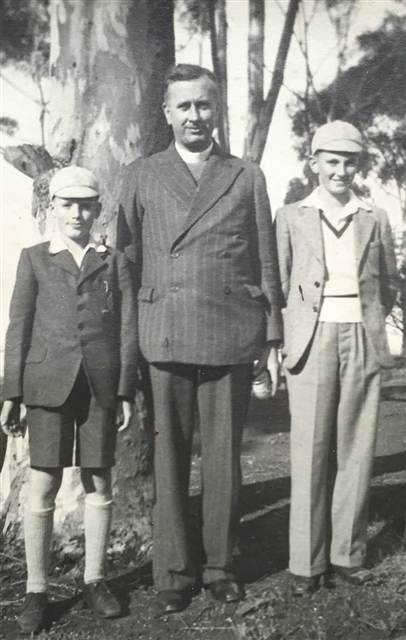
1944 – 1950
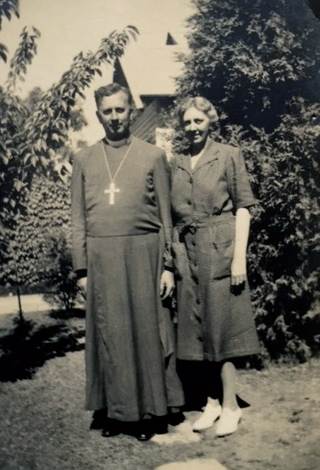
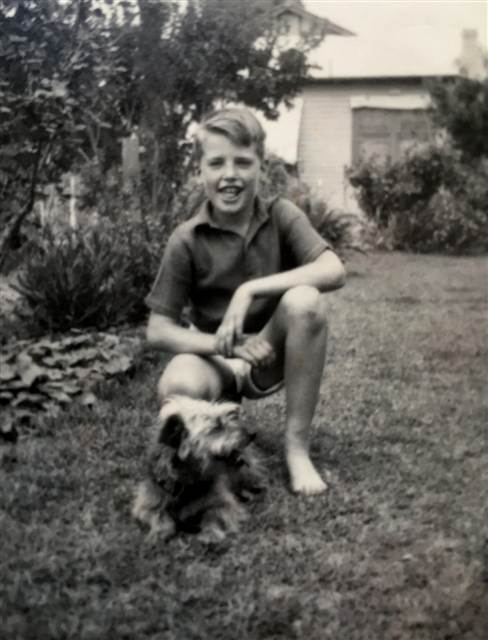
Yes we were sad to leave Melbourne but our father answered the 'call' and, after his Consecration as a Bishop at St Andrew's Cathedral in Sydney on 2 February, we found ourselves in Hay in a heat wave and a drought with war still raging in Europe and the Pacific. I still remember our first night there. We spent it at Tattersalls Hotel in the Main Street very near the Barber's Shop where the Barber insisted on calling me Mary Murray which I liked about as much as being cast in the female roles later on in plays at Corio. Next day we moved into 'Bishop's Lodge' in Hatty Street. This was a simple weatherboard house that had been acquired for us since we had declined to live in the old, traditional 'Bishop's Lodge' the other side of the river where my father's predecessor, a single man, had lived. I think my mother had dug her toes in fearing she may have to run the Hostel for Boys if we lived there. That house has become a heritage building. It has been totally renovated and is attached to Bishop's Lodge Motor Inn. The house in Hatty Street still stands I think as a private home, and the centre of the diocese has long since moved to Narrandera.
Our 'Bishop's Lodge' was modest and simple but it was satisfactory and I liked it and it had plenty of garden and space to play. I could draw a plan of the house now even though I have not been in it since early in 1950. It had an open front verandah and an enclosed side verandah - 'enclosed' with fly wire and canvas blinds. There was a central passage down to the back verandah. First room on the left was large and had been the master bedroom but this became my father's study where the walls became lined with books, many of which now line my brother's study walls in Geelong, although a vast number of theological volumes went to other homes when we left. Bookcases hid a door through to what had been a dressing room but this became my parents' bedroom where their large cedar-ended beds could just fit in end to end with little room for anything else. My mother's bed was the one immediately inside the door so it was easy to jump into bed with her for a cuddle.
Next to that little bedroom was the bathroom with a gas heater for the hot water. My father shaved with a cut-throat razor and I remember him sharpening the razor on the leather razor strop. That's not a misprint for strap. Strop it was - and is. Next to the bathroom was the telephone with the speaker on the wall and an earpiece on a line hanging on the side of the box. I think there was a winder to get a line. You had to stand up to have a telephone conversation which meant for a while I was too short to make it. I never wanted to speak on the telephone so I was in no hurry to get taller. Note that I have used the word 'telephone'. My parents didn't like some abbreviations and 'Phone' was banned.
Inside the front door on the right was the drawing room which, as in Melbourne, we children seldom ventured into. It was linked by double doors to the sitting room which was the focus for family life with a fire place and the same large piece of furniture from South Yarra, the radio and record player. The records were still 78s. The radio was popular for Mrs Obbs sponsored by Bonnington's Irish Moss which was a cough syrup and each night we were exhorted to 'sip sip sip' and be cured.
At the back of the house was the dining room linked to the kitchen on the left, and our playroom on the right with windows onto the enclosed back verandah off which were our bedroom, a spare room and the lavatory (never to be called 'toilet' thank you very much). All these rooms have memories. The dining room I associate with kneeling by our chairs and saying prayers before saying grace and then generally listening to our parents talking to each other. I associate it with my father carving the roast and sharpening the carving knife with the steel at the table. I associate it with 'clearing away' to the kitchen next door. The kitchen I associate with my mother calling out 'Charlie. Ready' when all the dishes were stacked by the sink and the water had boiled to put into the bowl in the sink. This was the cue for Charlie to emerge from his study and come and do the drying up and for Michael and me to stand by to 'put away'. I associate it with a chocolate cake baked by my mother almost every day and devoured in readiness for a new one the following day. I associate it with licking the brown mixing bowl of the remains of the chocolate icing or the sweet cake mix. I associate it with a fresh loaf of white bread cut thick and slathered in peanut butter. I associate it with Kia-Ora 50-50 Cordial - never Cottee's. I associate it with the delicacy of spreading the dripping from the roast onto white bread and sprinkling a generous spread of salt. I don't think we were particularly conscious of a balanced diet! Rationing continued for some time after the war so supplies were limited.
I associate the playroom with a piano inside the door on the right which I played badly 'by ear' trying to thump out hit songs and hymns. I associate it with the bookcase that contained a couple of metres of the Boys Own Annual which my father had somehow acquired. I associate it with that circus book and the Robin Hood book and the book by Horace Vachell called The Hill. It is 'A Romance of Friendship' and is set before and during the First World War tracing the friendship of two boys. It ends with a sentimental letter written from the Western Front the night before a 'big push' where the writer sees himself charging up the hill first as he did at Harrow on the Hill and he tells his friend that he was 'the best friend a chap could ever have'. I used to read and re-read that final letter so I could have a good sentimental blub! I associate the playroom with the toy box full of old friends. Over the years the box had various colours. Is it fanciful to think I remember it as red at one stage and then light blue?!
I associate our bedroom with many conversations with Michael after our parents had turned off the light, Michael in his bed with the square iron frame and me in mine with the rounded ends. I associate it with a huge wardrobe which we must have brought from Melbourne with a huge bottom drawer. It was a good hiding place. I associate it with saying prayers by the bed and being asked if we had cleaned our teeth and leaving our shoes out for our father to clean. I associate it with reading comics under the bedclothes, comics as daring as Mandrake the Magician and the beautiful Narda and their 'giant Nubian servant' Lothar. Mandrake regularly used to 'gesture hypnotically' and so save the world from many a madman. Wally and the Major and Bluey and Curley were other regular companions!
My father always read a book when he set himself up in the lavatory so one knew he would be in residence for some time. It was in the lavatory that I often had my blub reading that final letter from the western front in The Hill. That lavatory was a long way from the sitting room so, as I had done in Melbourne, once I had pulled the chain (that's right, not 'pushed the button') I ran as fast as I could back to the sitting room before the flushing noise finished. That noise somehow protected me from all the evil creatures that could attack me in the dark.
Before leaving the 'lavatory' and the 'telephone' and the 'refrigerator' I must identify a few more of the essential aspects of our correct upbringing. Say 'How do you do' never 'Pleased to meet you'; it's not nice to say 'nice'; blue and green must not be seen; invert your fork on your plate when you have finished; say 'table napkin' rather than 'serviette'; say 'traymobile' not 'autotray'; say 'excuse me' not 'pardon'; don't say 'what?'; never end a sentence with a preposition; never split infinitives; when people have 'white' tea put the milk in first; always use a butterknife, and a spoon for the marmalade; break your toast and only put butter and marmalade on a small bit at a time; never scrape or stack dishes at the table; put salt on the side of the plate, never sprinkle; never confuse 'Can I?' with 'May I?'; buy Eta peanut butter not Sanatarium; say 'wireless' not 'radio'; don't say 'tasty'; always say 'rabbits' as the first word you utter on the first day of each month. These are some of the vital trivialities that I recall from our upbringing and they became deeply ingrained in our behaviour!
There are lots of negatives in that list but there was definitely a significant positive and that was 'Show some gumption'! Gumption isn't a word you hear nowadays but we were always urged to show a bit of gumption. 'Positive Education' is now heralded everywhere. 'Pos Ed' is all the go. Well we were brought up with the philosophy of 'Gum Ed'!
It was on the back verandah that our ice chest stood. I remember, I think, that the first person in the family to have a refrigerator was Waah. Waah was the name we called grandfather Wheeler and I remember the delight with which he referred to his 'little Kelvinator'. I don't think we had a refrigerator in Hay although I do remember our parents insisting that we did not abbreviate the word to 'Fridge'. At any rate the ice chest was our main means of trying to keep things cool and we also had a 'safe' enclosed in fly wire. The ice man came regularly and carried in a huge block of ice on his shoulder wrapped in heavy hessian and put it in the ice compartment at the top of the ice chest. Of course one of the regular chores was to empty the melted ice tray at the bottom. If this was neglected the back verandah was flooded as it was from time to time. Milk was delivered. Bread was delivered. Milkman and baker had their horse-drawn carts. What else was delivered? Fruit and vegetables? Possibly, but I remember liking to go to Mr Gillies the Greengrocer in the Main Street because he could hold a coin between thumb and forefinger and make it disappear.
There was an outside door from the kitchen and one from the back verandah next to our bedroom. Outside there was a door to a little shower room and another to the laundry. Behind the laundry was a large woodheap with plenty of mallee roots if I remember rightly and certainly the odd snake which we nearly trod on from time to time. The house was on more than one block with quite a long drive down to the garage. This was ideal for Michael and me to play cricket but I can't remember our parents joining us much for that even though they were both interested in cricket, especially mum. I remember her talking about some of her cricketing heroes, always English. She spoke often of Pasty Henderson, or at least that I thought was the name until it dawned on me that she was referring to Patsy Hendren! The front lawn was ideal for battinton, a game with a shuttlecock and like badminton but played with bats rather than racquets. Both our parents had played tennis and mum was a good tennis player so they were both pretty good at battinton and they were both still in their forties. When we visited our Geelong grandparents, Mama and Waah, we played battinton on the front lawn there too. Alfred wrote a little poem about it all which I still remember.
Tim Tim the Bishop's son smacked a cork and away it run, dropping its grammar so great was its hurry until it arrived at Sir Michael O'Murray. Sir Michael O'Murray then rose on his toes and smacked the cork fair in Sir Timothy's nose. Sir Timothy having explained it by gum smacked it as hard as he could at old mum. Mummy O'Murray cried 'Look out my lad' and smacked it as hard as she could at old dad. He with his well-known episcopal nous sent it to rest on the roof of the house. Mum got a ladder and up it she clomb singing 'where and oh where did my little cork roam?" Sir Dodger soon afterwards took them all home. Now clan of O'Murray your antics must cease. If they don't I shall certainly call in the police.
Alfred often sent us poems for special occasions. I still remember the last two lines of a birthday poem he sent me:
For everyone of course has heard That Tim was born on March the Third!
For Christmas 1946 he sent us this poem:
We're sitting in the garden upon our garden seat Where Mama grows the flowers and Waah grows things to eat. She likes the phlox and pansies and things like candy tuft But as for sweeds and carrots Waah's never had enought. I'm not too good at spelling and may have spelt that wrong But things like that don't matter in a Poem or a Song. But - spelling or no spelling - we still have lots of fun Though Mama's nearly eighty and I am eighty one.
Happy Christmas WAAH
Back to Hay! Once there had been a tennis court on the property but previous owners had converted this into an orchard of fine trees bearing delicious crops. I remember particularly the nectarine tree. Nectar! Hot though it often was, bare feet were not a practical proposition in the back garden. Burs littered the ground and you couldn't walk two steps without the sharp points of the burs sticking into your feet. Behind the garage there was more space. We decided to have some chooks but one night we left the tap on and that was the end of our fowl house. It was behind the garage that Michael and I dug another air raid shelter, not because there was any immediate danger that the Japanese had Hatty Street Hay in their bombing sights - or the flesh pots of Booligal - but because air raid shelters were the context in which Michael and I knew how to play. So a new underground life was invented there with all its codes and passwords and top secrets! In the latter part of our time in Hay we filled it in. The war was over and our interest in playing there came to an end.
Throughout 1944 and 1945 Hay was our life. I attended the Public School. I think I wore shoes: many didn't. I remember ink wells and dip pens and the ruler on the knuckles, and playing alleys (marbles) in the dusty playground where we played 'for keeps' in 'big ring' and 'little ring' and 'follows' using our tors to knock out the smaller alleys. No fudging allowed! I remember playing jacks and bottletops against the back fence but I have no memory of any of the teachers or any other activities. I remember the peppercorn trees in the school grounds and I remember the boys toilet but that's about it!
Sometimes when our parents were away we went to stay in a hostel called Claughton House. I was happy there too. Here are some extracts from letters I wrote to them when they were in Sydney:
Dear Mummy How are you I hope you are well. I am enjoying the Hostel very much. We have let Skeater go of his chain for he will not go away. Skeater is aloud inside and he sleeps under my bed in the dorm. At the hostle we have a job every morning and have to have a shower every night. I suppose you have reached Syudney by now. Twelve of the Linton Hostle have come to our Hostle and are staying there. Cresswel is feeding my choocks every morning and night now I am very glad to. .....
Dear Daddy How are you I hope you are very well. I am enjoying the Hostel very much. You know the wheat in that bottle all white stuff is cumming out and the bean has split. Those two flow pots I took to school we put wheat in them and it has come up an inch and a half. another boy brought one which has no air and it is about an inch and a half to.....We had Arch Deakon Hardingham for scripture today and he isnt bad either. Skeater is very happy at the hostel and so am I. I hope you are going to get me a book in Sydney because you said you would. I am writing this letter in school and I hope you dont mind. I think I will stop now. Lots of love from Tim
Composition: What happened to the meat.
Once a young buther boy about 18 went to deliver some meet to a lady out in the country. On his way he came across an old friend who had a bran new bike. But alas when he came back he saw a dog wiche was just getting a leg of mutton out of the basket but when he saw the butcher boy he began to run over the dark green grass till he was out of site. When the boy went back to his basket he found it was empty. He found a string of sossages some chops and a liver not far off. Then he went back to the shop to get more meat but you can guess what happened when he got back. Then back he went again. T.C.Murray
Early in 2018 I went to 'Google' and found that Claughton Hostel, 206 Lindsay Street, Hay, is for sale for $320,000. It is described as follows:
This well maintained building features accommodation for up to 50 people at any time, large common living room, full sized dining room, stainless steel commercial kitchen, heating and cooling, private internal courtyards, boardroom, managers office and residence, games room, extensive storage, tennis court, BBQ facilities, undercover parking, extensive trees and gardens, 5 spare blocks of land that could be sold.
Location! Location! Location!
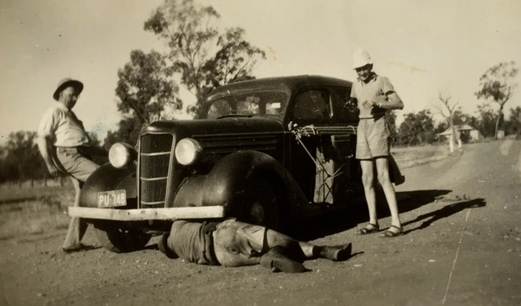
It would not be too much of an overstatement to say that in 1944, while the war was still raging in Europe and the Pacific and the country was in the grip of desperate drought, being Bishop of Riverina was a pretty short straw. The diocese was huge. The roads were unmade, often indistinguishable from the surrounding desolate landscape, the summers were a searing dry heat and the clergy were hardly the youthful cream of the Anglican Church. My father had to drive vast distances in our unreliable old Dodge car - the Sir Dodger of our Grandfather's little battinton ditty. The car didn't have a boot and all luggage had to be fastened onto the running board on the passenger side so we couldn't get in or out that side. We had a canvas water bottle swinging on the front bumper bar next to the registration number - PU748! Our father was not physically well suited to such a life and he suffered desperately from gout. He must have pined away for the civilised days of Christ Church South Yarra and cast nostalgic thoughts back to the halcyon days of Christ Church Oxford.
Our house was on the corner of Hatty Street and Orson Street. Hatty Street was a stock route so dust and sounds and smells constantly reminded us of our environment. Orson Street ran between the Main Street and where it merged with a track that wound down to the Murrumbidgee River. We were free to ride our bikes 'down the bend' and swim unsupervised and go yabbying. Once at the height or depth of the drought Michael and I actually stopped the flow of the river when it had been reduced to almost a trickle. Often I rode and swam and played with Billy Cresswell. The Cresswells lived in a little house near the bend just a few doors away from the Misses Wilkinson's beautiful home with its splendid verandah. Billy's father was a butcher. I can still see him in a bloodied singlet swigging down a large beer at the wooden table in their kitchen with its dirt floor. Billy was my friend. I was delighted that 40 years later we re-discovered each other in Canberra just as we were leaving and he was one of the attendants at the High Court. Billy often used to shout from outside our high galvanised-iron fence "Timmy. Can you come out to play?" - and I could except on Sunday mornings which were decreed to be a quiet time at home after we had been to church. Early in retirement I wrote a poem about Billy which is Appendix 1 to this chapter. It was read at Bill's funeral.
Dust storms were fierce. You could see them coming miles away in a massive dark cloud. You could time their arrival to the second. Five. Four. Three. Two. One. Hit! They hit with great ferocity and by then we had shut everything we could shut and blocked every gap that we could find. Even so the dust swirled into the house. I remember weighing the dust that had collected on our 'enclosed' verandah after one fierce storm - 14 pounds! Remorseless. Michael's memory is that it weighed eight pounds! Never mind. A dust storm ended as quickly as it began. In one of my letters to my parents when they were away I told them that we had a dust storm. 'It lasted five minutes.'
The verandah was used a lot. We had a table on which we played table tennis although it wasn't full size. We played bobs there. Michael and I presented our 'shadow plays' there behind a sheet for our paying parents. The most popular act was rather gruesome operations where innards closely resembling strings of sausages were hauled from the gut of the long-suffering patient.
One of my memories of my father is walking with him down Orson Street to the Main Street in the 'cool' of the evening to collect the mail from our mailbox at the Post Office. This was a good time for father and sons to talk and bond, and I remember feeling very proud that he was my father. On one occasion we heard that some Italian Prisoners of War had escaped from the Hay camp. I think there was one camp for Italians and one for Japanese. We still went to collect the mail but my father took with him a long smooth lump of sandstone that for some reason we owned. Presumably he would have beaten off hordes of attacking Italian desperadoes to save his children. Mercifully he wasn't put to the test.
I remember when a circus came to town. Apparently my father became concerned that one of the acts was vulgar and he made representations to the circus authorities that the offending scene should be omitted. I'm not aware of whether the Bishop's concern for the morality of his flock was heeded or not. I suspect that whatever it was would be regarded as totally innocuous nowadays. That story reminds me of when Michael and I went with our mother to see a show called Hellsapoppin. I think it was in Adelaide. Our mother was appalled at the lack of taste involved when an actor walked across the stage bearing a chamber pot. I don't think of my parents as prudes or killjoys and they both laughed a lot. They were creatures of their times.
All good things come to an end - and bad things too. Germany surrendered on 8th May 1945 (V-E Day). The Japanese surrendered on 14th August after the United States dropped atomic bombs on Hiroshima and Nagasaki on 6th and 9th August, formal surrender being signed on 2nd September. Of course at the age of 10 I knew nothing of what all this meant. In fact it meant a holiday and celebrations in the main street including free rides on the back of a truck and the excitement of soldiers returning on the train and being welcomed by the mayor and a brass band, having been reunited with their families a little further up the line. How good it would be to know what our father said and did at that historic time in Hay and throughout the diocese. Alas we were too young to be aware of the momentous nature of those extraordinary times.
On Sunday mornings we walked to and from church through the Park which was something of an oasis in the flat barren desert that was Hay, often associated with Hell and Booligal. The Oval was in the Park and it was there that I watched Hay's football hero Mick Breen flying high and taking spectacular marks. Years later John Breen taught at Geelong Grammar and I was delighted to learn that he was the son of my hero Mick. The Park was full of emus and kangaroos and peppercorn trees and on occasions was the scene of all the fun of the Fair. I have two particular memories of those Fairs.
One is when I neatly hooped a pound note in the hoopla stall but was robbed of my rightful prize by a stall holder who saw me as easy meat. A pound was a lot of money in those days and there was no way he would have handed it over to a little boy.
The other was the boxing tent. Almost certainly it was Jimmy Sharman's Boxing Troupe which toured many Fairs in country NSW in those days. Jimmy's boys took on all comers who stood to win more than a hoopla pound if they were successful. I remember an aboriginal challenger who could have done with the money but not with what happened to him. I had crawled in under the tent flap and my eyes were level with the floor of the ring. Thump. An uppercut sent the poor 'abo' (to use the terminology of the day) crashing to the canvas some three feet away and I looked into his unseeing eyes. He was counted out and carried out and soon 'Roll up, Roll up' echoed again from in front of the tent. I never did like boxing.
The war was over. Michael was 13 and I was 10. Our parents had been giving thought to our education and decided that we should both go off to boarding school. While they liked Melbourne Grammar my father knew of Mr JR Darling, Headmaster of Geelong Grammar School, and was convinced that GGS was the better school for boarders. The sons of clergy received a significant financial discount. Certainly our parents had very little money and spent the absolute minimum on themselves. They would have had very little that they could have contributed in fees. So as 1946 dawned and returned servicemen tried to resume 'normal' life the Murray boys had their first glimpse of Corio and began their new lives.
I was still only 10. The idea of boarding was not particularly daunting since I had spent most of 1942 aged seven boarding at Golf House Healesville. At Corio I was to be in the Junior School until the end of Form 2 (Year 8). Michael went into Third Form in the Senior School and joined Perry House. I think Mr Darling advised our father that Perry was the best house for the boys since Mr Vic Tunbridge was an outstanding Housemaster. Senior School and Junior School were very isolated from each other although physically they were fairly close. I usually only saw Michael on Sunday mornings when Senior School boys were allowed to visit their Junior School brothers. I was in Barwon House where Mr Doug Fraser was Housemaster. He was also Master in Charge of the Junior School. He lived with his wife, Joan, and young family in the Barwon Housemaster's house. Jane Fraser was born while I was in Barwon, cause for great celebration. Jane married Paul Sheahan and they had three daughters. Michael was the oldest son and Roddy the youngest.
I remember well my first day at Corio. I have written about it, as well as many other aspects of life at Corio, in my little book Telling Tales which Caitlin illustrated. Many of those glimpses of school life suggest a school with some very unusual practices - and by today's standards many were indeed unusual! Nevertheless I was very happy there and that happiness began on the first day when I joined a group of boys playing cricket between the Junior School Classroom block and the Senior School main oval. Several friendships began that day and I didn't look back. Some of those early Junior School friendships have lasted a lifetime. I think particularly of John Nixon, Richard Smallwood and Jim Plowman. I think, too, of David Maude-Roxby, a brilliant artist who I haven't seen since 1949 but with whom I renewed friendship by correspondence in 2017. Extraordinary. He is perhaps the best engraver of glass in the world and he has been working on 'The Cross of the Cosmos' for just on sixty years inspired by seven visions. It must be a rare work of art and it is surely destined for a place of honour among the treasures of the world.
I guess the teaching staff in those early years after the war were rather a mixed lot but I have happy memories of so many of them. Doug Fraser had just returned from war service. So had 'Frosty' Coleman, Brian Coulter and Ian Weber. IRC Weber (Irky) was pretty tough and judgemental. However I liked him and I liked his PE classes . We had a PE class every day and it was a pretty regular pattern. One day was 'physical jerks' - 'One, two, three, up . Stretch, stretch, stretch up. Harder two, three, up' etc. One was vaulting horse, broad and long, and mats. I loved doing swallow dives over the broad horse and Irky caught us. It was a huge responsibility he took. One was basketball when we were either shirts or skins. I preferred being 'shirts' not being a particularly impressive physical specimen. One was 'Relaxation Exercises' where we swayed our arms and bodies about to waltz time which Mr Brazier used to beat out on the piano. The Nutcracker was desperately overexposed. It didn't seem a particularly productive thing for the Head of Music to be doing but that's the way it was. The fifth class for the week could be skipping or 'Simon Says' or a range of games with 'medicine' balls.
Irky was very keen on promoting good posture. 'Head up. Shoulders back. Stomach in' etc. He stood very erect himself and was a fine example. We were expected to do the same and so we were photographed naked side-on to show us - and the Junior School world - what our posture was like and what we needed to work on. I was deemed to have a bad posture. I should have worked at it more.
Swimming was another dimension of Junior School life. It took place in the ghastly barnacled, muddy, tidal swimming prison in Limeburners Bay. It is the subject of one of my Telling Tales but I should record here that we had to swim naked as did the masters, including the Headmaster, and it accounts for my thorough dislike of swimming. I'm not quite sure of the philosophical basis for this policy but it probably has something to do with Rousseau's concept of the noble savage and his view that 'nothing is so gentle as man in his primitive state'.
Once a year the whole of the Junior School bussed to the You Yangs for the 'Great Push'. Inspired by the war ("Oh What a Lovely War'?!) we were divided into two groups - 'Invaders' and 'Defenders' - with Invaders having an identified mission to 'take' a stronghold that the other half were defending. It was a great day of manly adventure and heroics. I could think of my hero from Harrow on the Hill being first 'over the top' being such a jolly good chap. One day a group of us saw a huge snake which fortunately left us to get on with our ever-popular war game.
British Bulldog was another regular activity appropriate to the sort of manliness to which we should aspire with its associations of conflict and Empire. It was 'played' in front of the Junior School and gave plenty of opportunity for letting off steam and the survival of the fittest. 'Poison Ball' gave similar opportunities with its elimination of boys by being struck by the poison ball until there was only one left and he dodged and weaved until finally the poison ball dealt with him too. Boxing was compulsory - the subject of another one of my Telling Tales. A 'fish fight' was a great opportunity to encourage boys to belt hell out of each other and there were a few of these in the Barwon 'back area'. It all sounds like Tom Brown's Schooldays and alas for some it may have been but my memories of Junior School life are essentially very happy and my letters home demonstrate this. My parents would never have had cause to worry that I was unhappy or being bullied or neglected. Those letters reveal a remarkably rich, balanced and even enlightened education.
I remember Study Parties for boys on their birthdays when we could invite friends to a master's study in the evening before bed to enjoy our special day away from home, generally with a cake that had been sent out to Corio (thank you mum) from the ABC Cafe in Geelong. I remember 'Honk' Hirschfelt's band where we made musical instruments under his direction and strummed them to the accompaniment of Hirsch playing his accordion. I remember being encouraged in our hobbies, making model planes out of balsa wood and kites and models for projects and pottery and singing and painting in the hope that ours might be the 'picture of the week' and hung in the Jennings Hall, and playing cricket and football and having fun with plenty of friends. I remember dear 'Cochy' Neil, a lovely man who alas could not keep order and whom we sorely tested and who frothed at the mouth in fury and then forgave us and then it all happened again. Such a shame.
I guess in those days we were regimented a good deal and lots of things happened in response to whistles and bells and there were inspections galore. Everything was inspected - inspection of our Sunday letters, inspection of our routine daily job, inspection to ensure we had our cold shower in the morning (yes, it was the Master on Duty's responsibility to inspect us doing that too in those days), inspection of our hands as we lined up (knuckles, thumbs, palms), inspection of our tuck lockers and our drawers. Routines, Rituals, Regimentation. The three Rs! That's the way it was. That was our 'normal' in 1946 aged 10. Within that tight framework I felt secure and I always felt I had plenty of room to move.
1948 was my final year in the Junior School and it was the year of the Lambeth Conference in England, the ten-yearly Conference of Anglican Bishops from around the world. Our parents sailed away on the RMS Orion in February and were away for nine months returning on the SS Orontes in October. Michael and I spent Easter in Geelong with our grandfather at his home at 10 Stephen Street, Newtown. Sadly 'Mama', our grandmother, had died the previous year, leaving 'Waah' alone except that his faithful housekeeper, Eileen McDonald, lived in and looked after him in many ways - cooking and cleaning and caring for the Canon. Her family ran a hotel in Geelong. Could it have been The Terminus Hotel? Eileen was a lifeline for the Wheelers after they retired from All Saints Newtown in 1937 and went to live in the house they built in Stephen Street. Michael and I played cricket in the street outside the house. It was on quite a hill but that didn't deter a couple of cricket fanatics. Sometimes we took the tram from the nearby Newtown terminus down to Eastern Beach to enjoy the kiosk and the swings and even the swimming. Waah was a lovely man with wonderful musical talent. I can still see the piano in the dining room with the extended stand for sheet music, erasers and pencils so that he could get on with his compositions. He wrote much sacred and comic music as well as many operettas for children. He set many nursery rhymes to music and probably the best known of those is the four-part Old Mother Hubbard which I have sung, and heard sung, many times. For the first term holidays when our parents were still away Mr and Mrs Blomfield came in from their property, Yarrabee, and looked after us in our home at Hatty Street. Their sons Bruce and John presumably came too or perhaps they stayed at Yarrabee with their father. Mr Blomfield, Barry, never said a word. Mrs Blomfield, Julie, never stopped talking. I have seen numerous married couples over the years where one person does almost all the talking. Generally it is the almost silent one who is the more interesting!
While our parents were away our mother had a gall bladder operation which meant that many plans had to be cancelled. I knew nothing about the operation until she was well on the way to recovery when Mr Fraser told me that she was going to be alright. It was probably best not to know that things were touch and go for a while. I remember writing many letters to Bishop and Mrs Murray, Monks Risborough Rectory, Aylesbury, Bucks, England, where they were staying with our father's old Christ Church Oxford Friend Ellis Roberts. Many conversations with his old friend and a pilgrimage back to 'the haunts of his youth' must have fed his soul and done something to satisfy his nostalgia for the halcyon days of the 1920s. Our father preached at Westminster Abbey and attended the first meeting of the World Council of Churches in Amsterdam. They attended occasions at 10 Downing Street and Buckingham Palace. My father had to hire Bishop's gaiters for the royal occasion and I seem to recall my father being asked by the Queen where he was from. When he said 'Riverina' she said 'What a musical name.' Did I make that up? I don't think so.
Our parents returned to Australia on the same ship as 'The Invincibles', the Australian Touring Test Team of 1948 that went through the whole tour undefeated. As I write this the only 'invincible' still not vanquished is Neil Harvey who was the youngest tourist, just 18. Our parents brought back a cricket bat for us signed by the whole team. Whether they gave it to us both to share or to me I don't recall but I finished up with it. I varnished the names to preserve them but over time they tended to fade. I used the bat with great pride but with no particular success until, alas, it went the way of most bats. I suspect that if my brother had become its custodian it would have been preserved safely in tact and today it would be in his home and worth a fortune! Pity!
So the end of 1948 saw the end of my Junior School days. As a culmination to the year the whole school was involved in singing much of the Bach B Minor Mass in the School Chapel. I was a soprano in the choir and can recall enjoying it enormously. I was also one of the twelve boys in the Junior School to be awarded the Rutter Badge, large and circular, which we wore with pride above the school mitre on the top pocket of our suit coats. It was named to honour an Old Boy killed in the war who had shown great qualities of leadership when he was at school. It was time to move from being a big fish in a small pond to being a small fish in a bigger pond and join Michael in Perry House. I could put away my little suit with short pants and Eton collar and start at the bottom of the Senior School system. Perry House in those days was situated on the upper level of the main Quadrangle. It was not designed as a boarding house as far as I know but it served very well. Each side was on two levels - 'Upper Decking' and 'Lower Decking'. Two of the sides were essentially dormitories, a third side was four 'Study Rooms' and the fourth was the Communal Living Room, Tuck Room and Study Passage. There were five bathrooms, one of which was Senior Bathroom in one corner of the Quadrangle. In the other three corners were the Surgery and Matron's Flat, the Housemaster's Study and House, and 'The Dovecote' for resident Tutors. The layout reflects the nature of education in those days and virtually none of it would be acceptable today. That is not a condemnation. The School was a creature of its time and it worked well as far as we were concerned.
The Boarding House was the heart of the School and house life was very hierarchical. We were in the Senior School for five years - Third Form (Year 9), Fourth Form, Fifth Form and two years in Sixth Form. Privacy was not deemed necessary or even desirable. In one house the Housemaster had the doors removed from the toilets! Sleeping was in dormitories even in your final year. Showering was communal and morning showers were cold. Even John Brazier, Director of Music, who lived in the Tower Study at the top of the central stairs in the quadrangle had to shower with the boys, the only concession being that his shower could be hot. In Third Form we did our homework at long tables in the centre of one of the four study rooms, storing our belongings in an open locker which had to be kept neat and tidy at all times. In Fourth Form we graduated to a 'Cabin', our own little kingdom - one of the many cabins or cubicles around the perimeter of each study room. In Fifth Form or first year Sixth Form we may be a Study Room Head or Room Second or Room Third managing the room and ensuring that everyone kept their heads down during evening study which began precisely at 7pm with the shouted words 'Shut up and get on with it'. By then we had to have our heads down and be writing or a job list would ensue. 'Looking up' during First Prep was sufficient cause to be allocated six windows to clean or a batch of ink blots on the floor to scrape off. To some extent the words 'shut up and get on with it' sum up much of the educational philosophy of the day. Acceptance. Obedience. Compliance. A move to Study Passage and the lofty realms of House Prefect or even House Captain came in second year Sixth Form when we graduated to a shared study and could get younger boys to wash our dishes. Even so some boys weren't deemed to be 'prefect material' and languished without authority and possibly without self-esteem.
Each day began with 'Up now please' and the stripping of beds and cold showers and roll call and inspection. Each day ended with First Study and House Prayers and Second Study and Third Study and 'Silence for Prayers' and lights out and 'No more talking' - and then boys being caught talking and often caned for such a heinous offence by the house captain. So our life in Senior School was a progressive process of being given more responsibility and more privileges. I guess there's merit in that but I have no memory of ever being given any guidance on how to exercise authority and responsibility. We just had to pick it up as we went along dishing out punishments culminating in being expected to cane other boys if we were house captain as both Michael and I were in our final year. Some house captains did it vindictively and often. Richard Smallwood had the courage to refuse to do it. Short of caning, 'job lists' were thrown about like confetti by house prefects and names appeared in a job list book and the offender could be ordered any time to 'do a job'. I hope some of those books have found their way to the school archives. They would provide a window onto a rather strange world.
I suppose boys and girls give each other 'nicknames' these days although that expression may no longer be used. As I think of it now the nicknames could be pretty merciless or, by today's standards, politically incorrect. 'Flood' Angus was so-called because he was so wet, as was 'Soppo' Williams. Octa 'Wilson' was very large back and front and his nickname was short for 'octa belly triple bum'. 'Flappers' Greenwood had big ears, 'Bones' MacKinnon was wasting away with muscular dystrophy and, as a result of his gaunt face, we also called him 'Spook'. Another fellow was 'Lubra' because of his big lips and there was 'Abo' Monger and 'Bung' Landy because they looked slightly aboriginal. Cruel. Did the boy on the receiving end mind? Who knows?! Some may have gone through agonies and suffered in silence. For others it may have been like water off a duck's back.
To leave the house after tea and visit someone in another house or a teacher or even go downstairs one had to get an 'exeat'. It had to be signed by the Master on Duty to go out, signed by the MOD when you arrived, signed again when you left and then you had to 'report in' with all your documentary evidence! I remember on one occasion I popped downstairs without an 'exeat' to pin up a notice in my classroom about form tidiness since I had been appointed form captain. While I was in the room in came the housemaster, Mr Tunbridge. 'I don't think I gave you an exeat did I? I think I'll have to smack you.' and so I received three on the bum just before I went to bed. I told my parents about it in a letter concluding 'It's the first time I've been belted in senior school.' I wasn't complaining about it in my letter, just reporting it as a fact, and it did not prompt any sort of reaction from my parents. It's hard to believe nowadays that such things were deemed moral and beneficial.
Enough of that! It paints a very structured, regimented, disciplined, Spartan picture of my schooldays. Yes, in some ways the Corio of my schooling was something of a little Sparta. But Corio was also a little Athens and it is that balance that constituted its special quality and character. Teachers were in almost all cases warm, kind, generous, interesting and civilised human beings. As was the case in the Junior School many had been at the war and must have returned determined to encourage the formation of a world unlike the one they had witnessed between 1939 and 1945. The Headmaster, JR Darling, had, at the heart of his philosophy, the 'education of a civilised man'. The Art School and the Music School that he built in the 1930s were designed to promote an appreciation of The Arts and civilised things. In Chapel we learnt to enjoy singing and the beauty of the psalms and hymns and our surroundings. We sang parts of Handel's Messiah, Haydn's Creation and Bach's Mass in B Minor. The Bach Mass which I first sang as a soprano in the choir in 1948 I later sang as a bass in 1953. Visiting clergy preached and ran missions during Holy Week. The Bracebridge Wilson Hall was the centre for House Music Competitions and Fact and Faith Films and House Plays and School Plays. My interest in the theatre began there thanks to Ken Mappin and the Headmaster. Despite having to play the part of Viola (1949) and Lady Percy (1950) I retained my interest and it became a life-long passion.
I was lucky: I loved sport, particularly cricket. Michael and I had played and played wherever we could lay our hands on bat and ball and find a space. It must have been frustrating for him that I was three years younger just as I was frustrated in a different way that he was three years older. Despite those frustrations we arrived at Corio really liking cricket. Michael was a very good sportsman, a left-hander. He bowled in the First XI, played in the First XVIII, represented the School in the Associated Public Schools Sports in the long jump - and won. He was a natural on the tennis court and the golf course and much better than I was. I enjoyed all sports too but found that keeping wickets was something I loved and I became rather good at. More of that later.
Those first two years in Perry House in 1949 and 1950 were a strange combination of freedom and discipline, of independence and regimentation, of Athens and Sparta. While on a Friday night we had to get an 'exeat' to set foot outside the House and have our every move monitored, next morning we could go off on our bicycles on a Saturday Party all day trusted and free. Some people thrived on it. Some people may well have hated it. It suited me. I had good friends. I liked sport. I liked music and drama. I was conservative in my expectations and behaviour. The classroom was low down on my list of priorities although I loved it when I could read a part in a play like Richard of Bordeaux or The Admirable Crichton or The Importance of Being Earnest. Alas the Headmaster read all the parts in Macbeth himself! I also loved much of the poetry, especially with Rolf Baldwin whose enthusiasm was catching and I'm glad we had to learn a good deal of poetry by heart. Yes it suited me fine and I was very happy.
Then the 26 June 1950 arrived and everything changed.
In the course of June 1950 I was confirmed in the Chapel of All Saints at Corio by Joseph Booth, Archbishop of Melbourne. I can still remember the prayer he said at the laying on of hands and I can still hear the sound of his voice.
Defend, O Lord, this Thy Child with thy heavenly grace, that he may continue thine for ever, and daily increase in thy Holy Spirit more and more, until he come unto thy everlasting kingdom. Amen
This meant an enormous amount to my father. He would dearly have loved to be in the chapel with me. However, typically, he put his wider sense of Christian duty ahead of his family. He had been invited to conduct a Mission to Youth in Perth at the same time as my confirmation. The Mission must come first but he could go alone and leave my mother to represent them both in the chapel - and so it was.
When the mission was over he and fellow missioner, Dean Blow, boarded the AMANA DC4 to fly back to Melbourne on the evening of 26 June. Half an hour out of Perth the plane crashed and all were killed.
Somehow on the morning of 27 June the air was heavy with unspoken fears that there had been an air disaster and Bishop Murray had been on board. When someone came to fetch me from a classroom to say that the Headmaster wanted to see me I already knew what I was in for. Michael and I entered the Headmaster's study. He was grim-faced. There had been a plane crash. Our father was on board. There was news of a survivor. There was some hope. When we left his study I went for a walk along the foreshore. I may have been alone: I may have been with Michael. I can't remember. When we returned to the Headmaster he was shaking his head.
It was front-page news in the papers with photographs and graphic accounts. As soon as I saw the papers I ran down the stairs and shut myself in a lavatory booth (never 'toilet'!) and when I had dried my tears I went up to my cabin in Study Room 3. The Term Calendar was attached to the wall and it listed my father as the preacher at Evensong a little later in the term. I took out my fountain pen, unscrewed the top, and put a neat line through my father's name.
Many years later I wrote a poem about that fateful night and include it as Appendix 2 to this Chapter.
***
Appendix to Chapter 2
Appendix 1
Billy
(Poem by Tim Murray)
"So there we are" she writes in stoic acceptance. I look intently at the picture of the old man, searching for the boy I knew all those years ago - searching for Billy! First I heard his voice. He always called from beyond the corrugated iron fence, "Tim, can you come out and play? Tim?" and off we rode, except on Sundays, down the bend in the Murrumbidgee, and swam and swung on ropes and climbed trees and caught yabbies: happy childhood days in Hay - mindless of war raging in other lands and drought sucking the life out of the desolate landscape. I remember the dust storms, colossal whirlpools of blinding, biting sand; I remember droves of gaunt cattle driven to the slaughter yards along the dirt road outside our front gate; I remember the locusts in swarms of frenzied flight and masses of smashed sticky messes on windows and car radiators; I remember the river reduced to a trickle and stopping its flow altogether for a powerful powerless moment; I remember the war's end on a glorious, carefree day of celebration in the Main Street; I remember the returning soldiers welcomed at the station by Brass Bands and Mayors; and I remember Billy. Now his wife brings news he is in a nursing home and sends his photograph. The light still shines bright in his blue eyes. "He has fond memories of his life in Hay with you," she writes. So there we are.
***
Appendix 2
Destiny and Cross Feed Drain Cocks
(Poem by Tim Murray)
A minor inconvenience prompts a wife to telephone her husband. He leaves the plane to take the call. “Yes dear, I… Yes…of course…I’ll come straight home.” He went, another day’s work done, with fuel levels checked and cross feed drain cock opened.
Not far away another husband turns for home mission accomplished – accomplished in the faith that lives he’s touched will shine their light and be a force for good.
Perhaps as he and the other twenty eight prepared for take-off he might have envied those whose duty dealt so simply, day by day, in the destiny of drain cocks.
The rest is history: all died and lives in countless thousands turned and twisted differently as a result, and will for ever.
At Beverley, quite close to where AMANA crashed a resurrected landing leg now stands reminding all who care or casually come by about that fateful, ultimate good night.
Who knows what might have been had a phone call not been made or had a cross feed drain cock not been left open.
***
School and The University of Melbourne
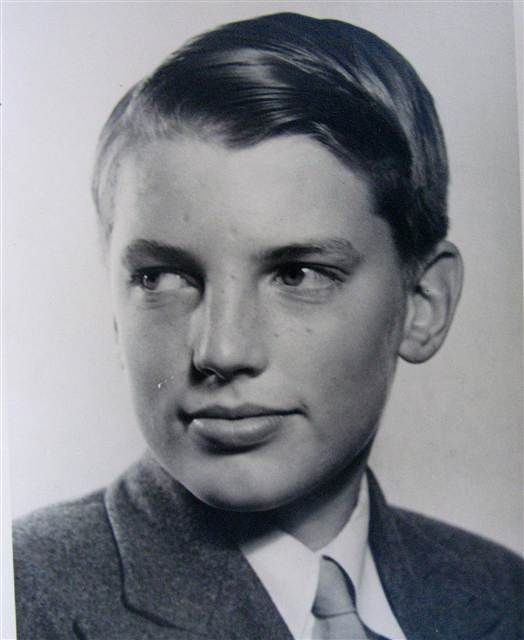
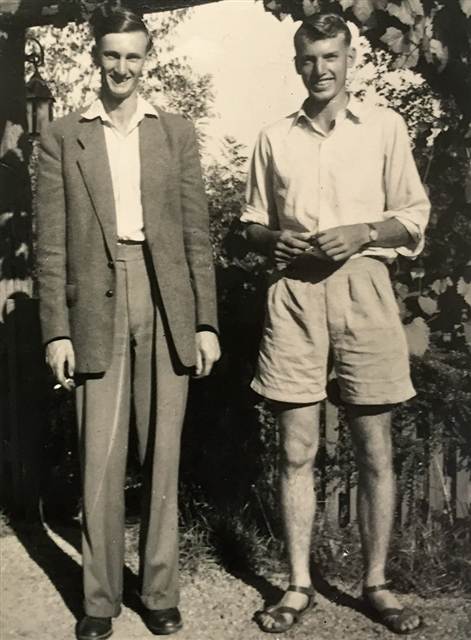
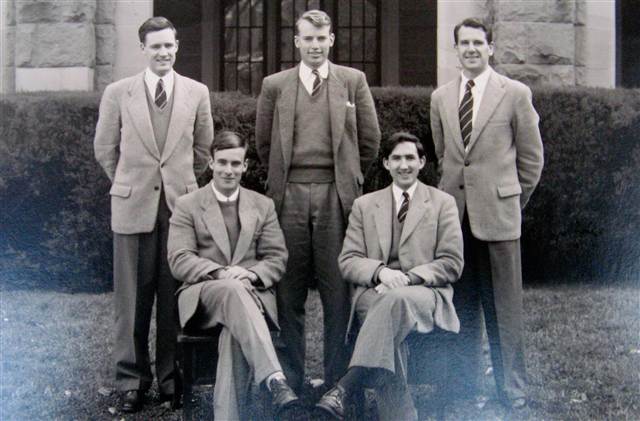
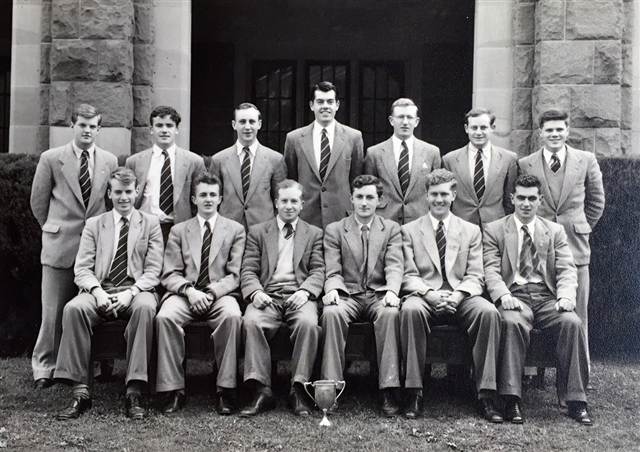
1950 – 1958
During the day on which we heard of our father's death our mother came down to Corio from Melbourne where she had been waiting for our father's return from Perth. I presume someone drove her but I can't remember who that was. We then drove to Geelong where I seem to remember being hovered over by a well-meaning Anglican Minister exuding parsonic sympathy. Later that day I may have returned to school while Michael stayed with our mother, the first of the older brother's new responsibilities. Michael's life was significantly affected by our father's death, my life much less so. Essentially our esteemed housemaster said to me ' Bad luck. Oh well, best to get on with it.' This was the 'Shut up and get on with it' of evening prep! 1950 was not the time for grief counselling. Despite all the anguish and grief of the war 'post traumatic stress disorder' was still essentially a concept for the future.
A few days after our father's death we all attended a Memorial Service at St Paul's Cathedral. I remember our being ushered to the front pew. I felt very conspicuous because that week my suit was at the dry cleaners and I had to wear an ill-fitting borrowed one! That afternoon we went to visit mum's great friend Colwyn Singleton in Croydon who pointed out that two adjacent blocks of land were for sale in Cass Avenue opposite where she was building her house. Mum, ever decisive, bought one for 200 pounds and then, a little later, bought the other one so the pattern for the next ten years was set even though she had no idea where the money would come from to build a house.
Not long after my father's death we went to Bishopscourt and met with Archbishop Booth. He told us that there were some of our father's personal belongings salvaged from the wreckage including, I think, his watch and possibly his cross. Would we like to have them? We said we didn't want them and nor did we want to see them. In the fullness of time my father's ashes were returned to Melbourne and placed under St Paul's Cathedral. Forty six years later they were joined by my mother's ashes. In the weeks that followed my father's death the family received more than 1,400 letters, cards and telegrams. My father was hugely respected in many parts of Australia and around the world. My brother is the custodian of all the sympathy messages we received. I have read many of these tributes and I quote a section of the letter sent by Basil Fletcher-Jones of St George's College, Crawley, WA, to illustrate the impact my father had in the last 17 days of his life:
You may be interested to hear that during the 17 days the Bishop was here in Perth he and the Dean (of Newcastle) spoke to a total audience of thirteen and a half thousand, in 17 schools, 14 Church Services, eight midday engagements, seven rallies and the five big Mission Services in the Cathedral. These were really wonderful services with never less than 600 present and on the last night the Cathedral was really packed...... How the mission was appreciated and what an inspiration it has been. The mission and the missioners will never be forgotten by the present young generation in Perth.....
Soon after the funeral my mother and Michael made the decision that they would return to Hay to pack up the house. I was not given the option of joining them aged 15. My destiny was decided by others and I went back to school to 'shut up and get on with it'. I lost my father and my home at the same time. Now you see me: now you don't. I did not share in any decisions about what to keep and I didn't say goodbye to people or places. No doubt I was being protected for all the best motives and the job would have been easier without me there. I accepted it at the time without question. Only later was I sad not to have shared in that whole process. Back to school I went, gave my friend his suit back and got on with it knowing that if it hadn't been for my being confirmed I would have been an orphan.
I was quickly caught up again in the rhythm and routine of school life without having to think about things like where we were going to live now. Fortunately the Melbourne Anglican Church had just built a little flat behind Deaconess House in Station Street, Fairfield. Would we like to live there until we had sorted out our longer term plans? The offer was gratefully accepted and by the next school holidays I could go 'home' to Fairfield. The flat had two bedrooms so Michael and I continued to share. We had never known anything else.
A few weeks after the plane crash reports for the middle of second term arrived home. The Headmaster always wrote in red ink, probably copying the practice of Frank Fletcher, the Headmaster of Charterhouse. In relation to Michael and me he wrote 'Both boys have behaved magnificently, and as good Christians.' That was a significant improvement for me on my usual 'Could do better'!
There was, of course, the whole question of fees. Michael was due to leave school at the end of the year but I had three more years to go. Mum could obviously not afford to keep me at Geelong Grammar School for that period of time. In a letter Michael wrote to mum on 8th August the answer was provided:
Dear Mummy, Last night I had to go and see the head master. He told me that he had some good news but didn't know how to tell you in order not to offend you!! I don't know whether he has written and told you about it or not but if he hasn't don't let on that I have told you as I don't think he will tell you the way I am going to. Someone who liked daddy very much and somebody else both wrote to the head and offered to pay for our education and asked the head to name a figure. Well the head assured me that they could afford it and he asked for 1,000 pounds, which they gave us! Well what do you think of that!!! I think it is something of a miracle.......
Our father's qualities inspired many people in different ways and, of course, the Murray family was very grateful to our benefactors for their faith in him and their generosity to us.
1950 was Michael's final year at school. He was House Captain, doing his Matriculation and dealing with many aspects of our father's death, not least helping our mother face the new reality. It would have been a tough six months for him. He still managed to win the Long Jump at the APS Combined Sports and secure an academic result that gave him the option of choosing between a Commonwealth Scholarship and a State Government Studentship which would have committed him to working in Government Schools for three years. He chose the former. Originally he had planned to be a resident at Trinity College where our father had been 30 years earlier but he decided that his responsibility was to live at home with our mother. At school he received no vocational guidance. No one did. A chance remark by house tutor Ken Mappin one evening suggested that he would probably have to teach given the absence of academic subjects that would qualify him for much else.
The flat in which we lived along with the tennis court behind it which we used have long since given way for further development but Deaconess House is still there minus the Deaconesses. Indeed I wonder if there are such creatures in Australia any more. They would hardly be called Deaconesses if there are. It's too gender specific nowadays.
Once our mother was 'settled' - and this included her having to complete her commitments as Commonwealth President of the Mothers' Union - she decided she had to get a job since she had very little money. She secured a position in a Gift Shop called Light and Shade in Royal Arcade in the City and went in on the train every day. She had never done that sort of thing before and we were very impressed that someone as old as 53 could manage it!
At school I had many friends enjoying cricket, football, tennis and athletics although cross-country running was definitely not my thing. I was in the choir and in plays and, as instructed, I did 'get on with it'. In the first holidays after my father's death I often took the bus down Heidelberg Road to Ivanhoe to visit Carlsberg Road where the Smallwoods lived. They had a tennis court and I spent many happy hours with Richard and Robin and their parents and their aunt and their grandmother, Mrs Hewitson. It never occurred to me that just five years earlier Mr and Mrs (Dr) Smallwood had been prisoners of war in Changi and Malaya. It was, naturally enough, not a subject of conversation. Mrs Hewitson had taken on family responsibilities with the grandchildren during the war and she now lived with her daughter and her family in Carlsberg Road.
The 1950s were, in a sense, the last decade of the Victorian era! Australia still had a White Australia Policy. The concept of a Multicultural Society still lay well into the future. In 1947 Arthur Calwell, Minister for Immigration, observed in Parliament that 'Two Wongs don't make a White'! Can you imagine the uproar if such a thing was said today?! It was not until the referendum of 1967 that Aboriginal Australians were included in determinations of population ie the census did not include them as citizens. Television did not come to Australia until the Melbourne Olympic Games of 1956. I can still remember our first television set - a black and white PYE set. No remote control, of course, and a reception often looking more like a snow storm. Colour television didn't start in Australia until 1975. In the 1950s Germaine Greer was not yet a household name. A woman's place was in the home. It was a man's world - a white man's world. Appendix 1 at the end of this chapter is an essay I have written entitled 1958 - Reflections on what we took for granted 60 years ago.
Geelong Grammar was a school for boys and all the staff were men. We knew nothing about girls. We were taught nothing about sex, at home or at school! We were generally kept busy given what idle hands are prone to do. On weekdays almost all hours were accounted for from morning roll call until lights out. House jobs had to be done and inspected. At recess we had to run out to the Perry Oval for 10 minutes of physical exercises summer and winter conducted by the prefects. We had set places at all meals moving along one place each week which meant that our turn regularly came around to ensure that we made conversation with the master who sat at the end of the table and had special meals brought to him by the maid. Somehow the onus was on us to make conversation with the master rather than the other way round - and with some it was like getting blood out of a stone. We took our regular turn as 'slushies', waiting on table and cleaning up afterwards. There was sport after school three afternoons a week. On one of the other days we had to be part of the Cadet Corps spending hours in advance polishing buttons and shoes. We marched and did drill and learnt about the Bren Gun and what the barrel locking nut retainer plunger was for and that the order of stripping the Bren was 'piston barrel butt body bipod'! We went shooting on the school rifle range which was troublesome for me because I couldn't shut one eye to line up the target and because the sound of rifle fire contributed significantly to my having to buy expensive hearing aids years later. I finished my illustrious Cadet career as Sergeant of the Guard. On the fifth weekday afternoon we did community service around the School which was sometimes worth the afternoon tea provided by favourite masters' wives.
On Saturdays we generally played in a sporting team. This suited me but it must have been hell for many boys who hated sport which served only to humiliate them. Sunday saw us having to go to Chapel morning and evening as a minimum. If we had been confirmed we were encouraged to go to Communion as well. Sunday morning saw house jobs and inspection and compulsory letter-writing and only between lunch and tea could we take off our suits and relax a bit.
In those days we had little privacy since great virtue was to be found in communal living. There were some escapes. One was the lavatory to which I fled on news of my father's death. One was the chapel and I recall going through a relatively short-lived 'religious phase' when I escaped the hue and cry by sitting quietly in the Chapel of All Saints. One was the plantation where one could take a solitary walk apart from bumping into a few smokers. And one was the Music School where I could go to a practice room to play the piano or go to the Music Library and listen to records.
Leisure time was generally happily spent playing cricket in the summer or having 'kick to kick' in winter or playing tennis or table tennis or even sailing. We had our own version of cricket in the study room with ruler and pingpong ball. The study rooms were gathering places on weekends, especially on winter evenings in front of the fire in study rooms 'one' and 'two' cooking jaffles in our jaffle irons which were very popular at the time. It was a different pre-television, pre-computer world but one in which I was happy.
I was lucky enough to play in the School 1st XI for my final three years being wicketkeeper for two of those years and Captain in my final year, 1953. I was even Captain of the Combined APS (Associated Public Schools) Team which played the Combined High Schools. I could never get enough cricket! One of the first things I did when we moved to Croydon was put a cricket ball in an old sock and tie it to a rope from the branch of a tree and hit it to and fro - to and fro - happy as a sandboy for hours on end!
I was also Captain of Perry House in my final year just as Michael had been in 1950. This meant I saw a good deal of Vic Tunbridge, the Housemaster, and his wife Marj. Vic had a fine reputation as a Housemaster and he was one to be feared. Alas I don't remember receiving any guidance from him on the nature of student leadership and how I might go about dealing with difficult situations or difficult boys. I think discipline and punishment were very confused. As already indicated we were given two means of punishment - 'job list' or 'the cane'. Boys did as they were told or they got one or the other. We called the roll every morning and conducted house prayers every evening, a ritual of little meaning to anyone I suspect and the Prefect on Duty didn't select his reading for the evening with a great deal of religious zeal! I recall Richard Smallwood choosing a reading one evening which began with these words: 'Dead flies cause the ointment of the Apothecary to send forth a stinking savor'! It says something about me or the system or both that the only reading I remember from house prayers was a send-up!
Reading in chapel in front of the whole school was taken more seriously. It was the custom for school prefects to read the lesson in chapel. Generally we read every day for a week and later in the year our turn came around again. We donned a gown for the occasion similar to a teacher's gown but blue rather than black. At the end of the year a 'Chapel Reading Prize' was awarded. I tended to be of the view that this was awarded as a Christian act of charity to a prefect who otherwise would have remained prizeless! Michael and I were both awarded the Chapel Reading Prize! Actually I was - and still am - delighted. I still have the volume I received suitably signed by JR Darling and embossed in gold on the cover with the school crest - The Oxford Book of English Verse. Perfect!
I was also 'Chapel Secretary' in my final year, an appointment based on my parentage rather than any particular conviction. The main responsibility was on a Saturday night to prepare the altar and side table for communion including the bread and the wine. I resisted the temptation to have a swig of the wine before it underwent its miraculous transformation next morning - or at least that's my story!
Before concluding these few memories of school life I will recall an event at the end of 1952. One of my contemporaries in Perry House was Clyde Packer, older brother of Kerrie. Clyde decided, given his publishing background, that he would edit a magazine to be distributed at the end of the year. He asked me if I would be on the Editorial panel, assuring me that it would involve no work. I agreed and heard no more until the magazine was distributed (presumably sold) on the last day of the year. The magazine was called Brew and I never saw a copy. It was deemed to contain inappropriate material by the powers that be and clearly a copy was shown to the Headmaster. On the final evening of the school year it was traditional to have a variety show in the Bracebridge Wilson Hall. I can still remember hearing Teddy Marshall informing the audience that anyone who had a copy in their possession was to return it to the authorities forthwith. I guess most were returned but doubtless there are still some copies of the infamous brew in some Old Geelong Grammarian Collections. My name, alas, was listed among the editors as was John Bedggood's and we were summoned before a hugely irate Headmaster in the study of his home. He paced up and down ranting and raving. The intrepid John Bedggood said 'What do you want us to do? Get down on our knees and beg for mercy?' I don't recall any particular punishment beyond the wrath of the Headmaster but on this occasion that was enough! I guess we learnt a lesson. I wonder what was in that particular Brew.
I end my reflections on school life with reference to several men who influenced me most. The first two I honour because of their kindness to me. They are Teddy Marshall and John Brazier. Their kindness was to some extent motivated by family connections. Teddy Marshall was at University with our father and played Sir Andrew Aguecheek in the same production of Twelfth Night as our father played Malvolio! That was a lasting bond. John Brazier's father was an Anglican clergyman in Geelong and 'Braz' knew Alfred Wheeler well. That was a lasting bond too. Braz and Teddy were single men at that time and good friends. Teddy sang Tenor in the choir. Together they often gave me an outing on a Sunday by taking me for a drive, often to Point Lonsdale. The drive was generally in Braz's old car which was known as Cecelia who was the Patron Saint of Music. Teddy wrote me a beautiful letter when our father was killed. They both made a significant difference to my life at school. On some days I would loiter in the hope that I would be asked to join them and I saw them disappear down the school road. This was my cue to slip into the chapel, turn on the organ and play songs from South Pacific! Against the rules - but fun!
Ken Mappin was a Tutor in Perry House by the time I arrived there in 1949. He was a Geelong man and already a keen actor and member of GAMA (Geelong Association of Music and Art). That year he decided to direct Twelfth Night at the School. I auditioned and, alas, was cast as Viola. I suspect I was pretty awful and, despite being dressed up as a girl who dresses up as a boy, I enjoyed it. We had a rehearsal camp at Mornington which was fun. Some members of the cast remained friends. Robin Cuming played Maria. I had known him at Melbourne Grammar and we were at Trinity together. Ron Thompson played Olivia and became a professional actor taking the name Ronald Falk. Tony Mirams played Andrew Aguecheek and we keep in touch pretty regularly. Later I was in Ken's production of The Importance of Being Earnest and stood in with 24 hours notice to play Antonio in The Merchant of Venice in which Ron Thompson was a brilliant Shylock. I'm sure I owe Ken a great debt of gratitude for my interest in the Theatre, something that will recur in these LIFE LINES.
John Gammell, 'Boris', came to Corio on exchange with KC Masterman in 1950. Boris was larger than life and a huge presence. He taught us Latin and claimed much later that he was just keeping a page ahead. That's not the way it appeared to us when he fixed us with his eye and spoke with a booming voice. He had been a war hero and had lost a leg so he loped about on a tin leg. Early that year the Headmaster had directed Henry IV, Part 1 in which, alas (again), I had played the part of Lady Percy. MA Hall had played Falstaff but had left to go to University in the UK. The Headmaster decided to re-run the production, this time with John Gammell playing the part of Falstaff. He was brilliant stomping about the stage with great gusto. His amputation lent new significance to Hal's question 'How long is't ago, Jack, since thou sawest thine own knee?' Boris was Commander of B Company in the Cadets and I was a lowly Private. He could jump down behind a Bren gun in an instant - and get up almost as quickly. Years later Anne and I stayed with the Gammells at Repton where he was the Master and we last saw him when we dined together in Canberra. A brave man (he had been awarded the MC) and an inspiring man, John Gammell was one of the old school. It is hard to believe that he was only 29 when he came into our lives in 1950.
Peter Westcott was a brilliant man and an inspiring teacher of English. Admittedly for much of the time we simply sat and listened but what a mind! He wrote two articles for The Age every week for many years, one generally relating to English texts and one a historical piece. From a fairly futile Dip Ed year in 1958 the only things I remember from the lectures by Professor Frederick, Professor of Education, were to stand where the class could see me and use coloured chalk! Peter Westcott stood at the back of the classroom, his short-sighted eyes an inch from the text in front of him, and he didn't use any chalk at all!
In 1953 Roger Blomfield went on exchange to Shrewsbury School and Michael Charlesworth came to Corio. Michael was a born schoolmaster and he certainly was the man who inspired me to be one too. He helped coach the 1st XI that year and to me he was everything a good schoolmaster should be - interested, able, personable, dedicated, friendly but not familiar, helpful, positive, kind and fun. He was a good sportsman and it was he who persuaded JR Darling to build an Eton Fives Court at Corio! He liked the theatre and I was part of the revue he directed in which a group of us in true Edwardian style ('white flannel trousers and tea on the lawn') joined him in a soft shoe shuffle song and dance routine including I Do Like To Be Beside The Seaside and You Too Can Have A Body Like Mine. I can still remember the steps - and the words:
Is your breathing poor? Does your stomach flop? Does a milkshake tend to make you go off pop? There's no need to be a clinging vine. You too can have a body like mine.
Simple joys!
Shrewsbury School was essentially Michael's life and he was often Acting Headmaster there while Heads were on leave or between appointments. For some years he was Headmaster of a school in Pakistan but after that interlude he returned to Shrewsbury. Anne and I stayed with him and his wife, Joy, at Shrewsbury more than once and we enjoyed seeing him when he visited Australia. I greatly enjoyed his autobiography Behind the Headlines.
There were many fine men and fine families living at Corio. We were very fortunate that our parents chose to send us there in 1946, and later I enjoyed teaching there for 17 years. I often refer to it as my spiritual home.
In March 1951 the National Service Act was passed providing for the compulsory call-up of males (a sign of the times - not equal 'opportunity' for females) turning 18 on or after 1 November, 1950, for service training of 176 days. It was abolished 8 years later. Michael had turned 18 in the January of that year so he was not eligible. On the other hand I would turn 18 in March 1953 so I would have to do 'Nasho'. Training for University students was timed to coincide with university vacation and so was split into three camps over three years with the longest camp, 100 days, occurring for my intake in January 1955.
On 31 December 1954 the Third Test Match between Australia and England began at the MCG. Naturally I was there. I was there on 1 January for the second day as well so having seen Colin Cowdrey make a century in England's first innings total of 191 I had also seen Australia get ahead in their reply and the prospect of an Australian win was strong. Alas on the third day, instead of returning to the MCG, I reported for military duty somewhere or other with hundreds of other unlikely heroes and began my change of identity from Tim Murray to Private Recruit Minor one star 3/754311! We took a train to Puckapunyal which became our home for the next 100 days. We could only listen to snippets of the radio commentary from the MCG and I missed the sensational bowling of 'Typhoon' Tyson in Australia's second innings when he captured 7 for 27 off 12.3 overs spearheading England's remarkable victory by 128 runs.
Having been in Boarding School at the age of 7 and again from 10 to 18 communal life did not come as a shock. I was one of 30 in a typical army hut with beds along each side of a central walkway. It was not air-conditioned comfort at Puckapunyal in the middle of January! Having 5 years in the School Cadets I had developed no love for the 303 Rifle or the Bren gun or marching in column of route or the spit and polish expected of a well-disciplined soldier. I decided I would seek my training in the cookhouse and ablution block so I spent most of my days 'bashing dixies' (ie washing up) and cleaning latrines. Bearing in mind Napoleon's dictum that an army marches on its stomach I felt I was contributing where it really counted! I hope I washed my hands between exercising my two responsibilities. I'm not convinced that I made a major contribution to Australia's defence but I guess it didn't do me any harm. We returned to 'civvy street' in time for the start of the University year and my second year at Trinity College. The following January I spent 21 days at Site 17, the other side of Seymour, extending my military insights and it was the same again the following January. So by the end of January 1957 I had completed 140 days (cut back from the original 176 days) of military training and emerged as I entered - Private Recruit Minor one star 3/754311!
My main aim on those camps was to get away on as many Saturdays as I could, hitchhike down the Hume Highway and play cricket with the university whose sides were considerably depleted. After the game we walked across to Sydney Road and plied the thumb again in order to get back to camp by 2359 hours and avoid being reported AWOL! Somehow all of that could be managed. It's all a matter of priorities!
For several years in the weeks before Christmas during my University days I worked at the MSD (Melbourne Sports Depot) in Elizabeth Street in the City to boost customer service during the Christmas rush and to earn a few pounds. Generally I worked at the tennis racquet counter but sometimes sold cricket bats. John Nixon and Peter Gebhardt worked there as well. It was fun and one quickly picked up the main issues involved in helping people make a choice. I have three particular memories associated with that experience.
On one occasion a fellow came to the counter and said to me 'I'm looking for Lindsay Doyle.' 'I'm sorry, what was that?' 'I'm looking for Lindsay Doyle.' 'I'm sorry, Lindsay Doyle doesn't work here.' 'No, have you got some Lindsay Doyle for my bat?' 'Oh you want linseed oil. Certainly.'
On another occasion I was back behind the counter having fallen asleep at the wheel of my mother's little Morris 1000 while driving back to Croydon and crashing into a light pole. That had put me in the Box Hill Hospital where I had about 30 stitches in my forehead. It didn't look particularly attractive when I returned to the MSD. A customer appeared and I asked 'Can I help you?' to which he replied with some concern 'Can I help you?'
The third 'memory' is a retrospective. Over the last few years I have attended several funerals of old friends at the Trinity College Chapel. Twice fairly recently the same woman has come up to me and greeted me like an old friend with the words 'Tim Murray. MSD!' I wish I knew her name.
During February and early March for two or three of those University years I became a 'stooge' at Geelong Grammar helping out in various ways at the beginning of the school year. John Nixon came too for at least one of those years and we were both there early in 1957. It was then that we became friends with Denys Carnill who had been captain of the English Olympic Hockey Team in '56 and stayed on for a year on exchange with Rolph Baldwyn. Denys taught at Dean Close School and it was through him that I secured a teaching position there later.
'Nasho', 'MSD' and stooging at Corio were, of course, sideshows to the main focus of 1954 to 1958 which was to get a degree and teaching qualification. Despite a remarkably unimpressive Matriculation I was offered a Commonwealth Scholarship which shows how liberally they were being spread around in those days. In a gesture demonstrating the truth of the text 'Faith, Hope and Charity, these three: and the greatest of these is Charity' I was awarded the Elizabeth Hebden Scholarship to Trinity College. It was designed for the sons of clergy. Mercifully Bertie Milne was awarded one the year before me. He was seriously clever. I assume there was no other candidate in my year.
It was an immense privilege to attend Trinity College for four years. My father had been a fine scholar there 30 years earlier and so there was hope, almost an expectation, that I would go there too. I went there almost 'as of right' little realising what distinguished company I would keep and how important it would be in my life. The University of Melbourne was the only University in Victoria in those days. Trinity was one of four Men's Colleges - Trinity, Ormond, Queen's and Newman. Our 'sister' College was Janet Clarke Hall and we shared the same chapel and the same direct telephone line and the same 'Jutoddie' initiation for Freshers and much else besides. Trinity essentially comprised young men from Geelong Grammar, Melbourne Grammar, Scotch, Wesley, Ballarat College and Ballarat Grammar. There were a few others but not many.
At Adrian Smithers' funeral - Adrian was a contemporary and a good friend - one of his sons said, 'Dad once said that Trinity was a great learning ground because you rubbed shoulders with people from all walks of life - engineers, doctors, lawyers, clergymen, architects!' Yes, that's how privileged we were and how limited our horizons were! So as I think of my first 23 years of life I am conscious of how sheltered that life was - a Vicarage, a 'Bishop's Lodge', boarding at Geelong Grammar School and a Resident at Trinity College. Yet there was a recurring theme running through it all. It was all our good fortune but it wasn't a right. A responsibility went with it all and there is no doubt that Michael and I grew up conscious that we had a responsibility to give back, to be of service. The day after my father was killed a letter for me from him appeared in the letter rack in Perry House. Happily it had caught a different plane. In that letter my father was thinking about me and my confirmation and he wrote as follows:
I think that I wish for you above all other things that in your life you will seek and use the strength of God for the service of God. What form that service will take is not for me to prescribe in advance, but I hope that you will take up a work in life that is interesting, fulfilling and of service to God and man.
The spirit of service was part of the 'Civilised Man' that characterised the Geelong Grammar education inspired by JR Darling and it was part of the structure and expectation of life there. I seem to remember JRD saying 'A boy may leave GGS selfish but he won't be selfish with a clear conscience.'
My contemporaries at Trinity were very conscious, too, that their presence there meant they had a debt to be paid to society in the future. As I think of my many friends from those days and what they have done in their lives I believe they have well and truly given back to the world which was so kind to them. I reflect on this in a poem I called The Golden Road which is Appendix 2 to this chapter.
Not having been clever enough to include Mathematics, Physics or Chemistry in my Matriculation subjects I was as limited as my brother in career options. Like him I chose to study for a Pure History Honours Degree which was four years instead of three. Never having gained an honour in History in my life it was rather a nerve to take it on and rather a miracle to be accepted. As well as History I had to take one other subject a year for three years: I took Economics A and B and Economic Geography. In those days an Arts Student also had to take a Foreign Language. Mercifully a 'French Special Reading Course' was devised for people like me and we could even read the French texts in English! I don't recall going to classes. I don't recall being examined. Somehow I was deemed to have 'passed' or 'satisfied the examiners'! For many years I had a recurring dream that I had not passed my French Special Reading Course and my Honours Degree was null and void.
I did finish with an Honours History Degree - a Second Class Honour in the A Division. Another miracle! I was privileged to have some fine lecturers in History and some fine fellow students. Professor Max Crawford was Head of the History Department and we appreciated his erudite lectures on the Renaissance and the book that he wrote on the subject. George Yule spoke about the English Civil War seeming to puzzle out issues before our eyes and come to historical conclusions as if for the first time. Geoffrey Serle who wrote The Golden Age was an inspiration in his fascination with Australian History. Indeed part of the course was to travel round country Victoria with him and fellow students to promote the preservation of local history documents. It was round a campfire with that group that I celebrated my 21st birthday on 3 March 1956. I had even taken a cake with me for the occasion!
A very young John Mulvaney shared his enthusiasm for archaeology and John O'Brien took us laboriously through aspects of Ancient History while popping a pill from time to time. Jim Main was a measured and meticulous lecturer speaking at just the right pace to allow the full taking of notes. Professor Norman Harper was a specialist in International Affairs and often spoke on the ABC Programme Notes on the News. In tutorials he would suddenly burst into a massive coughing fit and go puce in the face. Finally it passed and he continued as if nothing had happened. Professor La Nauze was measured and an expert on Alfred Deakin about whom he wrote a biography in two volumes. From time to time we had lectures from Margaret Kiddle who wrote the beautiful book Men of Yesterday and died tragically young, and Kathleen Fitzpatrick who had plenty of charisma. It was quite a team.
Much later, in 1983, Kathleen Fitzpatrick published her memoir Solid Bluestone Foundations - and Other Memories of a Melbourne Girlhood 1908 - 1928. As a student at The University of Melbourne she studied History and Philosophy. As part of her Philosophy study she took Logic. On page 170 she wrote as follows:
Logic was the province of a young tutor named Charles Murray, who afterwards became a Bishop. Already he had an Olympian manner and lacked the gift of communicating with the primitive mind. He scared the wits out of me and formal logic, with its major and minor premises, remained as unintelligible to me as sine and cosine had been at school. Mr Murray very naturally thought me a dolt. I have never seen such surprise on a face as his showed when, a few years later, we met by chance in the street at Oxford. I was on my way to a lecture and was therefore wearing a gown and the only possible deduction from that premise was that I was studying at Oxford. This really shook Mr Murray, and for once it was he who was struck dumb, until he rallied and asked 'How on earth did you get here?'
Oh dear. I can only offer in my father's defence that relating to women was simply something in which he had little experience. He grew up in the male world of Wesley College, Trinity College and Christ Church Oxford. In the hundreds of letters he wrote home between 1924 and 1927 women, at least single women, hardly get a mention. Shyness and lack of experience probably found their expression in haughtiness and apparent arrogance.
Among my student contemporaries in the History Department were Felix Raab and Anthony Clunies-Ross. Both were hugely clever and blissfully able to hold their own and hold the fort in Tutorials allowing 'dolts' like me to remain almost totally silent. There was George Brownbill who became a Diplomat and Molly Seymour who married George and became a teacher. Jim Rundle was in Trinity and became a professional Historian. He wrote the History of Mentone Grammar. I was fortunate to be part of the History School at that time. In retrospect I think of how good it would have been to do a combined History and English Degree if such a thing existed.
Apart from going to lectures and tutorials our University life was essentially College life. In my first year I had a bed-sitter in the antiquated Wooden Wing which was not unlike those army huts at Puckapunyal. It could get hugely hot but it was fun. For the following three years I shared a study with John Nixon. As well as sharing a study we shared a bedroom. In those days sharing was called 'wifing'. 'Who did you wife with in College?' I still hear people ask. Rules were strict about having women visitors and they had to be out of the College by 6pm. Trinity became coeducational many years later. Caitlin was the third generation Murray at the College.
The Chapel had just been built when our father went to Trinity and it would have meant a great deal to him. He would have attended Chapel very regularly because he wanted to. I attended Chapel regularly because I had to. I doubt that Caitlin attended Chapel much at all. Actually I enjoyed Chapel, not least because of its Collegiate seating. We sat opposite the ladies of Janet Clarke Hall and could 'survey the field' and feed our fantasies and possibly dash back to the phone outside the Junior Common Room with its direct line to JCH.
Freshers had two responsibilities. One was to partake in the annual 'Juttoddie', so-named after the students Jud and Oddie who invented it. We were handicapped with bricks, and with gowns flying we had to race round the Chapel in the bull paddock leaping the intervening fences. A good deal of sabotage took place behind the Chapel. Bookmakers laid odds. The other was that, on a roster system, freshers had to stoke the boiler to ensure the College had hot water. I doubt that such a responsibility exists nowadays. There were no initiations in Trinity College in the 1950s although there may well have been some in other Colleges. It beggars belief that there are still vindictive initiations in some Sydney Residential Colleges.
I remember that we sent our laundry away each week and it was returned in neat brown paper parcels. At one stage a notice appeared on the College Board seeking the identity of a 'Jim Murphy'. This didn't ring a bell with me until it became evident that my writing of 'Tim Murray' was regularly being read as 'Jim Murphy'. I'm not the only person who remembers that. Sometimes Peter Hollingworth greets me knowingly with a jolly 'Hello Jim Murphy!'
I was introduced to the game of squash at Trinity and the College had its own court. The College entered teams in a club squash competition and I generally played number 4 in a team generally comprising John Nixon, Adrian Smithers, Dick Hallowes or Clive Morris. We had a lot of fun either travelling to other courts in the suburbs or hosting the matches at Trinity which led to long alcoholic evenings. Somehow we got our essays and papers done and met our deadlines. We knew that when the oak tree began to bud it was time to get serious since exams were just around the corner.
As well as people I have already mentioned I was great friends with Clive Tadgell, John Batt, Randolph Creswell, Peter Pockley, Peter Hollingworth, Norm Carlyon, Bernard Newsome, Richard Smallwood, Ian Donaldson, Peter Gebhardt, Peter Reid, Jennifer Muntz (who married Adrian Smithers), Barbara Letheren, Jan Abson, Harriet Cook (who married Bill Lester), Mary Reynolds (who married Bernard Newsome), Elspeth Haydon (who married Dick Hallowes) and numerous others. What a life it was.
Peter Pockley had been a great friend since we first met at GGS in 1949 when we both arrived in the Senior School, Peter from Bostock in Geelong and me from the Junior School. Peter was hugely clever and went on to fame as a science broadcaster. At College he developed a reputation as the scourge of the College with his camera. No one was safe. Suddenly Peter would appear and - click - you were on record for all time. Many years later he presented the College with his photographs and super 8 films, a rare archival record of those simple, happy days. Peter also broke the record for keeping the fire going in his study in the Lower Clarkes building. Only once to my knowledge did the logs roll out and burn a gaping hole in the floor during the 100-day marathon. Of course he set fire to the chimney on many occasions and the arrival of the fire brigade was a regular occurrence.
There were many dimensions to College life. Bowls on the lawn outside the Dining Hall was a regular feature after lunch and dinner. The Billiard Room was well patronised. The bull paddock that I have already mentioned 'housed' both cows and the Chapel, a combination that Anthony Clunies-Ross referred to so beautifully in a speech that I still remember as 'the juxtaposition of the bovine and the ecclesiastical''. The College cricket nets were also part of the bull paddock - a fairly lethal part at that.
With the Olympic Games being staged in Melbourne in 1956 some of the clever science and engineering students were commissioned to ensure that the Olympic Flame kept burning night and day. Peter Pockley and Peter Reid were two of those who shared this responsibility. Alas, although I don't think it made the newspapers, their vigilance was not as thorough as it should have been and at one stage they had to quietly relight the eternal flame in the dead of night.
The College had a fine reputation for its theatrical performances. Our father, as I have already noted, played in a production of Twelfth Night. I was involved in two productions. Ben Meredith directed Hassan in the Union Theatre and I had a very minor part in what was to prove, many years later, a very significant experience. I was the Old Man on the road to Samarkand and gave the conservative advice to those who wanted to take the road: 'Have you not girls and garlands in your homes? Eunuchs and Syrian boys at your command? Seek not excess. God hateth him who roams.' Clearly the eunuchs and Syrian boys were not deemed to be the sort of excess the Old Man was concerned about! Philip Sergeant designed the costumes and Mary Reynolds (Newsome) was costume mistress. The next year I played the part of Heartfree in John Vanbrugh's play The Provoked Wife. This time Philip Sergeant was Director, assisted by his friend Colin Munroe. These experiences stimulated my interest in the theatre and I developed a desire to direct plays rather than act in them. This interest blossomed in my teaching life.
During my years in College two musicals were particularly popular - Salad Days and My Fair Lady. In the former Jane and Timothy graduate from University and sing 'If I start looking behind me, and begin retracing my steps, just remind me to remind you, we said we'd never look back.' It was time to move on and do my year's Diploma of Education while living at home with my mother in Croydon. It was good to be with her that year. Michael had completed his Dip Ed in 1955 and left home to teach at Tudor House in Moss Vale NSW. By the time he left he had done an enormous amount in establishing our home there on the two blocks of land our mother had bought. Both blocks were a jungle of blackberries and the first thing Michael did was clear them. Our simple house was built of the cheapest materials. It had a very large sitting room with a dining space at one end. There were three bedrooms, bathroom, kitchen with briquet/wood stove that was also our hot water service, and small laundry. We went up from Fairfield regularly to check on progress. One day we discovered that the brick enclosure for the stove and oven was being built in the bathroom. Rather a fundamental error. We decided to make a virtue of necessity and had the brickwork tiled and it became a large shower recess.
The house was built on one block which involved a good deal of earthworks because the block was sloping. We decided to build a tennis court on the other block which was equally sloping. Massive earthworks were called for. With a mattock, a spade (not a shovel) and a small wheelbarrow with a steel not a pneumatic wheel Michael set about the project. He was the architect and engineer and foreman and chief labourer. I was builder's labourer and my contribution was very modest compared to Michael's. Through summer months of rock-hard soil and winter months of quagmire with planks for the wheelbarrow's run from one end to the other we, mostly he, persevered. Finally it was level, drainage pipes and clinker foundations were laid, red gum posts were installed and wire netting was attached. I seem to remember that he and I spent his 21st birthday twitching rolls of wire together up a precarious ladder. Outside help was only used for the final en tout cas surface and the plastic lines. It was undoubtedly a magnum opus entirely characteristic of Michael's vision and patient perseverance.
While Michael and I played tennis together I was the main beneficiary and greatly enjoyed having friends to Croydon for tennis parties. Surprisingly mum very seldom played despite still only being in her fifties and having been a very good player in her youth. The same went for her piano-playing. She had been a very good pianist but she was a reluctant player by the time she reached Croydon. I find this hard to explain given the energy and spirit she showed for many years as she re-invented herself after we left home.
So in 1958 I lived at Cass Avenue, Croydon, and had a taste of the commuter's life which was a stark contrast to the convenience and companionship of Trinity College. The one-year Dip Ed year was an utterly undistinguished affair. Lectures really taught us nothing about the art of teaching. That happened through trial and error on our teaching rounds. A teaching round lasted about a month and we were given a limited timetable under the guidance of teachers at the school we were visiting. My three schools were Carey Grammar, Scotch College and Melbourne High School. We were introduced to the Headmasters on our arrival and never saw them again. Bill Woodfull, hero of Australian cricket during the bodyline series, was Headmaster at Melbourne High so that added a historic dimension to the experience. In order to arrive at these schools on time it was necessary to rise very early to get the bus to the station, take the train to catch another train and then walk to arrive before 8.30am. Welcome to the real world! Dip Ed had the virtue of providing a transition year between University and starting work - and so I arrived at the end of 1958 Tim Murray, BA (Hons), Dip Ed and the world stretched out before me.
***
Appendix to Chapter 3
Appendix 1
1958
Reflections on what we took for granted 60 years ago
Tim Murray - 2018
'The past is a foreign country; they do things differently there.'
(First sentence of LP Hartley. The Go-Between, 1953)
At the end of 1958 I left the security of the University after five years and joined the world. It was the modern world of the times, so far removed in its assumptions from the modern world of today.
There were all sorts of practices and attitudes and 'givens' which I accepted as 'normal'. Australia was essentially an Anglo-Saxon country in an alien Asian environment. The main point about the original Australians - Aboriginals/Aborigines/Abos - was that they were a problem. Over the years Governments had tried various 'solutions' to this problem - extermination, 'smoothing the dying pillow', protectorates, assimilation - but they were still a problem. Their culture was primitive and they weren't really to be counted as citizens because, well, they were inferior. I think I had seen one in my life - the one I saw close-up as he hit the canvas in the Hay side-show in the 1940s.
Since the Second World War our policy towards immigration had been 'populate or perish' - populate with British migrants or people from North Western European countries. It was imperative to secure Australia from invasion, and the Japanese had come perilously close in 1942. We were very conscious of the 'Yellow Peril' - the prospect of hordes of Asians sweeping down and overrunning us. Our policy was for a 'White Australia' and our Dictation Test in any language could keep out all undesirables. As Arthur Caldwell, Labor Minister for Immigration, put it 'Two Wongs don't make a White.'
We liked Italians quite well even though, as Nino Culotta (alias John O'Grady) wrote, 'They're a Weird Mob'. That book came out in 1957 and we were beginning to break out from tea, roasts and grills and starting to enjoy cappuccino, pizza and pasta.
Concepts like 'racial diversity' and 'multiculturalism' were not part of the Australian way. We did not believe in marriage between races. Their children would be half-castes and this would compromise the concept of purity of race, (Remember Nellie's first reaction to Emile's children in the Musical South Pacific?), breeding people of inferior quality. We didn't think of this as a 'Mixed Marriage' because it didn't really bear thinking about. No, a 'Mixed Marriage' was a marriage between a Catholic and a Protestant and there were very serious implications, generally resulting in the Protestant being 'converted' to Catholicism and guaranteeing that the children would be brought up Catholic. Divorce was a social stigma and moral grounds for divorce had to be demonstrated in court. You were supposed to stay together no matter how miserable you were. 'No fault' divorce was well into the future.
A woman who became pregnant out of wedlock was a social outcast having disgraced herself and her family. The child of an unmarried mother was 'illegitimate'. A boy from such a union was a 'bastard'. Abortion was wrong and illegal.
A man and a woman should not live together or have sexual intercourse until they were married. Marriage was a union between a man and a woman. Same-sex marriage was unthinkable. Homosexuality was unnatural and a crime and, in the eyes of most churches, a sin. Homosexuals were 'Homos' or 'Poofters' and they were generally at pains to hide their sexuality. People did not 'come out'. There was no such expression as 'The Gay Community'. The word 'Gay' meant vivacious, playful, full of fun and joie de vivre. Cross-dressing was kinky and unnatural. The idea that a male could be trapped in a female body or visa versa was totally outside our experience or imagination.
Education was to a large extent about doing what you were told - learning, remembering, regurgitating. Corporal punishment was appropriate for many breaches of rules, however petty. Coeducational schools were rare, particularly in the Independent School System. Generally speaking it was believed that children were better served by being in single-sex schools. We knew about IQs. People ranged from brilliant to thick. If you were very thick you were probably called a 'moron' or an 'idiot'. We didn't understand 'multiple intelligences' or anything much about learning difficulties and issues like ADD or dyslexia. If you didn't perform well you were probably labelled stupid, lazy or naughty.
Smoking at school was a significant offence, not because it was known to be bad for your health but because - well - I'm not quite sure really. It was a filthy habit and you should wait until you were an adult when it ceased to be a filthy habit and became sophisticated. All homes had ash trays. People smoked in homes, shops, restaurants - everywhere. Cigarette butts joined dog poo wherever you walked.
I had never been confronted with drugs or anyone who indulged in drugs. If people smoked pot I was totally unaware of it. It was simply not part of my experience.
Capital Punishment was still on the Statute books. Another seven years would elapse before Ronald Ryan was hanged, the last person to suffer capital punishment in Victoria.
Conscription for National Service was acceptable if it applied to all men and was not a lottery. It did not apply to women and it did not occur to anyone that it should. Indeed women could not be expected to be involved in stressful physical exertion (apart from child birth!) to the extent expected of men. For example the Women's Marathon did not become an event in the Olympic Games until 1984 - still more than a quarter of a century into the future. Before the 1964 Olympic Games the longest distance run by women was 200 metres.
A married woman's place was in the home, keeping the home fires burning, looking after the children and ensuring support for her husband whose responsibility it was to be the bread-winner. Domestic tasks were essentially the responsibility of the wife, while mowing the lawn was generally a man's job.
Our aspiration was to live in our own house - 'picket fence and sixty foot frontage'. The Australian Dream. This was two years before the establishment of the Reserve Bank of Australia. We were not encouraged to live 'on credit'. The first credit card was by the Diners' Club in 1950 and American Express began in 1958. The Bank Credit Card system began well into the 1960s. We paid our bills by cash or cheque. Our upbringing was essentially Shakespearean - 'Neither a borrower nor a lender be'. In the 1950s the Housing Commission launched a most ambitious slum-clearing project in Melbourne. Thousands of residents in undesirable working class suburbs like Fitzroy, Collingwood and Richmond were living in houses, mostly brick, deemed to be slums that had to be bulldozed with people being relocated to high-rise Housing Commission little boxes. As the '60s unfolded residents protested and refused to move. The surviving 'slums' are probably worth $1.5+ million now. Suburbs further out like Alphington, Northcote, Thornbury and, even further out, Preston, were deemed too distant and decidedly working class and inferior.
There was no strong sense of teenage fashion, teenage culture or a 'teenage industry'. James Dean and Elvis Presley had inspired the start of a revolution but jeans and T shirts weren't particularly acceptable until after 1958. We wore FJs, long-sleeved shirt, tie and sports coat. If we wanted to be a bit more casual - and I'm not sure the expression 'casual' existed in relation to dress - we took off our sports coat and tie and even rolled up our sleeves, but probably only to below the elbow.
The hit parade was beginning to include Elvis and Rock and Roll (Rock around the Clock with Bill Haley and his Comets) but crooners still prevailed - Bing Crosby, Frank Sinatra, Perry Como, Nat King Cole, Dean Martin. What we wanted was 'easy listening'.
Young people didn't protest: they accepted. There were not 'sit-ins' or 'lock-outs' or -'marches'. The first Aldermaston March against Nuclear Weapons in the UK was in Easter 1958.
Weights and measures were Imperial and the currency was pounds, shillings and pence. We laboured long over learning how to multiply, divide, add and subtract amounts like three pounds fifteen shillings and seven pence halfpenny . A penny was divided into four farthings until 1960. The Modern Olympic Games measurement had always been metric but the British Empire and Commonwealth Games did not change to metric until 1970 when the name also changed to Commonwealth Games. There was no place for the disabled in 1958 on the field and probably off the field. Building regulations did not consider the predicament of those who were 'handicapped'.
Awareness of world events was limited and simplistic and not immediate. We got alarmed about the Suez Crisis two years earlier but essentially most news was parochial. If we needed to contact people we spoke to them, we wrote to them, we sent them a telegram or we telephoned by dialling their number (we still use the word 'dial' but we really just 'touch'). Often we had to go through the 'exchange' for long distance and pre-book an overseas number where the conversation was difficult because of delayed reception.
We liked taking photographs but each one cost money. Once a film was fully used we sent it off to Kodak and within a couple of weeks we received our pictures back as slides in little yellow boxes, mostly under or over exposed. With these we could entertain our friends by holding them up to the light, pressing them into a view-finder or even having a slide evening. Some people were beginning to have polaroid cameras which produced a dull picture within minutes but soon faded.
The people who were really respected in the community, especially in country towns, were Bank Managers, Doctors, Vicars, Solicitors and possibly teachers. These people tended to be seen as the pillars of society. There was a significant difference in status between 'white collar;' and 'blue collar'. Politicians were not under daily scrutiny. There were no regular polls reflecting people's changing political allegiances between elections. Prime Ministers could travel to the UK by ship and be away for months. The pace of life was snail-like compared to today. For many life was good. - very good. The following year Harold McMillan went to the General Election in the UK with the slogan 'You've never had it so good.'
We were very concerned about the possible infiltration of communism into our society and earlier in the decade the Liberal Government had tried to outlaw the Communist Party. McCarthyism was prevalent in America. We were encouraged to beware of 'Commos' who were lurking under every bed. We were told about the Domino Theory that saw countries falling like dominos under the heel of Communism until Australia fell as well.
There may have been some people inclined towards Republicanism but generally we were good loyal Monarchists happy to stand and sing God Save the Queen anywhere, any time.
Australia rode on the sheep's back. Earlier in the decade wool had sold for a pound a pound.
If you wanted to get on in life you were well advised to go overseas, preferably to England, as soon as you could after graduating. Australia was essentially seen as a cultural backwater, and creative people - artists, musicians, writers, actors - needed to sail away.
We were scathing and ignorant about the disadvantaged. People with Cerebral Palsy were 'Spastics' or 'Spazzos'. People with Down Syndrome were 'Mongols'. Refugees were 'Reffos'. Despite two wars we still didn't recognise the existence of Post Traumatic Stress Disorder. People were 'Psychos' or 'Weirdos'. We didn't understand depression as a genuine illness. People were 'Schizos' or 'Lunies' and, if they couldn't pull themselves together they should be locked up in places like the Kew Cottages.
Germaine Greer's book The Female Eunuch was still twelve years into the future and we had not heard of the expression 'Women's Lib'. The first contraceptive pill was not available until the mid 1960s.
If there were claims by young people that they were being sexually abused in institutions like schools or churches or children's homes - and it would have taken great courage to do so - it is likely that the priorities of the authorities would be: first, to protect the reputation of the institution; second, to protect the rights and reputation of the alleged perpetrator; third, consider the welfare of the alleged victim.
Black and white television had begun in Australia two years earlier. It seemed that as television developed we would see the end of the cinema since people would not spend money to go out to a film when they could see it free at home.
There were no women priests and there wouldn't be until the 1970s. The Sabbath was essentially a day of rest when shops and pubs should be closed and sporting fixtures should not be held. Melbourne was 'dead' on Sundays. In 1959 when filming Neville Shute's On the Beach Ava Gardiner was said to have observed that Melbourne was the ideal place to shoot a film about the end of the world.
Hotels closed at 6.00pm six days a week and women were not allowed in public bars. Indeed beer was hardly a drink appropriate for women - or at least for ladies. If a man and woman were in a car the man should drive. A man should open a door for a woman and let her enter first. A man should walk on the gutter side of the pavement.
Men should take the lead in politics and business and become the CEOs and Chairmen. Expressions like 'Madame Chair' or 'Chair' had not entered our vocabulary. Headmistresses should be paid less than Headmasters and generally women should be paid less than men because men's working capacity was superior and it was 'their place'.
Cricket was a gentleman's game. The idea of 'sledging' or ball-tampering on the cricket field was unthinkable. The game should be characterised by restraint and mutual respect. 'It's not Cricket' was a familiar expression in everyday life and meant that the behaviour was unseemly and inappropriate. Cricket was played for love of cricket not for love of money. Almost all top sportsmen had other jobs. Yes 'sportsmen' not 'sports persons'.
We were not particularly conscious of protecting the environment. Steam trains were a regular form of transport fuelled by coal and wood polluting the air with soot and smoke. We thought of them fondly. What an exciting atmosphere it was with all those belching engines coming and going at Spencer Street Station.
1958 was pre - plastic bags. We took our own bags to do our shopping, including those string bags we made in the early 1940s. It would still be two more years before the first supermarket opened in Melbourne. It was not a throw-away or take-away society. We did take away fish and chips wrapped in newspaper but there was more than a decade ahead of us before we were introduced to the Colonel's Kentucky Fried Chicken and McDonalds with it symbol which is now the number one symbol recognised around the world.
Queen Victoria died in 1901. The Victorian Era finally came to an end in the late 1950s and we were on the cusp of massive change. It is not surprising that many things that are 'obvious' to the young today are not necessarily quite so obvious to those who were young sixty years ago. While sixty years on there may well seem to be a lot to apologise for we were creatures of our times and we can hardly be blamed for that. We can, however, have great admiration for those perceptive enough to see serious faults in the fabric of our society and courageous enough to put their own welfare on the line to bring about change.
We can also try to respond positively to this year's Australian Senior of the Year, Dr Graham Farquhar, when he encourages us to struggle to re-evaluate our prejudices.
***
Appendix 2
On 27 October 2010 I attended the Charles Nodrum Gallery in Richmond as guest of Frank and Gail Billson. We were in Trinity College together and he had invited a number of our contemporaries. Frank and I were in The Provoked Wife and Hassan together. In the course of the evening Mary Newsome gave me a copy of the Hassan programme – a production in the Union Theatre in May 1955. I recognised over 50 of the names listed and could put a face to all of them. What a talented lot they were and what careers they had. I read again James Elroy Flecker’s poem 'The Golden Journey to Samarkand' with its memorable final line
We make the Golden Journey to Samarkand.
Having read that poem I then wrote my own
The Golden Road
The faded pages had been loosely folded and set aside in memory’s bottom drawer. Now, in the dwindling light of late afternoon, old friends gather, reunited, unburdened by busy ambition, resting easy. “Hassan” she said, handing me the pages, “Remember?” “Hassan, of course.” I eased open the programme, a time capsule enticing me back to dramatic undergraduate days - Trinity College, 1955. Eagerly I scanned the names, and fresh young faces sharpened into focus beckoning me to defy the years and share again the Golden Road. What a pilgrimage it has been – and in what company: scholars, scientists, surgeons, architects and engineers, philosophers, poets, professors and priests, makers of music, painters of pictures, ambassadors, judges, teachers, philanthropists. A privileged cast of pilgrims, givers of their gifts, who set out together on the Golden Road and realized their own vision of Samarkand.
***
Overseas – 1
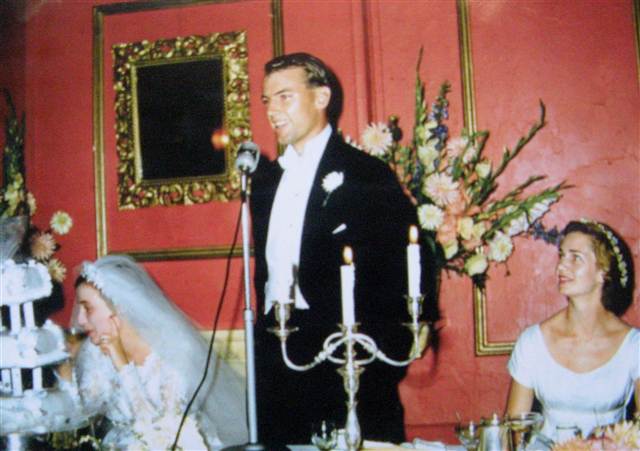
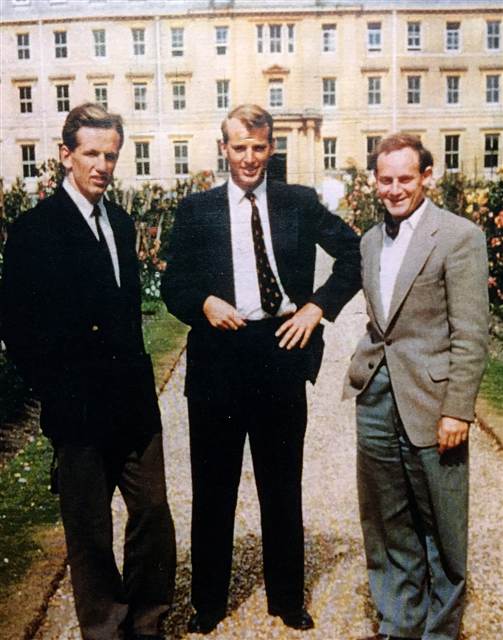
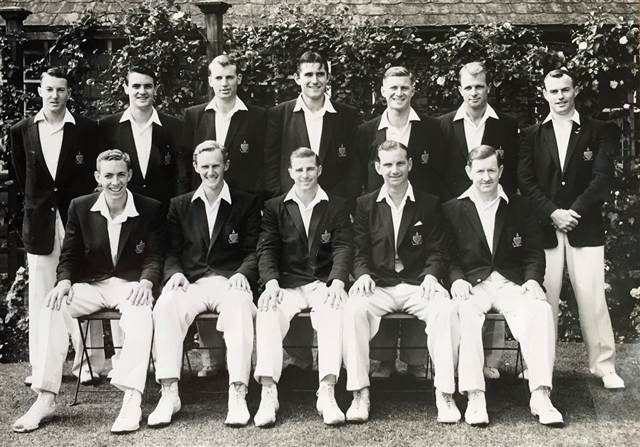
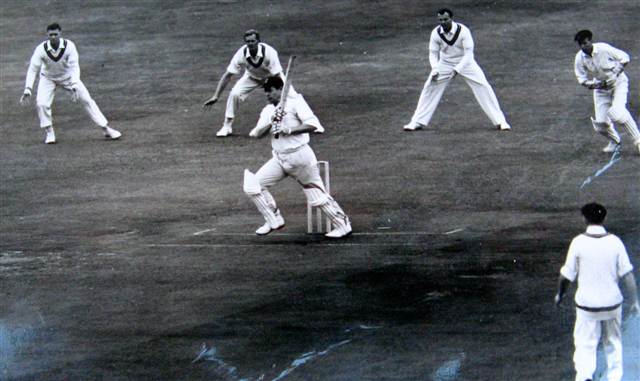
1959 – 1960
In the course of 1958 Graeme Wallace-Smith had made contact with me. Graeme was organising a world cricket tour in 1959. Was I interested in being part of it? The team was to be known as The Australian Old Collegians and he was in the process of putting together a fixture list that would include games in Singapore, India, Pakistan, Germany, France, UK, West Indies, USA and Canada. It was irresistible - but how was I to afford it? My mother offered to lend me 600 pounds that I could start paying back when I returned to Australia. She thought the opportunity was too good to miss. Furthermore, with both of her boys having flown the nest, she could now begin her own new life of travel and adventure and she could be in the UK by the time our team arrived.
The team was to gather in Sydney late in April. Before that I had nearly a term of teaching at Geelong Grammar School followed by 'leave' until the beginning of 1961! My good fortune was continuing. By the time the team left I had become very good friends with HW Eyre-Walker and Don Marles.. For most of my time away Eyre looked after the little Morris Minor and Don gave me an introduction to Frank Fisher for whom he had worked at St Edward's Oxford in 1957. Frank would be happy to give me guidance in my job-seeking when I stayed on in England after the team flew out on the rest of their tour.
A few weeks before we left, John Nixon and Libby Hawdon were married. As I have already indicated John and I had 'wifed' together at Trinity College! John generously invited me to be his Best Man. The two groomsmen were Barry Connell who had taught us History at GGS and then moved on to a career in the Law, and Bill Whitney who was a man of the land from NSW and had been a great school friend. Soon after they were married John and Libby travelled to England and we caught up again there.
Graeme Wallace-Smith didn't come on the cricket tour himself. Ken Nicolson, teacher at The Geelong College where Graeme had been a star cricketer, was appointed manager and he was accompanied by his wife and daughter, Gerda, who later became a professional actress. Jim Court, whom I knew well from University days, came as Captain and there were several Victorians I knew including John Miles, cricket coach at Scotch College, Angus Mackay and Peter Falconer. Peter and I were the only two to stay on in England and we became good friends. Richard Smallwood was very tempted to come but the long period of absence from his medical studies could not be accommodated. Peter Gebhardt was tempted to come as baggage manager but thought better of it. Ron Murnane from Terang came to look after the baggage and play the occasional game. He was a friend of the Wadeltons of Terang who entered my life a few years later. Leo O'Brien, now 50, was in the side. He had played Test Cricket with Bradman ('Braddles') and was past his cricketing prime. He was a tough nut and played hard on and off the field. Ron Murnane tried to keep up with him but he was no match for Leo.
I had just turned 24 when we set off from Sydney Airport, one of the youngest of the party and essentially an innocent abroad! Our first stop was Singapore where, of course, we stayed at Raffles which was the very essence of privilege and empire. I thought about what the atmosphere would have been like there some 20 years earlier as the war began and the fool's paradise of Raffles life continued mindless of the imminent fall of Singapore to the Japanese on 15 February 1942. A stalwart of the Singapore Cricket Club was John Kirkham, an exact contemporary of mine at GGS and a fine cricketer. We were in the Ist XI for two years together and he opened the bowling. I had the great joy of 'standing up' to the wicket for his late in-swingers occasionally effecting a delicious leg-side stumping, the greatest joy there is for a 'keeper. We were showered with hospitality which set the pattern for the next three months.
There were so many highlights of that trip, some of which I described in my letters to my brother. Michael kept those letters and many years later presented them back to me one Christmas in a volume he called Fragments Left Over. By re-reading those letters I was able to re-live three remarkable months. Extracts from two of those letters form Appendix 1 to this chapter.
In Bombay (now Mumbai) we stayed at the Brabourne Stadium and played there six weeks after even the Indians decided it was too hot to play cricket. The stadium was 'dry' but every member of our team brought in a bottle of whisky which kept Leo and his mates well lubricated. I kept wickets in the first match there and nearly expired - but a game of cricket is not to be missed! It was a real eye-opener to move through the streets of Bombay where pavements were crowded with sleeping bodies, and crowds of children, many horribly maimed, followed imploring us to give them money. Any gesture of goodwill resulted in a stampede of children begging for similar treatment. It was the first time that my privileged background was challenged by harsh reality.
In Dusseldorf we played a game against the British Army on the Rhine and were seriously indulged in the Officers' Mess. We visited Athens and Paris and drove through the Swiss Alps and French Riviera. We even played a game of cricket in Paris which was rather overshadowed by our trip to the legendary Lido night club with its brilliant floorshow which was even more fabulous from our front row seats.
We arrived in London on 1 June and made our way to the 'White House' Regents Park which was to be our home base for almost the whole of June. By then mum had been in London for some time living with her friend Lady Constance Clark and Miss Living (already well into her nineties) at Evelyn Mansions, Carlisle Place, Victoria, just round the corner from The Crazy Gang where Flanagan was still singing Underneath the Arches, and The Black and White Minstrel Show was not yet politically incorrect. We were immediately made honorary members of the White House giving us access to all of its luxurious amenities. Better still we were made honorary members of the British Commonwealth Society, the Public Schools Club and, even better than that, the MCC for 1959 so we were entitled to go into the Members at Lords free for any games including Test Matches which was of huge benefit to me and Peter Falconer since we would be there for the whole of the summer.
On the day of our arrival I immediately made my way to see mum. With the aid of a map I walked - along Oxford Street, through Piccadilly Circus, past Queen Victoria Monument and Buckingham Palace. As I wrote to my brother 'It was rather an odd sensation to knock on a strange door on the third floor of a strange building somewhere in London and find Mrs CFM on the other side.' It was a happy and emotional reunion. Mum was 62 at that time, full of energy and the spirit of adventure. Her 'new life' was just beginning.
The biggest highlight of our London cricketing fixture list was the game against an MCC XI at Lord's, the home of cricket. Naturally selection for that team was a prize all of us hoped to win. I was lucky enough to be selected as 'keeper. Playing there was a huge privilege and it followed a reception at Lord's in The Tavern the night before. I kept wickets quite well, didn't make many runs and mum came to witness the event. It must have been a great moment for her too. John Manning and George Tribe were two Australians in the MCC team while David Shepherd and Billy Griffiths, two former Test Cricketers, were also playing.
From the moment of our arrival we hired cars to travel to various grounds in London and then around England. Soon after we arrived in London we met two people who took a particular interest in our team and were very hospitable. One was Frank Russell, a larger than life character who we called 'Garth'. He adored his cricket but alas had no skill to match his enthusiasm or his very long bowling run up. Frank and his delightful young partner Sheila had a reception for us in their flat in Nottinghill when we arrived. Richie Benaud, the Australian Test Captain, turned up to share in the welcome. I often think of that night when I see hundreds of Richie look-alikes sitting in the stand at Test Matches. Frank ran his own cricket team which he had recently taken to Paris on a tour. Appropriately the team became known as the 'Parasites' and I played with them often during my two summers in England. Frank soon opened the Cricketers Club of London in Baker Street of Sherlock Holmes fame and that became quite a haunt after many a game.
The second person who took an early interest in the visiting Australians was Bernie Coleman. Bernie owned several pubs, his father also having been a publican. Bernie was, and still is, a cricket fanatic. In those days he was a single man although he confessed there were several women that he 'fancied'. Quite late in life the 'confirmed old bachelor' married Joyce who had worked for him for many years and they are a great pair. Many years later in retirement I flew to Sydney to have lunch with Bernie and Joyce and flew home the same day. I did this twice. Bernie had been so kind to me for so many years I didn't want to miss the opportunity to see him for what might well have been the last time. While Frank ran the 'Parasites' Bernie was a significant figure in the 'North and South of the Thames Licensed Victuallers Cricket Club'! Once our touring party left the UK Peter Falconer and I played a number of games with the Licensed Victuallers. The most memorable was at High Wycombe where I kept wickets to Jim Laker who had destroyed Australia in the Fourth Test at Manchester in 1956 when he took 19 of the 20 wickets. What a delight it was to keep wickets to his bowling and do rather a good leg-side stumping into the bargain. He was one of only two bowlers I kept to who made the ball fizz so that you could actually hear it fizzing. The other was Jack Iverson a couple of years later.
While we were playing in Oxford I contacted Frank Fisher as had been arranged through Don Marles and Frank took me round to the Dragon School and introduced me to Joc Lynam, the Headmaster. Joc's father and uncle had both been Heads of the famous Prep School which had a reputation for informality, eccentricity and the capacity for its boys to move on to the 'best' Public Schools in the country. Joc Lynam's network of contacts was second to none. After a fairly brief conversation and tour of the School Joc said to me 'Well, you can come when you like and stay as long as you like and - what's your name again?'
I was given a month to decide. A few days earlier, through the good services of Gabbitas and Thring, I had visited RJO Meyer, Headmaster of Millfield School in Somerset. RJO Meyer, former Test Cricketer, had founded the School 20 years earlier as a Cricket Coaching School. Set in 700 glorious acres it was a school for some 600 boys with girls coming in the final two years. It comprised 35 nationalities. Staff ratio was one to six with huge emphasis on tutoring and getting through exams. Fees varied from nothing to 600 pounds depending on the student's capacity to pay and the Headmaster's bargaining ability. There was huge emphasis on sport and professional coaching. At that time the School was regarded as something of an 'Enfant Terrible' among the schools of the Headmasters' Conference. I liked it. Having had 'tea' with the Headmaster and some rather snooty guests I was offered a job and given a week to decide. Frank Fisher was scathing about Millfield and advised me to go to the Dragon. Oxford was hugely tempting and so I took the advice. Robert Bolt, famous playwright, was teaching English at Millfield at the time. Later I directed his A Man For All Seasons in three different schools. How different might things have been had I taken the road to Somerset when the roads diverged? I certainly never regretted the decision I made.
Between the time the AOC left the UK at the beginning of August and the time school began some seven weeks later I stayed for several weeks with John Nixon's parents, Lance and Nora, in their apartment in Princes Gate, and when they went to Russia I joined Peter Falconer at the Overseas Visitors Club for the three weeks before heading for Oxford and the Dragon School. John and Libby Nixon were in England for much of this time but alas there had been a considerable falling out between the two generations which had its origins back in Australia when Lance won 100,000 pounds in the Sydney Opera House Lottery. Sometimes money is a burden and not a blessing. Lance's behaviour became quite irrational and vindictive in relation to his only son and daughter-in-law. I saw little of the Nixons when I was staying with them being out late most nights after cricket or the theatre. Certainly they were kind to me and on one occasion I joined them on the train from Victoria Station to Glyndebourne where we enjoyed Mozart's Opera Idomeneo and a lavish meal during the long interval. I visited Lords often and on one occasion reported to my brother that 'yesterday I surveyed Northants and Middlesex battling it out as I sat critically in the Long Room with Neville Cardus on my left and 'Plum' Warner on my right.' In cricketing circles that is name-dropping at its best!
All good things come to an end. Having left the Nixons at the end of August I wrote the following to my brother.
You may remember in my occasional letters to you on that cricket trip I toured on some time ago, I sometimes began "I write this looking over the beautiful snow-clad peaks of the Swiss Alps" or "As I write this I survey the historic majesty of Lords - the heart of cricket." I can now truthfully say about this one "As I write this I sit in a dirty, shabby and small basement room in Earls Court and look through iron bars which decorate the window out into a filthy drain and gutter which tends to smell and make noises all night." I can also truthfully say that I like it! Nevertheless I can further truthfully say that I like the other better!
The School Year was about to begin. Joc Lynam's vagueness at interview continued on into total lack of further communication about when I should arrive and what I might be teaching. Finally I telephoned and was advised that school began on Monday 21 September so I might like to turn up on the weekend. I discovered gradually that I was to teach 10 periods of Latin, 5 periods of Maths, 9 periods of English and 2 periods of History. On Monday the timetable appeared on the staff notice board for Tuesday and day by day our fate was revealed on a 'need to know' basis! My memories of school Latin were sketchy but sufficient to keep a page ahead of Lower Remove B for the two Latin periods that began every day! On that very first day I wrote
No more letters from Buckingham Palace, Lords Cricket Ground, the Lake District or the Lido Night Club. Back now to the humdrum everyday life of a little schoolmaster in a little school! No more social jottings; no more Colin Slaters or Jacks Club or David Tomlinsons. Life again presents its hard and mercenary face to one who for so long has enjoyed the delicious misconception that life is joy and merriment today, and merriment and joy tomorrow. The last drop has now been drunk; the last stumping missed; the last 50 thrown away. Too late to pursue things unfinished or untried; too late to change things foolishly begun or impulsively pursued......
There were two other Australians on the staff at the Dragon - Ian McConville and Ron King. I found myself doing duty in Ian and Meg's house twice a week and Ron and Patricia's house once a week. They were all lovely people and made me feel very much at home. I became very good friends with Ian and Meg and became Godfather to one of their boys. Later they returned to Melbourne where Ian became Boarding Housemaster at Grimwade House before becoming Headmaster of the Junior School at Peninsula. Alas Ian died young. Meg later married Don McMillan and they shared some happy years together before Meg was left alone again. I was delighted that Meg came to my 80th Birthday celebrations.
I loved life at the Dragon. There has been a tradition of their having Australians on the staff. Dick Potter, Ivan Sutherland and John Bedggood taught there. Richard Marles did a GAP year there. I made many friends and I shared a number of holidays with some of them. I spent some time in the Lake District with Peter Roberts and others. During the May holidays in 1960 I enjoyed a camping trip to Norway with Dick Mann and Laurie Mullins. Laurie was from South Africa and returned there to head up a school. Dick was an Englishman who later migrated to Australia and now lives in Canberra. Poor Dick. He taught next to me, our rooms divided by a thin folding partition. He could not keep order and the boys led him a merry dance to which he responded by losing his temper which made things worse. He was not really cut out to teach, certainly not little boys, being much happier with his own company and pursuits. Laurie and Dick were great companions on our trip. We took the ferry from Newcastle to Bergen and drove up to the South Fiord and Glacier. The ice has retreated some distance since 1960!
In December 1959 a Canadian staff member, Bob Burns, and I took 'my' little A30 on the flight from Lydd to Le Touquet and drove down through France and part of Spain to Marseilles. Alas when we stayed overnight at Perpignon the car was broken into and my camera stolen. We were further delayed because my passport did not allow me into Spain without a visa despite advice to the contrary back in the UK. Bob's father owned an apartment in Paris and Bob had the key so that was my first happy return to that beautiful city. It was a very cold winter with much snow and ice on the roads so driving was hazardous. Despite driving very slowly we once found ourselves spinning 180 degrees on the black ice and finishing up in a side road.
Throughout 1959 I had enjoyed pretty regular correspondence with my brother, Michael. Having started his teaching career at Tudor House, Moss Vale, he had moved to The King's School at the beginning of 1958 but not before he had fallen in love with the Tudor House Headmaster's Secretary, Gina Lipscombe. They decided to get married and the wedding took place in the King's School Chapel with Bob Darke as Michael's Best Man. The day after the wedding they boarded The Orion and sailed away through the Heads and into their future life together. What a way to go!
It was sad for all of us that mum and I were not in Australia to attend Michael and Gina's wedding. The next best thing was to meet them when they docked at Marseilles and that's what Bobby Burns and I did. We only had a few hours together but it was a happy meeting and we were to meet again very soon in London where mum was reunited with her boys. She must have been thrilled that we were all in England together. Once Michael had secured a teaching position at Bryanston School in Dorset she visited him there and me in Oxford.
I was delighted to be able to stay at the Dragon until the end of the calendar year, 1960, allowing me to have eight glorious weeks of summer holidays in England, returning to Australia for the beginning of the 1961 school year. For most of those eight weeks I lived in London. My friend Bernie Coleman offered me a bed in his London apartment. He headed off to work very early and I rose at leisure, took a bus to Bernie's pub where his wonderful cook, 'Cookie', prepared me a delicious breakfast. By the time I had finished that Bernie would generally drive us to some part of London or Kent or Surrey for a game of cricket with the Licensed Victuallers or the Parasites or West Surrey or some other team that had offered us a game! Games tended to go on until about 8pm in the long twilight and then it was time for a drink or three and a meal and possibly a trip to The Blue Lagoon in Soho or Bernie's favourite Jack's Club up a lane in Piccadilly. Whenever we went there Robert Coote was in his usual spot having his fill after giving yet another performance as Colonel Pickering in the record-breaking My Fair Lady with Julie Andrews. I find it delightful that my friend Tony Llewellyn-Jones played Pickering nearly 400 times in the 60th anniversary production of My Fair Lady directed by the very same Julie Andrews.
Bernie was hugely generous to me. It was almost impossible to pay for anything. Bernie had already done it. Gin and tonic was his favourite drink. 'G and T, Tim. Why not?' His was almost always without the gin. I have a memory of going to a party with Bernie in an apartment above the Strand Theatre. I don't know who the host was but I remember the big ornate room that was surrounded with mirrors. I was told the apartment had been the home of Ivor Novello celebrated actor and composer who had died at the young age of 58 in 1951. His first big hit was Keep the Home Fires Burning and his best-known musical hits on the West End were probably Glamorous Nights, The Dancing Years and King's Rhapsody. Certainly the room of mirrors must have served to feed his vanity. At that party I met a charming French girl who I was keen to 'take out'. Now what would any sensible chap do to woo a beautiful French girl in London? Almost certainly not what I did. I took her to a cricket match at Lords where we sat with Bernie and his great friend Boris Karloff - lovely gentle man despite his Frankenstein horror film image. Then, as if that wasn't English enough, I took her to the Musical Free as Air by Julian Slade who had written Salad Days. That, alas, was the end of the affair that never got off the ground. Pity. I know Bernie rather 'fancied' her too!
Cricket, Theatre, Travel, Friends, Dragon life. How fortunate I was. I spent my last day in London with mum, Michael and Gina. A photograph taken in Trafalgar Square shows me rugged up in a duffle coat and surrounded by pigeons with a few hours to go before boarding a flight back to Australia which was in the midst of a heatwave. Twenty glorious months had come to an end. Halcyon days!
***
Appendix to Chapter 4
Appendix 1
Two letters to my brother
1. A glimpse of life surrounding cricket - 5 August 1959
I can't recollect when I last wrote but I imagine it was from somewhere around Scotland: we certainly had a magnificent time up there. Edinburgh is a very fine city with Princes Street equalling practically any street in the world for beauty. I met a delightful girl there who had the same quality. Consequently I made Edinburgh my first stopping place when I drove one of the cars back. I'm trying to work out an excuse to go up there again this month. Perhaps the music festival will be sufficient! At Glasgow we were nearly killed by the generous hospitality of Duncan Drummond whose team we played, and with whom Court, Prell and myself stayed for two days and nights. It was the most concentrated burst of hospitality I have ever experienced. I have a standing invitation to stay with him any time. The first afternoon he took us to a Scottish Prep School which was having its Sports Day and Prize Giving. We attended both and heard the Headmaster's address to his 80 boys, their parents and friends, in a tent in the school grounds. It was an interesting afternoon.
I took three days driving the car down. First night in Edinburgh for reasons intimated above. Second night Crewe (near Birmingham) where Randolph Creswell in centred. Third night London via Oxford where I knew Denys Carnill was playing cricket on the St Edwards School Oval. The rest of the boys went to Ireland which they enjoyed tremendously. They arrived back on Friday morning and from then until they left on Sunday at midnight I seemed to be chasing round with them. Cocktail Party by B.P. at Piccadilly Hotel Friday night and cricket v Parasites on Saturday. I drove some around London on Sunday to see the important sights they should have seen months ago. Frank Russell (Captain of the Parasites) lent me a car for the Bank Holiday Weekend! Drove out to the airport Sunday night and reluctantly waved them off to Bermuda. Actually the break has not been too sudden since on Monday I played with the 'Parasites' against the 'Exiles' at Slough and yesterday, Tuesday, with John Slater's XI v Totteridge. Today's been free and tomorrow I'm playing with the Licensed Victuallers N and S of the Thames somewhere. John Slater's was a Stage XI. John himself is second lead with David Tomlinson in Ring of Truth at the Savoy. I need only ring him up for tickets and we'll have dinner afterwards. He played the Sergeant Major in Reluctant Heroes for two years over here and he has appeared in many films. Several other familiar faces were in the side yesterday including Sam Kydd whom we have seen often. It's very convenient here at the Nixons although I don't seem to be here often. Haven't found a temporary job yet. Must try. Would prefer to go to Scotland or over to Florence. May yet do either. Keep working hard and time will pass. Regards to Gina. Love Tim
A glimpse of life at the Dragon School - 17 October 1959
I didn't intend to write to you tonight but I have 15 minutes until I go out for dinner so I have time. It's Saturday night at 8.15pm. The last two hours have been such a riot I must tell you about it. The boys have had their first school dance for the term. All the boys learn dancing from the moment they first set foot in the place. The form is that most of the masters turn up to the performance, dressed in the most casual everyday things, and take part if invited by a little boy for a dance. I apparently seemed a fairly common choice, and for the first time in my life had quite a number of 'offers' for every dance, ranging from the 9 year old terror to the 13 year old glutton. In actual fact I only accepted two invitations, one for an old fashioned waltz and another for the Highland Reel. Naturally the master has to be the 'girl' since the boys have only been taught 'right-handed'. Most of the kids turn up (from 6.00 until 7.30), make a great deal of noise, have a marvellous time and think the whole thing is 'wizard fun'. I must say I thoroughly enjoyed it and laughed myself silly the whole way through. It's made a complete riot by the fact that Joc Lynam, our Headmaster, plays the drums in the two-piece band and sings the songs as we go along. He also has a magnificent time and looks a complete riot with cigarette drooping from side of mouth and ash all over everything. He once played in a dance band and, apparently, with a group of masters and some others used to run a dance band in Oxford. A few quick gins before, during and after also contribute to the evening's frivolity.
Tonight I am off to Ron King's for dinner (another Australian). As you may have heard from mum she has been, by chance, in Oxford over the past two days. On Thursday night I received a phone message from the Fox and Hounds the other side of Oxford since there was no hotel with a room elsewhere. I rode down on my bicycle through the fog on Friday morning at 7.30 and had a chat. Last night, since the car was sick, I went to the pictures with her in Oxford and saw The Boy on the Bridge. She seems well. It was good to see her. I seem to have heard a lot of news from Australia from one source or another. In spite of the fact that I now take half the school for P.T. at 8.50am I can say I am enjoying all parts of this Oxford interlude tremendously. Love Tim
***
Geelong Grammar School – 1
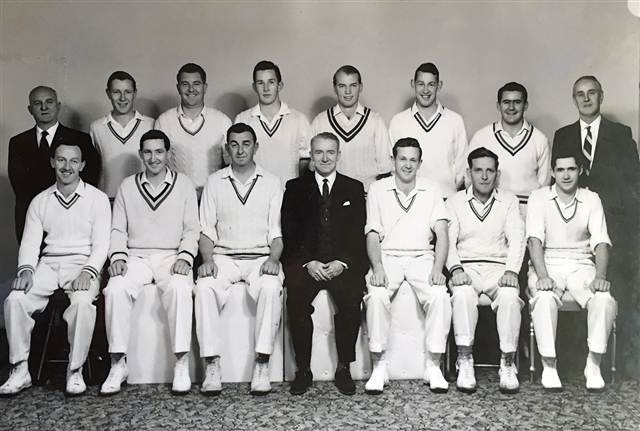
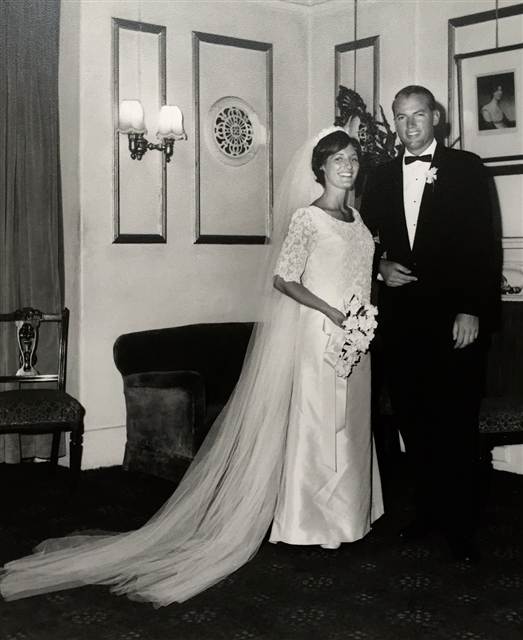
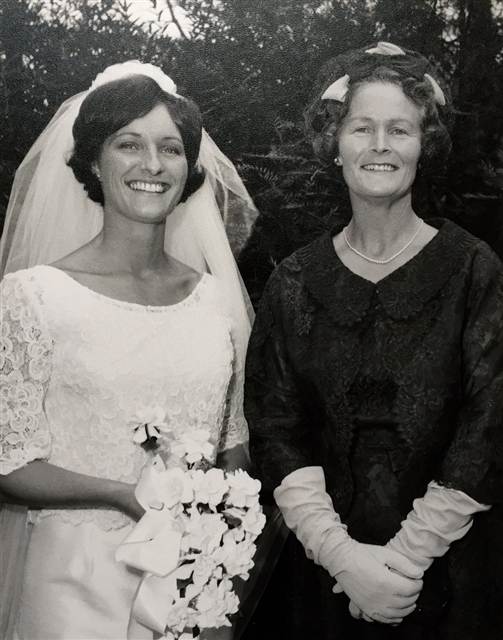
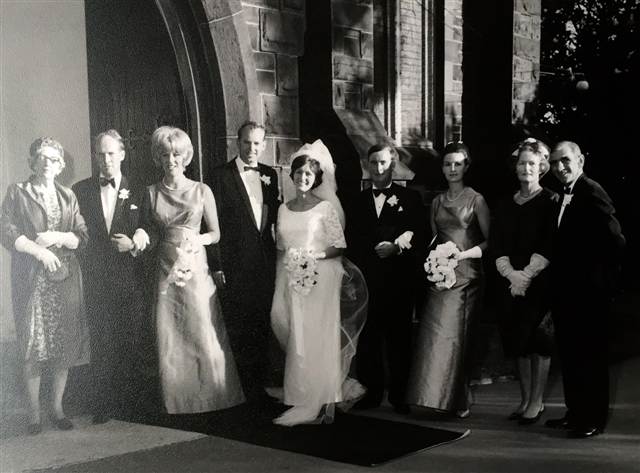
1961 – 1967
Soon after arriving 'home' I went to stay with John and Libby Nixon at Libby's parents' house in Blackburn. Our Croydon house had, of course, been let and so 'home' was going to be Corio from the latter part of January. Libby had just given birth to their first child, James Andrew John, and they invited me to be his Godfather. I remember tiny baby James lying naked on the sitting room floor in Blackburn nearly expiring in the heat. No air-conditioning then, of course. The Nixons have been such faithful friends for so much of my life and I am very grateful to them both.
Most of my belongings were on the high seas so when I arrived at Corio late in January I only had what I had brought back on the plane. I was nostalic about my time overseas and Michael, Gina and mum were still there. The letters I wrote to them in the first few months of 1961 have been preserved and reflect something of my mood and the nature of the times. A few extracts from some of those letters form Appendix 1 to this chapter.
At the beginning of 1961 I was 25 and looking rather younger. I remember a boy saying to me early in first term 'Are you a prefect?' I was to be a resident tutor in Manifold House where I was allocated a study and a bedroom next to the boys' dormitories upstairs. I had a partitioned-off area in the boys' bathroom where I could shower at least a little more privately than John Brazier in Perry House. CWR Dart was Housemaster, a rare character. It was he who had the doors removed from the boys' toilets believing, presumably, that boys could get up to too much mischief behind closed toilet doors. The story goes that 'Darty', or 'Cupy' as in Cupid's Dart, was sunbaking naked in his study one warm Sunday afternoon when he heard the house captain talking to some parents outside the study door. He quickly retreated to the cupboard shutting the door behind him just as the parents were ushered in. Since there was no sign of the housemaster the parents were invited to sit and wait while the house captain went off to find him. How long the housemaster stood starkers in the cupboard history does not relate! Good thing he hadn't had those doors removed too!
Yes Darty was a great character. He taught me Australian History and was always lively and entertaining. He married quite late in life and had a daughter. His brother was Headmaster of Ballarat Grammar School for many years. My fellow tutors in Manifold House in 1961 were Bill Lester and David Happell. All three of us were all Old Geelong Grammarians. On our return to the School in September for the start of Third Term I remember Bill saying to me very casually "I got married during the holidays. You know her. Harriet Cook." It was a typical low-key statement from the remarkable Bill Lester. Yes, I knew Harriet. She had been in Janet Clarke Hall when I was in Trinity, a wonderfully capable, whimsical person who in due course became mother of four splendid children. Bill was 'remarkable' in many ways. I never heard him utter a word of complaint over the 50 years that I knew him - and he had every reason to complain. He was a fine, tall, athletic man and it was not surprising that he was asked to play for Oxford in the traditional Oxford versus Cambridge Australian Rules Football Match. It was also not surprising that he agreed despite not feeling well. Alas it was the worst thing he could have done. After the match he couldn't get off his bed and it was quite some time before he was found. He had been stricken with polio which had reached epidemic proportions in the 1940s. He never walked again spending his life in a wheelchair. If you looked closely you would still see ramps into buildings at Corio specially built for Bill.
Towards the end of his life I remember Bill telling me about his period of rehabilitation at the Radcliffe Hospital in Oxford. One particular medical orderly was especially thoughtful and helpful throughout his time there. He had always meant to write to him to let him know how much his care had meant to Bill but he never quite got to the point of putting pen to paper. When Bill told me this he said that sadly it was too late now because he had read that his helper had died. His name was Ronnie Barker who gained worldwide fame for his acting and comedy roles, particularly in The Two Ronnies. It was a timely reminder from Bill that if you think of doing it - do it!
My return to Corio coincided with JR Darling's departure after 32 years as Headmaster, having arrived from England at the tender age of 29. There were, of course, very significant farewell occasions held in his honour. One of the events was Ken Mappin's production of Henry V with Michael Darling playing the King. It was performed in the Dining Hall so the logistics involved in setting up and dismantling each day were very complex. John Lewisohn was the French Ambassador and both he and Michael had rich voices and a fine stage presence. The following year John played Becket in Ken's production of TS Elliot's Murder in the Cathedral - for us Murder in the Chapel - and Michael was one of the Tempters whom, along with the Chorus, Ken asked me to prepare.
One of the delights for JRD in his final year was the Cricket Premiership that Don Marles's 1st XI managed to win that year. JRD had always protested that he was opposed to sporting premierships but this may have been because GGS never seemed able to win one. There was no evidence of any antagonism in his reaction to the premiership moment which I reflected in my letter to my brother.
It last happened in 1925 - GGS has finally won a cricket premiership. Perhaps 11,000 miles away this doesn't seem momentous news but I can assure you it is a remarkable event! All credit to Don Marles who, with an excellent captain, Michael Landale, moulded a group of mostly average cricketers into what must be the most determined, good fielding, hard working team ever. The Headmaster (it was Dr Darling's final year) was of course delighted and celebrated for a long time drinking whisky on the road outside his house with tears rolling down his cheeks!
A staff photograph was taken in 1961 reflecting the end of an era. There were no women in the photograph and everyone was wearing suits and gowns. There are 43 in the photograph 17 of whom had been on the staff before the war. I am standing between Bill Panckridge and Ken Mappin, both such good friends. Of the 43 there are only five of us left, all of us in our eighties - Ivan Sutherland, John Bedggood, David Happell, Hubert Ward and myself. In his 32 years JRD had, of course, transformed the School and it had developed a worldwide reputation. Timbertop had started in 1954 for Year 10 boys. Highton was established three years later. The School, although not particularly large in numbers, was complex in structure with four campuses - Corio, Timbertop, Glamorgan and Highton. In 1961 the School was, like society, poised on the brink of a very significant time of change. TR Garnett, Master of Marlborough College in the UK, had been appointed to be the School's fifth Headmaster. I had visited him and his wife, Penelope, at Marlborough when I was at the Dragon after his appointment was announced and I was looking forward to the new regime while I felt privileged to have had a short amount of time on the staff with JRD. I remember some of the new young staff meeting with him in that final year. He said to us 'Your responsibility is to be exploited." This was 1961. No Head would dream of saying such a thing today. There would be a mutiny! Quite right too. His statement reflected many aspects of the times. It was an expression of the Protestant Work Ethic, 'By their works ye shall know them.' It had a degree of the hairshirt mentality. Suffer. It's good for you. It reflected the understanding that a man's responsibility was to get out and earn a living for the family while the woman's place was in the home, and it reflected the traditional nature of Public School Boarding life. While boys were at school seven days a week and 24 hours a day so too should their schoolmasters. Dedication. Commitment. Service. This was what was necessary in 'The Education of a Civilised Man'. This was the way of life I chose - and I loved it. I loved living in the school community. I loved being able to enjoy my interests with the young, not least sport and drama and poetry. We had an enormous amount of fun together and it was 'Richly Rewarding' - the title of JRD's autobiography. There was a price to pay later when I became a family man but in the early 1960s that was all ahead of me.
Hopes were high when Tommy Garnett arrived. He was a remarkable human being and his life and passions and eccentricities have been beautifully captured in Andrew Lemon's fine biography The Master Gardener, TR Garnett. Inevitably his early years were controversial. Many changes needed to be made. It was not easy for some to accept change and the rate of change. An entirely different style of leadership left people guessing and sceptical. Despite these early tensions I was blissfully happy in those bachelor years of the early 1960s.
Almost the first change Tommy Garnett announced was the creation of Otway House at Corio for all the boys in Third Form. Until that time Third Formers had moved from Junior School to Senior School just as I had done at the beginning of 1949. Since my time, however, Timbertop had been established for fourth formers and so Third Formers were regarded as being rather isolated in their Senior Houses making four moves in four consecutive years. I remember very clearly the School Assembly in the Bracebridge Wilson Hall in October of Tommy's first term when he announced that from the beginning of 1962 Third Formers would not go to Senior School but rather they would be a member of Otway House which would be based in six portable classrooms across the ovals beyond the scoreboard on what was known as 'Siberia'. They would have many classes there, they would sleep in the senior school houses they would have been going to and they would have a common room in the Junior School! They would clearly be on the move - and so would the staff - so bicycles would be the order of the day. It was a hugely divisive decision and the new scheme lasted one year. I recall when Tommy announced that John ('Sack Lou') Barber would be Housemaster the boys laughed derisively out loud. Tommy's deafness was probably a mercy for him that day. I must have told my brother, Michael, in a letter because he wrote a poem from Bryanston about it which he called Bisyllabuscycle. It was rather a classic and I have included it as Appendix 2 to this chapter.
Some of the teaching was challenging, particularly since I was thrust into teaching Australian History and Renaissance and Reformation History at Year 12 and also English Expression. Fortunately I had studied the Renaissance and Reformation at University and my recent travels in Italy were helpful in giving me some perspective, however limited. I also enjoyed teaching English at both the upper and younger levels particularly sharing poetry which I loved reading aloud and I hope that love caught on a little with the young.
In 1962 I directed my first play - See How They Run - a delightful farce by Philip King set in the vicarage at Merton-Cum-Middlewick during the Second World War and revelling in mistaken identity, escaped Nazi prisoners, tipsy spinsters and much coming and going. It was a play I cast from the members of Manifold House and I can see and hear them all now. Tommy Garnett was encouraging. In fact after Darty retired as Housemaster at the end of 1961 Tommy decided that he would serve as Housemaster of Manifold as well as Headmaster with me as his Assistant Housemaster. Of course it was a big mistake. He had no time to devote to such an extra responsibility and I was very inexperienced. It was a decision based on his English experience and he assumed the boys would run the show and he would come in when he was invited. Early in the year he accepted its impossibility and appointed Hubert Ward as Housemaster. On 12 March he included the following in a letter to me:
I am conscious that I am not doing nearly enough in Manifold and that is why I am handing over at the end of this term. I had hoped to last for a year but too big a pile has landed on my plate.
Hubert was very capable and later went on to be Headmaster of King's Ely. However his particular English style was not well suited to Australian lads from the Western District and when he and his wife 'Pix' (John Béchervaise's daughter) went on leave to England it was 'third time lucky', Tommy appointed Boz Parsons to be Housemaster and it was a perfect fit. Boz's qualities are well reflected in Neville Clark's biography Boz. Boz had the common touch. He was a man of the world, a country man, and he had served in the war flying Lancaster Bombers. It was a great privilege and delight working with Boz. I became great friends with him and Barbara. As I write this he is in his 100th year, still living at home in Ocean Grove, forgetting what happened five minutes ago but with fond memories of those Manifold House boys.
In the latter part of 1962 two teachers arrived from the UK, Ian Potter and David Odling-Smee. Ian Potter was a cricketer and a marine biologist. We were friendly but it was David who became a good friend and that friendship continues to this day. David had been appointed to join the Timbertop staff from the beginning of 1963. He had three years there and loved it. He struck up a friendship with the Head of Timbertop, Hugh Montgomery, better known as 'Monty' or 'Basher Mont', possibly because of his belief in corporal punishment. He was not well known for his affection for 'Poms' but he liked David and when he opened a bottle of whisky with David at the end of a long day he threw the cork into the fire.
During David's time at GGS he and I went on a trip to Papua New Guinea with Michael Collins Persse and a party of boys. It was a great experience and our particular focus was to spend time at the Martyrs School which had been founded to commemorate the Anglican Missionaries who had been beheaded and thrown into the sea early in August 1942. The visit was a salutary and moving experience. I kept a diary which I typed up years later and sent to everyone who was on the trip. David and I also went to New Zealand together on a camping expedition. When I arrived at Canberra Grammar School as Headmaster someone gave me a photograph that they had found in a filing cabinet in the Junior School Office. The photograph was of David and me at one of our camp sites. Who took the photograph and how it found its way to the CGS filing cabinet is a total mystery!
When Anne and I married on 10 January 1966 David was groomsman. Next day he drove his land rover north to Yuendumu Aboriginal Settlement and he spent the rest of his working life helping Aboriginals and Timorese. He now lives in Darwin but he spent his 80th birthday with me and a number of his friends from GGS days.
1964 was the year of the Corio Jubilee. In 1914 the School moved from Geelong to the shores of Limeburners Bay. It was a bold and visionary step and the fundamental layout of the School was established then with buildings arching round from the Junior School Classroom block near the sea and the Junior School Boarding Houses and Dining Room backing on to Biddlecombe Avenue. Dividing Junior School from Senior School was the main entrance through the Lunan Gates with the Headmaster's house next to the entrance like the Gatekeeper's Lodge. Then came Manifold House, the Dining Hall and Quadrangle and Perry House beneath the landmark Clock Tower. Finally the Chapel and arching round to complete the semicircle and face the sea across the playing fields was Cuthbertson House. Manifold, Perry, Cuthbertson - three great names in the history of the School, one Chairman of Council, one Archbishop of Melbourne and one celebrated schoolmaster.
How were we to mark this historic occasion? Ken Mappin was in charge of shaping up our approach. Together we came up with the idea, loosely based on Glyndbourne of which I had recently had happy experience, of a production in the Bracebridge Wilson Hall with one long interval during which guests would dine and enjoy a variety of celebrations. Ken chose to direct Twelfth Night of which I had also had direct experience. During interval the audience would move to the swimming pool on the other side of the playing fields to wine and dine in style and enjoy music and a transformed environment. The move back to the second half of the play would be across the ovals through a designated path lit by lanterns where they would be entertained by the school band on the march looking and, hopefully, sounding splendid. The whole of the front of the School that I have described would be flood lit, there would be fireworks set off from the Spit by Boz Parsons and his Manifold faithful, sixty Middle School boys would then do a dance with sparklers to the tune of the Can-can and gymnasts would do the impossible under ultra violet light. Finally as guests moved towards the main entrance under the tower there would be a re-enactment of the laying of the Foundation Stone, the Headmaster of the day, Rev Francis Brown being played by his grandson and his wife being played by Jonathan King. Then it was back to the second half of Twelfth Night to revel in Ken's fine production or drift quietly into sweet sleep!
It was a great plan and, much to my surprise, Ken asked me to be in charge of making it happen. What a lovely opportunity. It all worked beautifully and even the weather was kind. It was a memorable way to celebrate such a milestone. Tommy began his letter to me with the words 'You must know by now what a triumph it all was' and he went on to quote Denny Evans' remark 'You've got to come to Corio to find imagination.' In 2014 I attended the Centenary celebrations which should have capped our efforts. Some people who paid a fortune could eat a gourmet lunch in the marquee and listen to speeches. The rest of us could buy an expensive picnic or bring our own and sit around while - nothing happened. It was a great disappointment and I visualised the fun and inventiveness and involvement - and imagination - that had characterised our efforts 50 years earlier. I went home and in half an hour drafted out the sort of plan I would have submitted to the Headmaster!
I mentioned Jonathan King. Earlier that year he had been in the cast of a play I directed called Man Alive with boys from Manifold and Perry Houses. Jonathan could clearly act and he loved it. Later he became a professional actor in the UK and changed his name to Jonathan Hyde. I contacted him when he came to Australia with the Royal Shakespeare Company and Ian McKellen to play in King Lear and The Seagull. He was brilliant in both. I appreciated his response to my letter.
Jonathan was in my production of Ross the year after the Jubilee. Tony Llewellyn-Jones played the part of Lawrence of Arabia. He was very young but he did remarkably well. Tony went on to NIDA and became a professional actor. We became good friends and we see each other pretty regularly. In one of the Revues I directed we included a piece I wrote setting the story of Shakespeare's Macbeth to the tunes of Lerner and Loewe's My Fair Lady. The part of Macbeth was sung by none other than - Tony Llewellyn-Jones!
I treasure a book Tony gave me in 2004 which contains poems written by Australian Prisoners of War in Changi. Tony took a leading part in presenting these poems as dramatic readings in Australia and Singapore. Inside the front cover he wrote these words:
TM. Can it be 40 years since the morning you ordered me to stand and read The Geebung Polo Club?! Unforgettable. My love of Australian (and other) verse was begun with you - also unforgettable. And much appreciated. Sincerely TL-J 15/06/03 .
That's one of the exciting, frightening things about being a teacher. You never know the moment that is going to make a fundamental difference to a young person's life - and that goes for a positive or a negative experience, the moment you acted or you didn't act. Years later you may hear of these moments and be gratified or regretful. Essentially it's an act of faith. Perhaps this is what JR Darling meant when he gave us the advice 'Don't look for quick results.' Nowadays there is so much emphasis on benchmarks and outcomes which, by definition, are short term. The best education is about being inspired - and the spirit that is fired by a sacred moment may not find its expression until years later.
While all these things were happening at Corio I had pursued my desire to play a little more good cricket. Ted a'Becket, who was helping Don Marles coach the 1st XI suggested that he take me to the St Kilda Cricket Club. That sounded good to me. He introduced me to John Edwards, Captain of the St Kilda 1st XI, and others. I donned the pads and gloves and kept wickets in the nets. As luck would have it I couldn't do anything wrong: everything stuck. I was selected in the 1st XI straight away and I had three delightful years playing for St Kilda including the 1961/62 season when we won the premiership. I had the good fortune to keep to some fine bowlers. The two I particularly enjoyed were John Edwards and Jack Hill. John ('Darkie') opened the bowling with his medium paced in-swingers so I could stand up at the wicket as I had for John Kirkham at school and experience the joy of some pretty quick leg-side stumpings. Jack Hill had played Test Cricket for Australia and he was still a very good leg-break and top-spin bowler. His main variation was in bounce and pace off the pitch. He was an aggressive bowler. He was known as 'Snarler' Hill!
Keeping wickets was a sheer joy. In 1961 I organised a team to play the visiting Cricket Club of India team. We played at Corio. My team essentially comprised old boys of Geelong Grammar School and Geelong College. Jack Iverson played. Lovely man. Sad man. He bowled freakish spin for Australia having learnt his unusual technique with a pingpong ball in prison camp during the war. I have referred to the sound of the ball fizzing in the air. Remarkable.
One member of the St Kilda side in 1964/1965 was Ian Langford whom I had known at Trinity College and one Saturday after the game he suggested that I come back with him to a flat in Paisley Street, South Yarra, where his girl friend, Sue Ross, lived. I couldn't see why not. When we arrived I was introduced to Sue's flat mate, Anne Wadelton. In fact I needed no introduction. I had met Anne a year before when she was bridesmaid at her sister Jan's marriage to John Tunbridge. Jan was working in the crèche at GGS and John was a good friend and son of my former Housemaster Vic Tunbridge. Ivo and Margaret Dean had organised a party for them at their home at Highton and I had met Anne there. I rather liked her, and I liked her more at the wedding. However after that I was focussed on all my school activities and a year went by before this fateful Saturday night. It was late and Anne kindly made up a bed for me in the sitting room. I confess that I was very impressed at the no-nonsense way she went about it and the way she did the sheet corners so they fitted perfectly! Was that moment of bed-making the thing that clinched it for me?! I don't know but three weeks later I asked Anne to marry me! Anne kindly and sensibly said she would think about it. Being entirely practical she checked me out with people who should know and that presumably helped her decide to say 'yes'.
By January 1965 I was coaching the 1st XI and Anne came along to some of the Melbourne matches. David Oman who played in that side and was Captain the following year told me many years later that they could tell romance was in the air. So for most of 1965 I was engaged and we planned to marry in the Christmas holidays. We stayed with Anne's parents at 'Elimatta' near Terang and their little holiday house at Port Fairy. Anne came to stay at our house 'Berry Ho', Cass Avenue Croydon where mum was living again after several glorious years of travel and painting. The Croydon house had three bedrooms. Mum's bedroom off the sitting room was at one end and the other two were at the other end with a linking door. Mum vacated her room for Anne and moved to Michael's room. It wouldn't have done for Anne and me to be sleeping in rooms that were connected, let alone the same room. That's the way it was and no bad thing. It didn't occur to us that it should be otherwise.
Anne and I were married at Christ Church South Yarra by Rev John Grindrod, an entirely appropriate place for the wedding given my upbringing and the fact that Anne attended church there quite often living very close in Paisley Street. John Grindrod became Bishop of Riverina soon afterwards so he was one of my father's successors in both places. John Nixon was my Best Man just as I had been his some seven years earlier, and David Odling-Smee was Groomsman. Anne's two Bridesmaids were Barbara Griffith who soon became Barbara Turner and Sue Grieve. Barb had been a friend from childhood in Terang and Sue had shared the Paisley Street flat with Anne before dropping out of nursing. The wedding day was hugely hot and John Nixon took me off to watch a cricket match for a few hours at the MCG! Our reception was at 9 Darling Street and we had Denis Farrington and his Band! Talk about a traditional sort of wedding! Such was life.
It was a lovely occasion and the Wadeltons were very welcoming, generous and hospitable. Mum, Michael and Gina were all there and I felt for Michael who had been married without his mother or brother present. At least we were the other side of the world to welcome them after their sail-away honeymoon.
Talking of honeymoons, Anne and I had no money for anything very adventurous. We drove to Canberra the next day and then on to Sydney where we stayed in Michael and Gina's house in the grounds of The King's School while they were in Melbourne. It was hot and dusty and my main memory is of thousands of little fleas that inhabited the dust. They nipped you all round the ankles whenever you were outside. On one day we drove up the Blue Mountains and bought a large cedar table with two extension leaves. Somehow we got the four pieces into the boot and back seat of the car and finally took them back to our house at Corio to start our married life there for the beginning of the 1966 school year.
At this time Australia was preparing to change its currency. Pounds shillings and pence were unnecessarily complicated and it was time to go decimal. There had been a debate on what the new currency was to be called. When the Prime Minister announced the new currency would be known as 'Royals' there was a public outcry and Mr Menzies had to accept the terminology Dollars and Cents. Part of the preparation was a jingle that we constantly heard on radio and television. The words are still in my head:
In come the dollars and in come the cents to replace the pounds and the shillings and the pence. Be prepared folks when the coins begin to mix on the 14th of February 1966.
Over the next two years we made new friends, lived in three different houses and enjoyed new challenges and opportunities. For the first term (in those days there were three terms each year) we lived in a little one-bedroom house on the Estate, a housing complex built essentially for workmen at the School. Maintenance men, painters, groundsmen lived there and our neighbour was the nightwatchman. He very generously lent us his double bed. He didn't need it at night! He must have had an alternative for his daytime sleep. His name was John Golding who did the rounds of the School all night and turned a key at various checkpoints at set times to report that all was well. His predecessor was 'George' who was nightwatchman in the fifties and early sixties when I was a bachelor in Manifold House. George could talk and my heart sank at midnight when I was up trying to prepare lessons for the next day and I heard George approach. He came straight in, plonked his torch on the table and himself in the easy chair, always wearing his military greatcoat and beany and he proceeded to talk. I don't blame him. I liked George but his arrival always meant an hour's less sleep.
We were grateful to John Golding for his bed despite its prodigious sag in the middle which didn't do our backs any good. We made one request of the School before taking up residence and they obliged by replacing the chip heater in the bathroom with a gas heater. Anne secured a job at Trethowan, a Private Hospital in Geelong with Psychiatric and Geriatric patients. Some of the psychiatric patients were pretty violent and unpredictable at times demanding a great deal of skill and patience from Anne. I became a Tutor in Perry House. I was coach of the 1st XI and had a full teaching load so it was a busy beginning to married life for both of us. Not content with that for my first school term as a married man I decided to direct a dramatic reading of Under Milk Wood by Dylan Thomas. I invited Tommy Garnett to read The First Voice and Captain Cat which he did with such insight and richness. Numerous staff, wives and boys were involved and I particularly remember Harriet Lester and Bill Mappin, Mark Downing and Tony Llewellyn-Jones. I can still hear Tony saying that great line from Nogood Boyo as he lies back and looks up to the skies, 'I don't know who's up there, and I don't care!'
That year Mr and Mrs Hutton went off on long service leave for second and third terms. Barney Hutton was Housemaster of Francis Brown House and I agreed that I would stand in for him for those two terms. So in May, four months after getting married, we moved into the Hutton's house and enjoyed their lovely furniture and belongings including a bed that didn't sag! My good friend HW Eyre-Walker was a resident tutor in his flat upstairs and so our friendship strengthened as we worked together.
Anne coped with it all brilliantly, of course, but it was hardly fair on someone who hadn't yet turned 23. She was, in fact, nearer in age to all the boys in the house than she was to me. I remember many of those boys with great affection. Many had great ability and sensitivity. Tony Llewellyn-Jones was there as were Andrew Lemon, Michael Thawley (who became Australian Ambassador to the USA), Robert Southey, Mark and Andrew Downing, Fraser Fair, to name a few.
Two new members of staff arrived in January that year. Bill and Alison Hayward arrived on 10 January and described Corio as something of a ghost town since so many staff members were in Melbourne at our wedding. Bill had been appointed as Deputy Head and stayed there seven years before going to Sydney for a year and then going on to be Headmaster at Churchie in Brisbane. Bill and Alison were such warm, generous and hospitable people and with their five children Mary, Kate, Tom, Sam and Dan ('short names to keep it simple' said Bill) made a huge contribution to life at Corio. The other new arrival was Dick Johnson who arrived as a 'ten pound Pom' just after term began. We found that we had numerous interests in common including cricket and drama, and we shared the same sense of humour. We made each other laugh. Dick and I became firm friends. He becomes part of the story for the next 50 years.
Once the year and the Francis Brown tenure came to an end Anne and I moved to an upstairs flat in Biddlecombe Avenue living next to the Haywards and above David and Sue Mackey and their baby son David. I had been at school with David. We had both been in the 1952 First XI when he was school captain and he was now the School Doctor. Sue and Anne became very good friends and they remained close until the day Anne died. Sue became Lisa's Godmother and a very thoughtful, loving and generous Godmother she was - a Fairy Godmother when Lisa became so sick in the middle of 2013. Anne began working at the Blood Bank in Geelong and I was always concerned when she was called in for an emergency in the middle of the night. She sometimes also helped out in the School's Medical Centre, Kennedy. By now we were good friends with John and Robbie Bedggood, Ivan and Liza Sutherland and many others in the Corio Community. I was still coach of the 1st XI with Don Marles and Dick Johnson being enthusiastic helpers. I had succeeded Don, and Dick would succeed me. One Wednesday Noel Rundle brought a team to play the boys in the afternoon. After the match the visitors all came to our flat for drinks. Ian Higginbotham had brought a dozen bottles of champagne being in the wine business and they were all quickly and happily devoured. Sensibly Anne knew that food was necessary before they drove home so miraculously she produced food for 15. A week or so later a small stainless steel jug arrived in the post inscribed 'To Tim and Anne from the Champagne XI.' I still have it.
We had rather a good staff XI in those days and we enjoyed a number of fixtures each year including one with the Melbourne Grammar School Staff. In my eulogy at Don Marles's funeral in 2017 I spoke of Don being the Alec Bedser to my Godfrey Evans. Godfrey had been my cricketing hero as he stood up on the stumps to Alec's fast-medium bowling. One Sunday as we played the MGS staff on the Chapel Oval Don was bowling and Bill Dickinson was umpiring at square leg. Don bowled one that dipped past the batsman's legs and I whipped off the bails. 'How's that?' I shouted looking across to Umpire Bill. He paused for a moment and then simply said 'Bloody marvellous.' Bill became Head of Scotch College in Perth where he achieved legendary status. He was a very fine National Chairman of the Association of Heads of Independent Schools. Alas he died of the cruel Motor Neuron Disease. I saw him towards the end. He said he had no complaints. The world had been kind to him and he could not have been happier in his family and professional life. I thought Bill was 'bloody marvellous'.
Hubert Doggart may well have been playing in that same match. Hubert was on exchange from England. He had played two Test Matches for England in 1950 and became Chairman of the MCC later and also Headmaster of King's Bruton. Alas Hubert tried to hook a rearing ball bowled by John Tunbridge recruited for the Staff side and had to be escorted from the ground to the Medical Centre leaving trails of blood on a good length. We saw Sue and Hubert again on our travels. Hubert was a great enthusiast and he had a very loud voice. One evening when we were staying with Charles and Jane Wright (Littleton) in Winchester Hubert was holding forth at great volume. When Charles could tolerate it no longer he interrupted Hubert to proclaim "Hubert, if you cannot speak more quietly I will have to insist that you do not speak at all!" We also visited the Doggarts at their home in Chichester where the establishment Hubert found it very difficult to come to terms with his totally punk daughters. Years later in retirement I ordered the book The Chronicles of Downhope by AH Bradley through Abe Books. In due course it arrived and inside the front cover I read the hand-written name of the previous owner, AH Doggart, almost certainly from Hubert's Library.
Jane Wright's maiden name was Littleton, The Hon Jane Littleton. Jane had come to Corio with the Garnetts in 1961 to help with the house and the family. She was unconventional, amusing and a delight. She became very popular in the community with a large number of young staff, particularly the bachelors. She developed the endearing habit of flying a white flag from her upstairs window when she knew the Garnetts had gone away to their property at Blackwood. This was the sign that the 'coast was clear' and it could well be time for - refreshments!
By the beginning of 1967 Anne and I had determined that we would spend 1968 and 1969 overseas. By then I would have been at Corio for 7 years so I guess it may have been evidence of the seven year itch. I negotiated leave with Tommy Garnett and set about applying for various schools to see if they would have me for two calendar years. One of the schools was Dean Close in Cheltenham. I wrote to Denys Carnill who I thought might be prepared to speak on my behalf to his Headmaster. Denys was encouraging so I wrote to the Headmaster, Rev Douglas Graham. In due course he replied offering me a position. We thought Cheltenham would be an ideal place to live and as I popped my letter of acceptance in the mail bag at school I received a letter from the Headmaster of Malvern College offering me a position. I hastily retrieved my letter to DCS to discuss the options with Anne. Next day I confirmed my acceptance and we could go about our planning accordingly. We decided we would sail on the Marconi conveniently leaving from Station Pier at the end of the school year and arriving in Naples just after Christmas. From there we would take the train to London where we would spend some time before travelling to Cheltenham.
Meanwhile we were greatly enjoying our second year of married life. Anne was busy and had many friends and interests while I was fully involved in school life. That year I put together the second Group Revue, doing four in all - 1965, 1967, 1970 and 1973. We called each Revue The Group because there was a group of main performers and a number of 'Guest Artists'. In 1967 The Group comprised 'Mr Buckley, Mr Johnson, Mr Murray, A Lemon, A Llewellyn-Jones and D O'Byrne'. It was rather nice that 50 years later David O'Byrne's niece, Anna, played the part of Liza Doolittle alongside Tony Llewellyn-Jones's Colonel Pickering. Dick Johnson was invaluable in three revues being very creative in his writing and very versatile on stage. During the 1960s The Seekers became very popular comprising Judith Durham, Athol Guy, Keith Potger and Bruce Woodley. In 1967 they were named as joint 'Australians of the Year'. At much the same time the book Let Stalk Strine was taking the country by storm and so I decided to combine the two in a song for the Revue called A Scoolevar Rone sung to the tune of the Seekers' hit A World of our Own. Here is the first half of the song:
Verse 1:
Lettuce spray, air free day, arscool will paver way fora whirles fil dwith luven lafter, wear nunnel stray, Button till that time calms, jar sleeve are salone, an wheel leer vinner scoolevar rone.
Chorus:
Wheel billder whirl devour rone, ferno won else toosh air, with an I slay ted lie, far be oncome pair, Anweno that wheel fine dereal pea sov mine, daswe leer vinner scoolevar rone.
I completed the third of my three years coaching the 1st XI and then handed the task on to Dick Johnson who was full of enthusiasm for the opportunities ahead. He had some good teams during his coaching years, as did I, but the Premiership eluded us, whereas Don had coached Premiership teams in 1961 and 1962. Nowadays coaches tend to be professionals from outside the School and the teams are bolstered by boys and girls head-hunted from across the country and offered lucrative sporting scholarships. This practice presumably boosts results and is good publicity. Independent schools have become very competitive where the fittest - or the 'fattest' - will survive.
December was soon upon us. Vic Tunbridge retired at the end of that year and Ken Mappin left to teach at Clyde and then move on to a distinguished teaching career at Scotch College. Just before we sailed away I could attend Speech Day held outside on the Music School Terrace. Guest of Honour was the recently retired long-serving Prime Minister, Sir Robert Menzies. I can still remember that his twin themes were the importance of writing and speaking good, simple, straightforward English, avoiding 'gobbledegook', and the other was the importance of engaging in a general education in the humanities before specialising. The University of Melbourne has led the way in the latter. The former is a theme very close to my heart and at times I have been a bit merciless on those who have gone the way of 'gobbledegook'.
We packed up and the School stored our furniture except for a few items which friends were happy to borrow. Peter Jardine looked after a square walnut table for us. When he returned it to us early in 1970 he had its legs protruding from his car and two legs were knocked off as they collided with the gatepost outside our house! Despite some clumsiness Peter was a fine craftsman and worked in wood. He made a stunning mobile buffet for the Staff Common Room and inspired boys to do beautifully inlaid pieces. A box with an inlay of the Timbertop Chapel was his creation as a gift to Prince Charles at the end of his 1966 time at Geelong Grammar School.
Station Pier has seen many emotional arrivals and departures over the years. Much of the State's history could be mapped by the comings and goings there. Family and friends gathered there for our farewell and Peter Jardine nearly missed the last plank off. Soon the many streamers were breaking and faces fading in the distance. We were off.
The trip across the Great Australian Bight was rough and it took a while to adjust. We were rather wobbly when we docked at Freemantle before the long haul across the Indian Ocean to Durban. There we had our first and only glimpse of some of the outward and visible signs of apartheid - on seats, on the walls of public toilets and that sort of thing. Little did we understand what was really going on. By then Nelson Mandela had been incarcerated for five years. It's a long time ago.
During the voyage we learnt of two significant events. The first was that Dr Christian Barnard had performed the world's first human to human heart transplant on 3 December at Cape Town in South Africa. This was a massive leap forward in medical science. What developments there have been in the 50 years since that remarkable achievement.
The second event occurred in Australia and it seemed almost surreal to us out on the -'wide wide sea'. It happened on 17 December. Australia's Prime Minister, Harold Holt, had drowned while swimming in rough seas at Cheviot Beach near Portsea, Victoria. His body was never recovered. Harold Holt had succeeded Sir Robert Menzies in January 1966, the month Anne and I were married. He fought an election in his own right later that year winning a landslide victory. In his short time in office he continued dismantling the White Australia Policy and, through a successful referendum in August 1967, amended the Constitution to give the Federal Government responsibility for indigenous affairs and include indigenous people in the Commonwealth Census. His Government expanded Australia's involvement in the Vietnam War and maintained close ties with the United States under Lyndon B Johnson who had inherited the Presidency on John Kennedy's assassination. Holt's assurance that Australia would be 'all the way with LBJ' became a catchcry for the American Alliance.
In the Group Revue earlier that year I had written a parody to Lara's Theme from Dr Zhivago. Andrew Lemon sang the song Zara's Theme, Zara being Harold Holt's wife. It began with these prophetic words:
Where are the beautiful days? Where are the parties 'til dawn? Where are the sports we - played down at Portsea? Where have they gone? Where have they gone?
On board the Marconi we enjoyed delicious food, cheeses and wines. We tried to keep reasonably fit by regular morning walks around the deck. We became friends with Lewis and Barbara Pape. He was an academic at the ANU and during our time in London later they lent us their house in Richmond. Denis Quilley, actor and singer, was on board with his charming wife and we spent quite a bit of time with them. At the fancy dress night we made our costumes out of Marconi menus and went as me'nu - not very clever or comfortable. The voyage took three weeks and was pleasantly relaxing after a busy year but we were well and truly ready to disembark at Naples. In the time we had before our train departed we were seriously fleeced of our dollars in a bar not being focussed on the value of Italian currency. After a rough channel crossing we finally arrived at Victoria Station where we were greeted by Anne's great friends Sue Grieve with daughter Catherine and Carol Smallwood and son David. We stayed with the Grieves in their Richmond flat and within 48 hours had visited the Smallwoods in Regent's Park, seen Peggy Ashcroft and Donald Sinden in The Hollow Crown at the Aldwych, enjoyed The White Swan in Richmond, The Roebuck and The Cross Keys in Chelsea, visited Eton College and Windsor Castle, caught up with Frank Russell at The Cricketers Club and introduced ourselves to the laundromat. So we farewelled 1967 and Monday 1 January 1968 dawned.
***
Appendix to Chapter 5
Appendix 1
Bisyllabuscycle
(Michael from Bryanston, Dorset, about Tommy Garnett's changes at Corio)
First lesson is in Junior School The second in the San The third, well as a general rule You hold it where you can. A funny thing happened to me on the way to the classroom this morning.......
A basket on your handlebars A gown upon your knees A pile of books and sundry jars Of chalk (or is it cheese?). Sorry I'm late Sir, I had a puncture.......Well it's plausible.
Then after morning tea at break You're off again somewhere But ere you've realised your mistake You've wasted half your spare. Sorry I'm late Sir, I thought we were in Siberia.
And so Corians journey out So many times a day For any class you'll find about A dozen lose their way. .....as I was passing through Biddlecombe Avenue looking for the main gate......
Come rain or shine the day goes on And wheels revolve apace It's progress, so don't frown upon The changes round the place. .......hands up those boys who know which one it is today.
But after school the trouble starts When cricketers appear To practise all their subtle arts If they can find their gear. ......no the HM can't stand the noise......
Siberia is lost to sport And Manifold has changed The pitch itself is two yards short And rules are rearranged. ......yes perhaps we could find 22 yards there for the 1st XI......
At last the bell concludes the day And off to bed you creep. So long as you can find your way You'll get a little sleep. .......a funny thing DID happen to you on the way to the classroom this morning:
You saw the headmaster Wearing a frown Cycling faster Minus his gown His face stern and ruddy HE'D MISLAID HIS STUDY.
***
Appendix 2
Extracts from Tim's Letters, January - May, 1961
19 January
Dear Mum
Here I am at Mascot awaiting my final flight to Melbourne. The trip from London was very smooth and I find it hard in some ways to realise that this is not just another airport but Sydney, Australia. There are some things that bring home to me where I am, however. I bought a 'Sydney Morning Herald' and when I handed over the money I was politely told that sterling wasn't accepted. Then I had to ask how many pennies for a phone call. Furthermore one only has to look and listen and then there is really no doubt as to where I am.
1 February
Dear Mum
At the moment I'm sitting in the Smithers flat where I'm staying for my last two days in Melbourne.....
Tomorrow I'm off to GGS for good. On Thursday I'm playing for Don Marles' team against the boys. On the weekend I will endeavour to do some work on my Leaving and Matric Modern Histories! Back to work I fear!
I went up to Croydon again this last Sunday, this time to see the Austins......They were very chatty (she not he)* and it was good to see young Bill again. He has brought back the most wonderful things for the house including a fantastic collection of long playing records to go with his Hi Fi Stereo radiogram.
* 'She' was mum's old friend Gertrude and 'he' was her husband Bill who had been a prisoner of war in Changi. Who knows what agonies he endured there. He talked very little.
10 February
Dear Mum
Many thanks for your letter after your return from Paris. You can imagine how much I envy the news you give of your London and Continental wanderings..... A guide in Westminster Abbey certainly sounds more reasonable than dirty Savoy dishes at 3am or filthy dry cleaning at any time. Thank you also for the letter from Mrs Mann. I certainly had no idea about it and Mr Ian Mann hasn't dropped any hints that I can remember. People are very kind*
*Mum was telling me that Mrs Audrey Mann (née Poolman) had made a significant contributuion to the paying of my school fees after our father was killed.
26 March
Dear Mike
Work is pretty hectic here but we have five days over Easter to catch up. Mr Dart has been trying to persuade me to go with him and 15 boys on a trip to New Guinea over the May holidays but I fear I will have to work*. Happell and Marles are constantly good value and I enjoy their company. We have a weekly pilgrimage to the Lara pub every Tuesday at 5.20pm. I still say goodnight to the landlord but he doesn't seem to understand.
* David Odling-Smee and I joined the School party to New Guinea in 1964.
28 March
Dear Mum
Glad to hear that Spring is improving your painting......I hope also that Westminster Abbey studies are progressing according to plan. I told Howard Hollis of your Abbey activities and he was very impressed! He's a good chaplain and it certainly is pleasant to listen to the way he takes the service*.
* Howard Hollis had been organist at Christ Church South Yarra when our father was vicar. Howard was Assistant organist at Westminster Abbey at the time of Queen Elisabeth 11's Coronation and was Chaplain at Corio when I returned there in 1961.
4 April
Dear Mum
I've been here all the Easter holidays (five days) working. How about that?! I've managed to get ahead by about two weeks in my Matric and Leaving History and it's been well worthwhile. Machiavelli and Bismarck have been receiving a bit of a bashing. People have been very kind and I've had three meals a day here, there and everywhere - Tunbridges, Frasers, Glovers, Marles. I prefer the Frasers and Marles because I can relax completely there. The Tunbridges keep you too long and the Glovers I don't know well enough.
1 May
Dear Mum
All your painting experiences sound interesting. Who would have thought you would be going to painting lessons in London painting nudes!
***
Overseas – 2
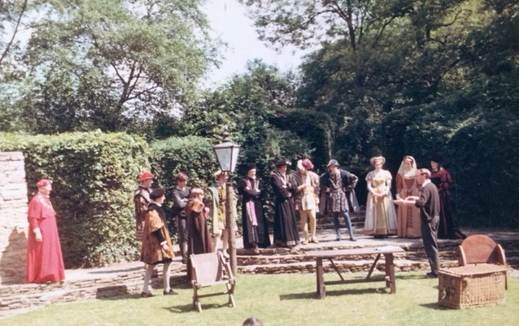
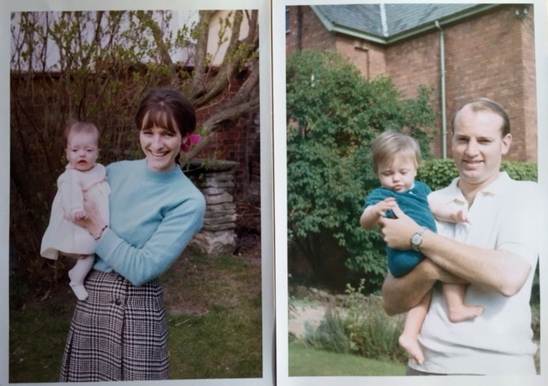
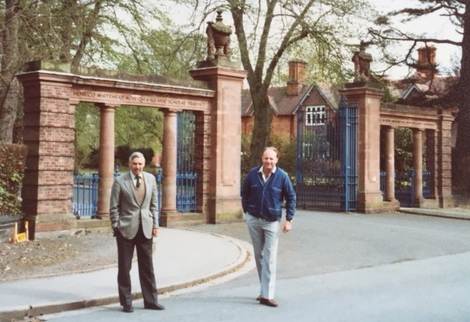
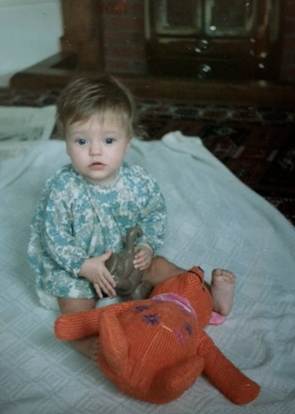
1968 – 1969
On Monday 1 January 1968 both the weather and the political scene were very bleak. It was freezing. Anne was going numb up to the knees and the elbows, while England was suffering from strikes, devaluation and foot and mouth disease (animals not people). Food prices were high. Morale was low. We stocked up on warmer clothes but it didn't do much for Anne who would happily have headed for the nearest travel agent to get back to sunny Australia. On that first day of the new year we took a train to Faversham in Kent where Dick Johnson met us and we stayed with him and his parents and enjoyed a delightful day in Canterbury. On our return to London the theatre beckoned and we saw three plays in two days: Wise Child by Simon Gray with Alec Guinness and Gordon Jackson; Rosencrantz and Guildenstern are Dead by Tom Stoppard at the Old Vic and Alan Ayckbourn's Relatively Speaking at the Duke of York's. John Stride and Edward Petherbridge were stunning as Rosencrantz and Guildenstern and I vowed there and then that one day I would have a go at directing this play.
By 5 January it was time to take ourselves and our belongings by train to Cheltenham where Denys met us and we stayed with him and his charming wife, Pam, and their two little daughters. Denys invited people in small groups to come and say hello so we had the opportunity to identify many people who would be central to our lives over the next two years. Brian Wilson, Head of English, and his wife Valerie came, as did Vaughan Harries, Head of History, and his wife Heather. All were charming and most welcoming. During those early days we met the eight people with whom we would remain lifelong friends and whose names appear on the back of a picture of the church at Painswick, a parting gift from them all. The eight were Denys and Pam, Chris and Sarah Kenyon, Martin and Heather Penney, Trevor and Angela Snow. Chris was Master in Charge of Cricket and a wicketkeeper. He also played squash and we had many games together finishing up about even. Anne got on so well with Heather, Angela, Sarah, Pam and their young children. They had great respect for her medical knowledge and calm approach to all situations. Martin was The Hon Martin, his father being Lord Penney, a key person in the development of the British atomic bomb in the 1950s and adviser on early American atomic projects. Martin was a scientist and he was in charge of cross-country running. I joined him in taking teams to various weekend fixtures. Very early on I knew we were in England when our host at one school, Mr Fotheringay, called out to his first runner in 'Well run Braithwaite. Jolly good show.' From that time on Martin always used to greet me with 'Jolly good show Braithwaite.' Trevor was a language teacher, French and Spanish, and he coached the hockey team. He was a very capable and competitive player himself and he did excellent work with the boys on the all-weather hockey field. It was the first all-weather field in a school in England inspired by Denys who had captained England in three consecutive Olympics, Helsinki, Melbourne and Rome. Eight lovely people who all those years ago were so welcoming and generous and friendly. Lucky us.
There was, of course, the question of where we were going to live. Denys had said that he would seek out something and he had organised for us a flat above the stables behind a grand house where a Colonel Tate (Retired) and his wife lived. Somehow one always associated Cheltenham with retired Colonels so this seemed entirely appropriate. The rent was four pounds a week! Martin offered to borrow the rather clapped out school truck and drive our belongings and everything kind people were lending us round to the Stables Flat and help us get established. The stables below the flat were not being used and were open to the elements with freezing air blowing up through the floorboards. The flat had a kitchen, sitting room and two bedrooms. It had not been used for some time, probably because it was so cold. We were told that the hot water bottle of the previous tenants had frozen in the bed! This was not encouraging news for Anne after her London experience. There was one little gas heater into which we had to feed coins and we borrowed various electric heaters and huddled together with the heaters surrounding us.
Soon after our arrival in Cheltenham Denys took us round to the School, a Victorian edifice established in 1886 and named after the Very Reverend Francis Close, Dean of Carlisle Cathedral. Its most famous Old Boy was probably the poet James Elroy Flecker, whose father was the School's first Headmaster. I directed several plays in the Flecker Hall named after him and, of course, James Elroy Flecker wrote Hassan of happy memory from Trinity College days.
Denys introduced us to the Headmaster, a fiery Irishman, Reverend Douglas Graham, who had been Head since 1954. In 1967 he had announced that he would be retiring in the course of 1968 to take up a post in America, so I would be there for a change of Head, a process I would enjoy witnessing. One of the things that encouraged Douglas Graham to take me on was my interest in theatre and drama. The School had a most beautiful Open Air Theatre set in a pleasantly wooded area near a stream. Traditionally this was the setting for the summer production which had taken place annually for the last 40 years. From the beginning for 38 years not only had the production been in the hands of CAP Tuckwell but he had also acted in most of the plays being particularly famous for his Lear, Shylock and Prospero. Two years earlier he had retired and there was no one on the staff prepared to take it on so two plays had been directed by someone from outside the School and the plays had not been particularly well received. Furthermore, while CAPT had retired from the staff he still lived nearby and ate in the Common Room most evenings. Enter TCM! Despite the whole situation being potentially fraught Douglas Graham was prepared to take a risk with an Australian he had never met - and I was delighted. Perhaps he knew that by the time the play hit the stage he would be safely in America.
The School Chapel was arranged with 'Collegiate' seating as was, and still is, the case at Trinity College so I was used to it and liked it. The weekly Sunday morning service was compulsory for dayboys as well as boarders and the teaching staff were expected to attend. I was asked to read the lesson on the first Sunday of term so I was being thrown in the deep end. As the staff processed out at the end of the service I found myself next to CAP Tuckwell who leant across and whispered "The play will be alright.'" It was very good of him to say that. Presumably he thought my voice projection and articulation showed some understanding of what was needed in theatre. He must have been very anxious that an unknown Australian might destroy everything he had built up. In due course I decided to direct A Man for All Seasons in the outdoor theatre in July and I invited CAPT to play the part of Cardinal Wolsey. He generously agreed and we worked happily together. He was a charming and gracious man and he kindly had Anne and me to his home on a number of occasions. Several times we took him for a drive through parts of the Cotswolds on Sunday afternoons. The theatre was renamed The Tuckwell Theatre in his honour.
I was given a mixed bag of English and History classes to teach ranging from very clever boys to boys who found it all rather - challenging.. The classrooms in the old building were decidedly grotty and the textbooks available from the book room were ancient and battered. I was happy to go with the flow and I liked the atmosphere of the School.
Early in our first term at Dean Close Sue and Rob Grieve came to stay so we had Heather and Martin Penney join us for dinner. In those days Australian wine was not well known in England. Wine casks had just begun to get popular and for some extraordinary reason Anne and I decided to take with us from Australia two casks of Penfolds Dry Red! We planned for them to last quite a long time since we could not afford to buy wine or spirits in England. That night most of one of the flasks was emptied, Martin taking an irresistable liking to the stuff. Next day he looked very seedy indeed and kept mumbling 'Penfolds Dry Red'.
It didn't take Anne long to get cracking trying to make the Stables Flat rather more homely and welcoming. In typical style she either painted or wall papered most of the rooms and her morale improved as the weather warmed up a little and she ensured she had enough appropriate clothing and bedding. She secured a job looking after the children of Gerald and Elizabeth Vinestock two days a week. Gerald taught at Cheltenham College and we became friend and enjoyed some close games of squash together. Anne and I both procured bicycles so Anne did a lot of cycling in Cheltenham visiting friends and exploring. Early in the term we bought a mini Austin Traveller car which served us beautifully in our travels in the UK and in Europe.
The last full day of First Term was Thursday 28 March so the focus was on farewelling Mr and Mrs Graham. The general feeling was that it would be fun to have a revue on the Graham's final night. The only difficulty was that no member of staff was prepared to take it on. The last two plays that boys directed never got off the ground and if the Revue was in the hands of the boys it would probably never happen. I had done two Revues at Corio so I had a pretty good idea of what worked and knew a few scripts I could use so I took it on. I involved a number of staff on stage - the ones whose very presence would make boys laugh - and despite early resistance from some of the boys who had highly inflated ideas about their own acting ability, the Revue happened and was acclaimed a thundering success. Actually it wasn't great but it did the trick and was a good start to my two years during which I directed eight plays or evenings of drama.
Holidays! It was time to head for Europe on 1 April taking our little mini traveller on the ferry and heading for Paris with me doing the driving and Anne doing the navigating. It proved a harmonious balance. Anne was a brilliant reader of road maps and somehow I was able to keep the car on the right side of the road. We arrived at Hotel Chateaubriand where mum was waiting for us and we spent the next 19 days together. Anne was 24, I was 33 and mum was 70. For the next five days we walked about seven miles a day and explored that wonderful city. I wrote in my diary 'Mum is marvellous with all the energy and enthusiasm that I haven't even got now let alone when I'm 70.' I guess we were pretty typical tourists absorbing the atmosphere and enjoying the architecture and the history and the culture - the Mona Lisa at the Louvre, Sacré Coeur, Champs-Elysées, Arc de Triumph, Eiffel Tower, Montmartre, 'jambon, fromage, pain et bière', Rue Pigalle, the Flea Market (where I purchased a large green bulbous decanter with a great big all-day-sucker stopper), After Paris we enjoyed the opulent magnificence of Versailles and on to Chartres and the rich beauty of the stained glass in the Cathedral and the delight of the Chateaux of the Loire, including an inspiring Son et Lumière at Blois Chateau.
As we turned our car towards Belgium and Bruges Anne shared the news that she thought she may well be pregnant and so it looked as though there would be another Murray joining us round about Christmas. Very exciting news - but early days. Mum immediately began dreaming about possible names for boys. Simon was her choice. Bruges was a sheer delight even if the idea of the Holy Blood in the Basilica was to be taken with a grain of salt. I understand that modern DNA tests revealing that the blood is that of a pig has not deterred either the faithful or the tourist. As with all good theatre it seems it is possible to suspend one's disbelief! Mum loved painting in Bruges and I have one of my Bruges paintings on the wall at home.
The time came for Anne and me to head back to Cheltenham and a new term. Mum had no such commitments and so we left her in her beloved Bruges and hit the road. Again we had one night with Dick Johnson's parents in Faversham on the way home and completed our 1,250 mile trip via lunch at The Trout outside Oxford. It had been a lovely three weeks and I was very grateful to Anne that she was happy for us to share it with mum who revelled in it all.
The new term brought with it the excitement of a new Headmaster. Christopher Turner had been appointed. On Commemoration Day at the end of the Summer Term Anne and I were horrified when the Chairman of the Governors said to the parents that the first two things they were looking for in the appointment of the new Headmaster were that he had been to a good Public School and to either Oxford or Cambridge. What horrified us most was that we seemed to be the only people who were horrified! In fact we both liked Christopher Turner and he was very good to us. After a few years he went on to be Headmaster of Stowe and when he retired he was ordained.
At the end of April it was confirmed that Anne was pregnant and so we spent the rest of the year looking forward to the arrival of Simon or Caitlin. It was very hard for me to know then or remember now what sort of pregnancy Anne had. If she was unwell she didn't let on. She kept living a busy and fulfilling life looking after children, sharing with her friends, helping me with play productions with refreshments for everyone and doing the costumes, riding her bicycle, being hospitable to boys and friends, doing a lot of brass rubbing, being good to mum when she visited and generally being typical Anne. During our time in Cheltenham we purchased a genuine old London Street Lamp that had originally been gas. It cost us the equivalent of 10 weeks rent! I used it as part of the set in the Open Air Theatre for A Man for All Seasons. We brought it back to Australia with us in a tea chest. While we didn't put it up at Corio we did put it up on the stage of the Bracebridge Wilson Hall for my production of Oliver in 1971 and fortunately had retrieved it before the hall burned down. Alas the cast iron post was destroyed in the fire breaking into several pieces. We put the lamp up at our home in Hamilton and then in Canberra and it now graces the front garden at 40 Ellerslie Place.
We enjoyed visits to Stratford for productions by the Royal Shakespeare Company. That term I remember seeing Julius Caesar with Ian Richardson as Cassius and King Lear with Eric Porter playing Lear. I recall the school captain, John Cutts by name, parading around the auditorium of the theatre in his gold waistcoat, crimson-lined black cloak and black cane. I was delighted when the Headmaster asked him 'Which side of the footlights are you?' School prefects were more interested in their privileges than anything else and they cut little ice with the other boys. When I asked Cutts if he was interested in auditioning for a play he said that he wasn't because the boys in the audience would only hiss.
We were lucky to have visited Paris when we did. By the middle of May there were very serious riots, factories and universities were occupied, cobblestones were being torn up in the streets and the entire economy of France was brought to a virtual standstill. For a short period of time President de Gaulle fled the city.
Anne visited Sue Grieve in London. John and Jan Potter visited us in Cheltenham and later we stayed with them in Wantage. John had been appointed to an International School in Singapore and would soon be leaving the UK. We stayed with them there on the way home when John showed all his skills at striking a bargain to buy Anne's gold watch and his total lack of any sense of punctuality often not leaving home until well after he was meant to be at work. Despite all this and his very conservative Anglo Catholic outlook Jan was very accepting and loyal. They had struck up a strong friendship with David Odling-Smee when they were at Timbertop together.
This term saw the first girl at Dean Close School. Just as Beth Rail was the only girl at Geelong Grammar for much of a term a few years later at the start of coeducation there so Pam Rowles was the only girl at Dean Close for a term. Naturally the Press was interested and in an interview asked her if she would be wearing plunging necklines and mini skirts and she said she would not. This appeared in the paper as 'I have no intention of wearing plunging necklines and miniskirts' as if she brought up the subject. It reminded me of the story of the Archbishop of Canterbury, Geoffrey Fisher, when he arrived in New York and was asked 'Do you intend to visit any brothels while you are in New York?' to which the Archbishop replied 'Are there any brothels in New York?' This appeared in the paper as 'Archbishop's first question, "Are there any brothels in New York?"'
At any rate I invited Pam to play the part of Margaret in A Man for all Seasons. I still needed to find a girl to play the part of Alice. Pam knew a girl by the name of Julie Champness and introduced me to her and her parents. Upon discovering that I was Australian Julie's mother composed herself and said, 'My son brought an Australian friend home once and he really behaved quite well.' I took this as a vote of confidence.
During the term Lewis and Barbara Pape came to stay for a few days. We had met them on the Marconi and had got on very well together. We did our morning walk together and Lewis always ran a book on the fastest speed the ship did each day. The Papes lived in Canberra where Lewis was an academic at the ANU. Very generously they offered us the use of their house in London during the summer holidays while they were in Europe, an offer we accepted with delight.
I spent a good deal of time rehearsing A Man for all Seasons in the Outdoor Theatre. There were plenty of sagas, not least as a result of lots of rain and students' histrionics. but it all came together very well and everyone seemed very pleased with it. I recall walking past the cricket pavilion on the way to rehearsal one afternoon when the cricket professional said 'Where are you going?' no doubt expecting me to linger at the nets. 'Down to the Outdoor Theatre' I replied. 'What for?' he asked. 'I'm directing the school play.' 'Oh' he said, rather stunned, 'I didn't know you were one of those.' The Arts and sport weren't seen as particularly compatible at Dean Close in those days. I think I did something in my two years there to redress the balance a little.
By the end of the Summer Term on 12 July mum had arrived and stayed for about nine days. Holidays stretched before us until early September. We decided that we would explore the UK having various invitations to stay, lots of people and places we wanted to visit, and lots of things we wanted to do. We rubbed lots of brasses and finished up with forty or fifty. When we returned home I used them for some history teaching. We framed some for our home or to give away. The rest ended up in tubes and there they remained - and remain. In the end, as with so much in life, it was the process that was the thing. We visited many lovely churches, met kindred spirits and quaint eccentrics, froze, destroyed our knees and made our backs ache. Anne rubbed brasses when she was eight months pregnant. Brass rubbing was very much the thing in those days. Soon brasses became more protected and much less accessible. I wonder if people still do it.
An early trip to Stratford to see Eric Porter in Dr Faustus was a real treat with brilliant staging of the Seven Deadly Sins. Cheltenham was so beautifully situated so that drives through the Cotswolds or to Bath or Stratford or Oxford were all delightful day trips. We drove mum to Oxford for her to stay with Denys Roberts, son of our father's great friend from University days in the Twenties and with whom they had stayed in 1948. The Son et Lumière at Christ Church was an absolute highlight with John Gielgud narrating. How mum's mind must have turned to those days long ago and her imagination played on all that might have been.
We spent time with Arnold and Elaine Parker, friends from Dean Close, at their isolated cottage in Galloway, Scotland. Turn left at Carlisle and keep going! Their friend Captain Caird and his charming French wife owned most of the coast line of New Galloway and made their living fishing for salmon and sea trout. They cheated by trapping them in huge nets and our task was to club these beautiful 6 to 11 pound salmon to death. I watched. Captain Caird lived as though the war was still on so the salmon were the Japanese and the sea was the jungle. This was Arnold and Elaine's farewell to Scotland since they had decided that England's days were numbered and they were emigrating to New Zealand where Arnold had secured a position on the staff of Wanganui Collegiate School.
We spent time with Annie and Clive Morris who were living in Leeds with daughter Jane (6), and sons Tim (4) and Richard (2). Sadly Clive had just learnt that injuries to his wrists when he played football meant that he could not hope to become a surgeon which had been his lifelong dream. He then trained to be a radiologist. When Clive came to Trinity College he had decided to study medicine after qualifying as a pharmacist so he had several changes of career directions. The Australian Test Team was playing at Leeds when we visited and I knew the two Old Geelong Collegians in the team, Ian Redpath and Paul Sheahan. Paul very kindly organised tickets for Anne and me to attend each day. Ian batted particularly well and used his feet dancing down the pitch to the spinners. I loved the comment I heard on radio, 'Redpath has chanced his arm and it's come off.' Not quite as good as Brian Johnson's famous comment on radio 'The bowler's Holding the batsman's Willy'!!
We visited David Odling-Smee's parents in Yorkshire and David's sister, Mary, was there with her three charming children. David's mother was very lively and capable. His father was an Anglican priest but I think he began as an engineer. I spoke of their sons who had taken unconventional, quite revolutionary career paths and he said 'I may not look it but I'm a bit of a revolutionary myself.' Certainly appearances and recent years did not suggest that but things are not always what they seem.
Mum was in Majorca, the largest of the Spanish Islands in the Mediterranean with a long and eventful history. She was there on a painting trip with Constance Clark. As with most of her friends at home or on her travels mum tended to have a bitter-sweet relationship with Constance. At that time she wrote that if she had to stay with Constance very long she would feel like a dried lemon! Certainly Constance was a domineering woman but they spent a good deal of time together in London and on painting trips.
By the end of July the baby was progressing well and Anne certainly didn't seem to curtail any of her activities. Of course she never complained and I would never have known how she was feeling. I don't recall 'Fine thank you' being her conditioned response in those days to any enquiry about how she was feeling but that's the way she behaved. Sometimes she admitted to being tired but not very often.
The Papes had sent us the key to their house in Richmond and for much of August we stayed there. What a boon that was to us. We did a lot of walking in London seeing so many of the sights including Westminster Abbey where Dean Abbot was a shadow of the man whom Mum had liked so much when she was a guide in the Abbey. We enjoyed the Henry Moore Exhibition at The Tate Gallery, The Tower of London, Hyde Park, numerous plays including Man of La Mancha, The Real Inspector Hound, The Sleeping Beauty, Fiddler on the Roof and The Canterbury Tales for which mum's friend Loudon Sainthill had designed the costumes. We walked past the Shaftesbury Theatre where there were big signs outside advertising the forthcoming production of Hair once the censorship powers of the Lord Chamberlain were abolished. One sign said 'Hair makes the Marat-Sade look like Peter Pan.' Towards the end of the year we sat in the second front row and were covered by confetti which the pregnant Anne found somewhat ironic. Those were the days when it was more customary to get married before giving birth. We dined with Frank Russell and Bernie Coleman at The Cricketers Club of London and Bernie Coleman and Frank Russell at The Dog and Fox.
One evening we dined at the Mill Inn with the Parkers and Arnold gave me the review of my production of A Man for All Seasons that would appear in the school magazine. Chris Wood had played the part of Thomas More and he was a great support in trying to promote Drama at the School. He played the part of Vladimir in Waiting for Godot the following year. I was pleased with the review. Here are two extracts.
Wood's More was deeply felt, beautifully spoken, splendid in gesture and movement. It bound the whole play together in the way that one would hope for. Of necessity he had to stretch himself to the limit to compass the part, especially as the play went on. The result lives in the memory as a triumph of intelligence and ability.
To sum up, it is the total effect of the production as a whole that remains in the memory, its sense of movement, its clarity of speech, its pace, its almost unfailing maintenance of the dramatic illusion, and its capacity to hold a large audience for a long time in the closest concentration. For all that we thank producer and cast alike. I wish that this distinguished production of an excellent play, having played itself in so fluently could have had the opportunity of going on from strength to strength in further performances.
For a few days we headed for Newport in Wales, a very pleasant little village between Cardigan and Fishguard. We were there with the Kenyons, Penneys and Carnills staying in a charming cottage up in the hills above Newport. After 18 holes of bad golf we all headed down to the sheltered Newport 'beach'. Sarah asked Anne about the symptoms of sunstroke as Anne lay on the bed of stones masquerading as sand with goose bumps and shivers and shakes. We didn't stay there long!
We received an invitation from mum to join her for a week in Majorca as her guests but we had already accepted an invitation from Frank Russell to join him and his Cricket Club of London Team to play the National Hunt Jockeys at Newmarket! There were numerous Test players in our side and we were all guests of Stanhope Joel, a multi millionaire Horse owner worth 68 million pounds. We didn't feel too guilty being in the bridal suite at Bedford Lodge. Although John Murray (England) and John Waite (South Africa) were Test wicket keepers in our side Frank asked me to keep which was a great delight, if a little daunting. Frank Tyson was also in our side. He had been coach of the Carey First XI when I was coaching the GGS team so we knew each other reasonably well. Frank opened the bowling and after a few balls, given that he was not the Typhoon that terrorised Australia in 1955 and given the pitch was slow, I stood up to the wicket. Helpful slips fieldsmen Murray and Waite asked me if I knew who was bowling. I assured them that I did and proceeded to do a very snappy leg side stumping. 'Stumped Murray, bowled Tyson . Bloody insult' protested Frank and he always greeted me with those words in our future meetings, one of which was when he came to see me at Canberra Grammar School to discuss the enrolment of his grandson.
Before returning to Cheltenham Anne and I were able to get to The Oval for part of the final Test Match with Paul Sheahan providing us with tickets each day. This was the famous match when, on the last afternoon, the heavens opened and the ground became a lake. During the storm Anne and I were 'trapped' in the Australian Refreshment tent as were Alan McGilvray, Radio commentator, and Frank Tyson, cricket correspondent. Clearly the game was over and Frank wrote to that effect, sent off his transcript and then had a few drinks. Frank tended to be a 'two pot screamer' and became very garrulous. Meanwhile the rain stopped, almost every blanket destined for Biafra was diverted to The Oval and a mopping up operation presided over by Colin Cowdrey and the umpires allowed play to begin at 4.45. Underwood sorted out our remaining batsmen and England won! I don't know how Frank talked his way out of that.
After a final visit to the theatre to see Donald Sinden in Not Now Darling at The Strand we farewelled the Papes who had just returned from a grand European tour with their family and headed for Cheltenham. Anne admitted to being tired which was unusual. It meant she was very tired indeed and it was good that we were 'home'. Alas one of the letters awaiting us was from our very unpleasant landlady, Mrs Tait. From the moment she heard Anne was pregnant she wanted us out and her letter said we were to leave as soon as possible. Before very long it was clear that this was a blessing in disguise and we were able to rent a lovely home from another Colonel who had a son at Dean Close School and was being posted away for 18 months. By early November we were happily established at 77 Painswick Road, just around the corner from Cheltenham College and a short bicycle ride to Dean Close.
The late sixties were, of course, a time of considerable social and political upheaval. I have already referred to England's economic woes. The contraceptive Pill had created a social and sexual revolution and a crisis in the Catholic Church. Germaine Greer's The Female Eunuch hit the world in 1970. In August 1968 the Soviet Union invaded Czechoslovakia. War in Biafra from mid 1967 resulted in a desperate famine there in the late sixties and starvation on a giant scale. These were difficult and challenging years. Bob Dylan's song of 1964 The Times They Are a-Changin was more prophetic than he could have known.
The changing times were being reflected in many ways, one of which was in the film IF directed by Lindsay Anderson. Anderson had been a boy at Cheltenham College, just around the corner from our new accommodation in Painswick Road. Somehow he managed to persuade the Headmaster and Board that the College would be an appropriate place for the film to be shot. It is said that he submitted a 40 page fake script that made the film look harmless whereas, in fact, it was about rebel schoolboys fighting the establishment, a microcosm of the revolutions taking place around the world. Towards the end the revolutionary boys are up on the roof of the chapel as the students, staff and be-gowned Headmaster come out of morning chapel. The Headmaster sees the boys on the roof with their guns trained on him and calls out with all the authority he can muster 'Boys, boys be reasonable,' and they shoot him between the eyes. One day we were walking past the College and stopped to watch the filming of a staged rugby game. When the film was released the College probably felt betrayed by Anderson but as time went on and it became a classic of its time that attitude almost certainly softened, a bit like Melbourne Grammar's attitude to Barry Humphries.
The times were a'changin at Dean Close School as well under the leadership of Christopher Turner and I particularly liked two of the new staff appointed to start in September. One was Peter Cairns, a King's Chorister, an English scholar and a man of the theatre. He supported me in my drama work at the School and took over when I left. The other was David Gibson the new Chaplain. Presumably he 'loved God' but he certainly loved Rugby. He was a great exponent of 'Muscular Christianity'. He was also a very fine artist and a great enthusiast in everything he did. I was delighted to move to CAP Tuckwell's former classroom next to the library which was literally a breath of fresh air after the small room in the old building which had doubled as a changing room for first year boys with their sweaty sports gear hanging up in string bags on hooks around the wall!
Stratford beckoned with As You Like It, at which Anne was very edgy on her seat thanks to the internal antics of Simon or Caitlin, and Troilus and Cressida with Michael Williams too unwell to play in the former but playing Troilus in the latter. Alas this fine actor, who married Judy Dench in 1971 died in 2001. I formed a Drama Group at the School which progressively became more popular and we did dramatic readings of such plays as Twelve Angry Men, Journey's End and The Admirable Crichton as well as a good deal of improvisation. It was so good to have Peter Cairns there to be a constant support and enthusiast and someone to share many a pint of Flowers Keg.
Mum spent the first week of October with us having caught the bus from London where she was staying with her life-long friend Kath Miller, whose brother Harry was Director of the Redfern Gallery in London. Anne, seven months pregnant, was in pretty good form and she took mum off on several occasions to enjoy brass rubbing in various 'wool' churches round the Cotswolds. Apart from her customary fierce independence at the start and end of her stay mum was in good form. I had been working on a Dramatic Reading of The Hollow Crown with staff and boys and Pamela Rowles, and I was very pleased that over 100 boys came including 14 of the 16 boys in my 'Remove B' History Class - a minor miracle. I determined to do The Hollow Crown again when I returned to Corio.
Late in October I attended my first class for pregnant mothers and fathers at the Maternity Hospital. There were 12 couples of all shapes and sizes and dispositions while we listened to a very charming matron on 'what happens' - a very good idea and it certainly helps to break any ice that doesn't melt! This was followed by a ten-day half term break which we divided evenly between a visit to Michael Charlesworth and his wife Joy at Shrewsbury and a trip to see mum in London. Both were entirely satisfactory. It was a delight to see Michael again and he and Joy were most charming and hospitable. I could see why it was that Michael had inspired me to want to be a schoolmaster. Joy played the double bass and, I think, the cello and this was part of the inspiration that led Anne to take up the cello ten years later. Michael introduced us to the Headmaster of Shrewsbury, Donald Wright, who had been a Housemaster at Marlborough in Tommy Garnett's time. I understood what he meant when he said this about Tommy, 'He used to drive us up the wall but he had a touch of genius at the same time.'
We then headed for London via a night in Cheltenham. Mum was in good form despite having had her purse stolen and getting an electric shock when changing a light bulb! I went to Westminster Abbey with her for a service on Sunday morning and enjoyed the beautiful singing of the choir and a good sermon by Canon Carpenter on John Keats. It was lovely to be with mum in the Abbey that she loved so much and in which she was a voluntary guide for some time. Moving from the sublime to the ridiculous, the previous evening Anne and I had been to see HAIR at the Shaftesbury Theatre. Row B for 48 shillings each. Crazy. At least I saw it so could form my view first hand that I thought it was nihilistic rubbish! To be fair I had nothing against the twin themes of 'Love' and 'Peace' but I could find nothing beautiful or compelling about it as theatre. After HAIR we had time to dine with Frank and Bernie at the Cricketers Club and we drove back to Cheltenham in the morning. How Anne coped with those 10 days I'll never know but cope she did in typical uncomplaining Anne style.
Sunday 10 November was Remembrance Sunday and Anne and I attended a very moving service in the chapel which the Headmaster, Chaplain and I had devised. None of us had been there the previous year and it involved none of the military stuff to which they had been accustomed. Traditional noses may well have been out of joint. I prepared all the readers and chose some of the readings. The sermon on the theme of '.....whose service is perfect freedom' seemed to me excellent. In seeking to identify true or perfect freedom the preacher took the example of the piano and we were asked to compare the boy who is given the complete 'freedom' of the piano and in his ignorance and desire for self-expression makes a ghastly sound with the concert pianist who plays beautifully. Clearly the one who has the real freedom of the piano is the one who has become its slave.
By the end of November Anne was beginning to feel a bit low. It was partly normal tiredness given she was now eight months pregnant, partly because, as she said, we didn't have much money and she wasn't quite sure how we would cope, and partly my not being home very much. I could and should have done less at the School. Alas getting the balance right between work and family was never my strong point. I should have thought more about the remark that seldom is a man's dying regret that he did not spend more time at the office.
Mum arrived at the beginning of December and stayed until the end of January. Naturally she wanted to be with us for the birth of Simon or Caitlin and she wanted to be useful and she was useful until the inevitable happened and good intentions and misunderstandings and strong wills all got confused!
One of the things that had kept me too much at school was the fact that Chris Wood who was directing The Long and the Short and the Tall and playing the lead part of Sergeant Mitchem got sick with Shingles and he had to rest. He asked me to take over the production which was in its final week of rehearsal and would be part of the Cheltenham Drama Festival at the Everyman Theatre. Naturally I said I would. After all the plays had been performed over a week-long Festival the outcome was that The Long and the Short and the Tall was awarded the prize for the Best Production and Chris Jones was judged to be the Best Actor with his performance of Bamforth. It was a very satisfying culmination to a year of hard work in which I think school drama had begun to be taken seriously again. A letter from Christopher Turner after The Long and the Short and the Tall along with two other letters written towards the end of our time at Dean Close form Appendix 1 to this chapter.
The 18th of December was reckoned to be 'D' Day for Anne. In fact someone asked her that day if she had had the baby! She prided herself on her neat bump! Various bottles of beer and wine arrived from Australian family and friends. No baby. School ended and we farewelled the Parkers to New Zealand. No baby. We watched Apollo 8 blast off on 21st. Still no baby. Christmas Day arrived early for Anne and at 3am she got up and had a drink, some cheese and a cigarette. Yes Anne was still smoking then! We watched Apollo 8 successfully negotiate its tenth orbit of the moon and start it return to earth. Anne cooked up Christmas Dinner, served it up, ate it up and finally brought it up. At 5.30 pm I took her to the hospital and she was extraordinarily calm. Anne calm? What a surprise. She said I should go home because the baby would not arrive for ages. I returned at 7.45 just as Anne gave birth to Caitlin Marne weighing in at six pounds six ounces. What a Christmas present!
Anne had a bath next morning which staggered everyone. The English seldom bath at the best of times let alone the morning after giving birth! She and Caitlin stayed in hospital for a week as was the practice in those days while mum and I did a good deal of visiting and celebrating and contacting friends and family. I saw in the New Year with the Kenyons, the Carnills and the Hoopers, going to bed in the early hours of the 1st January 1969 counting my blessings and celebrating my family of three.
Part 2 - 1969
At 12.30pm on Wednesday 1st January 1969 Anne and Caitlin came home. Caitlin was, of course, adorable, and Anne had, of course, got through the whole process with absolutely no fuss. Friends were full of admiration for the calm and confident way she went about everything. There wasn't much doubt about it, she was going to be a wonderful mother. Mum was very thrilled to be there and enjoy her first grandchild. She was very anxious to help but perhaps Anne was so self-contained that she wasn't very easy to help!
On 10 January we enjoyed our third wedding anniversary. John and Jocy Anderson came to stay having just arrived in Oxford a few days earlier. Peter Osborn joined us for lunch and in due course was delighted to accept our invitation to christen Caitlin and Peter Anderson. This happened about three months later in The Anglican Church of St Philip and St James, Leckhampton, in Cheltenham just down the road from where we lived in Painswick Road. We had a party at our house afterwards and Chris Kenyon took a Super 8 film of the whole happy occasion which we had transferred to a tape and in due course to a DVD. Angela Snow agreed to be Caitlin's Godmother and Don Marles her Godfather. The Kenyons, Carnills, Snows, Penneys, Hoopers, Vinestocks all had young children so Anne and Caitlin spent a good deal of time in their company. I think Anne was regarded as the medical consultant and was very helpful to all of them when they became anxious.
School resumed on 17 January and mum headed back to London once we had made general plans to meet in Italy at Easter time. I had a very full teaching load and had to do a good deal of preparation. Nevertheless I put in motion plans to do a dramatic reading of Under Milk Wood and have an evening of Modern Drama. Peter Cairns read First Voice beautifully and I was delighted that both Vaughan and Heather Harries were keen to be in it so it was a happy balance between boys and staff, as The Hollow Crown had been the previous year. The Modern Drama Night was a combination of works by several modern dramatists including The Sandbox by Edward Albee, Krapp's Last Tape by Samuel Beckett, Gladly Otherwise by NF Simpson, Last to Go by Harold Pinter and If there weren't any blacks you'd have to invent them by Johnny Speight. It was all very new and challenging but well worth doing and sparked a good deal of interest. The four key actors for my production the following term in the Open Air Theatre of Becket's Waiting for Godot were all involved. They were four outstanding actors including Chris Wood as Vladimir and Hugh Quarshie as Pozzo. Hugh went on to become a professional actor at the highest level getting rave reviews for his Othello with the RSC. It didn't surprise me at all and I was delighted to correspond with him many years later.
As the term progressed Caitlin put on weight and slept as she should but developed a nasty facial rash which the doctor put down to something Anne was eating. I wonder. As time went on a few allergies began to surface with Caitlin. The diagnosis of being allergic to petrochemicals coincided with our departure from Corio and the neighbouring Shell Refinery in 1977 and she identified various foods that she had to steer clear of as time went on.
As soon as term ended we were into our Austin Mini Traveller and heading for Dover with three months old Caitlin settling happily into her first European tour. We gave ourselves six days to drive to Florence so we enjoyed various parts of France and Italy on the way. We weren't particularly enchanted by northern France but enjoyed the Cathedral at Laon, Dijon, Lyons and the picturesque Rhone Valley, Avignon to see the Palace of the Popes of the Avignon Papacy and then on to Aix en Provence. Caitlin fed, gurgled, smiled, slept and then did it again. We hit the French Riviera at Cannes reminding me of the AOC visit of 10 years earlier, along through Nice and Monte Carlo and crossed to the Italian Riviera which we found quieter and more pleasant than the French.
We were amazed at the engineering of the massive bridges and tunnels as we made our way to Pisa and found accommodation next to the Duomo, Baptistry and Tower all making a picture even more beautiful than the familiar postcards suggested. On 4 April we drove into Florence and found our way to the Auberge Petrarca to be greeted by mum who was very quickly charmed by her granddaughter.
It was so good to be in Florence at last having tried from a distance to understand something of the Renaissance and the Medici and the miracle of Michelangelo and Ghiberti and now being able to see and absorb for the first time. We did a lot of walking and had five glorious days there. Thence to Venice where we had an ironic puncture in the car park. One doesn't associate Venice with flat tyres! Mum had identified a little pensione in Venice where she had stayed before. The sign 'Beware. Glass on the floor' had been there when she stayed the previous time! More walking and more delights. Venice is magic. Mum doubtless set up her easel after we left. How many artists have tried to capture the unique beauty of this extraordinary city?!
On 14 April we left mum to continue her Venetian feast before she headed off at the beginning of May to join a friend in Germany. It was time for us to point our car towards home and this meant crossing the Simplon Pass. We had the option of putting our car on the train and going through the great rail tunnel or driving over the pass which we were told was open. We weren't told that we would be wise to have chains and a four wheel drive. As we ascended, visibility became virtually nil and cars coming towards us were covered with snow. Anne, typically, was for going on. I, typically, was for turning around and going back to get on the train. I am very glad I prevailed on this occasion or our little mini traveller may well not have been found until the Spring thaw. Turning round was not easy because visibility was a nightmare in the thick fog and snow and it would have been all too easy to drive over the edge as we inched our way to and fro to face the other way. When we emerged from the train tunnel on the other side it was perfectly clear that we had made the right decision. I think even Anne had to admit that was the case!
So we returned to Cheltenham after a very happy Italian interlude and it was soon time for the Summer Term to begin. It was a blessing to be living in Painswick Road in a house that had good heating. We explored the Cotswolds as much as time allowed and we have plenty of photographs of those days. I had a baby seat that sat on my shoulders so Caitlin had a very good vantage point from which to enjoy it all. She really was a very 'easy' baby although I guess Anne didn't bother telling me about the bits that weren't easy. I'm not sure that I shared with Anne the fact that I had a congenital hernia which made carrying Caitlin on my shoulders quite tiring work. I had one hernia 'done' in the Geelong hospital in the early seventies and the other one 'done' at the Hamilton Hospital in the early eighties. Those two operations certainly eased the strain.
I had cast Waiting for Godot the previous term and absolutely loved rehearsing that remarkable play. I have always regarded those rehearsals as the most enjoyable work I have done in the theatre. Of course it is not everyone's cup of tea. While I thought the boys did it particularly well I could not necessarily expect all members of the audience to be enthralled! One review had described the play as one in which 'nothing happens twice'. In 1998 the School put together a publication of all the plays performed in the theatre since 1926. The review of A Man for All Seasons is there but in relation to Waiting for Godot all that appears is a cast list and the words 'No review of this production appeared, possibly because the play was so strikingly innovative.' Hugh Quarshie, Chris Wood, Chris Jones, Robin Rusher and I had a ball! Anne was very generous bringing many lunches and afternoon teas to rehearsals and Caitlin had her first taste of the theatre!
I think mum was with us for Waiting for Godot and she enjoyed the family and Cheltenham and more brass rubbing and most of our friends. I say 'most' because mum could make her mind up very quickly about people and if she didn't like you immediately then there was little chance of redemption. We saw this in Cheltenham which sometimes made things a little.........difficult! On 2 July she headed back to London and further travels and we next saw her in December a few days before it was time for us to head for home.
With Godot behind us by mid June there was still another month before the summer holidays. I could re-focus on being a husband and father again and also concentrate on the last weeks of teaching and exams and reports and all those inevitable tedious necessities of school life. I did manage to slip away on 26 June, the 19th anniversary of the crash of the AMANA, and get to London for the Old Geelong Grammarians Dinner in Piccadilly. I attended because I knew that John Gammell was giving the address, John of the booming voice, the tin leg, the MC, the Falstaff of Henry IV Part 1 at Corio when I played Lady Percy. He had become Headmaster of Repton in 1968 where one obituary (he died in 2007 aged 85) described him as a calming influence when the spirit of rebellion was still blowing through all educational establishments. I recall he fixed us with his eye at that dinner just as he had done in those Latin classes years before, sang the praises of JR Darling whom he admired enormously, and said that the aim of a public school education should be to produce 'Christian Gentlemen'. It was very good to see him and I arranged that Anne and I and Caitlin would stay with him and his charming wife Meg for a couple of nights in the holidays. I recall one other friend who was there - none other than Michael Collins Persse. Michael was in the UK for the Investiture of Prince Charles as Prince of Wales, a Ceremony that took place at Caernarfon on 1 July and which, as Michael wrote to me later, was 'very wonderful'.
Stuart McGregor and John Burnell were both also at the Investiture. They had both been members of my 1st XIs a few years earlier and had then successively become Prince Charles's companions during his time at Timbertop. Stuart stayed with us for five days in the middle of August and he had brought all his cricket gear because I assured him I would be able to get him some cricket. The first game I arranged was for the Gloucestershire Gypsies at the nearby town of Lydney. I had given Stuart quite a build up and he strode out confidently to bat at number three. Alas the wicket was rather damp and the second ball lifted sharply and struck Stuart on the elbow. Anne took him off for X-ray and he played no more cricket in England taking all his gear home again! Despite the setback we greatly enjoyed having Stuart with us. One never tired of exploring the Cotswolds and visiting Oxford, Stratford, Worcester, Malvern, Tewksbury, and meeting with friends and going to pubs for lunch.
When we left Australia we were fully expecting Anne's parents, Phyll and Bill, to come over and stay with us. They were still on their property outside Terang when we left but the sale of the property took longer than they had hoped and there were difficulties that delayed their receiving full payment. They had bought a house in Cook Street, Newtown, and Bill had taken on part-time employment with an Estate Agent. It was very disappointing all round that they couldn't be with us at some stage but they didn't dwell on it and neither did Anne. They all tended to be philosophical about what life served up, and shared the 'no regrets' mentality.
The last day of the summer term was 11 July and the following day Anne and I attended a 'luncheon' at some stately home somewhere as guests of the Imperial Relations Trust. Early in 1967 Tommy Garnett had suggested that this august organisation, whose purpose was to promote cordial relations between the mother country and colonials, might be prepared to make me a small grant to help me in my travels and, let's face it, boost 'imperial relations'. I was not averse to that and, in the fullness of time, I received a charming letter from Miss Judith Jackson, Secretary, saying 'Would you like to draw the 300 pounds on arrival in England or would you prefer to have it transferred to you in Australia?' This was no small amount given that my annual salary was to be 1,600 pounds and, happily, I didn't have to do anything in return except not let the side down and lunch with my wife in some stately home hosted by the trustees, The Hon. Sir Geoffrey Gibbs, The Dowager Marchioness of Reading, The Rt. Hon. AG Bottomley, Dame Florence Hancock, The Hon Sir Arthur Howard etc!
Our few days in London towards the end of July were, I think, the days when we left Caitlin in care in Cheltenham. Certainly I remember our returning to pick her up only to be greeted with the instruction that Caitlin was resting and we should come back later! Our London days included much that was typically tourist - Madame Tussauds, St Paul's Cathedral, Buckingham Palace, Green Park, The Mall - as well as several plays: Arthur Miller's The Price; Congreve's The Way of the World at the Old Vic (brilliant); 40 Years On with John Gielgud as the Headmaster at the Apollo - and dinner at the Cricketers Club with Frank! Just to make sure we weren't starved of theatre we went to Stratford on 30 July and saw When Thou Art King in the afternoon and The Jacobean Tragedy Women Beware Women in the evening! I don't recall who devised and directed the former but it was very effective with 10 actors taking numerous parts and moving the scenery themselves.
For the first 10 days of August Anne gave me a leave pass and I took the train to Chichester to attend a Drama Conference. She would then drive down with Caitlin on the 10th and we could wend our way home over several days. The Conference was most stimulating involving lectures, workshops, watching rehearsals, seeing performances including Peter Dews' production of Shakespeare's Antony and Cleopatra with John Clements and Margaret Leighton. What a treat it all was. And what a treat it was to see Anne and Caitlin at the end of it all and enjoy Winchester, Salisbury, Longleat, Glastonbury, Wells and Bath on the way home. Before the holidays were over we had spent more time in London staying with Clive and Annie Morris and several days in the beautiful Lake District on the way to sharing a house with the Andersons a long way from anywhere in a rugged part of Scotland. Meanwhile mum had celebrated her 72nd birthday in Asolo in Northern Italy on a painting trip with Constance Clark. We hoped that mum was surviving the regime of Captain Constance Queeg and not feeling like a squeezed lemon, otherwise there could well have been a mutiny!
Our final term at Dean Close began on 10 September. Before the end of August I had taken theatre parties to Stratford for Pericles and Twelfth Night. Early in October Pickfords Removals came to pack up everything we were sending home by ship. They just tossed things into boxes. When we complained that they weren't packing them properly they said they would all be repacked back at the depot. When finally they arrived at Corio they were just as we had seen them at 77 Painswick Road.
I decided that I would do one more play - my eighth production in two years! During my time at DCS I had been 'attached' to Court House which meant eating with them at lunch and doing duty in the house when the housemaster was going to be out. It was a very unsatisfactory arrangement and prompted no sense of belonging. Nevertheless I thought that I would finish with a House Play and chose See How They Run which was the first play I every directed. The boys had never acted before but somehow we cast it and had a lot of fun and it went down well. Certainly in a school where drama was comatose when I arrived there were plenty of signs of life when I left - and Peter Cairns was there to enliven and enrich it.
Caitlin was heading towards her first birthday. Anne, at 26, was proving to be a wonderful mother to whom her many friends looked for guidance and reassurance. As the time for our departure came closer we were almost killed with kindness and hardly had one evening at home in the final month. We sold our trusty Austin mini traveller to Lieutenant Colonel 'Jake' Jarrett-Kerr on the staff and boarded a flight for Rome on 13 December. Anne had organised 'knockout drops' for Caitlin to encourage her to sleep but when we opened the hand luggage we found that the bottle had leaked and the disposable nappies were saturated in sticky brown liquid. A certain amount was salvaged by wringing them out and Caitlin and Anne both coped very well. We had three days in Rome staying with one of Anne's nursing friends whose husband was Clark Kent most of the time but became superman when he got behind the wheel in the survival of the fittest Rome traffic. Then it was on to Singapore for a three-day stay with Janet and John Potter who were wonderful hosts. John was Chaplain of an International school but didn't seem much fussed about meeting his obligations there preferring to be a generous host to us and showing extraordinary bargaining skills in his wheeling and dealing! Then it was on to Sydney where we spent three days with Michael and Gina in their house at Bishop Barker at The King's School. On 23 December we flew to Melbourne and by mid afternoon we were at 24 Cook Street, Newtown, with Anne's parents, not having seen them for two years and never having seen their home. It was a happy reunion and, of course, Phyll and Bill were delighted to meet their new granddaughter.
We all spent Christmas together at Cook Street and I can remember Caitlin's response to the many presents that were showered on her. She was preoccupied with one piece of colourful wrapping paper and one of the saucepans in the cupboard!
So we celebrated Christmas, two wonderfully happy years, our one-year-old daughter and our reunion with Anne's family. We had many blessings to count.
***
Appendix to Chapter 6
Appendix 1
12 December 1968
Letter from Headmaster of Dean Close School after the production of The Long and the Short and the Tall
My Dear Tim
I can't tell you what happiness the play has given me, and I am immensely grateful to you for all you've done and for the way it has been done. It was a great experience for the cast, and they acted superbly - sensitively, unselfconsciously and 'cleanly'! I told the school this morning that one of the signs was the response given by the audience. It is a remarkable thing that boys can handle a play of such explosive possibilities (sorry!) and appear so relaxed. All thanks to you.
I have just asked Chris Wood to be Head of School next term. It seems entirely appropriate in the circumstances.
All the best to you both, especially Anne, on D Day.
Yours ever Christopher Turner
***
December 1969
Letter from Christopher Wood as we were about to leave Dean Close School
Dear Mr Murray
Many thanks for your letter and the photos. It is always hard to say thank you without sounding either pompous or insincere and I can only assure you that I am neither when I say how much I have enjoyed and benefited from the many good times (and the bad ones too!) experienced in the course of five terms drama under your production. The majority of my dramatic knowledge has been acquired from observation of your 'methods' - how to bear with fortitude and overcome sundry problems of production (like rain in the open-air theatre; the creaking mechanics of a school stage, vendettas between lighting and sound staff;) and, perhaps most important of all, how to 'manage' people - especially temperamental actors, a category into which I'm afraid I was guilty of falling on many occasions!
Life at Dean Close has always been, for me, extremely happy and it is no exaggeration to say that the happiest of those many happy hours have been spent in the Open-Air-Theatre or the School Hall over the last two years.
May I, then, thank you once again for everything and say that I shall long remember my days of school drama and especially an Australian producer and his charming wife - the frequent provider of excellent mid-rehearsal and after-performance meals - whom I hope it is no disrespect to regard not merely as two acquaintances, but as two friends.
Yours very sincerely Chris Wood
***
14th November, 1969
Letter from Christopher Turner towards the end of our time at Dean Close School
My dear Tim,
I have just been given your final cheque to sign. Many bouquets will be thrown at you before the end of term but I would like to seize this opportunity of telling you most sincerely how much I admire what you have done for Dean Close in the past couple of years. It is not just that you have produced some superb plays and done some very fine teaching, but you have set the School standards which I do not believe it has ever seen before.
On a more personal note, I must say that you have contributed to all the hope and promise that I have felt in the School on my arrival more than you could possibly guess yourself. Lucky will be the school that has you as Headmaster in the - I hope - not too distant future.
Our warmest thanks and good wishes.
Yours ever,
Christopher Turner
***
Geelong Grammar School – 2
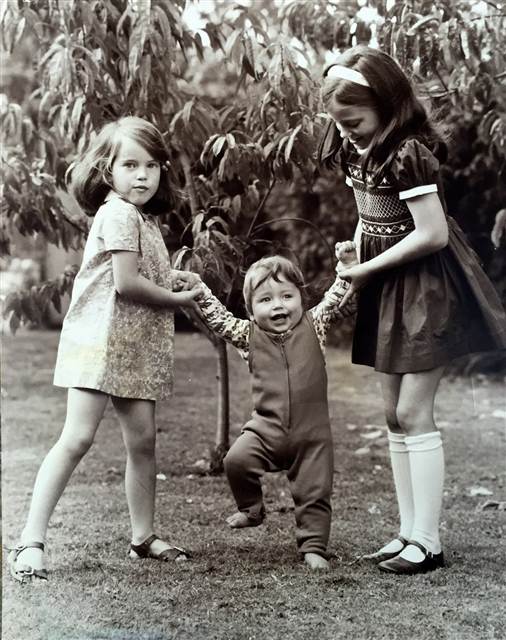
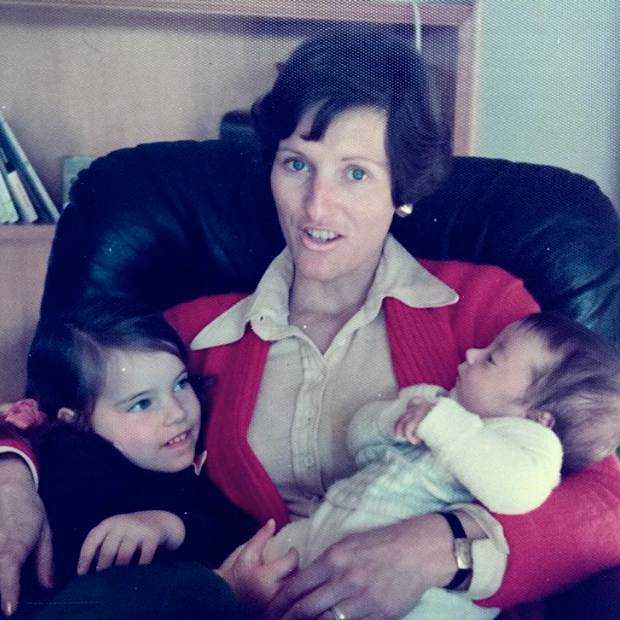
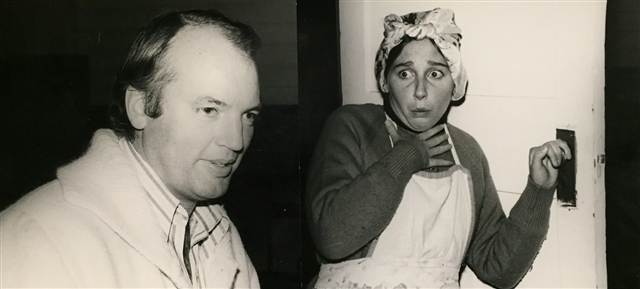
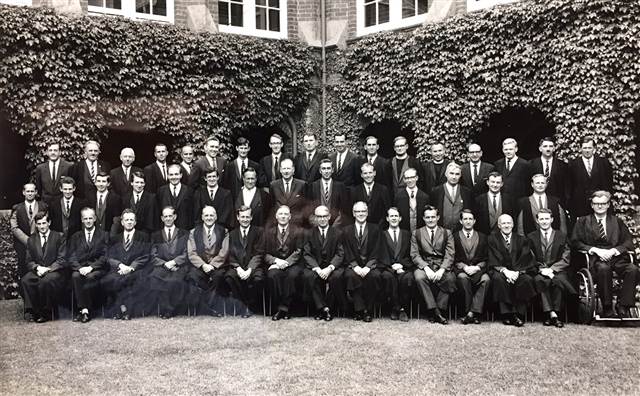
1970 – 1977
The Romans dedicated the month of January to Janus, the two-faced God that looks to the future and the past. Janus is the God of Gates and Doors. Certainly for us January 1970 was a time to look back and to look forward. We had enjoyed two blissful years overseas, apart from the cold! We had made new life-long friends, travelled to many fascinating places, been part of a vibrant school community and started our own family. Anne's parents had moved from their Terang property to a new life in Geelong and my mother had continued in good health revelling in her many interests and travels and the new experience of being a grandmother.
We could now look forward to further opportunities at Geelong Grammar School. I received a letter letting me know that increases in the salary scale meant that I would begin on the handsome salary of $6,000 per annum! We were invited to live in a delightful new house across the ovals and beyond the swimming pool, looking out over Limeburners Bay on one side and open fields on the other. A garden had to be established. I did some spade work but Anne was the creative one as far as gardens were concerned and she soon had things on the go. There was only one other house in that part of the School. John and Jill Ince and their young family were living there. When they moved to Barwon House at the end of the year Adrian Monger, recently married to Sue, came to live there. We had visited Adrian in England where he was teaching at Eton College and being looked after like a king! He was very happy with the practice of leaving his shoes outside his door for them to be cleaned by some Eton retainer!
I would be teaching Matriculation History and English as well as those subjects at lower levels. I would also be focussing on drama and was looking forward to taking on more productions. I was never formally asked to be in charge of drama. There was no Academic Drama Department as such at that time or at any stage throughout my time at GGS. It was still just an 'extra curricular' activity. At no stage of my whole time at Geelong Grammar School was I ever paid one extra cent or given any time allowance or relieved of any other extra curricular activity. Furthermore at no time did I ever think that I should be! In one sense I'm proud of that but in another I would have been a considerably better husband and father if I had done less school and more family.
While we had been away the Headmaster, Tommy Garnett, had clearly been working very hard towards making the School coeducational. 1970 saw the first stage of this process when 26 sixth form girls from The Hermitage came out to Corio and took all their subjects with the boys. The Hermitage was finding it difficult to have viable science and Mathematics classes and so the arrangement was of mutual benefit although it was really the thin end of the wedge as far as The Hermitage was concerned. This 'experiment' lasted two years before the first Geelong Grammar School girls began at Corio in 1972 so we were there for the beginnings of the move to coeducation just as we had been at Dean Close School. In his 1969 Speech Day address Tommy Garnett had said
There is nothing very new about this.......Tens of thousands of their contemporaries have been doing the same sort of thing for years and years without comment.
In 1970 I had no significant responsibility beyond the full range of commitments in a busy school. We were very happy. I remember one morning as I walked across the oval from our home towards the School Tower I said to myself 'This is a wonderful stage of your life. You will never be happier than you are at this moment.' That's the way I felt. That's the way it was.
Anne's parents were delighted to have their younger daughter living so close and I'm sure they met up often with Caitlin while I was busy at school. Bill Wadelton had taken on part time work with a real estate agent, a task he would have done with great warmth and empathy. Anne's approach to motherhood was that while the children were young she would be at home to look after them. My approach to fatherhood was that my main role was to earn a living to support my family. My employer's approach to parenthood was that teachers should devote themselves to the School during Term time while long holidays provided ample opportunity for families to be together. So not only were we expected to teach a significant load, we were expected to coach sport, run activities and do duty in one of the houses. We were encouraged to attend chapel and school events. I had no difficulty with this expectation and thrived on committing myself to the hilt. How fortunate I was to have a wife who accepted me as I was - for better and for worse.
The School at Corio was very self-contained and in those days virtually every teacher, along with many maintenance and domestic staff, lived on the spot. All were provided with rent-free accommodation as part of the quid pro quo for the dedication and commitment expected of us. Bachelors had their own dining room, the Morris Room, where they were waited upon and ate sumptuously. Matrons had their own dining room, less well appointed in every way. It was still a man's world in the 1970s! A strong sense of community was fostered in the Staff Common Room and the Community Centre. There was a crèche for staff children. Corio was virtually a self-contained village. In many ways this was a great strength and I loved it. Anne made many friends as part of that community and contributed greatly to it all. If at times she was frustrated by the isolation or my obsession with always looking for more that I could do, she never let on. That was very typically Anne. Her capacity to accept things constructively and without complaint was extraordinary.
Having had our overseas 'fling' we decided that the sooner we began the process of owning some property the better. Don and Fay Marles had bought a block of land at Clifton Springs and as soon as we could manage it we followed suit. I can't remember what it cost but it was in Mirrabooka Drive with a view of the sea. From time to time it needed mowing and the School lent us a Deutscher Motor Mower which we took down to Clifton Springs from time to time. Caitlin has unpleasant memories of those trips because the car always had the smell of petrol and we discovered later that she was allergic to petrochemicals! Living next door to the Shell Refinery was not particularly helpful either and in due course we were advised that for the sake of Caitlin's health we would be wise to leave. Fortunately this coincided with our move to the clean air of Hamilton in the Western District.
With much the same timing as had been the case with Caitlin, Anne became pregnant again and a second Murray would arrive in December, possibly even on Christmas Day. I was outside in the Waiting Room, of course, and was duly informed by Dr Garnett Smith of the safe arrival of Lisa Jane on 22 December, 1970. We were thrilled that Caitlin had a little sister. I imagine that Anne's mother was looking after Caitlin. I'm rather ashamed that I don't remember. Nor do I remember if Anne was in hospital for Christmas Day. She had been in hospital for a week after Caitlin was born so that may also have been the case again. Certainly Anne and Lisa were home before New Year's Eve so our beautiful family of four could welcome the new year together.
During that first year back at Corio I had hit the ground running as far as drama was concerned doing a production of The Hollow Crown in April including two Hermitage sixth formers, Jennifer Glen and Angela Hope, in the cast. Mrs Jane Davison played the piano and her performance of Beethoven's Variations on God Save the King was stunning. Jane played for various productions and she was a fine violinist as well as a brilliant pianist.
Having done two Revues called The Group before going to England I was keen to do another on return and so in July The Group number three hit the Bracebridge Wilson Hall stage. Dick Johnson, Christopher Koren and Peter Stewart were key members of The Group and one of the sketches was Hamalot. I remember writing this script for nearly the whole of one night in our home beyond the swimming pool quite early in the year. It was a sequel to A Lerner's Macbeth, this time setting the story of Hamlet to the music of Camalot. My fourth and final Group revue was in 1973. On Australia Day that year the Prime Minister, Gough Whitlam, had announced that the country should have a new National Anthem and he was calling for submissions. I found this irresistible and so wrote Grayderstrylia. It was a series of verses and a chorus to the tune of My Favourite Things from The Sound of Music and it was printed on the programme and was rousingly sung at the Revue. It was later printed in the School's magazine Light Blue and it forms Appendix 1 to this chapter. I did not submit it for consideration in the competition!
Not content with two dramatic productions in my first year back I directed A Man for All Seasons again with a strong cast. Peter Stewart was a very fine Thomas More. He poured his heart and soul into the part. At the curtain call at the end of the first performance there was no Thomas More to be seen. He was in a heap on the floor having fainted. Stage Manager for that show was Chris McKeown, son of the man I was to succeed as Headmaster of Canberra Grammar School 16 years later. For the production of A Man for All Seasons at Dean Close School I had used our London street lamp. For the Corio production I recalled that when the rood screen had been installed in the chapel in the early 1950s two of the big wall lights had been removed. I rummaged around in the old storage garages that housed many treasures and, sure enough, there they were. I had one of them set up on stage as part of the permanent set for the play and it looked very fine. Our London street lamp made its appearance on the BWH stage the following year for Oliver!
Another piece of writing I recall doing that year was adapting William Golding's novel Lord of the Flies for the stage. I think I devoted a significant part of one of the holidays to the task. Poor Anne. How tolerant and uncomplaining she was about my obsessions. I thought it would be a travesty if most of Golding's brilliant prose was lost and so I incorporated a Narrator in my dramatisation. I then directed the play twice at Corio. The first was in 1971 as part of an Easter Festival when everyone remained at school because Easter was so close to the First Term holidays. I invited Tommy Garnett to be the Narrator on that occasion and he did it most beautifully. The second was in 1975 when Neville Clark and Hugh Crole were Narrators. In that production Jeremy Kirkwood who is currently the Chairman of the Geelong Grammar School Council played the part of the bully-boy, Roger, and the part of Piggy was played by Miles Prince who more than 40 years later saved my life.
I remember two very significant events in Melbourne during that first year, 1970. Australia had been involved in the Vietnam War since 1962. Many Australians were fighting and dying there including National Servicemen who had been conscripted if their birthday came up in the birthday lottery. Opposition was growing in Australia to our involvement and in May 1970 over 100,000 people marched and occupied the centre of the city of Melbourne. I remember the following week Tommy Garnett talking to the School about it. He said that he was very disappointed no boys had come to him to ask permission to attend the rally. 'I'm not sure that I would have given permission,' said Tommy, 'but I'm very sorry you didn't ask.' This says a lot about Tommy Garnett. The following month Douglas Trathen, Headmaster of Newington College in Sydney, wrote a letter to the Sydney Morning Herald speaking out against conscription and calling on young men to defy the National Service Act. He resigned from the School in September.
At noon on 15 October that year I was at home. I must have had a 'spare' and come home to join Anne and Caitlin for lunch. The radio was on and we heard some dramatic breaking news. A giant 120 metre span of the Westgate Bridge then under construction had collapsed into the Yarra River. It was a massive disaster. Thirty five people were killed. Most Victorians remember where they were when they heard that news.
At the school level 1970 saw the first full year of operations in the Kennedy Medical Centre which had opened in November 1969. At that time it was state of the art, although now it has been superseded by the imposing buildings and staffing associated with 'wellbeing' at GGS. David Mackey had joined the staff in the sixties as resident doctor specialising in adolescent medicine and Anne helped in the Centre at key times when the pressure was on, as did Anne's great friend, Sue Mackey, who we asked to be Lisa's Godmother with Dick Johnson as Godfather.
1970 was a fine year for us as it was for the School. Tommy Garnett's early years had seen some tension as the School came to terms with change - change after 32 years of the JR Darling Headmastership and fundamental change in society. As the sixties had unfolded so confidence at the School had grown and we were very fortunate to have the wisdom and inspiration of Tommy Garnett at the helm. Perhaps it is only many years later that we realise what a remarkable contribution he made. I was very pleased to be able to serve on the committee that set up and launched the Tommy Garnett Scholarship. The first Tommy Garnett Scholar will start at Corio in 2019. In his December 1970 Speech Day address Tommy's emphasis was on change. He didn't want people to do as they were told. He wanted them to use their own judgement, make mistakes and learn from them. In an age of long hair his encouragement to parents was not to worry too much about it. Perhaps Harriet Lester identified the fundamental difference between Tommy Garnett and his predecessor when she said 'JRD wanted to be a stone in the pond creating a lot of ripples but Tommy wanted to create a lot of stones.' (Quoted by Andrew Lemon in The Master Gardener page 524).
Geelong Grammar was a lovely place to be in the holidays. Living very close to the swimming pool we were able to enjoy the water together in January. I have a clear image of swimming with Caitlin and Lisa when they were little and wearing their yellow arm floaties. Anne was a good swimmer and liked to do laps while I puddled about. I remember Lisa taking her first jump from the high board!
Inevitably I spent a good deal of time in the Bracebridge Wilson Hall (BWH). Caitlin called it Daddy's Hall and rather liked being present at rehearsals. I can recall early in 1971 having two lots of rehearsals going on at the same time - preparing for the April production of Lord of the Flies and Oliver in late June. Madness. Tommy Garnett said soon after he arrived 'What we want is more madness.' I'm not sure it was that sort of madness he was referring to.
Oliver! What fun that was. Dick Johnson was a brilliant Fagin and we had a cast of over 100. Richard Moore was the perfect Oliver, son of Des and Felicity, Des having been a couple of years ahead of me at school. Richard went on to have a big career in Film, Television and the Arts, running many national and international festivals. Included in the cast were not only boys from the School but many girls from The Hermitage, members of staff and several members of GAMA in Geelong. It was a big community effort. A pregnant Jocy Anderson was a Londoner, standing on a table and singing Oom-Pah-Pah with the best of them. At the last minute I had to play the part of Mr Brownlow because Ken Hemmens was unwell. Ken was rather smaller than I was and squeezing into his costume was no easy matter!
From the beginning of 1972 Geelong Grammar had its own girls at Years 11 and 12 and I celebrated by directing the musical Paint Your Wagon in June that year. Peter Westcott wrote the review for The Corian and noted that this was a seminal moment in the maturing of the School.
I came away from Paint Your Wagon with a warm glow of pleasure and pride. The pleasure was naturally the high standard of the production; the pride was that Geelong Grammar had brought its dramatic work to real maturity in the wider social sense.
Although there have been some very lean periods, the School has had a splendid record in drama for nearly half a century, and there have been many admirable producers and actors, some of whom have become well-known. To make comparisons with productions in the past would be unfounded and irrational. What was significant about Paint Your Wagon was the way in which the producer had drawn on the School community without inhibitions, so that one felt a sense of 'involvement', to use what has become a common but very meaningful term. More than that, he had also asked the help of friends of the School, as so often in times past where the music was concerned.
Paint Your Wagon celebrated in the brightest manner the coming of co- education to the School, as well as the integration of staff and pupils in real education, which is so much more important than mere success in scholarship. In particular, the thoroughly mature co-operation of young men and young women with one another and with the adults of Corio on the stage gave a spontaneity and wholesomeness to the production which was impossible in a totally male school.......... I feel delighted that Corio producers today can draw on the best actors, male and female, without restrictions. School drama has grown up.
That year Paint Your Wagon was the forerunner to a bigger Festival of Arts in November, spreading over three days and including a full range of literary, musical and dramatic activities. The School had a strong tradition of such things - the big event - since the Latin Plays of the 1930s. The performance of Michael Persse's (he was not Collins Persse then) Their Succeeding Race in 1957 to celebrate the Centenary of the School's foundation was on a grand scale. Ken Mappin and I had continued the tradition with the Corio Jubilee in 1964 and so my suggestion of a Festival of Arts was readily taken up by Tommy. It was 'more madness' after all! 1972 was the first year of a new Fifth Form Drama course I had been allowed to introduce so we did a performance of Twelve Angry Men on the floor of the BWH while Dick Johnson did an excellent production of Hamp on the stage - not concurrently but the same weekend! Ten Little Niggers was performed in the Jennings Hall - a title not yet deemed politically incorrect but destined in due course to become Ten Little Indians.
The Festival was opened by none other than Barry Humphries. He lunched with a group of us and then launched the Festival as himself - a relatively unaccustomed role for him. He felt that the powers that be of the Associated Public Schools would heartily disapprove of such a non-sporting occasion and for this reason it gave him all the more pleasure to declare the Festival open. Three years later I suggested to Charles Fisher that we hold another Festival of Arts and he was delighted to support the idea. That time Derek Nimmo launched proceedings. Derek Nimmo was particularly well known for his role as the Reverend Mervyn Noote in the British sitcom All Gas and Gaiters about three incompetent bungling churchmen - Bishop, his Chaplain (Noote) and the Archdeacon. Charles was keen to play the Bishop and do a double act with Nimmo but we talked him out of it!
I was pleased that Dick Johnson inspired a third Festival the year after we left adopting a similar pattern to the earlier two. A three-year pattern - a Triennial - could well have been in the making but the idea fizzled out after that. Different people. Different priorities. C'ést la vie. I confess I took the idea with me to Hamilton and Canberra and we enjoyed variations on the theme in both those schools.
By 1972 mum had sold the house in Croydon and purchased a delightful first-floor, two-bedroom apartment towards the back of an apartment block in Power Street, Hawthorn, half way between Riversdale and Burwood Roads near a pedestrian crossing on the tram line. She was very happy there and we often visited or stayed with her as did Michael and Gina who by then were in Bishop Barker House at The King's School. Mum also came to stay with us for a few days at a time so she was able to be part of the early life of her two granddaughters. From March to July that year she kept a diary and I have already quoted her first entry. She was so interested and active and positive. Her memories of her travels were very vivid and her hopes of further travel were still alive. In fact she travelled overseas for another ten years.
1972 was a huge year in the life of the School. Not only did it see the beginning of coeducation, it also saw the Day House, Geelong House, become Allen House and move to a new location based around what had been a colony of single men's quarters behind Kennedy. In the course of 1972 a residence was built for the Housemaster and was ready by August of that year. Tommy Garnett invited me to be Housemaster and we continued to live beyond the swimming pool until the house was ready. Allen House was coeducational from the start. As Housemaster, director of plays and teacher of English and History almost all aspects of my working life included boys and girls from the moment coeducation began. Allen House was small in its first year with 24 boys and 6 girls. Numbers quickly grew and by 1976 the House comprised 37 boys and 28 girls while a second house for day students had been established with Neville Clark as Housemaster. For most of my time the two house tutors were Bill Lester and Adrian Monger. Day boys and girls were known as Day Boarders since they stayed for the evening meal and prep, heading home by bus at 9.0pm. I was happy not to be responsible for them overnight and on weekends. It did give me time for other things.
The third key development starting in 1972 was Linden, a house for second year matriculation students. Girls were immediately members of Linden. Ian Edwards was the first Warden assisted by Dick Johnson. Members of Linden were given much more freedom and autonomy giving expression to the Garnett philosophy that older boys and girls should be taking more responsibility for themselves.
Before we moved to our new house in August that year we had a special dinner for Anne's parents who celebrated their 40th wedding anniversary on 29 July. I wish I could remember who else was present. Anne was very good at remembering birthdays and anniversaries. In retirement she was the inspiration for a 'naughties' party in 2005, celebrating many family milestones at the same time.
Anne did so much behind the scenes for all the plays I have mentioned and for many productions that lay ahead. She and Jane Stoddart took on responsibility for costumes. Anne could sew beautifully and she made so many of her own clothes and clothes for the children. She was a tower of strength making and adjusting costumes galore for play after play. No fuss. No complaints. I could simply not have done what I did without her constant moral and practical support. She told people that well before the play I was directing reached performance I had other plays on the bedside table planning what was next. She was very long-suffering. My only complaint which I expressed for many years was that when she was pinning material she put all the pins in her mouth. My exhortations not to do that for fear of swallowing one fell on deaf ears. She never did swallow one thank heaven so I guess she knew what she was doing!
The new house was right next door to Allen House. It meant another garden for Anne to design and work on. The back garden was fenced and the back gate opened onto the Community Centre and crèche which Caitlin and Lisa both attended. Anne became great friends with Pauline Davies who was in charge. What with her sewing, helping in the Medical Centre and the crèche, many friends in the community, parents in Geelong, raising children, contributing to Allen House and surviving an absentee husband, she had her hands full. She seemed to take it all in her stride. Any health issues, stresses and strains she kept to herself.
One example of this was when, soon after moving to the new house, she was clearly not feeling well. Finally she succumbed and told me she had an appointment with Garnet Smith. When I arrived home towards the end of the day there was a note from Jocy Anderson on the front door letting me know that the children were with her and Anne was in hospital. It transpired that Anne had an advanced ectopic pregnancy. When she said to Garnet Smith that she would drive the car home first before hospitalisation he said 'No you won't. You will go by ambulance to hospital now' where he operated immediately. Typical Anne. Foolish of course. Most women would have checked things out much sooner but Anne suffered in silence for too long.
In 1972 and 1973 many of the girl boarders were accommodated in the homes of married staff who were prepared to take them in. Throughout 1973 Liz Patterson slept at our house. Tommy Garnett left the decision about the next step in coeducation to his successor, Charles Fisher, who arrived with his wife Anne and large family at the beginning of 1974. I had been Chairman of Common Room in 1973 and so had to preside over the staff farewell to Tommy Garnett as well as organise the presentation we would make to him. I commissioned Richard Weatherly to do a painting reflecting some of Tommy's interests. He did a beautiful painting of very colourful Rainbow Bee-eaters sitting on the dead twigs of a blackwood. Behind is a yellow box-tree, and in the distance are Mount Buller and Mount Timbertop. Forty five years and five headmasters later one of my drawings was purchased by the Master of Timbertop as their gift to the retiring Principal, Stephen Meek. It was the tenth of my limited edition of ten prints of my drawing of the Timbertop Chapel. It was not in the same league as Richard Weatherly's work but it was a nice little connection that I enjoyed.
The transition to Charles Fisher in 1974 was a smooth one. In the fullness of time I have come to understand Tommy Garnett more and have reason to appreciate enormously his contribution to the School and to me personally. He challenged our assumptions and had a very wise and balanced philosophy of education. This philosophy was clear in the recording he made in 1965 which was sent to the homes of all parents and Old Boys. In March 2018 I found myself chairing proceedings at the launch of the Tommy Garnett Scholarship and Andrew Lemon's biography of Tommy, The Master Gardener. My credentials for having that honour were that I had been on the staff for the whole of Tommy's Headmastership, I had known Andrew Lemon for more than 50 years and I had served on the Tommy Garnett Scholarship Committee. In that recording Tommy emphasised four elements of a good education:
1. Imagination and flexibility of mind sufficient to deal with the present and the future;
2. Readiness to think for oneself and listen to the opinions of others;
3. Generosity of spirit to appreciate what others are doing in every field of endeavour;
4. The humility that is prepared never to stop learning.
Andrew's analysis of Tommy's years at Corio is very balanced. What an extraordinarily versatile, gifted and interesting man TR Garnett was. All the while he suffered from increasing deafness and it is only in my latter years that I have come to understand how debilitating that is - and in the 1960s hearing aid technology was not very sophisticated. As a result of not hearing he would often avoid contact or simply chuckle or walk away. Consequently he could appear distant and arrogant. The truth was he was self-effacing and deaf.
On the other hand Charles Fisher was larger than life - an extrovert, a people-person, with a great sense of fun and prodigious memory for names! He knew how to charm and to flatter. He was very kind to Anne and me. We both liked him and Anne enormously.
Tommy Garnett's view about retirement was 'when you leave you leave' and he never interfered in any way with his successor's decisions. Tommy was far too busy concentrating on building his garden at St Erth. In fact he had left it to his successor to make the final decision about coeducation and whether it would permeate right through the School or simply be at the Primary and Senior Secondary levels. Timbertop was seen as a difficulty if the School was to be fully coeducational. At that time the assumption was that girls would not be able to cope physically with the sort of programme boys undertook - camping, hiking, cross country skiing, running up Mount Timbertop or running the marathon. It was only in 1984 that the women's marathon was added as an event in the Olympic Games. On the other hand in their personal and emotional development Year 10 girls would probably be too mature for Timbertop. Two key decisions were made. The School would become fully coeducational and Timbertop would transition from Year 10 to Year 9.
This decision was warmly welcomed in all parts of the school community. I was on the Old Geelong Grammarian Committee at the time and I don't recall any voice of dissent there. What a contrast to Melbourne Grammar, for example, where there was such an outcry from Old Melbournians when the Council announced they were going coeducational that the decision was reversed and a school for boys it remains. Such a contrast, also, to Independent Boys Schools in Sydney most of which remain single sex to this day. The smooth transition was all the more creditable since GGS was essentially a boarding school, a much more complex matter than if it had been a day school only.
What might have been a relatively slow process was put into fast-forward with the Amalgamation of GGS with The Hermitage and Clyde. Both those schools were in significant difficulty with numbers and finances so it was more of a take-over than an amalgamation although Charles Fisher did everything he diplomatically could to ensure it all happened smoothly. Alice Pringle came from Clyde and became Head of the new Clyde House. Elizabeth Britten came from The Hermitage and took on special responsibilities Charles created for her but sensibly soon left to run her own school in Melbourne.
In 1974 Vicki Mendelson (now Steggall) spent one year at Corio. As she said on a promotion video many years later, it saved her life. She had been very stifled in the rather stilted life of the Melbourne Girls School she attended and she found GGS a liberating experience - so much so that she is presently writing the story of GGS going coeducational and I have been helping her by recording interviews with many of the teachers who were there at the time. Those interviews were 'just in time' since, alas, we are a dying breed. I got to know Vicki pretty well that year since she was in one or two of my classes as well as playing in my production of The Real Inspector Hound.
In Sydney Michael had been at The King's School for 10 years and he and Gina had devoted themselves to the School and to Bishop Barker House. Michael was now over 40 and had obviously been thinking about his career and what life might hold for them both after TKS. He made contact with the Principal of The Geelong College and, to cut a long story short, he was appointed Vice Principal and so from the beginning of second term 1974 Michael and Gina lived in Newtown, Geelong, so we were able to keep in closer touch. Mum had both her boys in Geelong and Anne had her parents there as well.
With 1975 and the amalgamations the School suddenly became considerably bigger. There were more teachers and more women including 'Gem' Reid who came down with the Clyde girls. Gem became a good friend for our remaining three years at Corio. Ours became a second home for her and our children became her extended family. In fact the friendship was undoubtedly an important lifeline for 'Mima' and she stayed with us in Hamilton and in Canberra in later years.
For us the most important event of 1975 was the arrival of Andrew Charles on 3 May. Two had 'got away' between Lisa's arrival in 1970 and Andrew's arrival in 1975 - one in dramatic circumstances as I have already described. Once again I attended in the Waiting Room finally to be informed of Andy's safe arrival. While in those days it wasn't the custom for fathers to be present at the birth I'm sure Anne had no desire for me to attend. I would have been a liability. She had a job to do and she would do it - less fuss the better! The girls were thrilled when Anne came home with their little baby brother. From an early stage Lisa demonstrated her instinct for looking after little children. She has never lost that despite the extraordinary challenges she faced after becoming a mother. Andy was christened in the Chapel of All Saints at Corio on 29 December 1975. Godparents were Michael Murray, David Odling-Smee and Linda Auton. When John Potter asked Lisa what other names Andy had apart from Murray - probing to get the 'Christian' name dimension - Lisa said 'Possum'!
1975 was a big year on the wider stage of Australian politics. The Labor Party under Gough Whitlam's leadership had won the 1972 election and for the next three years Gough went about his reform agenda including the end of military conscription, the institution of universal health care and free University education. By November 1975 the Government was in crisis and the hostile Senate denied the Government supply. On 11 November I had the radio on in a History class and we listened to the news that the Governor General had dismissed Mr Whitlam and the Government and commissioned the Opposition leader, Malcolm Fraser, to form a government. So 11 November now had a third historic event to join the Armistice to end the First World War and the hanging of Ned Kelly.
By 1975 at the school level the Fifth Form Drama Course I had introduced in 1973 had taken off. Those were the days! We finished up having 50 boys and girls doing Drama which Dick Johnson and I shared. Our aim was the teaching of Drama as opposed to Theatre but we did do a number of productions as well including One Friday in Eternity in the Chapel at Easter, and a Double Bill comprising David Campton's Us and Them and an Anzac Day piece that we devised with the drama class called Anzac Scrap Book.
That year, as well as the second Festival of Arts that I have already mentioned, I loved directing Rosencrantz and Guildenstern are Dead in July, just as, years earlier, I had promised myself I would! We did this on a specially constructed stage on the floor of the BWH. I laboriously made the necessary barrels myself in the School Maintenance Department. They had to fit two actors and sit above trapdoors to the world beneath the stage. Jon Haughton and Hugh Crole were Ros and Guil - or were they Guil and Ros?! I had been preparing them for those challenging roles by casting them as Moon and Birdboot the previous year in The Real Inspector Hound, also by Tom Stoppard, which I had seen in England with Richard Briers and Ronnie Barker in those roles. In September that year Dick and I had taken a party of 10 to Canberra for a Drama Festival at Canberra Grammar School. This inspired me to take on the running of a Drama Festival at Corio in 1976 for a week of the school holidays which was attended by about 100 secondary boys and girls and their teachers from all around Australia. I commissioned Don Mackay to be artistic director and he had good contacts that enabled us to have excellent professional tutors. At the last moment Julia Blake lost her voice so Dick Johnson took over and did a great job. It was a huge task for me and I confess that by the end of the week I was staggering around lame and exhausted. Anne did a vast amount to make it happen. It was organised under the umbrella of the Headmasters' Conference and it would have been good if there had been a follow-up Festival. Not surprisingly no one came forward who was mad enough to take it on and that was that.
1976. The family was growing up. Caitlin and Lisa were catching the bus to the GGS Highton campus in Geelong. Anne managed it all at home while I headed out early and was often home late. I am so much more aware of my grandchildren's development than I was of my children's. If they were not happy at school at times I was not focussed on their problems. Anne dealt with the issues and, at times, she may well have encouraged them to behave the way she would have behaved: don't complain, make the best of things and get on with it. Certainly home life was very happy and I doubt they ever heard Anne and me raising our voices at each other.
Anne was always calm and had great presence of mind. I remember when we had guests for a fondue dinner with a number of us seated round our french-polished cedar table and reaching into the central dish above the flame. Suddenly the dish was knocked over and a blue flame licked across the table. While I was fussing about ineffectively Anne had soaked a towel and had spread it over the table dousing the flames in seconds. We had the table french-polished again, this time on insurance. When Andrew swallowed a drawing pin Anne calmly ensured that is was quickly accompanied by a good deal of bread and in the fullness of time the drawing pin made its exit without doing Andy any harm. I enjoyed devising treasure hunts for the children's birthday parties, sometimes incorporating many of the Allen house studies as locations for the treasure. Lisa has easily surpassed my skills in the beautiful treasure hunts that she devises for her children's parties.
In January 1976 we decided we should make our next real estate move and the Bank of NSW approved a loan of $18,000 to assist in the purchase of 127 Kilgour Street, East Geelong, a pleasant weatherboard Victorian house in pretty reasonable condition. Repayment was $200 per month to cover principal and interest, while the interest rate was 11.25%. We spent a good deal of the holidays painting and wall-papering before it was let. Eight years later in May 1984 we sold it for $40,000 so that we could upgrade by buying 2/18 Riversdale Road in Hawthorn for $78,000 - a three-bedroom brick apartment in an excellent location which brought us in rental income for the next 16 years.
6 October 1976 is a date firmly imprinted in my memory. Just before midnight the old wooden Bracebridge Wilson Hall burnt to the ground in 30 minutes. An electrical fault was deemed to be the cause. We were woken by the sound of the fire alarm and saw the orange glow from our front window. As I rushed out the front door in dressing gown and slippers I recall Anne saying very firmly to me 'Don't do anything silly.' She was warning me not to try to enter the building to try to save some treasures before the building was engulfed. In different circumstances I may have been tempted but the old weatherboard building was a tinderbox and the fire spread through it at great pace. It was an inferno. I remember standing and watching with Charles Fisher, Jim Winchester and Dick Johnson and a big crowd of witnesses. I felt very sad and I remember thinking that I was glad I had swept the hall a couple of days earlier so she had gone being loved! How crazy is that?! I also remember Jim Winchester, the Bursar, saying to me, largely in jest, 'Have an inventory of everything that was in there on my desk by nine in the morning!' In fact I had it to him soon after that but I could not itemise what was in the school museum that was housed in one of the side rooms. I think there were some real treasures in there. Dick came back to our house and we didn't go back to bed that night, drowning our sorrows and sharing memories. I wrote a piece for The Corian which I called The BWH I Remember....... It forms Appendix 2 to this chapter.
Thank heaven the fire occurred when the hall was empty. If it had been during a performance it could have been an appalling tragedy. Earlier in the year I had loved directing Salad Days there. John Leggett and Malcolm John were the pianists and many staff and wives were in the first scene for the song The Things that are Done by a Don. The role of the dancing bishop was shared between Jim Winchester and Charles Fisher. Two years earlier in Charles Fisher's first year at Corio I had organised a Music Hall Night in the Darling Hall and invited Charles to be Chairman of proceedings. He had begun by proposing the loyal toast which he did with these words, 'Ladies and Gentlemen, in the words of the immortal William Archibald Spooner I invite you to glaze your arses and drink to the health of the queer Dean!' Perhaps it is an indication of the nature of the two men and my relationship with them that I asked Tommy Garnett to be narrator for Lord of the Flies and First Voice for Under Milk Wood, while I asked Charles Fisher to be the dancing Bishop in Salad Days and Chairman at a staff and parents Music Hall Night. The Director of Music redressed the balance when he produced the One Act Opera Noah's Flood by Benjamin Britten in the Chapel and asked Charles to be the Voice of God!
After Salad Days I came to the conclusion that we were ready to do My Fair Lady. Dick Johnson could play Professor Higgins and we had the right girl for Eliza Doolittle. We organised the rights and the music. In due course the music arrived but alas after the BWH fire which robbed us of our 'theatre' I had forgotten all about My Fair Lady and I had to send the music back with abject apologies. I think Anne and Jane Stoddart were greatly relieved to be spared having to do the costumes for that show!
Throughout the 1970s I was involved in coaching sport every season - Under 16A Cricket every summer, and Australian Rules Football during the winter. In those days I still believed in the benefit of team sport for all boys regardless of their ability or interest. I regard that as quite absurd now. I generally found myself 'coaching' the least capable and most reluctant older boys - the 4th XVIII. I blush as I think about it! Those boys would have been much better off doing some other individual exercise and then getting on with things that interested them. A trip to Haileybury College, Keysborough, one year was not untypical - two hours in a bus, four quarters in the pelting rain and freezing wind, a score of one point against their 189 points, a cold pie, a two hour bus trip back to Corio. Parents were paying good money for such futility!
By 1976 I was beginning to think I should be interested in applying for a Headmastership. I was still hugely happy at Geelong Grammar School but as I had read in one of the books I was teaching in English 'If things are going to stay as they are things will have to change.' I did not want my whole life to be Geelong Grammar School. Christopher Turner had been encouraging about my potential to be a Head. A colleague had also said to me 'You should apply for a Headship. Look at all the idiots who become Heads. You could do it!' Anne was supportive. We looked carefully at various schools as they 'came up' and were always in agreement about which we would ignore and which we would pursue. I had interviews at All Saints College in Bathurst, Ivanhoe Grammar School in Melbourne and Oakburn College in Launceston. Fortunately I withdrew from the last of these after returning from the interview. When I telephoned their Chairman of Council with my withdrawal I got the impression I may well have been offered that job. Not to pursue the application was a wise decision.
Charles Fisher encouraged me and when he appointed the Director of Studies, Ian Good, to be Housemaster of Francis Brown House from the beginning of 1977, he offered the Director of Studies position to me, assuring me that it should not delay my headship applications. Quite early that year we saw that the position of Principal of Hamilton College was available from the beginning of 1978. We liked Hamilton and we drove up to have a look. The College looked very tired and unloved but clearly it had a history and it had potential. Anne being a country girl loved the idea of living in a country town and we knew that such a move would be very desirable for Caitlin's health. Anne knew people in the district and we liked the idea of our young family growing up in the country. I applied. Anne saw that the Chairman of Council was Mark Brian who she remembered when she was at Morongo and Mark was Captain of The Geelong College. In due course we had an interview and I was appointed. I knew the other two short-listed applicants and they both soon became Heads of other schools.
This all meant that I only had one year as Director of Studies but it was certainly very good experience particularly in thinking about what constituted a balanced curriculum and working on the complexities of timetabling. It was good to attend Heads of Department Meetings presided over by the Headmaster. It was good to begin to understand the bigger picture. As it happened one of the three short-listed for Hamilton was Head of the English Department at Corio. I remember one day he popped into my office and said 'Excuse me but do you mind if I communicate with you orally?!' I said 'I certainly do, but you can talk to me if you like.' I have never liked 'eduspeak' and jargon. You shouldn't be Head of English if you talk like that!
After a relatively short time at The Geelong College Michael was keen to run his own school and at the beginning of 1977 he and Gina moved to Adelaide for Michael to take up his appointment as Headmaster of Westminster School. It was a challenging opportunity and he and Gina devoted the next 18 years of their lives to a patient and visionary process of transformation. By the time they retired and returned to Geelong at the end of 1994 the character of the school was so firmly established that its development since that time has been totally consistent with his vision. Westminster School was Michael's 'Masterpiece'. The year he began there was the year our mother turned 80. While she was still overseas Michael suggested that she may like to move from her flat in Melbourne and set up home in Adelaide. Mum took up the idea and bought a charming terrace house in Kingston Terrace, North Adelaide. So, nearly 40 years after our family of four left North Adelaide to live in Melbourne mum left Melbourne on her own to live in North Adelaide. By the time mum turned 80 on 24 August we were on the countdown to our move to Hamilton at the end of the year so 1977 was quite a turning point for all the Murray family. Mum's birthday saw us all - Mum, Michael, Gina, Anne, Tim, Caitlin, Lisa and Andrew - gather at The Barn in McLaren Vale for a celebratory lunch. It was a happy occasion and was a special moment for mum. She was a very good 80 and - DVWP (her trademark 'touch wood' saying for fear of tempting Providence meaning 'God Willing (Deo Volens) Weather Permitting') - she would have a few more happy and healthy years ahead of her. In fact she had another 18 years. As a result of that lunch I wrote a few celebratory verses which I gave her and which she enjoyed. On various Christmases and Birthdays over the next 18 years I wrote more verses so in the end there were 125 of them. I have included those first verses that I wrote in 1977 as Appendix 3 to this chapter.
Despite everything that was going on in 1977 I still found time to introduce a four-day extended Creative and Performing Arts Workshop for all fourth formers cutting right across the normal curriculum and to direct Oh What a Lovely War which was performed in the more intimate space of the Jennings Hall. It worked and many people were moved by it. It is the sort of theatre I love.
Inevitably Anne and I had to undergo some 'body maintenance' during these years. I had a congenital hernia dealt with in the Geelong Hospital and I was finally able to convince the doctor that I needed to take medication to control my uric acid levels and so hopefully eradicate some nasty attacks of gout. Like father like son. Anne had veins in her legs attended to. She had emergency surgery for an ectopic pregnancy as I have already explained and over the Christmas holidays between GGS and Hamilton College she had another significant operation which left her very tender and sore for quite a long time. A bear hug from Dr Wallace McVicker on arrival in Hamilton did not help one bit. Not often did I see Anne showing signs of pain but I did after Wallace's 'welcome'.
Over the Christmas holidays we rented a house by the sea and Gem and Anne's parents joined us there. I went up to Hamilton alone to greet the furniture van and, with the help of Olive McVicker, Dot Orton and others, unpacked and distributed things as best I could so that it was reasonably ready for our arrival at 'The Lodge' - a very grand-sounding name for a modest dwelling at the top corner of the Myrniong property with another unmade garden needing attention.
It was hard to leave Geelong Grammar School but it was time. I had been a boy there for 8 years and had been on the staff from 1959 to 1977 incorporating nearly four years overseas in two lots. We had made many friends at Corio, not least the Mackeys, Bedggoods, Haywards, Marles, Mappins, Pascoes, Clarks, Eyre-Walkers, Sutherlands, Bechlys, Lesters, Mongers, Parsons, Sheahans, Johnson, Odling-Smee. Anne and I both owed them and the School a deep debt of gratitude. I was pleased that at Speech Day Charles Fisher referred to my contribution to the life of the School as 'vigorous and imaginative'. I guess that essentially relates to perspiration and inspiration. There were many farewells including one at the home of Anne and Charles Fisher for which Charles had written a farewell piece which was 'performed' with the professional help of David Wade who had a splendid voice. I still have the script written in Charles's own hand. It is called
The Slave of Duty or The Pirates of the Riverina with humble apologies to G and S. (A Cautionary Tale for Tim Murray)
That was a lot of fun and a good 'note' to leave on.
***
Appendix to Chapter 7
Appendix 1
Grayderstrylia
(I wrote this 'National Anthem' for the 1973 Group Revue to be sung to the tune of My Favourite Things from The Sound of Music)
1. Lib for the women and Margaret's diary; A cool Courage draught when you're hot and perspiry; Nice Mr Hawke and the A.C.T.U. These God created for me and for you.
2. Sixty foot frontage - brick veneer houses; Playtex for brassieres - F.J. for trousers; A laundromat social with clothes on spin dry; Lashings of sauce and a nice hot meat pie.
3. Surf boards on rooftops, bodies on beaches; Lounge suites in lounge rooms groaning with features; A few cans of Fosters and Replay on Nine; These make us proud to be fair dinkum strine.
CHORUS We all Hail ya, Grayderstrylia, You're our own true blue. To hell with the British and 'God Save the Queen', Australia - God Save You.
4. Discounts and trade-ins and fantastic bargains; High-pressure salesmen and commercial jargons; Rents car, renta plane, rent anything; Here in Australia the dollar is King.
5. Melbourne Cup parties and heady fruit punches; National Trust and some Charity Lunches; Three weeks at Surfers or cruise to Fiji; Smart photographs in the Women's Weekly.
6. Three flying ducks on the sliding glass doorway; Genuine flowers made of plastic in hall way; Gladdies and curlers and slippers and things; These are Australian we're all proud to sing.
CHORUS We all Hail ya, Grayderstrylia, You're worth all the fuss. To hell with the British and 'God Save the Queen', To hell with them all - Save us.
7. Up to the snow for a weekend at Buller; Saturday night getting fuller and fuller; Shouting your mates even when you are broke; This makes the Aussie a genuine bloke.
8. Do it yourself with a power Black and Decker; Knocking it down? Send for Whelan the Wrecker; Pink toilet paper absorbent and strong; Here in Australia it's hard to go wrong.
9. T.A.B. doubles or conning the sheilas; Down with the wowsers and down with the squealers; There isn't anything we Aussies lack; You can go jump because I'm alright Jack.
CHORUS We all Hail ya, Grayderstrylia, Land of Liberty. To hell with the British and 'God Save the Queen', Won't somebody please SAVE ME!
***
Appendix 2
The BWH I Remember.....
(I wrote this after the BWH Fire on 6 October 1976)
I remember my children coming for a walk to 'Daddy's Hall' to give a puppet show on the stage to an audience of one.
I remember swaying prodigiously on top of the suicidal aluminium ladder.
I remember encouraging young actors to project their voices to the 'deaf Greek in the back row', and the rain attacking the tin roof so that no one could hear anything anywhere.
I remember names galore scrawled on the backs of the flats - plays and players of the last thirty years.
I remember a sign in gold lettering on the stage door saying 'Stage Crew and Actors' - in that order.
I remember drama classes and 'freezes' and 'machines' and silhouettes and shadows and 'Keep the Home Fires Burning'.
I remember a pig's head on a stick and a pig's head in the deep freeze; I remember hammering hell out of the pig's frozen nose to get him on the stick.
I remember Bob and Joe, Ros. and Guil., Anne Frank and Lawrence of Arabia.
I remember barrels and trapdoors and another world below the stage.
I remember pushing thirty-two platforms up to that end of the hall and pushing them back again.
I remember 'Oliver' rehearsals on Sunday afternoons and all the 'converts' to drama watching The Hermitage girls singing 'Oom-Pah-Pah'.
I remember rain cascading down through the roof and dust careering up through the floor.
I remember the execution of Thomas More, and Jane's mother under the drier; Rubashov's last wish and 'Mrs Drudge one morning in early Spring'; twelve angry men and cucumber sandwiches.
I remember birds in the hall and boys in the roof; I remember 'slimy things with legs' under the ropes and little 'savages' on top of the scaffolding.
I remember sounds and silences; I remember months of rehearsals and moments of truth; I remember saying 'last time' and 'never again'; I remember walking out - and coming back.
***
Appendix 3
C.F.M. - 24.08.1977
'Silly Verses' wrtten by Tim for Mum's 80th birthday
It was something of a climax to the great Victorian Age when the Wheeler family album turned another glorious page. There was cause for celebration on earth as well as heaven on the twenty fourth of August in Eighteen Ninety Seven.
Yes, Cynthia Fane was here - to stay - a pretty little thing; Fanny was as proud as punch and Alfred felt a King. But they weren't aware that Cynthia, as she crawled on hands and knees, was looking everywhere she could for all the birds and bees.
She grew up fast, and didn't stay right under mother's thumb. Cynthia wasn't quite a fool although she acted dumb. She played the piano - tennis too - and other things as well, but when a certain Charles appeared Cynthia simply fell.
But Charlie played it cool and didn't rush our Cynthia Fane; a year passed by before he came and saw her once again. But this time Cupid shot his dart, and wedding bells rang soon, and Cynthia boarded with a friend throughout their honeymoon.
Born into a Vicarage and married to one too, Cynthia's life might well have been religion through and through. Don't misunderstand me, she was thoroughly devout, but sometimes, just occasionally, she had a bit of doubt.
Despite her doubts she entertained the local clergymen; she went to Church, she watched and prayed, she always said 'Amen'. She joined the Mothers' Union and to her surprise that meant she was such a splendid mother she became the President!
A Bishop's wife, a President, the mother of two boys, her life was well and truly set like Burgy's and Johnny Moyes. But fate stepped in and in a sense it's not too hard to see that life outside the Vicarage began at fifty three.
Of course the next few years were not all flowing with milk and honey - years of too much Light and Shade and not nearly enough money. But life went on in Croydon with its anguish and its joys; she had her house and garden, her dog and 'darling boys'.
When they left home our heroine decided she would too; so years of globe-trotting began: she looked for pastures new, and Florence, Venice, London, Bruges; Paris, Turkey, Rome became her haunts with friends galore: the world became her home.
She sailed; she flew; she went by train; she drove; she ran; she walked. She took up painting, went to play and galleries - she talked to 'friends' across the restaurant floor or on a London bus. In every place she stayed, she found, with no apparent fuss
a kindred spirit - friend for life - and there's no doubt it's true she never has a moment when she hasn't things to do: it may be cursing Whitlam or praising Malcolm's latest whim; agonising over Michael or possibly even Tim.
She looks so young it isn't fair to mention the word 'age', and so I'll simply say that, as we turn another page, it seems to me appropriate, and only right and just, that she and the house she lives in are classified 'National Trust'.
***
Hamilton
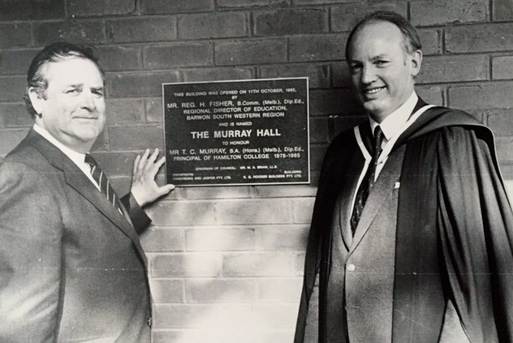
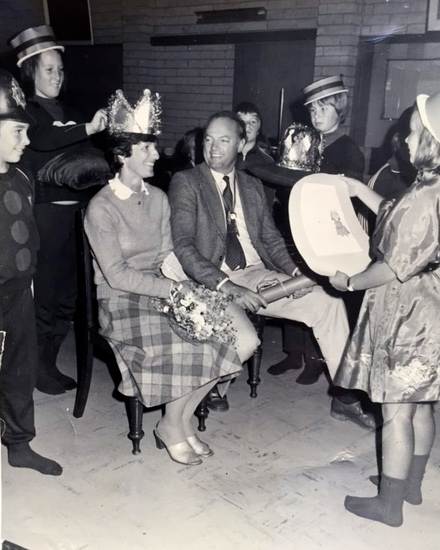
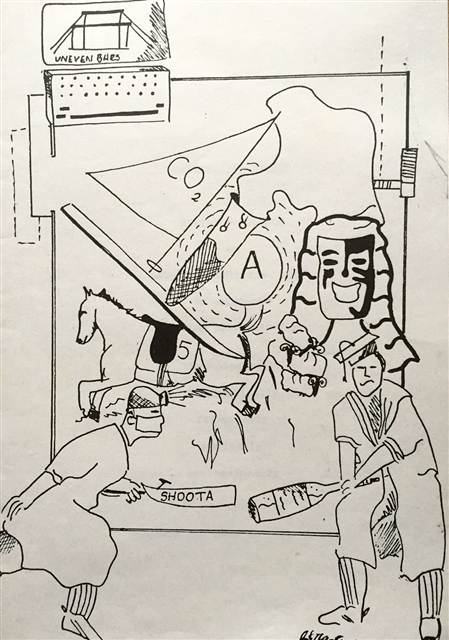
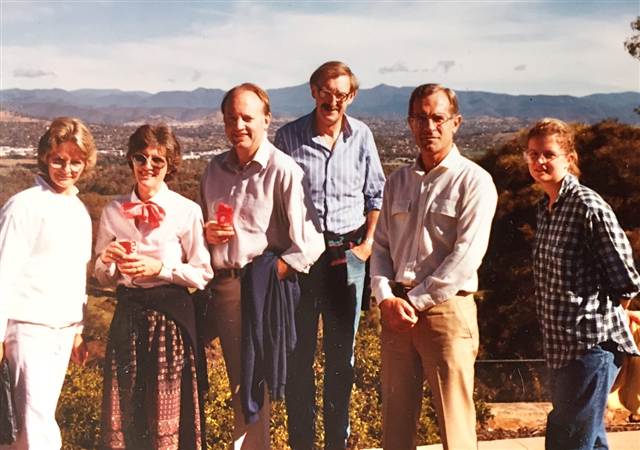
1978 – 1985
'Every exit is an entrance somewhere else' says The Player in Rosencrantz and Guildenstern Are Dead. I made quite a number of entrances to Hamilton College before our final exit from GGS. The previous Principal, John Shilliday, had left mid-year to take up his appointment as Principal of Ivanhoe Girls Grammar School. The Deputy Head, Terry Cavanagh, was Acting Head for six months. During that time numerous staff gave notice that they were leaving at the end of the year - or were given notice to that effect. In the end I had to replace nearly half the teaching staff - quite an opportunity but quite a challenge. Generally those appointments were considerable improvements on the people they replaced including Tom Stone, Tom McCombe, John Bates, Andrew Frost, Neil MacLean, Ian Brown, Sandra Sanders, Nora Muir and Shelley Richardson.
Another key issue during those six months was the Homestead at Myrniong which had been leased out to the Hamilton Education Centre, presumably to bring in a bit of income. This seemed to me to be a terrible waste of one of the College's greatest assets. So in consultation with Mark Brian and the College Council we made the decision to end the lease to the HEC and move the Junior School to Myrniong from the beginning of 1979, giving ourselves one year to effect the transition. We announced this at the 1978 Speech Day which I attended and where I made the first of my 21 Speech Day Addresses! Tammy Fraser was Guest Speaker being an Old Girl of Alexandra College (founded 1872) which had amalgamated with The Hamilton and Western District Boys' College (founded 1871) in 1962 when Mary and Brian Waters had been appointed as Joint Principals. For the rest of the 1960s they had steered through the process of amalgamation and coeducation, developing Myrniong as the site for boarders and the Boys School as the site for teaching. Alexandra College was sold. The Myrniong property had been acquired in the 1950s. Both schools had been taken over by the Presbyterian Church well before the establishment of the Uniting Church in June 1977. The uniting Church was a coming together of most congregations of the Methodist Church, about two thirds of the Presbyterian Church and almost all the Congregational Churches. This meant that nine Victorian schools formerly associated with these churches had to change their allegiance. Seven, including Hamilton College, became part of the Uniting Church, and the other two, Scotch College and PLC in Melbourne, remained part of the Continuing Presbyterian Church with its much more conservative, narrow and literal approach to religion and its place in schools. The distribution of schools was very much based on wealth and property. Scotch and PLC were 'rich'. A school like Hamilton College was a financial liability. Indeed while the College was part of the Presbyterian Church a good deal of debt was incurred. When Union came the College was burdened with having to 'repay' this debt to the Presbyterian Church. We fought this fiercely but in the end the 'debt' was paid.
So in the six months before I took up my appointment there were staffing issues, church issues, financial issues and organisational issues that had to be resolved. It all meant we hit the ground running when our final exit from GGS led to our entrance to Hamilton College early in January 1978.
I was 42, Anne 34, Caitlin 9, Lisa 7 and Andy 2. My contract, which I finally received in the December of my first year, stated that my salary would be $17,000 per annum, that our residence would be free of charge as would the education of our children at the College. 'The Lodge' was in need of some tender love and care since it had been empty for six months. It had a study, sitting room, small breakfast room off the kitchen and four bedrooms, one tiny (the room in which Brian Waters had his dialysis machine), two small and one a little bigger. There was no garden and no fence. We had some of the ground behind the house enclosed with chicken wire which at least provided a bit of security for the children - and once again Anne set about creating a garden.
The Murray Family and the Brian Family quickly became firm friends with their three children, Jane, Nicholas and Kate being much the same age as ours. Soon Richard and Ruth Walter and their sons Simon and Jono returned to Hamilton and Richard joined the Council. I gather that the Brians, Walters and Murrays became known as 'The Firm'. I'm not sure that was such a good thing. A great many times we enjoyed Sunday family barbecues in the Grampians or at Mount Eccles - a good steak, a good red and a good walk. Sometimes it also became a good climb which Anne was particularly keen on and good at. Ruth was a fine musician and in a voluntary capacity helped John Bates with choirs and did so much to make music and Musicals happen. John was brilliant on the keyboard, both piano and organ. I remember when Dick Johnson brought his production of Godspell to Hamilton College in 1983 with a cast that included my Godson, Richard Marles, now Federal Member for Corio and likely to be a senior minister in any Labor Government. Malcolm John who had played the piano for the Corio performances was unable to come and Dick asked me if we had anyone capable of playing the accompaniment. I assured him we did. They had one rehearsal to adapt to the small stage in the Myrniong Refectory and to coordinate with John Bates before giving two performances. When John started playing their jaws dropped. They had never sung to such an accompaniment and it lifted their spirits and their performance.
John was starting from behind scratch. When I attended the 1977 Speech Day the 'School Choir' performed one item. Up went the curtain to reveal a 'choir' of five which included two staff members, one of whom strummed a guitar. The music room - that's all there was, just one music room - had two different coloured carpets which had been bought as bargain remnants in a sale. On the dusty shelf were a number of broken violins, untouched for years. There was a piano with numerous bung notes and - well - that was it. Before term began John gave it a spring-clean and painted the chairs but essentially there was - nothing.
The same was the case with the 'Art Department' which had one wooden portable classroom and a former toilet which was the pottery. That brick building is, miraculously, still there with its eight neat bricked-in arched spaces on the road-side where the night man came on his rounds to collect what the College had to offer. - a bit before my time I hasten to add! Sandy Sanders said she didn't mind about the inadequate facilities and I could see why. She was so creative and imaginative. She demonstrated what could be done with nothing - except imagination and the capacity to inspire. Alas Sandy returned to England with her partner after two years. In due course they split up and she regretted leaving Hamilton College and Australia. She has returned often and always come to see us - and more recently me.
John Bates and Sandy Sanders - creativity personified. Then there was Neil MacLean who was happy to join the Boarding House as a resident tutor. He loved his cricket and hockey and fell in love with the College and Hamilton and Heather. Their two daughters have graduated now but Neil and Heather are still there and I enjoyed being a special guest at the beginning of year Staff and Council Dinner in January 2018 to celebrate Neil's 40 years on the staff. That was a good appointment before I even got there!
Tyrrell Evans was on the Council, married to Jan who was on the teaching staff of the Junior School, President of the Parents and Friends and a brilliant organiser. Their country hospitality was out of this world. When John Anderson married Jocy Bailey just before Anne and I were married I was Best Man. The wedding took place in Hamilton and the Reception at the Bailey property. Tyrrell remembered the speech I gave - which was more than I did - and had been impressed. I think Tyrrell's memory - or perhaps it was his faulty memory - helped my being appointed!
Towards the end of the year before we arrived, the Housemaster of the Boys Boarding House said he wanted to leave Boarding but stay on as teacher. He had not immediately inspired my total confidence so I was not too disappointed about the former decision. However it created a problem. The resident tutor who taught Chemistry took over but he soon had a nervous breakdown and left. What was I to do? Out of the blue I received a phone call from an Ian Denman who was looking for a job. He had applied at Geelong Grammar School where there wasn't a position at Corio but our friend Brian Simons, Head of Science there, knew my needs and suggested Ian get in touch. He came up and I offered him Head of Science and the position of Boarding Housemaster. Fortunately the Hamilton Hospital offered nursing training and his wife, Linda, wanted to train as a nurse. Ian rang. He accepted. 'Which one?' I asked. 'Both' he said. You've got to be lucky. Quite early on Boxing Day 1978 while we were all sitting on the front terrace of 'The Lodge' with Anne's parents a car loaded to the hilt drove through the gate into Myrniong. The Denmans had driven into our lives. What a Christmas present that was!
Alas there was one significant sadness at the end of 1978. On 5 December Charles Fisher was driving alone from Corio to Timbertop. Near Kanumbra his car left the road and hit a tree. He was killed instantly. Don Marles had the unenviable task of breaking the news to Anne Fisher. Robin Ritchie, Chairman of the GGS Council, was thoughtful enough to telephone me with the news. As soon as I was off the phone I simply burst into tears. A couple of hours later I was delivering my address at our Speech Day. The following year we invited Anne Fisher to stay with us for a few days. She was still living in the Headmaster's House at Corio. The whole experience must have been devastating for her. Charles was at the height of his powers when chance intervened and everything changed in an instant.
By the beginning of 1979 the College had received Emergency Funding from the Commonwealth Government. Without it I don't see how we could have survived. The Junior School was ready to start at Myrniong releasing space at the Day School for other developments. The old building had been renovated, the old hall beneath the tower becoming a gracious Entrance Hall and the College flag flew from the top of the tower every day. The College was, indeed, 'on the move', the expression used as a headline in an early edition of the little publication The Ivy and the Tower.
The Entrance Hall had been panelled and painted and carpeted and furnished. It was enhanced by two additions. One was a beautiful circular cedar table which was positioned in the corner near a stained glass window. Soon after arriving I had gone on a search in all the usual places to see what treasures might have been hidden away years before. One of the things I discovered under the stage at Myrniong was an old cedar table. I stripped it and French polished it and restored it to its former glory. The other addition was a colourful woollen wall hanging depicting the owl - College emblem symbolising one of the two themes of the motto 'Knowledge and Wisdom'. I had commissioned Ben Shearer to create this for the College. He did a beautiful job. It is no longer in the Entrance Hall but hangs in the Junior School.
Meanwhile the family had settled happily into their new environment. Caitlin and Lisa were in the Junior School while Andy was still too young for school. Caitlin was undoubtedly healthier away from the fumes of the Shell Refinery and they were making new friends. Caitlin and Lisa even explored horse-riding, borrowing the slowest horse in the Western District for a while. Their horse-riding never 'took off'! A number of boarders had their horses at the School and, not without a few dramas, we developed our own horsemanship course. Horsemanship is a very strong feature of College life today but it can hardly compete with the course at Geelong Grammar where they seem to be able to spend many millions of dollars on making life very comfortable for everyone, including horses.
Margaret McKellar and Margo White were both horsewomen, Margaret being Housemistress of the Girls House and Margo the matron for all boarders. Margaret's husband was Don McKellar, local MP, and Margo was married to Fred. We seldom saw Don or Fred. I don't know if their wives saw much more of them than we did. Margo was prepared to sit up all night with a sick horse. The boarders were less confident of her dedication to humans!
Andy quickly became a character round the property with a variety of different hats and caps - nothing has changed - and an early capacity to play the bugle and trumpet. Caitlin began learning the violin and ballet and gymnastics and was in the choir and showed an early love of drawing. Lisa's love of little children emerged strongly in those early years and they loved her back. Anne was a tower of strength in all areas of life. While the children were young and at home they were her first priority but it is remarkable how much she was able to accomplish. She made many friends. She taught spinning and embroidery on a voluntary basis in the Junior School; she was welcoming and hospitable to so many people new to the community; she catered; she made clothes for herself and the children and dramatic productions; she supported the development of music and she started to learn the cello when an instrument became available; and she laid cobble stones by the dray load. I will return to cobbles and cellos shortly!
As well as describing things as being 'On the Move' we referred to the College as 'A Family School'. It was good to have families involved in Working Bs and so many people were generous with their time, skills and equipment. Countrymen knew how to work and provide the necessary machinery and make practical decisions and meet in the pub for a liquid lunch. It all resulted in some great enterprises with many railway sleepers and thousands of cobblestones being laid. The upgrade of the back courtyard was the result of the first working bees in 1978. Stuart Dufty and Stuart Cumming were stalwarts with their heavy machinery and countryman's know-how. It was fascinating to compare the fastidious cobble-laying technique of surgeon Barry Aarons with the more basic approach of some of his country cousins. I was very glad that it was Barry Aarons who attended to my second hernia operation when I was in Hamilton!
Anne and I always attended working bees and Anne gained a great reputation for her cobbling skills. Between us we really did lay a lot both at the day school and at Myrniong. At our departure Tom Stone presented us with the 'Golden Cobble Award' - a cobblestone painted gold and mounted on a wooden base with a suitable plaque! Doubtless all these things are done professionally at a price nowadays but that was a luxury we didn't have. Self-help was the order of the day - and it became a stronger community as a result.
The College Ball was another example of the nature of the 'Family School'. It really was a family occasion - mothers, fathers, sons, daughters, grandparents and staff. All enjoyed each other's company. The girls, of course, looked beautiful. The boys, in the early years, didn't look very comfortable in ties and out of riding boots but as the years went on they became more and more black tie and evening tails - very dashing. The music and dances were 'old time' with fox trots, prides of Erin, progressive barn dances, waltzes and elimination dances. Dot Orton, Maths teacher and Senior Mistress, was dancing-teacher extraordinaire in the Berry Hall with gym shoes, whistle and a multitude of what sounded like 78 records. Husband Hal spun the bottle with rare aplomb for the elimination dance on the night. Yes the College Ball in the Town Hall was very special. Something like that is long since gone I imagine.
The College Fete was another family affair and everyone did their bit. Again this was held in the Town Hall and many parents worked the whole year round preparing for their stall. Anne became heavily involved in the sewing stall and earned a great reputation for her skills. In the eight years we were there Anne must have made the school, and saved the school, a great deal of money. Certainly Hamilton College got two for the price of one - just as Westminster School did.
Our guest of honour at the 1979 Speech Day was Mary Waters. It was a delight to welcome her back. She had clearly been the strength of the partnership. Her affection for the College shone brightly. Mary spoke at the Leavers' Service the night before Speech Day. I remember her referring to the commonly held view that school days were the happiest days of your life. 'Well' she said, 'I've got news for you: they're not!" She then proceeded to talk about the joys of travel and the rich adventure of life.
I can't think of the year 1979 without thinking of 'Project '79'. This was a fund-raising enterprise to raise $50,000 to add to the $85,000 Project Second Century Building Funds to build a multi-purpose hall and extend 'The Lodge'. Had we not gained two lots of Emergency Funding from the Commonwealth Government the Council would have found it difficult to locate those $85,000. The financial picture in 1978 was not a very happy one. Tyrrell Evans took on the chairmanship of this Project. He was magnificent. While he had a great supporting team it was undoubtedly Tyrrell's energy and drive that made things happen. Fund-raising is not easy. It does not enhance one's prospects of making new friends or even keeping old ones. I remember Tyrrell observing that people he had known for many years would cross the street or duck through shops to avoid bumping into him! He was certainly single-minded in his support of the College that year and the goal was achieved.
At Corio I had directed Twelve Angry Men in the Bracebridge Wilson Hall. In 1979 I directed Twelve Angry Women in the Entrance Hall at Hamilton College. It did not need to be adapted much to make the change. Later at Geelong Grammar Dick Johnson directed it with boys and girls and called it simply Twelve. The Hamilton College production was a good way of celebrating the refurbished Entrance Hall and the School's acting talent among the girls. The play worked well in that confined space. We were part of the jury ourselves and couldn't escape the intensity of the debate. Early that year staff and parents combined forces to enjoy a Music Hall Night in the Refectory, a pretty typical Tim Murray production. Not content with that we put together a 'Mystery Night' in 1981 and a 'Surprise Night' in 1984. They all helped our sense of community and our sense of fun.
From the beginning of 1979 we reduced the number of Houses from eight (four for boys and four for girls) to four coeducational houses which meant they could be central to the sense of belonging and pastoral care rather than simply being incidental add-ons to a student's life for sporting purposes. That remains the structure to this day.
The multi-purpose hall was opened in March 1980. It was very basic indeed, essentially steel, brick and colorbond not as big as a basketball court with a store and an office but compared with the old Berry Hall which was rather like a Snowy Mountains Scheme hut it was a palace. It served the School well for about 30 years until being pulled down to make way for a stunning Performing Arts Centre. We honoured my predecessor by calling it the Shilliday Hall and we incorporated the opening ceremony into a big Festival Weekend when there was an Alice in Wonderland extravaganza inspired by Ann Scott in the Junior School at Myrniong, much music-making in the Entrance Hall, Drama in the cobbled courtyard where we had incorporated a stage in the landscaping, a one day event as part of the horsemanship course, debating, dedication of a small chapel, much eating and drinking , fun and games.
The extension to The Lodge was completed that year which made a huge difference to a growing family of five. The process of the extension had its moments, mainly dominated by rats and mice. Whenever we opened the dishwasher there were always mice scurrying for the escape pipe. Once the extension was complete we naturally had to cobble the new terrace. This meant taking up the big concrete pavers which had been laid two years before. I began the process but after moving two pavers I retired to bed exhausted. Who did the rest? Anne, of course, demonstrating her single-minded determination. Then we did some more cobbling!
Ann Scott was married to Peter and they had two daughters, Libby and Kate. I had known Peter since school days since he was an exact contemporary at Wesley College and a fine cricketer. We had played against each other since the Under 13s. He was also a fine gymnast. I was aware of the story that in order to win a bet he walked on his hands right across the University Oval. It didn't surprise me to hear that at their wedding reception people were laying bets on how long it would last! The road has been rocky at times but it has lasted to this day - somehow! In 1980 Peter started a gymnastics club that met in the Shilliday Hall. Daughter Kate was a fine gymnast and was an inspiration to many of the younger boys and girls.
Scheduling use of the hall was difficult and I didn't help by directing my third production of Lord of the Flies there towards the end of the year. This involved platforms and scaffolding and nets of rope which had to be erected and removed for each rehearsal. It was worth it.
By 1981 Andrew Frost was Senior Master and Dot Orton was Senior Mistress succeeding Olive McVicker who had been the most gracious, civilised and loyal support for my first three years. John Jobber arrived as Head of English and we had a good team although we never seemed to find a teacher of French who could control a class in either French or English!
The early 1980s saw a prodigious number of written applications for student places from overseas, often followed by phone calls from Hong Kong or Singapore enquiring about prospects. These were never easy conversations. The name was always Chong or Lee; the line was always bad; the broken English was almost unintelligible and the application papers were buried with hundreds of other Lees and Chongs.
One girl we enrolled from Hong Kong, Winni Li, was very worried that I would not be able to recognise her when she arrived at Hamilton Airport. It was only when she did arrive that she understood why I had not panicked about my ability to identify her from the tumultuous hordes of Lis and Chongs arriving at the little tin shed off Hensley Park Road! In fact, our overseas students were wonderful: Shamala Nainapan was an absolute delight. The overseas letters of application tended to be variations on this sort of them:
Please.
I am interested in my son to continue his secondary education in Australia, thank you. I would like to take this opportunity to enquire about the general condition of your esteemed school.
Well, the 'general condition' was getting pretty good and, unless I deceived myself, morale was high.
It was, and always would be, a small school but it was not nearly as small as it had been. 1981 began with 345 boys and girls including 95 boarders and 95 in the Junior School. Anne Scott and I looked forward to cracking a bottle of champagne when the Junior School hit 100 and the champagne was nectar when it happened. By 1981 we were delighted to have over 100 College students learning a musical instrument. A string group and band were progressing well and by Speech Day that year we had the College Orchestra with an average age of 13.
A key factor in the growth of music was the agreement we had with John Hopkins who organised students from the Victorian College of the Arts to visit Hamilton every fortnight. It was so hard to get competent brass and string teachers who were prepared to live in the country but this scheme of visiting young teachers worked well. We accommodated one of the teachers in our home each fortnight and Caitlin and Andrea Keeble were taught by her. When she graduated and ceased to be part of the scheme Caitlin and Andrea went to Melbourne fortnightly for lessons - up and back in the day driven by Marjorie Keeble or Anne - mostly Anne. What dedication. It paid dividends, especially for Andrea who is a fine professional musician today. When a cello became available and no student was keen to take it up Anne took it on and so started her passion for the cello and the great joy it brought her for the remainder of her life.
I directed Joseph and his Amazing Technicolour Dreamcoat that year which was a lot of fun. It included a show-stopping performance of Pharoah by Richard Towler doing his sensational Elvis impersonation. Many in the audience rose to their feet and screamed with delight as Richard gave it the works! Caroline Danker, a Year 12 Boarder, did the choreography beautifully and it was a great thrill that she went on to teach drama at Geelong Grammar School. What about the costumes? Need I say that Anne dealt with all of that with great skill and no fuss.
Meanwhile sport and outdoor education were on the move. Tom McCombe was doing a great job with football and swimming and he made outdoor education part of the Year 8 Curriculum. Neil MacLean and Tom Stone were hockey stalwarts and Neil was devoted to cricket as well. Netballers and softballers were always active at Pedrina Park just across the way from Myrniong. Generally in winter it was bitterly cold and fiercely windy there but inevitably I spend many shivering hours there showing the flag - and so did Anne.
The family was growing up. That year Andy was in a composite Year 1 and 2 class while Lisa was in Year 5. Caitlin was now in Year 7 in the Senior School with quite a few boys and girls who have remained friends including Kate Scott, Jon Walter, Sophie Tischler, Andrea Keeble, Neridah Bade and Simon Bromell.. All three seemed very happy at the College and the early '80s were a very happy time in our lives.
In my belated contract with the Council it was stated that 'The Principal shall be entitled to three months study leave in addition to his annual leave after the expiration of each period of five years during the term of his appointment.' We were rather pleased that Chairman Mark Brian and the Council were prepared to be pretty flexible about this and happily we were able to take the leave in the course of our fifth year and the word 'study' was optional! Accordingly we arranged to be away overseas from 4 April to 21 May. Nowadays parents may well discuss possible plans with their children and even take them overseas too. In 1982 we simply presented the family with a fait accompli. Another extraordinary aspect of that leave is that Anne's parents, Phyll and Bill, agreed to live in our house at the School and look after the children. Bill escaped to Geelong at regular intervals but there was no escape for Phyll and I realise now what a hugely generous contribution that was by them both. I think all members of the family were greatly relieved to have us home again.
When mum heard that we were heading to England she asked if she could join us on the flight and then she would be independent living with her friend Kathleen Foa in London. Mum was 84 and saw the possibility of one final visit to many of the people and places she loved. Essentially, alas, it was one trip too many. She was not particularly well when we left Australia together. She became ill at Kathleen Foa's home - a chaotic environment belonging to a most eccentric woman - and was admitted to St Luke's Hospital for the Clergy, something her friend Michael Miller was able to arrange. She moved from there to recuperate at the Overseas League in Piccadilly, returning to Australia later in the year when she had the strength. It was hugely disappointing for her and sapped her strength and her confidence.
For the first week of our leave we were based with Heather and Martin Penney at Bearwood College in Berkshire where Martin was Headmaster. We then caught up with all our friends from Cheltenham days and the Wards in Ely and the Charlesworths in Shrewsbury and explored North Wales. A few delightful days in Amsterdam were followed by a five-day cruise up the Rhine to Basle, a train to Rome where we were based for a week before our flight home. No formal study involved but we learnt a lot and had a wonderful time.
Before heading off overseas that year we had decided it was time to launch another appeal. Our aim was to raise funds to extend the Junior School at Myrniong and develop a Music Centre, Technical Centre and Home Economics Centre at the Day School. For a school of only 350 it was quite an adventurous programme. Appeals aren't much fun but it is possible to squeeze some fun out of the process, the meetings, the dinners, the personal contacts. I remember at the Key Gifts Dinner in the Entrance Hall John Williams, Chairman of the Appeal, proposed the Toast to the School and, in the context of nothing at all, he rendered the following limerick with his characteristic laconic understatement:
There was a young man from Devizes Whose testes were different sizes. While one was so small It was no ball at all, The other had won several prizes.
Slow-witted though I am, I was able to think of the following limerick by the time I had to reply:
There's no doubt that when duty calls John Williams undoubtedly falls; But why does he speak With his tongue in his cheek, And talk such intolerable balls?!
Much to my surprise the next day John's daughter, Sue, delivered an envelope to my office in which was written the following further limerick by John:
We were treated to dinner and wine And the speeches were 'specially fine. We were set up like bunnies To give Tim our monies, To finance his trip up the Rhine.
And so began a 'correspondence' of limericks between Doctor's Surgery and Principal's Office. Twenty three limericks and two months later the correspondence came to an end and all limericks were read at a wind-up Dinner on 30 March. The appeal was remarkably successful and we achieved all our building plans - and the Murrays went up the Rhine!
In 1982 John Jobber was in his second year as Head of English. I knew he could act: he said he couldn't sing. I gave him a note: he sang it. I immediately knew we had our Fagin for a production of Oliver! later in the year. John Bates and Ruth Walter could handle the music with an orchestra comprising staff, boys and girls, including Caitlin and Andrea Keeble playing the violin. We had a big stage and plenty of scaffolding erected in the Shilliday Hall and did five performances to five packed houses. Kirsten Jacobs was a strong Nancy, Jono Walter was the perfect Oliver while older brother, Simon, blew his trumpet in the orchestra beyond 'stage right'. 'Stage Right' was Fagin's little money-counting corner to which he quickly retreated each time he 'reviewed the situation' and decided he'd 'better think it out again'. At one performance he careered back to his seat, the seat took off with him on it, and both finished up out cold on top of the first violin. I quickly approached and, as he came to, I asked John Jobber what he proposed to do now. He said he proposed to sing the next verse. He clambered back on stage and the show went on.
1982 was a good year! At Speech Day I was at pains to thank the Friends and Parents of the School:
Here are some of the things that you, friends and parents, have done for this school this year. You have given or promised to give $206,000 over five years to improve the teaching facilities of the Junior and Senior School; you have served on the necessary planning, collecting and follow-up committees to make it all happen; you have served on the College Council and its various Committees - Executive, Finance, House, Building and Grounds; you have run the Tuck Shop and Second Hand Uniform Shop; you have, through the Parents and Friends Association, run the fete and luncheons and street stalls and raised over $13,000 for the College; you have built rockeries, paved courtyards, constructed horse yards, re-laid cricket pitches, cut down trees, cut up trees, planted trees, coached sports, conducted choirs and choruses, catered for luncheons, helped with extra curricular activities, had your homes and woolsheds inundated with teenagers, sewn, quilted, driven, weeded, fed and watered. You've even coached rowing!* The list goes on and on.
No school could wish for a greater parent contribution - all this when fees are high and times are not as good as we would like them to be. You have decided that the last thing on which you will economise is the education of your children, and so many of you invest not only your money in that enterprise, but your time, energy and talents as well. I am immensely grateful for this, and the School is a much better place for it.
* This was the first year that rowing was offered as a sport at the College.
The following year Kirsten Jacobs and Simon Walter were our senior students. The Jacobs family had come to Hamilton for Garry to take up his appointment as Uniting Church Minister. We couldn't have been more delighted about this appointment. He and Elspeth with their daughters Kirsten and twins Tania and Sally were a great family and made such a contribution to Hamilton and the College. I first met Garry when he played cricket for the Scotch College 1st XI in 1951 and I played my first game for the GGS 1st XI. He caught me behind the wicket and his appeal was very loud indeed. He was a legend at the University where he was a member of Ormond College - a 'theolog', a fine cricketer and golfer. He married the daughter of the Vice Chancellor - Elspeth Paton. Soon after he arrived in Hamilton Garry became a member of the College Council and played cricket with a College team. He was a great role model for the young.
1983 was a fine academic year for the College and enrolments were strong. We were on the crest of a wave. It proved to be the end of an era in the boarding house when Marg McKellar and Margo White decided to retire and Ian Denman relinquished the Boarding House after four splendid years. Ian was a great horseman and a great gardener - a happy combination. There was always plenty of fertiliser in the horse paddocks and always plenty of 'volunteers' to collect it. Ian's regular birthday present to Anne was a trailer-load of manure!
Soon after mum returned home to North Adelaide late in 1982 after her time in England recovering from illness she decided the time had come to stop living independently and move to Hamilton where she could live at the Lutheran Eventide Home and be closer to her grandchildren. It was a sad day when we gathered at her lovely North Adelaide home and made decisions together on what she might keep and take with her and what Michael and I might look after. By early 1983 she was a resident in what she was to call 'God's Waiting Room'. After 'waiting' there for two or three years she moved to Canberra after we found another home in which she could 'wait'. From both places she wrote to Michael and Gina fairly regularly and Michael kept all those letters, typed them up and gave me a copy.
Of course 16 February, 1983 - Ash Wednesday - is tragically memorable for the ghastly bushfires that swept through Victoria and South Australia. That day 47 people died as a result of the fires in Victoria, including Joan Fraser, wife of Doug, whom I first met when I arrived in Barwon House in 1946. I still vividly remember smoke quickly reducing visibility to a few metres and an angry red glow in the air. Anne was at the town swimming pool with the children and hurried home. Anne Scott, Libby, Kate, and various pets and treasures arrived at our house in their car. We gathered all the boarders in the Refectory and kept each other informed and supported as best we could. Many boarders were very concerned about their homes and families and for a long time were unaware of what might be happening to them. We were lucky. Thousands weren't so lucky. In the weeks following the disaster the School did all it could to help those who had suffered loss in the ordeal.
On a brighter note, soon after we moved to Hamilton my membership of the Melbourne Cricket Club came through. Mark Brian was a member and a keen follower of cricket. Mark also had a share in the ownership of an apartment near the top of Collins Street. For many a Boxing Day Test Match the Murrays and the Brians got together there and walked across the Treasury Gardens to the MCG and the Members Stand. Anne and Helen used these days as a glorious time to catch up on every topic under the sun and cast the occasional eye at the cricket. What about the children? Nicholas was a keen cricketer so it would have suited him. Caitlin, Lisa, Andrew, Jane and Kate must have been bored out of their minds - although when we were playing the West Indies I remember Lisa was very keen on Gus Logie! Bernie Coleman came to Australia for the cricket and the warmth every summer in those days and we often caught up with him at the Hilton, in the Members or at our home.
In 1982, as I have already described, Anne and I went overseas on 'Study Leave'. We were entitled to three months so we still had some owing. Once again I doubt that we 'consulted' the family on what we might do. Rather we probably presented them with the fait accompli that we were all going to live in Brisbane in April and May 1984 where Bill Hayward had offered us a house at Churchie where he was Headmaster. The house would be in exchange for my teaching four periods of Drama a week. It sounded a pretty good deal to me. The children would attend Somerville House for the term. Their school uniform was green. Caitlin, Lisa and Andrew wore their Hamilton College uniforms - blue! How conspicuous they must have felt. I think it's safe to say they didn't enjoy it very much. In retrospect we could have done a good deal better by the family. Did it widen their horizons and encourage them to be more adaptable and resilient? That's what we tried to tell ourselves. I certainly enjoyed the novel experience of being at 'home' and taking the children to school and picking them up at the end of the day. I enjoyed being at Churchie and seeing Bill in action and how things operated there. I enjoyed being in a school and not having any responsibility for a while, except teaching a few drama classes. I convinced myself that this leave had an element of 'study' about it.
That year Andrew Beinssen, Year 11 at Hamilton College, was selected to attend the National Capital Seminar at Canberra Grammar School, a gathering of a hundred Year 11 boys and girls from around the country coming together for a week to develop a greater understanding of the way the government of our country works. It was an eye-opening experience for Andrew and it certainly broadened his horizons. He found Canberra Grammar School 'very big'. Within two years I was discovering how big it was and enjoying a whole succession of National Capital Seminars, each one somehow better than the last.
At the end of the year we said goodbye to the Wallace Family. Peter had been the Bursar for the whole of my time so far. His wife Pauline taught part-time and all their four children attended the College. Peter did a remarkable job balancing the books. No easy task. He was moving to take up a job with the Anti-Cancer Council. His first challenge was going to be giving up smoking! We were lucky to have Alan Barker on the Council who took over the Bursar's role for my last two years. John Jobber's replacement as Head of English was John Mazur. John was unique. Simple as that. The boys and girls loved being in his English classes. He was generous, able, positive and original. He wrote an essay on each student's essay that was given him to read. They knew he was interested. John Marsden had dedicated his book So Much to Tell You to John Mazur. I was delighted that a few years after we got to Canberra he joined us at CGS, as did Ian Denman.
By 1984 Kate Scott's gymnastic achievements were stunning. It suddenly occurred to me that Kate could be the centrepiece for a production of It's Cool in the Furnace. Kate became the miracle-worker and cooled the furnace by her miraculous acrobatics on the uneven bars. Caitlin and Lisa were both in that production, Caitlin as a cool dancer and Lisa in the singing group.
By 1984 I was beginning to ponder my future. In that year I turned 49. The family was very happy in Hamilton and I was very happy at the College. Should I stay there for the rest of my working life or should I try to move on to a second Headship? If I was to do the latter I needed to start looking at possibilities. I had interviews at Eltham College in Melbourne and Pulteney Grammar in Adelaide. Both schools made good appointments of men who went on to head second schools a few years later. Early in the year I saw that Christs College in Christchurch New Zealand was looking for a Headmaster. This school had a fine reputation and I talked to Nigel Creese about it. Nigel had been Headmaster of Christs College before he came to be Headmaster of Melbourne Grammar School. Nigel encouraged me to apply and I was interviewed at Melbourne Grammar by Professor George Rolleston, Chairman of the Christs College Council. After that I was shortlisted to go to New Zealand for interview with the whole Council. At that point did we share the whole thing with the family and get their opinion? In retrospect it would have been a sensible thing to do and they might have persuaded me to withdraw. Why on earth did we consider it might be a happy thing for us all to leave family and friends and Australia and go to New Zealand? No. Anne and I decided we would go over but pretend to the children that we were going to Melbourne for the weekend. On our return our cover was blown when the children discovered New Zealand coins in Anne's purse and asked why they were there. By the time we were flying back to Australia I was hoping against hope that I would not be offered the job - and fortunately I wasn't. However it was a closely run thing. On 3 May that year Nigel Creese wrote to me as follows:
Dear Tim. I got back last night to find your letter and one from George Rolleston. Bad luck; I'm very sorry; I thought it was 'in the bag' but School Councils are wayward bodies, unpredictable. The Deputy Head of King's, Auckland, a bachelor called Rosser, got it. George Rolleston had told me he was being ruled out for that very reason, and clearly from his letter he and Colin Averill wanted you, but were over-ruled.
Phew! I'm so glad the cards fell the way they did.
When I arrived at Hamilton College there was one computer and that was housed in the Mathematics Department and jealously guarded by the Head of Mathematics, Sandra Walker. Few of us had seen the computer and people spoke of it in hushed and reverent tones. I don't recall ever seeing it, or wanting to see it, or knowing what it did that was useful. The remorseless tide of 'progress' could not be halted, not even by the Luddite Principal Canute, and I was pleased to hand over the planning of the place of technology to Tom Stone and his Committee. By now Tom was Deputy Head succeeding Andrew Frost when Andrew left at the end of 1983. Tom seemed to know what he was doing and in due course we had a classroom full of BBCs. I don't know whether that was a smart decision or not and I'm sure they were quickly superseded or found not to be user-friendly or not to be compatible with something else important.
1984 had begun with a group of boys and girls, staff and parents, travelling to Adelaide to take part in the 24 hour marathon at Westminster School. This event was inspired by the Canadian motivator Brian Powell who had visited Michael at TKS for many years and had followed him to Westminster. He visited Hamilton College and worked his magic with the boys and girls who were inspired to take part in this event. They were disappointed that he himself did not turn up but for 24 hours two teams of ten did their mile and then, nine runners later, another mile, until 24 hours had elapsed. Boys from Trinity Grammar, Sydney, arrived with Headmaster Rod West by bus. It was a three-day trip and the boys alighted from the bus impeccably dressed in school uniforms including ties, blazers and shiny shoes. Rod West ran a tight ship - and a tight bus!
During that year I enjoyed presenting a 'Double Bill' in the Uniting Church. The plays were two old friends: Out of the Flying Pan by David Campton and One Friday in Eternity by Edward Banyard. The Church was a very suitable setting for the occasion and I was readily able to persuade the Minister, Garry Jacobs, that it was a good idea, not least because I cast his twin daughters, Tanyia and Sally, as the two 'Diplomats' in the intriguing, quick-fire, full-circle Out of the Flying Pan. Somehow having twins in these two parts added an appropriate extra dimension to this brilliant double-hander.
In September an advertisement appeared in The Age for the Headmastership of Canberra Grammar School. Paul McKeown would be retiring at the end of 1985 after 27 years at the helm. I immediately felt some sense of connection. I knew Paul in the context of AHISA (The Association of Heads of Independent Schools), he had taught at Timbertop and his son, Chris, had been stage manager for some of my productions at Corio. Furthermore I had visited Canberra Grammar with Dick and GGS Drama students for the Drama Festival and had then run the Festival at Corio under the AHISA umbrella. It sounded right. Having discussed it with Anne but, yet again, not with the rest of the family, I applied. Eight people were short-listed and our interviews were held towards the end of January 1985. For a long time after that I heard nothing and I assumed that I would hear no more apart from a polite, though belated, 'thanks but no thanks'. It must have been some time during March that I was staying with Michael and Gina. We had been out and it was about 11.00pm when the telephone rang. Michael answered it and then turned to me and said 'It's for you!' It was Peter Bailey, Chairman of the Canberra Grammar School Board. Somehow he had tracked me down to Michael's house. He wanted me to know that I was on a short list. 'In fact,' he said, 'a very short list.' I had wined and dined well that night so was emboldened to say 'How short?' to which he replied 'One!' Ah! We must then have made some arrangements for further discussions and meetings. In due course all was formalised and I received a letter from the new Chairman of the Board, Bruce Topfer, dated 26 April 1985 confirming my appointment and spelling out conditions. My salary 'package' was to be $44,000.
I knew that Peter Bailey would be retiring from the position after the appointment was made. The delay related to differences of opinion in relation to who would be his successor. Peter is a delightful man. He said to me later that as soon as he read my application he was certain I was the right man for them! If that is true then I have my father to thank. Peter's father was at Wesley College at the same time as Charles Murray and they were friends and scholars. Peter knew this. 'Connections' can be quite helpful sometimes! Here is what Peter wrote to me on 9 January 1986:
Dear Tim
Just a note to wish you - and Anne and the family - luck and God Speed as you take up your new, important, and exciting job.
It was a joy to us all that you thought to apply - in my mind, I had no doubts from the day your application came in.
There are many good things in the School as it is, and I know you'll preserve and improve them. But there are also things that can change with benefit, and I wish you well as you seek them out, and plan. I hope the Staff can enjoy more in the way of care and development than they have had, and that the search for development of the less well endowed can have a little more attention, and the pressure on the able be a little less acute, while maintaining a standard of excellence that isn't based on elitism except in the egalitarian sense.
But I mustn't - and won't - interfere. All I want to do is to encourage you on a new venture, which won't always be easy and will sometimes be lonely. And to say that if at any time I can help, you have only to phone or make contact in other ways.
Good luck. Regards Peter Bailey
I seemed to have the blessing of both Church and State. Once the appointment was announced the Bishop of Canberra and Goulbourn, Bishop Owen Dowling, included these words in his letter:
Right from the time that I met you in the first interview I thought that you were the right candidate for the job, and this was confirmed by conversations which I had with various of my friends who had known you and your work.
I received numerous letters and messages. I liked these two comments in what Tommy Garnett wrote:
You will have the experience similar to mine at GGS - succeeding a patriarchal figure who has been there for a long time.......I wonder whether you will succeed (or want to) in joining forces to a greater extent with the girls.
That 'patriarchal figure', JR Darling, also wrote me a generous letter, making an interesting companion and comparison to Tommy's. It included the following:
I think that Paul has done a great job there and may be difficult to follow, but I will not proffer more advice than this, which is to endeavour to give yourself time to look around and assess the situation before acting. It isn't easy because some decision involving first principles nearly always turns up in the first week and destroys all one's good intentions.
I was delighted to receive a letter from Peter Westcott who had numerous contacts with Canberra Grammar including some grandchildren there. This part of his letter really struck a chord with me and I had not been at CGS long before I took action:
I notice that Timothy has been given some sort of recognition of being in a certain position in his class. Could I express my views on 'class orders'? I hope I helped to get rid of them at GGS, and I CERTAINLY did at St Joseph's. A number of pupils get together in the same school and in the same class by the complicated lottery of chance. They do NOT get together for the purpose of competition, and to impose a competition ON them is not only educationally ludicrous but positively immoral. Imagine yourself walking up Collins Street. Suddenly 30 people are picked out as they pass, and you are pronounced the most handsome. Next day you happen to pass the same spot and another 30 are grabbed. You again, but this time you are declared after examination the most ugly. Class orders are EXACTLY in the same category, except that the Collins Street order is an adult jest, and the school one is educational treason. No one benefits, and the majority are made to feel inferior.
April was a month of decisions. Mum was very thrilled about the Canberra appointment and immediately determined that she would move to Canberra as well, and we started exploring what possibilities there may be there for her. She would be 88 and she saw the prospect of a move as another, probably final, adventure for her. She also decided it was time to sell her North Adelaide home which until now she had been renting out. She said in a letter to Michael 'The rent quite half goes on maintenance, rates, taxes, commission, land tax and odd repairs tenants manage to demand.' The responsibility and uncertainty worried her and it was time to part with that lovely little terrace house. When she wrote that letter on 19 April she had just returned from staying with Michael and Gina in their house in Newtown Geelong - a welcome break from the Hamilton 'backwater'. At the Eventide home she had some friends and kept her mind active with reading to herself and to others, playing chess, and bowls if I remember correctly. She also was friends with Marcia Winter-Cooke who had moved to Eventide although that friendship, like a number of mum's friendships, came to grief from time to time! The Winter-Cookes were very good to mum and to the whole Murray family. Sam and I had been in Perry House together just one year apart. He and others at school called me 'Teece' based on my initials TC, and that's what he called me for as long as he lived. He also called Richard Smallwood by his school nickname which was 'Faggots', originally based on small wood and nothing to do with its politically incorrect meaning. So many of those nicknames of the fifties would now be regarded as racist or sexist or verbal bullying of one kind or another. Sam and Catherine Winter-Cooke were both very loyal to the College. Their four children all did their entire schooling there, unseduced by the beckoning Geelong Grammar School. Catherine was on the College Council and Sam took a lead in one of the appeals. Many times the Murrays enjoyed their hospitality at 'Murndal', the Winter-Cooke family seat for many generations. It was Sam's grandfather who brought back acorns from the oak trees at Gallipoli. One was planted at 'Murndal' and another at GGS Corio.
Mum came to us regularly or I visited her. She came to various events and performances at the College and loved seeing the progress. She was always convinced that both Michael and I were killing ourselves with work in our schools. I think we did work too hard but we didn't see any alternative if our schools were to progress as we hoped they would. We survived into retirement and we are both still going at 83 and 86. I think our mother's genes are partly responsible for that.
On 3 March I turned 50. We decided we would have a belated party over the weekend of 18 and 19 May. This was in the school holidays so guests could be accommodated overnight in the boarding house. We invited many friends from various parts of our lives. This is the list of the people who came: Robby and John Bedggood; Helen and Mark Brian; Rosie and Randolph Creswell; Linda and Ian Denman; Sue and Rob Grieve; Elspeth and Richard Hallowes; Susie and Brian Harbison; Margaret and Graham Jasper; Dick Johnson; Meg and Ian McConville; Annie and Clive Morris; Libby and John Nixon; Ann and Peter Scott; Anne and David Shute; Christine and Brian Simons; Carol and Richard Smallwood; Jennifer and Adrian Smithers; Ann and Tom Stone; Chris and Clive Tadgell; Barbara and John Turner; Ruth and Richard Walter; Catherine and Sam Winter-Cooke. We had drinks in the Myrniong Homestead first and mum was able to be there for that and enjoy many people she had known for a long time. Then it was a sit-down five-course dinner in the new Boarders Common Room at the end of the Refectory. Anne did the catering with some help if I remember rightly. She was a remarkable woman! The main course was, naturally, 'Wool Capital of the World Roast Lamb'. Caitlin designed the programme cover giving us a taste of the talents that would in due course make her a very successful professional illustrator and artist. There were some delightful speeches including one from Richard Smallwood who described a service he attended at St Paul's Cathedral when he saw silver buckled shoes and gaiters walking past him in a pompous procession down the aisle and as his eyes moved up to see who was wearing this antiquated legal garb he suddenly recognised the occupant and exclaimed 'Shit, it's Tadgell!' Self-service breakfast was available in the Refectory on Sunday morning and this was followed by a visit to 'Murndal' to enjoy typical Winter-Cooke hospitality which we all appreciated enormously. For the stayers we provided a barbecue lunch and refreshments at our home and people gradually headed for home after a very special weekend.
There were a few other pretty special things that year. One was early in the year when a number of staff and parents, including the Murrays, drove a group of boys and girls to Adelaide to stay at Westminster school and attend the Sydney Theatre Company's marathon production of Nicholas Nickleby. As Tania Jacobs and Jonathan Walter wrote for the College magazine that year:
There were 96 scenes in the whole production and very few props or changes in scenery. The characters changed the mood of the play very well. Much of the play was sad and very emotional but each of these sections was followed up with a section of comic relief. Ten hours, forty minutes, three intervals, one dinner break and ninety-five scenes later, the play ended with a double wedding for Kate and Nicholas.
My old school friend Ron Thompson, now professional actor Ron Falk, was in the cast. Before the action began the actors mingled with the audience in the theatre. We had excellent seats very near the front. When Ron saw me he let out a loud 'Tim!' and came over for a chat. My stocks went up significantly as a result of that. Thank you Ron!
Towards the end of the year there were two performances of which I was very proud. Before they happened there was a big production that went on for much of the year and that was the building of a new school hall. We asked Graham Jasper to design the hall cum theatre and he flew up from Melbourne often for consultation and he stayed with us. I had pretty clear ideas about what we wanted and what the priorities were within the budget. In my final year at GGS after the BWH fire Charles Fisher asked me to take a lead in designing the new Bracebridge Wilson Theatre and I worked closely with the architect. Alas I left before I could do a production there and, of course, it has now been superseded by the $20 million SPACE - The School for the Performing Arts and Creative Education. Our building was modest by comparison but it had an excellent stage, good wings and changing rooms, excellent lighting and a spacious foyer which could become an extension to the auditorium by sliding away the back wall.
It was an honour that the College Council decided to call it The Murray Hall and we had a great occasion on 11 October for the official opening. Mum came to that and gave her impressions in a letter to Michael a couple of days later.
Tim looks really tired. He was a fool to do so much himself. He knew it wouldn't be ready in time unless he did - so I suppose he is excused for ensuring a short life! The whole Show went off without a hitch, and the things that were said about him in speeches made my whole being nearly turn to jelly..... I think Graham Jasper was pleased with the finished article. Proportions are perfect - the wooden lining, the unusual beamed roof, the quiet but effective colour scheme and the unusual huge white balls of lights hanging from the ceiling were certainly quite unique and the let-in lights around the side of the hall sent light and made interesting shadows from beams to ceiling. The curtain is exactly the colour of the walls and is very effective. The Regional Director of Education said Headmasters fall into one of two categories - either they are builders or curriculum men. In Tim we have both.' - and lots of other things he said complimentary to him. The whole thing lasted just 45 minutes. The Hall was jam-packed and the whole courtyard filled also. An occasion indeed.
In the evening we held a 'Grand Concert' and I did my one and only production in 'The Murray Hall' - a brilliant ensemble piece called Find Me with a cast of five boys and five girls. It was a play I did again in Canberra to celebrate the building of a foyer there to link the War Memorial Hall with the Dining Hall. This was a very different space but it is a play that only needs chairs and is entirely adaptable. As I think of Find Me I think of Peter Brook's book The Empty Space. I was thrilled with the evening of music and drama in the new hall. We had come a long way since the curtain opened on the school choir of five accompanied by a guitar at the 1977 Speech Day! Soloists (including Caitlin), Orchestra (80 musicians), Jazz Band, Madrigal Choir, massed choir all performed and the culmination to the evening was a joyful rendition of The Hallelujah Chorus from Handel's Messiah.
Mum came to the evening performance as well and wrote to Michael afterwards 'As you can imagine, I am a mess and tired out and it will take me days to get over it - crowds and emotion are no good to 88.' However she was very glad to be part of it all.
While all this was happening we were beginning to focus on Canberra. In August the Biennial Conference of The Association of Independent Schools was held at Canberra Grammar, which was something of a coincidence. The McKeowns had a house full including Max Howell and his wife, Betty. Max was Chairman of AHISA and Anne and I had got to know them both as we all happened to be on the same Rhine Cruise! One of the Boarding Housemasters very generously offered us the use of his house for the duration of the conference since they would be away. The Housemaster was David Mulford and very soon the Mulfords and the Murrays became very good friends. They have been hugely generous to us ever since. At the end of 2018 David retires from his third Headmastership, Newington College, having been Principal of Radford College and Blue Mountains Grammar before that. He is surely Australia's most outstanding Head. It was good to be at Canberra Grammar that week, getting a sense of the place without having responsibility for it. Paul McKeown handed over the organisational side of the Conference to his 'Administrative Assistant' Len Nairn. We got to know Len and Vada a bit that week and became very good friends before they left at Easter the following year for Len to take up the position of founding Head of a school on the Gold Coast.
In the latter part of the year I returned to Canberra for a couple of days to have a bit of time with Paul McKeown. In the end he gave me very little. His main piece of advice was that I should sack the Bursar. I quietly decided to wait and see. I didn't sack the Bursar and he proved one hundred percent honest and reliable throughout my time there. I think Paul was trying to pretend he wasn't really leaving and his 27 years there were not coming to an end. Caitlin and Anne also went to Canberra together to sort out schooling and music. It was very tough on Caitlin having to change schools and educational systems in her final year. She coped with it very stoically and without complaint - just as her mother would have done. She auditioned for the Canberra Youth Orchestra and was accepted. Leonard Dommett also agreed to be Caitlin's violin teacher which was a great opportunity - for Caitlin!
Meanwhile at Hamilton College the Council had appointed Stephen Newton to be my successor, a very able, single man aged 29. He was staying with his uncle, John Williams, in Hamilton when Mark Brian told me so I took a bottle round to the Williams house and we had a drink together. Later Stephen came up for a day or two for a hand-over briefing. A week or two after starting he telephoned to say 'Thank you for the Murray Hall'. It certainly was a significant improvement on the Berry Hall which I inherited! After a few years Stephen went on to be a very successful Headmaster of Caulfield Grammar School and make a big contribution to education in Australia.
Mum's letters to Michael reveal her anxiety about her move to Canberra - not that she was going but that a position may not become available until well after the end of the year and she would be left languishing in God's Hamilton Waiting Room. Of course positions don't 'become available' until people die and the authorities can't be too specific about that in advance! Mum tried to keep her sense of humour and remain philosophical. Many of her descriptions of her depressing company and bleak outlook finished with the familiar words 'Heigh Ho'! She unloaded many of her possessions, including her television, with us so they could go to Canberra with our furniture leaving her room looking rather bleak.
We were generously farewelled. We had all loved our eight years in Hamilton and I was very sorry the children would not be continuing their schooling there. We had all made very good friends and, of course, many of those friendships continue to this day. I think particularly of the Brians, Walters, Jacobs, Denmans, Scotts, Wallaces, Shutes, Ortons, Stones, Winter-Cookes, Evans, Keebles, MacLeans, Williams, Harbisons, Pecks. Sharrods. When the van finally headed out the gates of Myrniong we followed in our little car. The McKeowns vacated the Headmaster's house well before Christmas and so we were able to unload and head back to Geelong in the new school car and have Christmas with the Wadeltons. Mum had Christmas dinner at the Hamilton Eventide home and somehow kept her sense of humour writing to Michael 'My 1985 Christmas was about as grim or funny as possible - I chose to think it funny.'
Heigh Ho!
***
The Hamilton College Magazine, The Collandrian, used this tonal drawing by Caitlin of the Main Entrance on its title page in our final year there.
Reg Fisher opens The Murray Hall in 1985, later to be incorporated in a much larger Performing Arts Complex and downsized in name to The Murray Room.
Junior School Farewell 1985 Tim's 50th menu cover by Caitlin
Helen Brian, Anne, Tim, Dick Johnson, Mark Brian, Jane Brian during a walk in the Grampians.
The family towards the end of 1985 poised for departure to Canberra.
Canberra
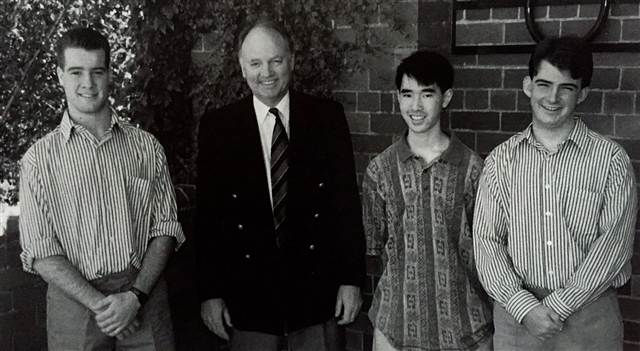
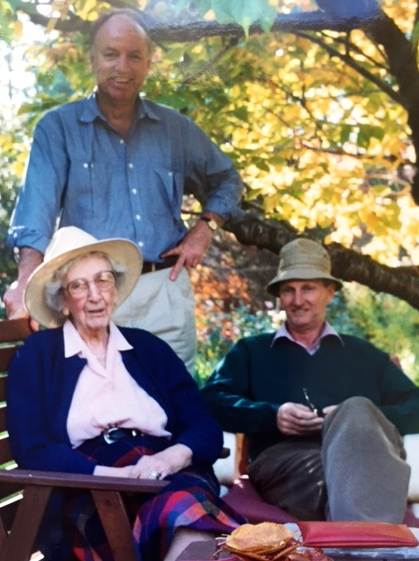
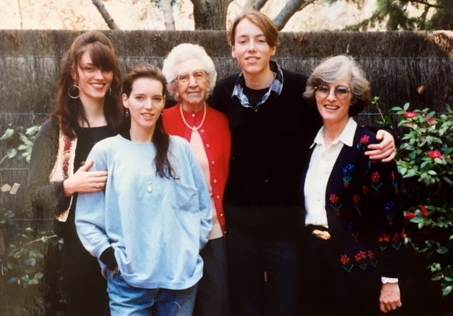
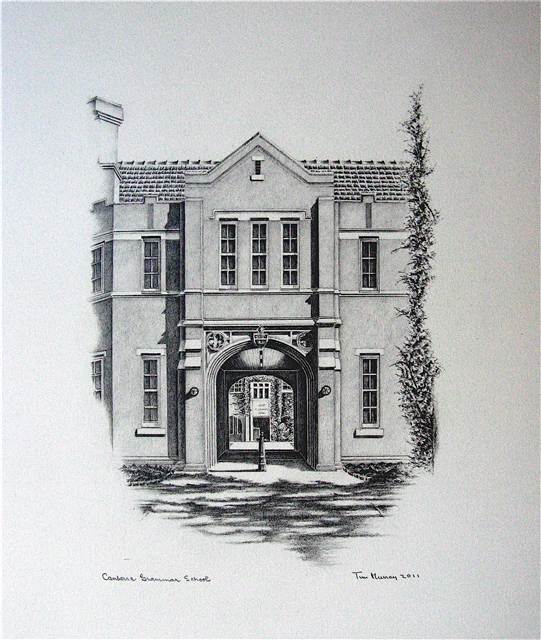
1986 – 1998
I remember at one Heads Conference Bruce Carter gave a Paper on The Head Who Changes Schools, Bruce having moved from being Head at Scotch Oakburn in Tasmania to being Head at Cranbrook in Sydney. The double meaning of the title of his talk was, of course, deliberate, and it struck a chord with me as I moved from a small country coeducational school to a big school for boys in the Nation's Capital.
It was, of course, a big change for the whole family and I felt for the children as they faced the unknown at the beginning of 1986. Early in the New Year we drove back to Canberra to get things established in our new home and then we drove down to Merimbula where we had rented a holiday house. It was very important for everyone to relax and take a break before facing the next stage of our lives. I hope I relaxed for a while. Doubtless my mind was beginning to focus on what lay ahead and all the 'firsts' with which I would be faced: first meeting with staff; first Board Meeting; first school assembly; commissioning and so on. 'The less said the better' perhaps! Bruce Topfer, a straight-shooting lawyer-cum-farmer who had succeeded Peter Bailey as Chairman of the Board, had arranged to introduce me to the staff at a meeting before the school year began and so I prepared a talk for that which I called Torches, Artichokes and Acorns and I have included it as Appendix 1 to this chapter.
Caitlin and Lisa would attend the Girls Grammar School, Caitlin in Year 12 and Lisa in Year 9. Andy would be in Grade 5 in the CGS Junior School. The original Terms of Appointment stated that 'Children of the Head will receive tuition at the School free, where applicable.' Obviously Andy's education was the only one that was 'applicable', CGS being a School for Boys. I was very grateful that Bruce Topfer wrote in his letter of appointment that the Board had agreed to meet Caitlin and Lisa's school fees at CCEGGS.
Caitlin's achievement in her one year at CCEGGS did her so much credit. It couldn't have been easy for her to settle in, make friends, get accepted and become involved. She did it all with flying colours before she headed off to The University of Melbourne and Trinity College at the beginning of 1987 - the third generation Murray at Trinity. How sad that Charles Murray did not live to see that. Charles Murray would have been delighted to learn that probably Caitlin's greatest friend at Trinity was Kate Oliver. Kate was the granddaughter of Frank Oliver, one of Charles Murray's greatest friends. In one of the many letters Charles wrote to his mother from Oxford in the 1920s he referred to the fact that he was going to visit Frank's grandmother - 'one of the old school so I will be careful.' Caitlin is Godmother to Kate's daughter so perhaps 160 years are represented in the six generations of friendship between these two families.
Lisa had two years at Girls Grammar where she made a number of good friends. She didn't much take to being in the academically and socially competitive environment of a Girls School and was glad to move on to Narrabundah College for Years 11 and 12.
Andy had six years at CGS before he, too, went to Narrabundah for his final two years. He even boarded in Jones House where John Pascoe was Housemaster when Anne and I went overseas on Study Leave. I think he quite enjoyed parts of CGS but it wasn't really his scene. Hamilton College would have been a better environment for him.
Once we had all got started Anne was keen to take on part-time employment. I have included the curriculum vitae she compiled as Appendix 2 to this chapter. For much of the first two years she was a Receptionist and Nurse with the Dentist Dr Weissel in Lyneham. For the next nine years until 1996 she was Receptionist and Nurse with Dr David Wilson in Kingston. For the final two years she did similar duties for Dr John Eather and Dr Tom Middlemiss for two days each. I can still see her heading off on her bicycle down the school drive bound for Kingston or Deakin. Alas it was while she was working for Dr Wilson that she got the disease that was ultimately responsible for her death. The best way to explain what happened is to quote the email Anne sent to Andy on the subject of hearts on 17 November 2009. This was in response to an email from Andy in which he wrote:
I am in the process of seeing specialists about my heart and taking advantage of this free health care. I was wondering, Lisa and mum, if you guys could tell me exactly in a sentence or even a couple of words what your heart conditions are called.
In her reply Anne pointed out that her and Lisa’s heart conditions were different, and she said this in relation to her own:
Mine is due to the ‘undifferentiated connective tissue disease’ that I have, triggered by a dose of very nasty gastro that a patient had and passed on to me in 1993. This causes inflammation around the body, anywhere there is connective tissue which is in fact almost everywhere. So muscles, tendons, joints – small ones first and now large ones - and also to the blood vessels. The blood vessel inflammation means the vessels are constricted and so the heart has to work harder to push the blood through them. This has given me ‘pulmonary hypertension’ ie increased blood pressure in the main vessel taking blood from the heart to the lungs – the right side, and the opposite side to Lisa’s problem. It has also caused ‘mild mitral and tricuspid valve regurgitation’, and ‘trivial regurgitation’ in the other two valves. I am on sotalol, nifedipiine and dithiazide, and perindopril arginine for my heart and blood pressure plus a heap of others for inflammation.
From the beginning of our time in Canberra Anne was determined to continue learning the cello, and finding a teacher was an early priority. Perhaps the best way to explain how Anne found a teacher and how her music blossomed in Canberra is to quote the eulogy I gave for Vladimir Doitschinov in the CCEGGS Chapel on 19 May 1994. Stephen Prickett who organised the Celebration of Vladimir's Life and was a great friend asked me to talk about 'Vladimir the Music Teacher' and this is what I said:
When Stephen asked me to say a few words today I found it impossible to say 'No' and almost impossible to say 'Yes'.
The Murrays arrived in Canberra on 1 January, 1986; the Doitschinovs arrived in Canberra on 2nd January the same year. It was quite a while before the Canberra Times had anything to say about the Murrays, and then it was in the context of my being a mean and nasty Headmaster. It only took a few days before there was a full-page spread on the Doitschinovs and the Stringed Instrument Centre and the musical talents they were bringing to Canberra.
Anne wanted to continue learning the cello; she contacted Lindy. Lindy was prepared to take on anybody at the time and so the Murray/Doitschinov friendship began!
Vladimir taught cello and double bass to boys and girls in our two schools. Jenny Kain said this about Vladimir, 'With his students, Vladimir was infinitely patient; he understood their youth. He never compromised his musical standards, and never ceased his efforts to have his students aspire to the very best performance, the very deepest understanding of their music. Yet he loved them all in such a way that his reprimands and criticism were within a framework to which each could respond.'
One of his Year 9 students said to me yesterday, 'Vladimir was a very kind and considerate man. He always wanted to know how recitals went and always tried to come along to hear me play if he could. He was also willing to help me on weekends if I needed it before an exam. He was a very good teacher and with his help I have achieved a great deal in just over two years.'
In Vladimir's first years in Canberra he was shy about his English so he went to TAFE. One of his early triumphs was having enough English to catch the bus to TAFE by himself. Once he was more confident he started taking on adult students and no doubt that helped in developing a colloquial turn of phrase. Always patient, always kind, always generous, always humble; never irritated by beginners, never judgemental, never raising his voice. Perhaps he kept some less virtuous moments for home!
Individual lessons led on to cello days at the school for his adult students and he spoilt them rotten with cheese pastries and elaborate chocolate cakes.
When Musica de Camera needed a bass player Vladimir would oblige, and when everyone else was pacing around twitching and retuning, Vladimir was cool as a cucumber enjoying the scenery, having an apple or a glass of milk - and at the end of the concert, whatever its quality, he would say to the conductor 'magnificent, maestro!'
Something of a tradition developed at the school and in our house over the years with another cello day when Lindy and Vladimir and their adult students celebrated their music-making in the first part of a late December afternoon and then their families were captive audience at a unique performance.
I remember one perfect summer's day when everyone came back to our garden for afternoon tea. All the trials and tribulations of the school year were over and I was decidedly relaxed on the terrace under a hat and a clear blue sky. Vladimir saw me, gave a big smile, shook my hand warmly and said, 'Next time around I will be a Headmaster.' To which I replied 'Next time around, if it's like this all year, so will I: otherwise I'll be a cellist.'
The cello days were followed by cello evenings when the Salon Players made beautiful music in the garden and the rest of us relished every moment. I always ensured that lighting was rigged up so, when dusk gave way to dark, the Salon Players wouldn't really notice and would play on into the night and give us some of the most peaceful and beautiful moments in our ridiculously hectic lives.
When I think of Vladimir I think of peace and beauty although his life was ridiculously hectic too. His humility, his gentleness, his generosity, his sensitivity, his sincerity and his sheer talent touched our lives and the lives of many in our schools. It's our privilege to celebrate the gift of Vladimir Doitschinov.
Anne purchased her beautiful German cello from Lindy and she loved playing it for the rest of her life. She played that instrument in a quartet on 19 May 1994 with Louise Butler, Justine Gibbons and Maria Prickett - all adult cello students of Lindy. It was a huge musical and emotional challenge for Anne but she did it. They played Mozart's Ave Verum which had a special place in her heart and which Mary and Michael Tatchell sang at the Celebration of Anne's Life, accompanied by Lindy playing Anne's cello.
At the Service on 19 May 1994 Jan Reksten spoke about Vladimir the Craftsman and Instrument-maker. Jan, too, was and is, a fine craftsman. He has made two beautiful violins and he made an occasional table for Anne which stands beside her favourite chair at home. Several years later Jan and Lindy married and they have both remained firm and faithful friends of the Murrays to this day.
In my eulogy I referred to the wonderful Salon Players. Anne and I attended their first Concert when they played The Trout by Schubert at the Beaver Galleries in Canberra - Vicki and Reg, Lindy and Vladimir, Jill and George. What an evening. Unforgettable.
In my eulogy I made reference to Musica de Camera. Anne played with that group for years and loved it. They played so many concerts in Canberra and in surrounding towns. It was a delight to be able to support them by allowing them to use the school for rehearsals and concerts.
Music. Music. Music. How fortunate we were to arrive in Canberra at the same time as Lindy. She was, in fact, returning to Canberra after a number of years living and making music in Bavaria. It was there that destiny brought her and Vladimir together.
Music was such an important part of family, school and Canberra life. Tommy Garnett had said 'I wonder if you will succeed (or want to) in joining forces to a greater extent with the girls.' I certainly did want to and music and drama were a very good starting point. It was clear that the relationship between CGS and CCEGGS was virtually non-existent. In the AHISA Conference at CGS the previous year the Girls School and Principal were totally ignored by Paul McKeown. I made it my business to get to know Liz McKay, Principal of CCEGGS, and we became good friends. A thaw between the two schools quickly set in. It seemed so silly that we made no music together. Some tensions and misunderstandings prevailed at staff level so I soon invited the key music staff from both schools to sit down together in our Board Room, thrash it out and emerge with some positive resolutions. 'Be honest with each other' I encouraged them. They were. What they discovered was that their differences were petty and minor or didn't really exist at all. The result was that we developed very fine combined orchestras and bands and an exquisite Motet Choir. Over the next 30 years the Combined Music Programme thrived until CGS became coeducational at the beginning of 2017.
Having been in coeducational schools for the previous 15 years I wasn't madly excited about being back in an all-boys school. In the early years we looked carefully at the possibility of our becoming coeducational but the time was not right during my headmastership. In a substantial report to the School Board in July 1991 entitled Reflections on Study Leave and Future Planning I wrote the following on the subject of Boys and Girls:
The trend to coeducational schools is very pronounced. While some of this trend may be explained in terms of economic necessity, it is very much more a function of educational philosophy. All things being equal, I would have Canberra Grammar School be coeducational throughout. The time may well come when this is possible as a result of changed circumstances within and outside the School. If this proves to be the case, then I believe we should be very positive about making such a move. However, all things are not equal.
I went on to explain why the time was not yet right to become coeducational and then concluded
It is important, therefore, to contribute to the education of boys and girls in a way that extends the practices that already exist. Debating, Music, Drama, History Society, Services, Service, social activity - these are some of the areas in which there is a good deal of sharing. We must encourage these and develop others, not necessarily only with CCEGGS, but with other schools and other groups, too. I believe there is an increased maturity and harmony in the way young people of both sexes relate here, despite our school not being coeducational. We can and must develop this further.
I hope Tommy would have been pleased with what we were able to achieve.
When I arrived at CGS we had four members of staff from overseas on exchange: Chris Featonby from Wanganui, New Zealand; Marek Kwiatkowski from Marlborough in the UK; Rick Raumann from Canford in the UK and Colin Skinner from St Michael's University School, Canada. They were all good value especially Colin Skinner who had a touch of genius in his English teaching and as a man of the theatre. He was extremely deaf which made life difficult but his production of A Midsummer Night's Dream was a delight. Caitlin enjoyed being in the cast and playing the part of Hermia. She continued her interest in the theatre playing in several productions at Trinity College, just as her father and grandfather had done before her.
In August that first year I put on one of those Music Hall evenings that I had done at GGS and Hamilton College: this time it was a 'Mystery Night'. Colin Skinner featured as the Inspector in Streuth and did a brilliant Stanley Holloway recital of Albert and the Lion. Two years later we followed up with a 'Surprise Night'. All good fun. Colin's style was well described by the Head of English, Bruce Fairfax, in his farewell article for the School Magazine. This was the first paragraph:
It's the eyes that strike you first: the shining eyes of an exuberant, over-excited six foot tall leprechaun just about to perpetrate his next piece of exuberant mischief. How appropriate that Colin should choose to produce A Midsummer Night's Dream; Puck could teach Colin nothing, he knew it already. The first time I walked into his classroom I found a group of boys perched precariously on a desk clinging to each other as if for very life while the rest of the class stretched avariciously towards them from the classroom floor. Midsummer madness had struck early in Room 102 and Colin explained airily that imaginative re-creation was at work - or was it play? It was hard to distinguish in Colin's classroom where the driest subject was invested with an insane delight and the normal was non-existent. Those involved with 'Dream', as it came to be called, will realise that it was simply an embodiment of the life-giving spirit of fun that bubbled out of Colin in an apparently un-ending spring of good humour.
What an eccentric inspiration. Wonderful! Tommy would have approved of this sort of madness.
JR Darling had encouraged me to give myself time to look around and assess the situation before acting. I did that - and I didn't like all of what I saw.
Philosophically and physically the four parts of the School were very separate and isolated from each other: Senior School (Boys Years 7 - 12); Junior School (Boys Years 3 - 6); Infants School, Red Hill (Boys and Girls Years P - 2); Infants School, Northside - not far from the War Memorial (Boys and Girls P - 2). The two Infants Schools did not relate to each other and neither related to the Junior School. Physically, between the Junior School and the Senior School there was the Maintenance building and compound full of rusted old machinery, and six derelict wooden huts that had formerly been part of the Snowy Mountains Hydro-Electric Scheme being used for workers' accommodation in the 1950s. They were literally falling down and housed teaching rooms, craft, Uniform Shops and storage. I was delighted that one Sunday morning while we were in Chapel a big gum tree fell on one. It was unoccupied mercifully and I regarded it as an 'Act of God'.
As soon as we could we relocated the Maintenance Department and got rid of the huts. This opened up the space between the Junior and Senior School and we were able to build a very substantial Resource Centre and International Centre accessible to all parts of the School.
When my friend Peter Pockley wrote to me congratulating me on my appointment he referred to my 'translation from educating the children of the land to those of people in power.' It didn't take me long to understand what he meant as I tried to follow Dr Darling's advice to give myself time to look around and assess the situation before acting. In the first week this involved the Induction of School Prefects who had already been appointed before I arrived. In accordance with tradition we invited the parents of the school prefects (about 25) and their sons to lunch and then moved to the Hall for the Induction Ceremony where they all sat at the front and the remaining 120 Year 12 boys sat at the back. The ceremony was full of absurd questions and promises and rituals. I found it highly embarrassing, not least for all those able boys at the back who were excluded. For the few years that we kept the 'institution' of School Prefect I always received a number of angry letters from hostile parents who assured me that I had destroyed their son and shamed their family by not including their son in the list. There were so many capable boys in each Year Group, it was absurd to choose this sort of elite. I was delighted to move to a system where we retained captains and vice captains of School and Houses, sports and activities but did not divide Year 12 into prefects and non-prefects - but rather expected leadership and contributions from them all in different ways. Even so, when we made this move, one member of the School Board said to me that I had got it all wrong because 'There are winners and losers in this life and they needed to understand that.' I was incredulous. Essentially he was telling me that I should be telling 150 very capable seventeen year olds that one sixth of them were 'winners' and five sixths of them were 'losers'.
A second example was the Cadets. As I wandered round the School after classes on Tuesdays to see how the Cadet Unit functioned I quickly became convinced that what I saw was institutionalised bullying. At the big parade at which I had to take the salute - bit of a come-down from dixie-bashing and latrines - the visiting speaker congratulated the cadets on their manly activity as opposed to those in the 'granny parade' who were helping people in nursing homes as an alternative to Cadets. I was very pleased that we quickly established a new outdoor programme for the whole of Year 9 so Cadets became unnecessary and could be disbanded. I liked the fact that we appointed the intrepid John Wilde to run the outdoor programme whereas Christine Brain had been appointed as Librarian!
After one year of witnessing the Year Group Orders to which Peter Westcott had referred the system was abolished. Four times during that first year every boy in every subject was ranked from one to 140 or whatever the total number in the Year Group was, and the list was publicised. It was used by teachers to congratulate boys on 'going up' and therefore 'improving', and to chastise boys for 'going down' and therefore needing to work harder. It was very consistent with that member of the Board's observation that there are winners and losers in life, but it was calculated in my view to make the 'top' more arrogant and the 'bottom' more demoralised and so it was totally unacceptable.
A further practice I identified as I gave myself time to 'look around and assess' was a very unpleasant initiation ceremony that was part of the boarding house culture. It staggers me that the two boarding housemasters, both of whom went on to become eminent headmasters, knew of the practice and allowed it to continue. When I heard about it I called housemasters, resident tutors and all boarders together, described what I understood to be the practice (dunking newcomers head first into a rubbish bin of 'slops' collected specially for the purpose from the kitchen), established that the older boys, now the perpetrators, had hated the practice when they were the victims, and assured them that we were not going to phase it out, we were going to cut it out, IMMEDIATELY.
A fifth dimension of the culture was reflected in a conversation I had with the Senior Master responsible for the curriculum and timetable when I visited for a couple of days when Paul was still there. The Senior Master, who also went on to be a very long-serving Headmaster in Brisbane and Sydney, was complaining to me about various things in the curriculum that were in urgent need of change. I said that he should obviously go and talk to the Headmaster about the issues. 'What?' he exclaimed, 'and get my head bitten off yet again? No way!' Clearly I was not going to languish in a state of boredom at Canberra Grammar School!
I think I was a disappointment to the rugby fraternity. My inclination was to treat all sports equally and to watch as much as I could at all levels as often as I could. I could not bring myself to go into the changing room of the 1st XV before and after matches or sit in a special enclosure. I just wanted to stand around with everyone else. I guess I had not been brought up with the mantra that 'Rugby is the game they play in Heaven' - the theme of the first rugby dinner I attended.
When I arrived all the staff called me 'Headmaster' and one of the older ones called me 'Sir'. I felt I had to let them know what I expected so I told them that in front of the boys I was 'Mr Murray' while more privately I was either 'Mr Murray' or 'Tim' whichever suited them better. You never know what small things are seen as a fundamental change of style and relationship. When Peter Lennox addressed his first school assembly at Brisbane Grammar School he said 'Sit down please gentlemen' unaware that he had immediately effected a quiet revolution. His predecessor, Max Howell, had always said simply 'Sit'!
When there was something of a crisis in 1992 and I took a hard line in relation to drug-taking Pam Guilfoyle said to me 'Now you understand the Canberra scene rather better where everything is negotiable and there is no bottom line.' Bruce Topfer's successor as Chairman of the Board referred to parents as the 'client base'. I remember an interesting exchange I had with a powerful member of the 'Client Base' who was used to throwing his weight around and getting what he wanted now if not sooner. His son was a boarder and had exactly the same attitude. The son was not happy with some aspect of his study conditions and when father complained I referred him to the Housemaster. He was used to going straight to the top and his response was certainly a red rag to this particular bull. His letter to me included the following:
It is not an administrative matter to be sorted out between me and the Housemaster: it is a matter I am raising with you as Chief Executive Officer of a Company which has clear obligations to me as consumer.
I was beginning to understand Peter Pockley's remark about my 'translation from educating the children of the land to those of people in power'!
When I arrived at Canberra Grammar the School did not have a Prospectus and held no Open Days. All boys sat an Entrance Exam before being accepted by a school that claimed to be for boys of 'average to very high ability'. Quite often families were ostracised because one brother was accepted while another was rejected. Its best propaganda was 'No Vacancy'. Circumstances were changing before I arrived. Radford College opened its doors in 1985 and was a low-fee coeducational Anglican school, a very attractive proposition for many families. Soon in 1987 the 'recession we had to have' undermined parents' and the School's financial positions. We had to change our attitude to enrolments and to all aspects of the way we presented ourselves. No bad thing either.
All these things combined to make rather a fascinating challenge, and so much about the culture, composition and public face of the School changed in those early years of our time in Canberra.
At an early Open Day I spoke about 'Learning' - perhaps not surprising in such a setting. I suggested to parents that the learning boys should enjoy while they were at CGS should be essentially four-fold:
Firstly, they should learn to learn. That is, they should develop the motivation and resources to be responsible for their own learning. They should develop habits of mind, the capacity to think, to discriminate, to articulate.
Secondly, they should learn to give. That is, they should develop a sense of responsibility, a concern for the welfare of others and a desire to give of their gifts.
Thirdly, they should learn to stand. That is, they should build solid foundations for their behaviour and a code of ethics by which to live. Indeed, they should develop a desire for discipline; and
Fourthly, they should learn to fly. That is, they should develop a spirit of enquiry and adventure, a desire to explore, have visions, reach out, grow, take off - a desire for freedom.
From that early Open Day until my final year I came back to those four concepts and the words became enshrined in the School Aims. Not surprisingly my successor wanted to put his own stamp on things in his own style and before I had even left these words had been replaced by rather prosaic clichés - but I mustn't say that must I!
It was never difficult at CGS to celebrate achievement. So many of the boys were so capable. I said to the staff on more than one occasion that if they were ever feeling rather flat or depressed all they needed to do to cheer themselves up was look at the bright eyes of the boys. Every day we celebrated achievements but at my first Speech Day in 1986 I tried to get things in perspective:
Let's test our real quality as a school by seeking to help every boy pursue his own excellence - not only the natural high-flyers or those who like the spotlight up front .
Let's give credit to the quiet achievers, the honest toilers.
Let's be sensitive to those who fight their own individual battles because of personal problems or parental break-up.
Let's enjoy the Under 13 D Team, as well as the 1st XI; let's recognise the value of Athletics Standards for every boy; let's acknowledge a boy's overcoming of fear on the rock-face or overcoming of pain in the marathon; let's ensure that encouragement to do one's best is not sacrificed to unreasonable pressure and unrealistic expectations; let's applaud those who receive Encouragement Awards and Citizenship Prizes; let's not forget the lighting crews, the backstage boys, the support staff; let's strive to help every boy have a taste of success - a sense of personal fulfilment - to experience the joy of doing something to the best of his ability.
So often we shared moments that had the capacity to inspire if we were open and receptive. These may have been at the Goulburn Cathedral when the whole school travelled by vintage train to record carols for our bicentenary recording, or at the annual National Capital Seminar at CGS or in the Combined Schools Music Festival or at the dedication of the Peace Window in the Chapel or at the Service to mark 'Australia Remembers' or the completion of the cross country run by a boy on crutches whose leg had been amputated or at the annual Evening of Fine Music begun in 1987 or during Arts Week or listening to a talk from a visitor or a boy in Assembly. There were so many 'moments' I feel compelled to include words from just three of the inspiring moments that I remember.
At my first Speech Day in 1986 James Wilson-Hogg was our guest and he concluded his speech with these words:
The deepest purpose of this school is to give knowledge a direction by producing men of Christian character. And the importance of this concept has increased decade by decade through the violent tumultuous, morally disruptive years my life has spanned.
Traditionally and historically, knowledge and morality - married in education - have walked hand in hand, but in the years of this century their fingers have loosed; their hands are in danger of falling apart, - and should they altogether part, knowledge will become no more than a sword in the hand of a blind man.
Here is part of a letter that says it all: it is written by a headmaster in America to his staff: "I am a survivor from a Concentration Camp. My eyes saw what no man should ever witness: gas chambers built by learned engineers; children poisoned by qualified physicians; infants killed by trained nurses; women and children shot and burned by High School and University Graduates....." Learned; qualified; trained; informed; skilled. But educated? You young men are intelligent human beings.
I leave the answer to you.
On 21 February 1988 Sir Mark Oliphant spoke in the Chapel. His grandson, Michael Wilson, was a boy and a chorister at the School and we were privileged to have Sir Mark join us on many occasions. This time his special purpose was to present a silver cross that he himself had fashioned to the Head Chorister - and the Head Chorister was his grandson. This is what Sir Mark said:
As a man of science, I am filled with wonder at the magnitude and complexity of the Universe, in which our Earth is a minor planet in a minor solar system, at the edge of a Galaxy of millions of millions of stars, the Milky Way, itself one of millions of millions of such galaxies existing throughout space. The Universe can be studied with optical and radio telescopes of ever-increasing power. The most distant galaxies which can be detected at present, are so far away that the light from them has been travelling through space for more than ten thousand million years before reaching the Earth, and light travels at a speed of three hundred thousand kilometres every second! So, we study the distant parts of the Universe as they were ten million years ago! Explorers, called astronomers, study this Universe, the matter of which it is made, the space in which it exists, the forces - electric, magnetic, nuclear, and gravitational - which hold it all together, and the radiations - light, radio, x-rays, and cosmic-ray particles - which fill all space.
Closer to home, this planet, Earth, is the only place in the solar system where the extraordinary phenomenon of life exists. Life is therefore very precious, in every form. Living creatures, from minute viruses to bacteria, plants, animals, and man, are all made of the same materials as the sea, the rocks, and the sand or soil upon the Earth's surface. Science has unravelled many of the complexities of structure, function, and other properties of living matter, and of the genetic code which enabled evolution to take place, with thinking Man as its pinnacle. But what life is remains a complete mystery.
We must remember always that life is fragile, that every form in which it is expressed can so easily be destroyed. Man, by changing the interactions between all forms of life, by interference with the genetic code of reproduction, by misuse of nuclear energy in warfare, using knowledge to satisfy greed and the desire for power over others, now possesses the means to destroy civilization, and even eliminate life itself from the Earth.
Realization that there are not only facts which can be used for gain, in this Universe, but also values - spiritual, indefinable values - in the life of Man, is what this Chapel exists to teach. Perhaps music and harmony, and the beauty of language, are special symbols of these values of the spirit. That is why, possessing no artistic abilities, I have made a very simple, but universally recognised expression of these values, which has been accepted by this school to be worn by the Head Chorister. I thank the Headmaster, and all members of this School, for your kindness.
On 5 February 1997 the Dux of 1996, Adrian Fung, returned to the School to speak at the first School Assembly. Adrian had gained a TER of 99.90. This is what he said:
Mr Murray, staff and students, I am very pleased and honoured to have this opportunity to share a few of my thoughts at the start of a new school year.
Ten years ago I arrived at Canberra Grammar School, and every year since then I have wondered what it took to be Dux. What characteristics, what attributes, what traits were required? Cerebral brilliance, perhaps, coupled with profound insight, a cool rationale and the ability to succeed in every assessment and every exam? You may be surprised then to learn, as I was, that the Dux I am most familiar with, myself, was not strong in these regards.
How then, you ask, do I come to stand before you today? Recently I asked myself the same question, and came up with three answers. But before I disclose these I would like to tell you a story. It's the story of the maths paper and the three boys.
Once upon a time there lived three boys who had to sit a maths paper. The first boy was smart and intelligent, but careless. He did well on the maths paper, but still made errors which he shouldn't have. The second was not as intelligent as the first, and decided that he would not attempt any questions because they were too hard. As a result he did very poorly on the paper. The third was similar to the second - of only average intelligence. But unlike the second boy he tried his best on the exam. After receiving his paper back he made sure to learn from his errors so as not to make the same mistake twice.
Which boy are you? The first, the second or the third? I would put it to you that only one of them was worth being. Only one applied himself to do his best, to learn from his mistakes. That is, the third boy.
It is for the qualities of the third boy that I am standing here today. The qualities of failure, hard work and humility.
The first - failure - is rather paradoxical in nature. 'But I fail all the time,' you say, 'and I don't succeed.' Perhaps it is not so much failure but the lessons learnt from it which are paramount.
Failure, like the other of life's fears, has to be confronted head-on. It should be viewed positively rather than negatively. Without it one does not improve, learn or grow - one is prone to self-contentment and satisfaction. It is a fact of life that none of us is perfect, that we all make mistakes. But there are two ways to cope with failure. The first is to be defeated by it. To push it away and ignore it. To say that it is too hard, too difficult, or that we just can't be bothered. The other, more difficult choice is to defeat it. Defeat it by admitting our mistakes not just to others, but to ourselves. Always remember: to make a mistake once is to be human. To make the same mistake again is to fault.
When we look at the true champions of our lives, it is not how well they cope in good times that counts, but how determined they are when the going gets tough. With that determination comes a lot of hard work - the second criterion for success. Too often it is easy to equate success with talent. To say that we're no good at something because we are not smart enough, talented enough or strong enough. To me, that attitude is mere laziness - the 'bludge' culture which regrettably exists in our society. This is not to say that there should not be times for fun and relaxation - only that there is a time for work and a time for play.
I have always placed brains second to effort. Brains are merely what we are lucky enough to be given - effort is what we decide to do with it. Never be afraid of hard work and, furthermore, never be ashamed of it. More often than not, it will take us far further than we could ever imagine.
Criterion number three - humility. To be gracious in defeat, humble in success. These are principles which I have tried, if not always successfully, to live by. It would be very naive of me to think that the TER I received was solely mine, because it wasn't. Without you - this school, without my teachers, my family and friends as support, I would never have come this far. For this, I would simply like to say: thank you.
If there is one message I would like you to take away with you today, it's this. Don't strive to be the best - strive to be your best. When you strive to be the best, you're striving to be someone else's best - something that you cannot always achieve. Even 'the best' can only be so for a short period of time, a fleeting moment. When you strive to be your best, and achieve that, the satisfaction outweighs any material accolades that you can receive. You're fulfilling your potential.
I wish you good luck in 1997. I hope that you will be one of those people who chooses to do the difficult things in life, rather than the easy. I hope you find success, whether it be academic, cultural, social or spiritual. Most of all, I hope you enjoy learning in what must be some of the most trying but rewarding years of your life. Have a good year.
I remember the acclaim that followed Adrian's speech. When finally it faded to silence I let the silence speak for quite some seconds before moving. It was quite a moment. We all sensed that we were in the presence of a very fine young man. Twenty two years on, Professor Adrian Fung is a brilliant vitreoretinal surgeon and macular disease specialist.
Among the photographs I have included for this chapter there is a photograph taken on the morning Adrian gave that speech at assembly. With Adrian and me are the Captain and Vice Captain of school, Carl O'Sullivan and Ben Jackson. Two more capable, loyal and delightful young men you could not wish to meet. Carl had a natural bearing of strength and humility about him. When he wept during his final address to the School everyone stood and applauded until he was ready to go on. Vice Captain Ben was a fine debater and very responsive to the needs and sensitivities of others, not being 'manly' in the old-fashioned schoolboy sense. Late one winter afternoon I was working in my study when there was a knock on the door. It was Ben. He said 'I saw your light on and thought I would come and say hello. It's lonely at the top.' Dear Ben!
Naturally during our time in Canberra there was a fair bit of travelling in Australia. During most holidays we didn't go far afield. Christmas tended to be spent in Canberra or Geelong with New Year often spent in Geelong or Melbourne. The Boxing Day Test Match regularly beckoned and we stayed at Cook Street in Newtown or with the Brians at the top of Collins Street in their apartment. AHISA and NCISA Conferences took us to Hobart, Perth, Adelaide, Melbourne, Sydney and Brisbane. For one of our Perth trips Anne and I decided to go on the Indian Pacific Train from Sydney which we found very relaxing after a long term. I recall at the previous Speech Day the Board Chairman, Don Dyer, had said that expressions like 'On Line Real Time' were very familiar to the Headmaster. I tried to show no visible sign of surprise but actually had no idea what he was talking about. On that trip to Perth I bought a postcard of a train stationary on the railway line that stretched on and on into the horizon and I sent it to Don Dyer saying 'Now I know what you mean by On Line Real Time.' Technology was not my strong point! I remember when the Assistant Librarian, Anna Steele, asked me if I would be happy if she and two boys developed a school website. I didn't actually know what she was talking about. However I knew that she and those two particular boys were totally responsible and very able so I assured her I thought it was an excellent idea!
Anne came to all the Conferences. She was friends with many of the Heads and their wives and enjoyed their company and many local expeditions together. I remember that Andy flew over to join us at the Perth Conference and the whole family came to a Conference in Brisbane.
Naturally during our time in Canberra we were anxious to ensure that we were providing for our retirement as best we could. We had the property in Hawthorn which we had purchased in 1984 and we hoped my superannuation Fund with AMP would build reasonably well. In July 1989 we decided to buy a Studio Apartment at 4/45 Hampton Circuit, Yarralumla. It was a charming little spot and brought in a reasonable rent to help pay off the mortgage of $80,000. The interest rate we had to pay to Westpac was a staggering 19%. A tenant of one of the other apartments in that block was the Foreign Minister, Gareth Evans, and we assume that it was there that he had his 'foreign affair'! Meanwhile we regularly checked out the property market in Melbourne since we had decided that it was there that we would retire. On Boxing Day 1993 I drove to Melbourne to go to the Test Match at the MCG leaving Anne in Canberra since she had to work. The early days of the cricket were washed out and so I checked the paper for any properties that might have missed out at auction before Christmas. I saw several and arranged inspections. 40 Ellerslie Place looked as though it ticked nearly all the boxes that Anne and I had agreed on so I telephoned her suggesting she come and have a look. She came. We looked. We bought. It cost us $365,000 and we took out a 7.95% fixed interest rate loan with Westpac. To begin with the people we bought it from were our tenants and then Roger Hayward and Jean rented it for several years. Early in 1995 we sold the Yarralumla Studio Apartment for $95,000 and when we retired in the middle of 1998 we were able to pay off the small amount owing on Ellerslie Place and move into our own home debt-free while still retaining 2/18 Riversdale Road Hawthorn.
Happily from time to time as I was trying to run the school I could engage in a theatrical production to keep the rumour alive that I was capable of doing something. My third Oliver! hit the stage there in 1987 with Year 12 boy Adam Trevena a brilliant Fagin Of those three productions I think most fondly of the one at Hamilton College and the reason for this is very clear. At GGS and CGS we had to 'import' all the girls from The Hermitage and CCEGGS. I remember the artificial 'hype' generated by the arrival of about 30 girls for rehearsal and the difficulty of getting boys and girls who didn't know each other to work together unselfconsciously. At coeducational Hamilton College rehearsals were just another dimension to daily life. No image or relationship issues to contend with. Peter Westcott sensed all that when he reviewed Paint Your Wagon at Corio the year after Oliver! by which time we were a coeducational school and a new maturity and coming-of-age was obvious. A great advertisement for coeducation if, indeed, it needs one at all.
I did my third production of A Man for All Seasons , this time in the chapel; my fourth production of Lord of the Flies and probably the best of the four; an evening of Music and Drama consisting of 'Pairs' - The Problem by AR Gurney, a scene from The Winslow Boy, in which I read the part of Sir Robert Morton, and Out of the Flying Pan (again!) by David Campton; my second production of Find Me which we did in the new Foyer we had built to link the War Memorial Hall with the Dining Hall and complete indoor access around the quadrangle at the upper level . There were some fine actors in these casts including Sibylla Budd and Paul Ashton who went on to professional acting careers.
My final production was Kes, a dramatisation of the novel A Kestrel for a Knave by Barry Hines, which I did on the floor of the War Memorial Hall where I had set up an interesting staging arrangement that allowed a very fluid production. Alas one sunny Saturday morning I was groping my way through the dark hall to turn on the lights only to fall over a box and tear the ligaments round my left knee leaving me in considerable pain sprawled in the middle of a dark deserted hall. At that moment the brass section of the orchestra was just outside rehearsing Peter Sculthorpe's Small Town and they were playing The Last Post. I thought my number was up! It all left me on crutches and that's the way I was for the official opening of the Health and PE Centre a couple of weeks later where I struck a rather unfortunate image. Robert de Castella, the marathon runner, opened that building and did so with a long and turgid speech. Afterwards a member of staff begged me to get a sprinter next time!
It's interesting to think of the buildings that were constructed during my 12 and a half years at CGS. There were many of them. Most of them, inevitably, were associated with the blood, sweat and tears of fund-raising and we conducted two major campaigns, one beginning in 1988 with the main focus being the building of the Resource Centre, and one beginning in 1993 focussing particularly on International Centre and extensions to the Junior School. I dread to think of how many cocktail parties we held in our house, how many dinners we attended, how many speeches I gave. Fund-raising is no fun. The present Head effected a massive coup when Old Boy and Developer Terry Snow gave the School $8 million!
When we left, the Senior Staff invited Anne and me to a farewell dinner. It was a delightful occasion comprising Anne and myself, Jim Windeyer (Deputy Head for the whole of my time), Bill Maude (Director of Studies), Daphne Fullagar (Director of the Co-Curricular Programme), Allan Shaw (Director of Staff Development) and Michael Chittenden (Head of the Primary School). They presented me with a plaque upon which was inscribed the following:
Presented to
Mr T.C.MURRAY
by the Senior Staff
In grateful thanks for
the 37 +/- brass plaques
he caused to be erected
in his time as
HEADMASTER OF
CANBERRA GRAMMAR SCHOOL
June 1998
It is over 32 years since we went to Canberra and 20 years since we left. Given the rate of change these days perhaps it's not surprising that most of the buildings for which I was responsible have been pulled down or have changed the purpose for which they are used or are programmed to be recycled in some way as part of yet another 'master plan'. At school, I remember reading Alfred, Lord Tennyson's poem In Memoriam AHH (a poem on the death of Arthur Henry Hallam) and these two lines have always stayed in my head:
Our little systems have their day; they have their day and cease to be.
We do our bit as best we can and we move on and times change and needs change ...........
While so much of my energy was focussed on 'our little systems' at Canberra Grammar, much was happening within the family. In April 1986 Mum finally came to Canberra to stay with us and then move to 'respite care' at Ainslie, finally moving in to residence at the Goodwin Home in Farrer in June. It had been a challenging six months for her aged 89 and, as I think about it now, I have great admiration for her patience and fortitude during that unsettling time. Not only did she manage to make the move she had to accept the death of her remaining friends so that she was the 'last woman standing'. On arriving at Goodwin she had to see a doctor. Not one to hide her prejudices she wrote to Michael on 10 June that she had the choice between a woman and a Chinese, 'So I chose the lesser of two evils and will have the woman'!
Anne's parents came to stay in1986 and there were later visits too, the last one being by Phyll on her own. While we were in Canberra Anne suffered the death of her father, her brother, Harry, and her sister, Jan. Harry died in Terang in 1987 aged only 54. Anne went down for the funeral and provided great support for the family. Phyll and Bill endured the death of their oldest son with stoicism. It must have been dreadful for them. I think of John Marsden's Prayer for the 21st Century which includes these two lines:
May we be outlived by our daughters May we be outlived by our sons.
Such poignant words for every parent.
Alas by the early 1990s Bill was moving towards dementure. The time inevitably came when Phyll could no longer be responsible for him at home. On 1 January 1993 I began keeping a diary. While it was something of a false start and didn't last beyond the end of the month, the entry I made on that first day of 1993 provides something of a family snapshot:
The year begins with much 'poised' in terms of family. Michael is in his 61st year and putting the finishing touches to his retirement plans. Gina's mother languishes in a nursing home four minutes from Westminster with legs swelling, clots threatening, bleeding, mindless and hopeless. Phyll will soon be in her 80th year and Anne in her 50th. Ian marries his partner and Josie languishes elsewhere. David and Lois return from Europe mid January full of culture and purpose and life and artistic talent. John and Jan struggle on gamely and lamely with perhaps a second wedding in the South Australian air. Bill ('Pa') is nursing- homed and 'away' in various 'aways' - so little in terms of life's quality that the only alternative is surely rather a better one. Ma soldiers on (a non-sexist term) in her 96th year and it seems to me that she'll be in full battle-dress for a year or two or more yet - mind alert, eyes just sharp enough to read, ears blocking out progressively more.
Caitlin at 24 is unemployed by degrees!. She has her B. Ed. but doesn't want to teach. She wants to do jewellery-making etc next year but is desperate for a job. Here's hoping. She has a lot of sorting out to do on a personal and professional level and perhaps '93 will see good things. Lisa, having dropped her second tertiary course is in 'no-person's' land - RMIT for print-making? Maybe. A job? Maybe. A boy friend? Yes, at the moment - and 'parent-friendly'. What will '93 bring for her? Andrew has Year 12 at Narrabundah and then - who knows? Drums? Jazz? Childcare? At least his job goes well at the moment and he's positive.
And what about TCM? I turn 58 this year. The Headmastership of Canberra Grammar is 'open-ended' to 65 Eight more years? Surely not! Three would see me 60 at the end of '95. I could finish then or possibly at the end of '96. Who knows?!
Bill died three weeks later on 21 January. David returned from overseas just in time to see him. Anne drove down from Canberra but didn't make it in time. I flew down on 26th for the funeral on the 27th. Caitlin was planning to be with the family for the funeral but in the middle of the previous night she fell down the steep, lethal stairs where she was living and Lisa took her to hospital with broken wrist and hand. It was not a happy time.
I flew back to Canberra that night and Anne drove back the next day with Caitlin getting back very late after I had a day full of appointments and six hours of meetings with Senior Staff. I recall saying to Roger Hayward at the end of it all 'Do you think things would have been any different for the boys if we hadn't met at all?' One does wonder! Roger was of the view that all meetings should be conducted standing up. Certainly that would sharpen the focus. I doubt if Roger practised what he preached when he ran St Leonard's College for 10 years.
Anne's sister, Jan, died on 28 December, 1995. In a collection of cuttings kept by Anne there is an article from The Canberra Times of 7 December 1997 describing the rare form of Meningitis caused by a fungus living on red gum. This is what caused Jan's death when she was still in her 50s - so sad. With those cuttings is a card Caitlin wrote to Anne the day after Jan's death in which she said,
Dear Mum. I woke up this morning feeling sad and thought of you waking up for many mornings feeling sad and wanted to send you a reminder card to say that I love you and am thinking of you. I hope you can feel the vibes!
Anne was a great one for sending 'positive vibes'!
Anne had, in her unobtrusive way, been a huge strength to John Tunbridge in those last weeks and months. John wrote,
Dear Anne. Just a note to say thanks for all your wonderful support. I am not sure that I would have survived here without you to lean on, even though I'm sure that has been rather unfair to you.
We all went to Jan's funeral at St David's Church Burnside on 3 January 1996. Taffy Jones, John's great friend from schooldays, gave the eulogy.
By now Michael and Gina had retired from Westminster and returned to live in Geelong. Gina suggested that they move to Canberra for a few years while Mum was still alive. Their presence gave Mum a new lease of life and Michael put together a volume entitled The Downhill Run - Mum's Life August 1994 - May 1996 as recorded in Michael's Diary.
Michael's presence gave Mum focus and purpose. Anne and I continued to do what we could as best we could. In retrospect, of course, it's tempting to regret that I didn't work a bit less and see Mum a bit more - but we did the best we could at the time. Mum died on 29 May 1996, well into her 99th year. Michael and I wrote a letter to people who we felt would like to know and that letter is Appendix 3 to this Chapter.
Mum left a piece of paper at the bottom of one of her drawers which she intended us to find after her death - as we did. On it she had written these words:
Silly Verse! Well here's another From your silly old stupid futile mother I am off to - well - Your guess is mine - My advice to you is "Have a good time" My last words without tears is "Cheers dears".
It's hard to read those words without tears. They are very typically Mum! The 'Silly Verse' reference relates back to those verses I wrote for her 80th birthday. I wrote a Postscript to those verses which I have included as Appendix 4 to this Chapter.
In those final verses I make reference to the fact that I had spent some time in the USA and kept Mum in touch with my doings by fax. By 1996 I was due for more Study Leave and I was fortunate that this coincided with a group of Heads going on a Study Tour to Boston and New England organised by the Association of Heads of Independent Schools. The tour lasted from 26 March to 29 April, much of this time coinciding with school holidays. Alas Anne was not able to join me since the illness that struck her back in 1993 was doing its damage and Anne was in a good deal of pain and her capacity to walk any distance was severely impeded. She was working on the appropriate medication but the rigour of such a trip was out of the question. She was very insistent that I should go. I would keep in regular contact by fax and she would share these with Mum who also selflessly encouraged me to go. She would share in my travels indirectly and, of course, count the days to my return.
I was very fortunate that our good friends Margaret and Alan Pearson were living in Washington at the time so I was able to stay with them for a number of days before and after the 'study' part of the tour in New England. I found Washington a fascinating city and spent most days exploring the superb monuments, public buildings and galleries of the National Mall. My time there coincided with the early days of Spring and the cherry blossom. I realised how much Burley Griffin owed to Washington in his plan for Canberra. I enjoyed sacred music, pop music and ballet at the Kennedy Centre; I was moved by the Holocaust Memorial Museum; I attended a Senate sitting at the Capitol, a fine service at the National Cathedral on Palm Sunday and much else besides including a flying trip to the University of West Virginia to consolidate links with the Physical Education Department of that University, links that had been forged by Nick Hately, a fine young teacher I had appointed to CGS and who is now Head of Trinity College, Gawler, a huge school with six campuses and over 3,500 students.
The New England Study Tour was a most stimulating and exciting time. I visited 11 schools altogether and greatly enjoyed the company of many friends and colleagues. The whole trip served to broaden the horizons, sharpen the focus and re-charge the batteries. Those five weeks are still very vivid in my mind. They constituted the only trip I made to the USA. I would love to have returned to Boston with Anne but it was not to be. One of the sharpest memories is seeing the headline in the Sydney Morning Herald on the morning of 29 April as I walked into the Qantas Lounge. There had been a mass shooting at Port Arthur in Tasmania. We soon became aware of the name Martin Bryant who was responsible for the murder of 35 people and the wounding of 23 others. It was an appalling tragedy. It led to much stricter gun controls in Australia. Regrettably no such action ever seems to take place in the USA despite countless massacres of a similar kind.
Five years earlier Anne and I had shared in my first lot of CGS Study Leave from 30 April to 22 June, 1991. By then Caitlin was working in Melbourne and living at 22 Stewart Street, Brunswick; Lisa had left school but was still living at home in Canberra and Andrew boarded in Jones House for the term. Ma was in Goodwin Home, Farrer, and I gave her addressed air letters and timing for her to keep in touch. Her letters form the first part of the Four Glimpses of Murray Life in the Early and Mid 1990s and give Mum's perspective on what was happening at CGS, Westminster School and on the Australian political stage, pulling no punches about her political persuasions!.
The 'Study' part of our trip did not begin until we reached the UK. Before that we enjoyed the charm and delights of Innsbruck, Salzburg, Vienna and a Danube cruise to Budapest. A huge highlight for Anne was our train trip from Innsbruck to Mittenwald - the home of cello/violin-making - where we visited the Workshop of Benedikt Lang who made Anne's cello. He was very charming and hospitable. It was something of a pilgrimage for Anne and she loved playing that cello until her frail body could play it no longer. She would be pleased that, at the time of writing, the beautiful instrument is being played by a fine young German Cellist.
Our home base in the UK was Bearwood College with our great friends Heather and Martin Penney. We visited many schools in order to keep faith with the 'study' dimension of our trip. Everyone was so friendly and welcoming. My experience at Wellington College where our host was Headmaster Jonty Driver, led to my thinking about developing an International Centre at CGS. The Board was so taken by the idea that only two years elapsed between concept and completion! That must be some kind of record given it was not part of any Master Plan! We caught up with the Snows in Taunton, and the Kenyons and Carnills in Cheltenham. We loved Yorkshire and the Lakes and Cambridge and London. What a treat. We spent a few days in Singapore where my old friend John Kirkham from school cricketing days and his wife Michelle were so generous and hospitable.
I kept a substantial diary during our time away. My final entry on the very last page is dated Saturday 22nd June and concludes like this:
I'm writing this at 2pm home again at CGS where Ma is reading the print-out of the MURRAY FAMILY made at Westminster Abbey, Andrew is recording a special tape for his Walkmans, Anne is reading instructions for Lisa's camera, Lisa has driven to show Kate (Denman) her presents, I'm writing these last few lines before going to sleep, and we're all back where we started 54 days ago. Everything has gone superbly smoothly and we have had lots of fun with lots of friends. It's a big wide world out there to be enjoyed. Not to be forgotten!
Also not to be forgotten is that it has been STUDY LEAVE. Ah yes, well, I've learnt a good deal. For example - Oh dear, I've run out of space........
While Anne and I quickly settled back into our working lives in Canberra, Caitlin and Lisa were on the move. From Melbourne Caitlin decided to head overseas arriving in Spain by the end of 1991 where she stayed for several months. Lisa had teamed up with Adrian who, I must confess, wasn't in our view particularly 'parent-friendly'! Anne and I were very apprehensive when they decided to travel overseas together. I will never forget the moment we both stood at the Canberra Airport and watched Lisa and Adrian disappearing up the escalator to the departure lounge. We discovered later that Lisa was just as apprehensive as we were. At any rate my way of trying to deal with my emotions was to talk about them. On the other hand Anne's way of dealing with her emotions was to remain silent. Essentially silence had to prevail. It did not take Lisa all that long to decide that she needed to get away from Adrian. Somehow she and Caitlin cooked up a plan which resulted in Lisa joining Caitlin and Gus and friends in Spain where they all celebrated Christmas together on the beach.
Several years later the time came for Andy to leave home. He did not take off overseas but drove off in his kombi van to join his sisters in Melbourne. That moment of departure, too, is vividly imprinted in my mind as is the predictable reaction that Anne and I had to the departure of the last of our children. The house seemed very empty and silent. Andy had, of course, taken his drums with him! Many Canberrans were aware of Andy's drum-playing! When people commented Anne would say 'Well at least we know where he is!'
Between my two lots of Study Leave in 1991 and 1996 I enjoyed a good deal of International travel but sadly Anne always stayed home, partly because she was working and these were quick school trips, and partly because she was not well enough after getting that wretched virus in 1993. In fact the first trip was a father/son bonding trip from 8 to 17 January 1992 when Andy and I went to Singapore and Malaysia together. I kept a diary which I called Timnandy Go Walkabout. At 16 Andy wasn't always totally communicative but we got on well and I enjoyed watching Andy gaining in confidence. Everything was new for him.
International Centre opened its doors on 22 September 1993 with Enrique Buj-Flores, Ambassador of Mexico to Australia, doing the honours. Michael Kelly was the first Director of the Centre. In anticipation of the opening Michael and I spent 10 days in April that year visiting Korea, Hong Kong and Singapore to explore ideas and contacts in the context of our emerging international emphasis. Our visit to Korea was particularly designed to develop a working relationship with the Cheong Won Middle School. In Hong Kong we visited several International Schools and promoted CGS among Old Boys and interested parents, while a conference on aspects of International Education was the focus in Singapore. I kept a diary which reflected 12 days that were always hectic and often hilarious.
The following year in November 1994 Michael Kelly and I spent 8 days in Japan where we attended the PAPE Conference in Tokyo. Again I kept a diary and never spelt out what the acronym PAPE stood for. It must have been too obvious to be necessary. Now I can't remember! What I do remember is that on our final day we visited Hiroshima:
Saturday 19 November 1994 8.40pm
Let's start slowly by reflecting that we've probably travelled 700kms today by train - Osaka to Hiroshima to Osaka to International Airport. The Shinkausen train averages 210 kms/hour and is very smooth. We didn't have much time in Hiroshima but we used every second. Tram to the Intersection from which one walked to the Arcade which lead to the Peace Park, Peace Dome and Museum. The 'Peace Dome' took me by surprise first of all. It is, quite simply, the remains of the building immediately above which the bomb exploded at 8.15am on a day of clear blue sky on 6th August, 1945. The building happens to be the Industrial Promotion Hall ie the Chamber of Commerce. The ruins of the building and the twisted steel skeleton of the dome strike a stark, almost simple reminder of the devastation - 75,000 immediately killed including many thousands of Koreans drafted to work in Hiroshima, and many thousands of Japanese children. Over 200,000 were killed overall in the fullness of time.
The Chamber of Commerce Peace Dome stands ironically as a symbol of peace and cooperation. There are many monuments including the flame which is not the 'eternal' flame but rather the flame that will be extinguished when the threat of further nuclear destruction disappears from the world.....and so, perhaps, it is an eternal flame given our extraordinary capacity not to learn. Around many monuments are thousands of paper cranes, especially surrounding the children's memorial to Sadako, the young girl who died of the 'atom bomb disease' in 1955 and who made 644 paper cranes in her quest to make 1000 such cranes to drive away the evil spirit and who, when she died, was buried with the 644 cranes and the remaining 356 made by her school mates. In dying young in this way she has created a spirit and become a legend.
On 6 August 2010 I wrote a poem being reminded on that day of the visit to Hiroshima that I described in my diary nearly 16 years earlier. I have included that poem and its preamble as Appendix 5 to this chapter.
As a result of hosting various overseas groups in International Centre I was invited by Gulliver's Travels Travel Agent to join a group of Heads on a week's trip to South America in the September Vacation 1995 - all expenses paid. It was too good to resist! The party of 12 included Bob Grant, John Wickham, Ian Paterson, David Mulford and Barbara Stone. It was going to be fun - and utterly exhausting! We spent a couple of days in Santiago in Chile and then flew back to Buenos Aires visiting various schools, rich oases in a desert of slums. The most memorable day began with a two hour flight to view the legendary Iguazi Falls where we looked in awe at the vast mass of water cascading over the edge of the broad expanse of the Falls, and then we were taken for a spin in a raft on the white water below the Falls. We all behaved like screaming teenagers and had a marvellous time! It was over these Falls that the priest, bound to the crucifix, crashed to his doom in the film The Mission. At the end of an extraordinary day we flew back to Buenos Aires. Thence we faced the long flight home - an utterly exhausting and fascinating week.
It was in 1995 that the School Board decided to commission Graeme Inson to paint my portrait. Graeme was an old boy of the School and had painted all three portraits of the former Heads, Canon Edwards, Bishop Garnsey and Paul McKeown. Graeme had trained with Max Meldrum and so he had the Meldrum tonal approach to his work. The Board's decision may have been a hint to me that really it might soon be time! It may have been an acknowledgement that Graeme was no chicken and his eyesight was beginning to fade. Certainly the latter accounted for the Board having Graeme do a portrait of my successor, Simon Murray, very soon after he arrived. Even then it was reckoned to be too late and apparently the portrait had to be handed on to another artist for an overhaul. I went to Sydney to sit for the portrait two or three times. I was delighted that when Graeme brought the portrait to our house late that year mum could be there, meet Graeme and give the portrait the seal of her approval. I think she was quietly pleased that both her sons had been in positions where it was deemed appropriate that they should have their portraits painted.
It is nearly time to bring this chapter to a conclusion. At the end of each year I presented a report at Speech Day. These reports were faithfully recorded in The Canberran the following year. They reflect my perspective on things and are doubtless subjective and self-justifying. The School historian will make of them what he or she will when the History of CGS is written, perhaps in time for the Centenary in 2029. In my subjective, self-justifying opinion they reflect what I regard as the most important thing I tried to do during those 12 and a half years - change the culture from a top-down, authoritarian, 'winners and losers' type of culture to one where mutual care and respect prevailed. To illustrate this I include three brief extracts from three different Speech Day Reports.
In 1987 I included these remarks:
I am concerned about the ruthlessness of some boys. They plan to succeed and, for some, it doesn't much matter at whose expense. I am concerned about the coarseness of some boys - thoughtless it often is, but it can be deliberate, calculating and remorseless. I am concerned about the arrogance of some boys. Some seem to know everything but little else. I am concerned about the lack of concentration of many boys. Perhaps television has conditioned us more than we know. I am concerned about the expectations that so many boys have about alcohol and what constitutes a successful party. The fast lane is fairly congested with Canberra Grammarians. I am concerned about the way some boys have scant concern for other people and other people's property - and, indeed, their own. Easy come: easy go. These are among our proper concerns as educators and as parents.
In 1995 I included the following remark in the context of 'Educating Boys':
We want to become better and better at understanding the 'distinctive tempo, sequence and style' of boys' learning. Masculinity is not synonymous with muscularity. In promoting a student culture that is accepting of difference and encouraging of a supportive community spirit, it must be understood that it is no less masculine to be sensitive, artistic, civilised, vulnerable and fallible, than it is to be muscular, physical, macho, chauvinistic and crass.
In 1997, my final Speech Day Address, I spoke of the emergence of a spirit which was giving meaning and purpose, heart and soul, to Canberra Grammar School. I identified 15 ways in which I felt that this process was strengthening and maturing. Among these I emphasised these five:
It has occurred through our strategies associated with valuing difference and celebrating cultural diversity.
It has occurred through the establishment of practices whereby older boys care for younger boys right across the School - Years 6, 7 and 11 with Kindergarten; Year 11 with Year 7; Year 12 with Year 8.
It has occurred in the spirit and style of the boarding community, largely as a result of the wisdom and commitment of our boarding housemasters.
It has occurred because more and more boys care and want to give, as evidenced by the Camp Quality Year 11 plans and the PNG Aiome School Community Care developments.
It has occurred because this year the School has been superbly well led by Carl O'Sullivan (School Captain) and Ben Jackson (Vice Captain), all the House Captains and so many of Year 12. They have been united, purposeful and proud. Each year on this occasion the Year 12s will be brought to mind as the Class of '97 Year 10 Prize for Citizenship, their gift, is presented.
In relation to the developing spirit of the School I was very thrilled to receive a letter from Julia Atkin several months later dated 31 October 1998. Julia had a child at the School and she was an Educational Consultant. It seems the School must have engaged her services after I left to make some sort of analysis of where the School was at and this is what she wrote:
Dear Tim
During the last couple of weeks I've spent many hours listening to the staff at CGS (mainly senior school) talk about what is positive concerning the boys' learning at CGS and about what concerns they may have re the learning of the boys.
It quickly became evident to me that there is something rather special operating in the "human spirit dimension" at CGS. The phrases, and reflections reverberating in my mind are, "caring", "committed to the boys, to each other and the School", "accepting of diversity and individuals", "positive energy", "generosity of spirit"..... The list goes on and on!
As you know, I have the privilege of gaining insight into many schools. I quite often walk away dismayed at the lack of deliberate attention to develop the human spirit dimension of a school. I'm often left wondering how I can convince them of the power of what they regard as intangibles. It seems so hard for so many schools to get the human dimension 'right' and they often seem reluctant to invest time and energy and money to get it 'right'. As I noted to the staff, I walked away from my meetings at CGS asking "What is it exactly that has worked to get it 'right' here?" The responses from staff flow freely, as does my imagination. The staff have a deep appreciation of the time, energy and money that has been invested in caring for them (lunches, morning teas, personalised 'thank you' notes) and in the development of an aesthetically pleasing environment. The wonderful thing to witness is how this then flows on to the way the staff, in turn, care for the boys and each other.
On a personal note, when I received Sandy's semester report, it was clear from the teachers' comments that they knew him - they knew his nature, his learning efforts, and they accepted him for who he is. As a parent I couldn't ask much more of a school. As an educator I'm all too aware how critical such a human environment is to create the conditions on which young people can grow to be fully themselves.
You have created a wonderful human dynamic at CGS. As an educator I applaud your wisdom and sensibilities and as a parent I thank you for the opportunities and relationships my two boys will experience at Canberra Grammar.
Thank you for your powerful leadership and thus your legacy. I hope retirement is bringing you both much joy and recreation.
Regards Julia Atkin
I must confess I was very pleased to think that I had made a contribution to the development of such a spirit.
In March 1997 I gave notice to Dale Budd, Chairman of the Board, that I intended to retire at the end of June 1998. From 1 July 1997 I started to keep a diary thinking it would be interesting to have a record of a Headmaster's life for one whole year. By the time the final day arrived the diary had become a habit and I have been keeping one ever since so that I now have about a metre and a half of diaries that will make a good bonfire when I've gone. In fact in retirement I put together an edited version of that diary of my final year at CGS. I called it Running a School: It's a Funny Business. Essentially I included only those things that prompted a laugh or a smile or at least a philosophical or fatalistic sigh! There were lots of them and they touched on many dimensions of a Head's life. Sometimes the only alternative to having a laugh would have been to have a cry. Having a laugh is almost always the better option.
In due course Simon Murray was appointed to be my successor. As I said in my farewell speech 'Simon says' has a greater ring of authority than 'Tim says'.
We made many friends at Canberra and at Canberra Grammar School. I think particularly of Len and Vada Nairn, David and Judy Mulford, Ian and Linda Denman, John and Wendy Pascoe, Roger Hayward and Jean Edwards, Tony and Peta Hill, Jim and Peronelle Windeyer, Hugh and Sally Dakin, Jane MacKInnell (my wonderful secretary) and Grahame, George Hyder, Maintenance Manager par excellence, Alan Shaw and Sue, Adrian and Jeannine Keenan, Lindy and Jan Reksten, Michael and Mary Tatchell, Geoff and Judy Kay, Rodney Swansborough, Jenny and John Kain, Jock and Margaret McLean, Pam and Adrian Guilfoyle, Bruce and Daphne Topfer, Dale and Dianna Budd, John and Lesley Beckhouse. Anne made many special friends through her wide range of interests and activities, including her medical work, music-making, sewing and quilting groups, book club, even belly dancing!
The School turned on a wonderful farewell weekend of which the highlight was undoubtedly the performance of Bach's Mass in B Minor. This was performed to a full house in Llewellyn Hall. I had sung part of the Mass as a schoolboy, once as a soprano and once as a bass. Now I could sing it all as a bass making sure I stood next to Michael Tatchell who could keep me reasonably well tuned in. Anne played her cello in the orchestra next to Lindy. What a farewell.
Leaving involves making many speeches. The last one was at the Staff Farewell. As part of that speech I suggested that, while we could rejoice in much of what happened over the previous twelve and a half year, we could equally rejoice in much of what did not happen, and so I finished like this:
Often it's been a very closely run thing, but despite the marauding Kelly Gang in the night armed to the teeth with weapons stolen from the Deputy Head's arsenal; despite nocturnal air attacks on anything breakable from orangemen's mortar guns; despite attacks on the Head's cars and house by baseball bats, eggs and rocks, not to mention the Deputy Head's letter box; despite anonymous and insulting midnight telephone calls of obscene bravado; despite fire and mayhem in the Eddison area in the small hours; despite floods in the Gallery, both Acts of God and ungodly acts; despite giant terra cotta pots sledge-hammered to death; despite wheelies galore and vandalised wickets and wicket covers; despite trees that crash on photography hut or headmaster's house - always on Sundays; despite rampaging possums and rampaging streakers in Chapel and at Manuka Oval; despite graffiti, theft, explosions, liberal use of the Terrorist Handbook, and grand master keys for all ( a sort of open-door policy on security); despite all the police interviews and trips to casualty; despite a million hard things thrown, hard knocks taken, hard things said, hard luck stories and hard lessons learnt; despite the massive temptation of Providence involved in running a school of 1460 - mostly boys; despite all that, there wasn't a major crisis; there wasn't a major scandal - no rape, murder, extortion, kidnapping, blackmail; a major part of the School didn't burn down; the Headmaster didn't have an extra-marital affair - as far as you know; neither did his wife - as far as I know; there wasn't a motion of no confidence; I didn't get the sack; we weren't sued to any significant extent; the Bursar didn't embezzle funds - or so his wife tells me; we always had enough students and staff; staff didn't go on strike; we always budgeted for a surplus and always did as well as our budget - generally better.
As my children would say, 'Not bad, heh!'
At the end of 1998 The Canberran naturally contained a certain amount about our departure, and one of the things it quoted was the following extract from my diary dated 7.50 am, Thursday 11 December 1997 - the morning after the Junior School Speech Night:
Just after I arrived at the office Anne burst in clutching our red plastic slops bucket that is kept in the left hand sink. She said with glee 'I thought I'd show you this: do you think it's symbolic?' Indeed it was! There at the bottom of the bucket, all the meaningful slops having been tipped to the worms in the Anne Murray compost compound, was one neat rectangular piece of paper with one bold, neatly typed word looking up in proud desperation as the mean-looking liquids slowly encroached to render it a final pulpy morsel for those squirming worms. It was that little piece of paper that had marked my pompous central seat at the Junior School Speech Night. Suitably gowned and hooded, having removed the said little piece of paper and popped it in my pocket, I had looked down on the proud, eager faces and played my part. On arriving home I had dropped the paper in the compost bin and thought no more about it until Anne reminded me a few minutes ago, holding the bucket up as though it were a mirror. I looked at my reflection. There it was, absorbing the final ooze of garbage surrounded by orange peel and sticky substances; there it was, doggedly retaining its identity despite the odds; there is was defiant in defeat, desperate and alone - one word - HEADMASTER.
A good wife stops you taking yourself too seriously.
For 32 years Anne has been wonderful: capable, calm, balanced, supportive, a tower of strength - and very good at keeping things in perspective.
***
Appendix to Chapter 9
Appendix 1
Address to Staff, 4th February, 1986, before being commissioned as the Fourth Headmaster of Canberra Grammar School
(slightly abridged)
This morning I thought I would like to talk briefly about TORCHES, ARTICHOKES and ACORNS..
The second building to be constructed at Canberra Grammar School was the Headmaster's House, completed in 1934..... Brian Porter wrote in Deo, Ecclesiae, Patriae - 50 Years of Canberra Grammar School that 'WJ Edwards had a bold vision, it must be granted, of how a Headmaster should be accommodated'.
In the stairwell windows is depicted the School Crest in stained glass. Also in those windows and above the front door are three red flaming torches - constant reminders to those who live there, and those who visit, of our heritage and our responsibility.
Brian Porter called his chapter Backward Glance. The 1985 Canberran also took a backward glance to honour Paul McKeown and his 27-year Headmastership. For just on half of its history this School has been led by Paul McKeown. He came in 1959 - my very first year as a schoolmaster and before some of you were born. There were 361 boys here then, and many of you have contributed very significantly over the years to the School's growing stature, so that today, I can assure you, it has a very fine reputation throughout Australia and beyond.
The Canberra Grammar School torch is burning brightly and has shed both warmth and light to many. It is now our privilege and challenge to receive that torch and kindle it so that, in the years ahead, the light will burn even more brightly and we, in turn, will be able to hand it on to future generations.
May I briefly bring to mind two qualities of this School's past which help to account for the Canberra Grammar School torch burning so brightly now - qualities which I hope will characterise the School for many years to come.
One is the vision of our forebears.
Brian Porter wrote that WJ Edwards in 1926 must soon have 'caught the vision' of its directors that Monaro Grammar School should lose its identity by becoming the fountainhead of a Church of England Boys' School to serve the National Capital.
'Vision' involves not only sight but insight; not only seeing but seeing beyond; not being so preoccupied with the immediate and the material that we can't take the broad and the long view.
The other goes hand in hand with such vision: it is the pioneering spirit.
Every school wants to establish itself - establish its buildings, its financial base, its clientele, its reputation, its values, its traditions.
Nearly sixty-years-on we should continue to be establishers and not just maintainers. Don't let's lose those essential pioneering qualities - qualities of improvisation, endurance, courage, dedication, imagination, tenacity, service......and vision - and so we will keep the Canberra Grammar School torch burning.
***
On Easter Sunday, 1945, the eminent conductor, André Kostelanetz, visited Matisse, the artist, in his home in the Riviera. Matisse was nearly 80 and he lived in a small house overlooking a magnificent sweeping view beyond his vegetable garden.
The place was covered with paintings, most of them obviously new ones, and Kostelanetz marvelled at how the great man could remain so prolific and so inspired. Later he wrote about that meeting in The Best Advice I've Ever Had:
When I arrived at Matisse's home I was not only late but exhausted. The exuberant artist listened good-humouredly. "My friend, you must find the artichokes in you life!" I was frankly baffled......then Matisse, motioning to follow him, stepped outside. We walked through the garden until we came to the artichokes. "Every morning, after having worked for a stretch, I come here," he said, "and watch the play of light and shade on the leaves. Though I have painted over 2000 canvasses, I always find here new combinations of colours and fantastic patterns. No one is allowed to disturb me in this ritual of discovery: it gives me fresh inspiration, necessary relaxation and a new perspective toward my work!"
This struck me forcefully, for Matisse was telling me gently that every day should have its moments of silence and contemplation. He was saying that thoughts may wither and actions go stale if we are not wise enough to pause now and then to restore the mental and psychic fuel burned in the course of the day.
Ours is a very demanding profession - very demanding indeed, if we try to do it well. We never know the moment when what we do will have a lasting, life-changing impact on the young. It makes demands on all our resources and all our reserves of energy.
If we are to be equal to the task, we need to be renewed day by day and term by term. If we are to be worthy models for the young and not 'weary, stale, flat and unprofitable', we must seek out sources of inspiration and be open to them.
***
Not long ago I attended a Service in a small Western District Church, at which a stained glass window in memory of Mr William Lempriere Winter-Cooke was unveiled and dedicated. The window depicts a soldier resting on his arms reversed.
At the service of dedication, Bill Winter-Cooke's grand-daughter placed a small wreath beneath the window. The wreath consisted of cuttings from a tree that grows in the Winter-Cooke's garden. Two similar trees grow in the gardens of Geelong Grammar School, where Bill Winter-Cooke was a student before the First World War, which took him to Gallipoli and France. The trees are Gallipoli Oaks and they grew from acorns sent back from Gallipoli by Bill Winter-Cooke in 1916.
The cutting from the Gallipoli Oak seemed to me to symbolise a number of important things.
By 1916, when the acorns were planted, the optimism and enthusiasm of 1914 had waned, and Bill Winter-Cooke could have been forgiven for thinking his acorns were being sown in barren ground. But from the seed new life sprang, and the Gallipoli Oaks have stood for nearly 70 years, surviving drought and depression, fire and further war, so that a grand-daughter could pick some branches and thus symbolise a faith in the future which we must all share and work for.
The small oak cuttings also reminded me that things of quality and enduring value do not come quickly or easily. I remember one of the key pieces of advice I received from the first Headmaster with whom I served. 'Don't look for quick results' he said, and that's good advice for any budding schoolmaster or schoolmistress, especially in the 'instant' age, when we're inclined to want everything and want it now.
I hope the School doesn't have a coffee machine - that chrome and plastic mini computer from which one can extract a nasty imitation of coffee, tea or soup, add powdered milk, stir with a wooden spoon, and drink from a plastic, throw-away cup - a symbol of everything that is instant, synthetic and disposable.
The Gallipoli Oak represents the very opposite of this. Nothing instant about the oak; it represents slow growth nourished by time and care. Nothing synthetic about the oak; it is the real thing and symbolises something that was only too real on the Gallipoli Peninsula. Nothing disposable about the oak; it is made to last, and it represents the qualities that endure - loyalty, strength, courage, character......hearts of oak - and the family stretching across the generations.
And, thirdly, the sowing of the seed that gives birth to the Gallipoli Oak made me think of our lives as schoolmasters and schoolmistresses.
We deal in the business of sowing seeds and we can't escape the consequences. Partly through what we say, more often through what we do, but ultimately through what we are, we sow seeds in the minds and hearts of the young that will significantly affect the sorts of people they become and the sort of contribution they will make to the world.
It has been estimated that a child spends 15,000 hours at school, and Fifteen Thousand Hours was the title of a study carried out in Britain, seeking to answer the question 'What makes a school successful?' It is reassuring that the conclusion reached was that it is not the age of the buildings, nor the size of the grounds, nor the number of children there are to a class. TEACHERS make the difference - enthusiastic, dedicated and just teachers who set a good example.
The report advises parents who are looking for a good school to look at the teachers. It is their attitude towards their work, towards their students and towards themselves that is of paramount importance.
And so, when I saw a girl with a simple wreath made from cuttings from the Gallipoli Oak which had grown from an acorn planted by her grandfather, it was a moment of symbolic significance. It symbolised the need for faith in the future, and the responsibility we all have to seek to build a better world; it symbolised the fact that there is no substitute for quality and genuine values which endure, despite our shallow preoccupations with the instant, the synthetic and the disposable; and it reminded me of the nature of our vocation as schoolmasters and schoolmistresses who, in all humility, seek to sow seeds and so influence the lives of the young.
***
Appendix 2
On 15 September 1986 Anne put together this Curriculum Vitae
1. Personal Details
Name: Mrs Anne Murray
Date of Birth: 5.7.1943
Place of Birth: Berwick, Victoria
Address: Canberra Grammar School, Monaro Crescent, Red Hill, ACT, 2603
Telephone: (062) 95 0355
2. Educational Details
Secondary Schooling: Terang High School, Victoria. Morongo Presbyterian Girls' College, Geelong, Victoria.
1961 - June 1964: Alfred Hospital, Melbourne. Passed with Distinction. My training included six months General, Thoracic and E.N.T. Theatres.
3. Employment Details
July, 1964 - December, 1965: Staffing at Alfred Hospital on General, Paediatrics, Ophthalmic, E.N.T., Plastic and Neurosurgical Operating Theatres.
January, 1966: Married Tim Murray, Schoolmaster from Geelong Grammar School, and moved to Geelong.
1966: General Nursing at TRETHOWAN, A Private Hospital in Geelong with Psychiatric and Geriatric patients.
1967: Blood Bank at Geelong Hospital. The S.R.N.s were responsible for all the donor bleedings, donor and patient tests and cross-matching of blood.
1968 - 69: In England. During 1968 I looked after three Pre-School children in their own home until the birth of our first child at the end of 1968.
4. Further Information
Since then I have largely been concerned with raising our family, now aged 17, 15, and 11, and in supporting my husband in his job as Housemaster at Geelong Grammar School, and as Headmaster at Hamilton College in Western Victoria, and from this year as Headmaster at Canberra Grammar School.
During these years I have done between three and six hours per week of voluntary work teaching cooking, embroidery, spinning and gymnastics, or as Teacher's Aide at both the primary and secondary level.
While at Geelong Grammar School I assisted with the annual full medical examinations of some 600 boarders, taking B.P.s, doing eye tests, weighing and measuring and doing urine and audiometric tests. I have also helped in the School Hospital, an eighteen-bed establishment, in times of epidemic or staff illness.
During our last eighteen months in Geelong I worked as part of a voluntary family-aide programme, helping a local disadvantaged family, who were unemployed or low income, with budgeting skills and rearing their two young children.
Since my husband's job is very much an any-hours, seven days a week job, I have been involved in entertaining, often on an impromptu basis. This has included students, parents, school visitors and on school camps on all sorts of situations, from 1 - 150, both informal and formal. This has required a good deal of organisational and cooking skills, especially when combined with a very young family. It has involved meeting new people and helping to set them at ease in the school situation.
For five years I ran a sewing stall at the school Fete, which cleared in excess of $3,000. This involved buying material, co-ordinating, inspiring and motivating a group of around thirty parents over a three-month period annually.
It has involved organising costumes for plays for casts of anything from 5 - 120 on low budgets, with imagination and improvisation playing a large role.
It has involved helping with landscaping around the School and laying literally thousands of cobblestones as part of a parent/student team.
It has involved supporting staff members' wives to settle in to a new environment and introducing them to locals to help them adjust more easily. It has also meant supporting them in times of family stress, such as new or difficult babies, or illness.
I believe the above demonstrates that I am physically very well, energetic, organised, enterprising and certainly not afraid of hard work or tackling a job.
My personal interests, apart from my family, are playing the cello, needlework of all sorts, embroidery, tapestry, quilting, gardening, reading and dressmaking.
5. Referees
1. Dr. D.B. Mackey, Geelong Grammar School, Corio, Victoria, 3214. Telephone Home (052) 751473. Dr Mackey is Resident Doctor at Geelong Grammar School .
2. Mr. R.M. Walter, B.Comm., Dip.T.R.P., 71 French Street, Hamilton, Victoria, 3300. Telephone Home (055) 722170; Office (055) 7233355. Mr. Walter is a Planner and Valuer; he is Chairman of the South Western Regional T.A.F.E. Board and a Member of the Hamilton College Council.
Anne Murray 15th September, 1986.
***
Appendix 3
Letter from Michael and Tim about Mum's death - June 1996
We are writing to you in this way so that people who knew our mother, Cynthia Murray, will learn that she died, peacefully and quickly, a little before dawn on the 29th May. She had been in hospital for 2 and a half weeks, retaining all her faculties right to the end, and we were able to be at her bedside through her waking hours to give comfort, support and love. She asked for her ashes to be placed near our father's, under St Paul's Cathedral in Melbourne.
It was really only in the last year of her life that she was plagued by failing health and the frustration of decreasing energy, strength and mobility. Then, in the months following Christmas, medical problems became more and more preoccupying.
The daughter and wife of ministers, our father's tragic death in 1950 was followed by a complete change in her way of life. She was to become an ardent traveller and for 23 years enjoyed the world, only finally deciding enough was enough when she was 84. Her later years, in Hamilton and Canberra, were spent watching her grandchildren growing up and, as they left home, Michael brought her pleasure by retiring to Canberra and sharing her final two years with her.
Wherever she went, she touched the lives of others and we believe she will be remembered with affection by those who knew her. We feel she was in many ways a remarkable lady and it was our extreme good fortune that she lived until we had ourselves both reached our sixties.
Knowing all the people who would want to hear of her death is not easy for us and we would be grateful if you could inform anyone known to you whom we have inadvertently overlooked.
***
Appendix 4
Postscript to the series of 'silly verses' I wrote for Mum
29th June 1996
It's time to write the final lines of all this silly verse; It's time not least because the verse itself is getting worse, and so was Ma in terms of health for the final month or two and really she had done the things she set herself to do.
Tim was back from studying across in USA - The fax machine had given Ma the story day by day. At Bavin Street the pergola and carpet were in place and Mike had done all the painting that he could ever face.
All was quiet at CGS - her grandchildren had departed. For Tim and Anne - Darby and Joan - a new lifestyle had started. Of course Mike's published novel was something she'd like to have seen but that would doubtless have involved a cable from the Queen.
A birthday at a hundred years was not a celebration to which our hero, Cynthia Fane, had any aspiration. There's a time to come, a time to go, and the time to go had come for Timothy Charles' and Michael Frederick's remarkable old Mum.
She died on May 29th in 1996. Until the end - or just about - she was up to her old tricks. Michael tried to keep control of doctors and of nurses and tried to keep Ma's spirits up and deal with all her curses.
Ma liked this 'silly verse' I think - and she left us all another. We found it in her chest of drawers - "from your stupid, futile mother." "I'm off to - well your guess is mine," the silly verse declared and, of course, we'll never know just how well she fared.
"Have a good time," the verse went on - I'm bound to say "Amen," "Cheers dears." - final words - were typical CFM. She's played her hand, she's left the crease, she's through the players' gate. The scorer's ruled the innings off with "Run out, 98."
"Kindly - do not disturb," she put outside the door - A notice to advise the world her day could take no more. Now the time has come at last for Cynthia Fane's release. May she kindly - please - not be disturbed, and may she rest in peace.
***
Appendix 5
Today is 6 August 2010. I was reminded of the significance of this day when I saw Leunig’s cartoon, layered with quite poignant irony. Two derelicts are sitting on a bench:
Ah yes. This is the day that sheds a bright mysterious light on those who aspire to political power. Those who make things happen. Those who make decisions. Those who make a difference and lead humanity into a new world.
Why today?
It’s Hiroshima Day.
On Saturday 19 November 1994 Michael Kelly and I visited Hiroshima and the Peace Dome, the Peace Park and the Museum. It was a hugely moving experience.
6 August 2010
Little Boy, Little Girl
Monday morning. 8.15, August 6, 1945. Blue sky: all clear – a day of promise and infinite possibility. High above, the Enola Gay climbs beyond 30,000 feet beyond credibility, beyond imagination. Little Boy – a euphemism of unparalleled irony – is released and for 43 seconds the heavens hold their breath. Nineteen hundred feet above the doomed Hiroshima Little Boy detonates and the terrible explosion lights the morning sky bringing death to the city and shame to the world. Ten years and 200,000 lives later, a little girl, dying from the ‘atom bomb disease’ folds her six hundred and forty fourth and final paper crane. Her young friends fold more and bury Sadako and the 1000 paper cranes and make a wish for her at the foot of her memorial: This is our cry. This is our prayer. Peace on earth. I have seen the Peace Park and the domed skeleton stark against another blue sky; I have seen the flame that will be extinguished only when the threat of nuclear destruction disappears from the world; I have seen Sadako’s memorial draped in paper cranes, tributes from children who live in hope and keep her spirit alive; I have seen ground zero and I have wept. Today is Hiroshima Day.
***
***
One of the many cards I received in the last few weeks of June 1998. There are some pleasant messages being held up by happy-looking people. Perhaps the really ironic one is the one being held upside down!
***
Retirement – 1
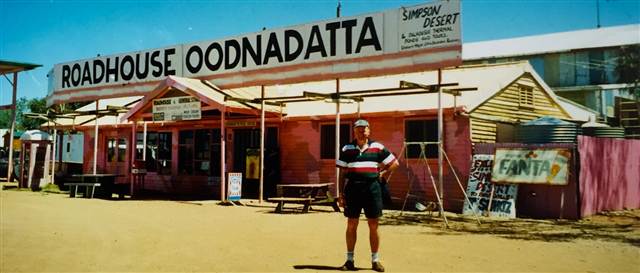
1998 – 2012
Edith Wharton wrote the following advice on how to deal with the 'Twilight Years':
One can remain alive long past the usual date of disintegration if one is unafraid of change, insatiable in curiosity, interested in big things, and happy in small ways.
As we drove out the school gates for the last time I had this advice firmly in my head. The other piece of advice I took with me was the answer Julian Singh made when I said to him 'Julian, what do you think is the secret of retirement?' Julian's reply was immediate and simple. Three little words:
DO SOMETHING DIFFERENT
On 30 June 1998 two furniture vans arrived early and we spent all day packing up. The Board very kindly provided us with a night at the Hyatt and first thing next morning we had to call in to the School briefly. I became aware then of the three aspects I would miss most. George, Maintenance Manager, was already reshaping parts of the house according to the instructions of the next resident. I would miss George. Jane MacKinnell, Headmaster's Secretary soon to be known as his PA, was already in her office getting used to all the new technology. I would miss Jane. We dumped some final rubbish in the hopper. I would miss the convenience of the hopper! George. Jane. Hopper. These three! We drove out the gate in our two cars and turned left. By the time we had turned right at the roundabout we were happy not to look back and to be on our way driving into the next stage of our lives - via our Financial Adviser in Civic!
That night we stayed with Anne's brother, Ian, and Lorraine in Elsternwick and were at 40 Ellerslie Place first thing next morning just in time to welcome all our belongings. We had a pretty good idea what went upstairs and what went downstairs although we had to modify some plans quickly because of the narrow stairs. Over the next three days we sorted things out sufficiently to celebrate Anne's 55th birthday with a family lunch on Sunday 5 July. Phyll came but was very lame, very deaf and rather unsure what was going on. It was clear she was on the brink of another stage of her life. Marg Wadelton came from Terang. I didn't recognise her when she arrived. She had taken off 41 kilos since I had last seen her. Ian and Lorraine came with Jon and Alex, as did David and Lois, Michael and Gina, Caitlin, Lisa and Andy. Three rooms were being used as store rooms while the rest of the house looked very settled!
We decided that we would devote most of our first six months to getting ourselves sorted out at Ellerslie Place and enjoying a bit of a holiday. There was plenty to be done inside and out. No wonder I missed George! There were countless letters to be written. No wonder I missed Jane!! There were piles of rubbish. No wonder I missed the hopper!!! One of the many letters to which I had to reply was from Jane herself, a letter which included the following:
Thank you for - always saying 'thank you' at the end of the day; - for elegant English that was a joy to type; - for making me feel part of a team; - for your delightful sense of the ridiculous and for never taking it all too seriously; - for your sense of style and flair for lifting things above the ordinary; - for making it FUN!
Now if I had wanted to write what I would like my secretary to have said about me, that would have been it - if I had been clever enough.
40 Ellerslie Place met almost all the conditions we had identified as we set about searching for the right home for us. One of the conditions that it did not meet was a bath! Anne was determined that we should have a bath. The bathroom was very small so the bath would have to be specially made for the space. It was cast iron and cost $1,700. When it was ready the delivery van arrived and the bath had to be moved up the narrow stairs and along the passage. The driver was on his own and he asked me to help. Of course I should have refused and asked him to go away and return with the necessary helpers to do the job. Foolishly I agreed. How we got the bath into the house, up those narrow stairs with two 90 degree turns and along the narrow passage to the bathroom I will never know. It was madness and a huge strain on all parts of the anatomy. Anne was out at the time and when she returned the bath was there ready to be linked up to the plumbing. 'Excellent' she said. I told her of how it got there but don't recall much sympathy. Job done: move on!
One thing had to be quickly resolved. Who was going to be our doctor? Anne enquired around and we decided we would make an appointment to see Dr Andrew Allan and see what we thought of him. I will never forget that interview. Andrew asked each of us to give a brief medical history of ourselves. With Anne's prompting I got through mine. Anne's was more complex as was her medication. She gave the most calm, coherent summary. No wasted words. During her summary it became clear that she was a nurse and had a good deal of experience working with doctors. Not only was Andrew prepared to take us on as patients he offered Anne a job as part time Medical Receptionist early in November on our return from holiday which Anne was delighted to accept. So began nine years part-time work (generally Tuesdays and Thursdays) at Mathoura Road Medical Centre, about an eight minute walk on a good day. She thoroughly enjoyed it and became great friends with Chris Gosling the other part-time receptionist. They made a great team allowing each other to get away for holidays as required. Anne became highly respected by the patients. She never wasted a moment giving the whole place a spring-clean and keeping it clean, something her successors never seem to do! Andrew Allan got huge value when he employed Anne. She never let him down.
For most of October we were away seeing a little bit of Australia. We made a nostalgic start by going to Hamilton and staying with Helen and Mark Brian for a few days and we could all include a Sunday barbecue in the Grampians with Ruth and Richard Walter 'for old time's sake'. It brought back many happy memories. This time there were just six of us but we could sense the presence of eight others no longer little - Jane, Nick and Kate; Simon and Jono; Caitlin, Lisa and Andy. We had all loved those family outings together. On we went to the Barossa Valley and enjoyed the Chamber Music Festival and stocked up on some beautiful wine which I put away to mature when I arrived home but was not mature enough to let it! The highlight of the trip, especially for Anne, was Coober Pedy where we lived for five days underground. Anne became a fossicker for opals and she claimed that she would be happy to spend the rest of her life doing just that. Coober Pedy, on the Stuart Highway, is 846 kms north of Adelaide and 685 kms south of Alice Springs. In 1920 the Stuart Range Opal Field had been re-named Coober Pedy, from the Aboriginal words 'kupa piti' meaning 'white man in a hole'! Thursday 22 October was a great day when we went on the 12 hour Mail Run with John Stillwell - a 600km 'round trip' from Coober Pedy to Oodnadatta to William Creek and back to Coober Pedy. We saw three other cars that day. Part of the leg to William Creek we spent in a light plane that took us over the dry salt beds of Lake Eyre. Our 23 year-old pilot pulled beer in the William Creek pub when she wasn't flying so when we arrived she taxied up to the pub door. The Flinders Ranges and Broken Hill were also great dimensions to a most memorable trip.
There were several reasons why I knew it was time to retire in 1998. One was that I was having real problems hearing and this was becoming both difficult and embarrassing. Early in retirement, before buying hearing aids, I was often baffled by what I thought I heard - on the radio, in the car, in the supermarket, in daily exchange with family and friends. For a while I jotted down words and phrases that I realised I had not heard correctly. Here are some of them:
Margaret Throsby's guest was doing farting (exciting) work in community groups.
She played music of the sweetest bulldozer (Swedish composer).
Luther posted 95 feces on the church floor at Shittenberg (Presumably it was in relation to this that he said 'Here I stand. God help me. I can do no other.')
Guy Noble informed us that the piano was to be played by a Japanese slob. It turned out to be Jacqueline Schwab.
One of Margaret Throsby's guests threw up on America's West Coast. I guess a lot of people grew up there.
Then another guest was pissed off properly playing the violin - but it was Christof Poppin all the time.
Anne said on the phone that she had had her dental chart for the day. I realised it was a gentle start that she had had.
'It makes a good testicle' he said. 'Balls' I thought to myself. Oh yes, a good spectacle.
At the tennis I was shocked to hear the commentator refer to an arse hole perve but he was only telling us that Haas had held serve.
'Is your wife old and square?' asked Anne on the phone but what she meant was 'Are you right holding there?'
On the news I heard about the disappearance of an artistic cobra. Charming I thought. No, it was an autistic toddler who had disappeared.
'Joe's clothes are long johns' I was told but I realised that he meant 'Those days have long gone.'
Our terms of trade were interesting. I heard there were steel carrots but really there were still tariffs.
We were told that at the Menin Gate ten gigglers laugh at jokes every evening. Surely not I thought. Ah. Ten buglers play the Last Post every evening. Not so funny.
When you're deaf people do say extraordinary things! I often wonder what consequences there have been in history simply because people misheard the news or the instruction. At any rate the evidence for hearing aids seemed overwhelming. It was time. They have accounted for at least $20,000 expenditure since then.
Anne combined her part-time work with her many other interests and quickly developed a busy and fulfilling life. She joined the South Melbourne Orchestra and then the Kooyong Chamber Players and played regularly at the Amateur Chamber Music Society's weekend workshops. She soon established the 'Anne Murray Quartet' comprising Anne, Hymie Wien, Geoff Gloster and Margaret Wu, a fairly incongruous foursome. I was in charge of morning tea and always enjoyed our Sunday conversations.
Roger Hayward and wife Jean Edwards now lived in a charming little Victorian house in Armadale. In fact we had exchanged houses with them one Christmas a couple of years earlier when we were still in Canberra. Roger was Head of the Wesley College Prahran Campus and Jean was a Counsellor at The University of Melbourne. She was part of a Book Club and invited Anne to join. Anne was delighted and made many new friends, remaining part of the group until well into 2011.
Quilting was already one of Anne's many passions and she joined a group soon after arriving. She was already working on a big project and I remember her quilting for part of that birthday lunch on the first Sunday in our new home. She completed that massive quilt in the course of 2000. It was a huge feat of patience and dedication. It has nearly 2000 pieces, 700 metres of seams and stitching and approximately 300,000 stitches. The following year she embarked on another even more magnum quilting opus! She completed it in the middle of 2003 and this description is sewn into the underside corner:
Time Warp
A hand quilted trapunto quilt by Anne Murray.
Inspired by Kathryn Bereson's "Quilts of Provence"
and the 1930s Art Deco plasterwork on our bedroom ceiling.
Made between August 2001 and June 2003. It took
approximately 1000 hours, and 1 kilometre of thread to complete.
Soon after the quilt was completed she exhibited it in the Box Hill Town Hall with 150 other quilts as part of the Australian Quilters' Biennial Exhibition. It was no surprise to me when she received The Megan Terry Award for the best quilt in the show. She received a Cup (for a year), a Winners Sash suitably inscribed and a painting to mark her achievement. I added a limerick to exhibit with these trophies:
BRAVO
Anne Murray lives life to the hilt; 'Til death us do part she won't wilt. Her fingers are bent, Her money is spent, But my God - bloody hell - she can quilt!!
Anne immediately took to the roads and bike paths and soon she purchased a much more satisfactory bicycle. We often went cycling together but for much of the time she had to stop and wait for me to catch up. One of our favourite little rides was to South Melbourne for lunch at the Emerald Hill Cafe and then an ANAM Recital in the Town Hall opposite. We did this countless times during those early years of retirement and enjoyed splendid performances by brilliant young musicians many of whom have now become famous around the world. Anne loved her Saturday morning bike rides which took her further afield often along the Bay to Sandringham and beyond. She certainly got to know all the best places for coffee along the route. During her bike riding in Melbourne and on the Gold Coast she came off the bike three times so was lucky to survive. On one occasion she got her wheel wedged in the tram track in Malvern Road and crashed. Anything could have happened. She hardly commented.
Julian Singh's three little words were ringing in my ears as 1999 dawned. My appetite for working in education had been fully satisfied. In fact during 1999 David Mulford invited me to run a two-day Year 10 Drama Workshop at Blue Mountains Grammar where he was Head. I agreed to do it. We stayed with David and Judy and then went on to their house at Red Rock for a week so we had a lovely time away. The Drama was hard work. I discovered that I hadn't lost the touch but I had lost the urge! They were a pleasant group except for one particular boy whose name somewhat ironically was Christian! He undermined everything for a while until I threw caution to the wind, took him aside and said, 'Christian I've had enough. You can either cooperate or piss off!' Now I shouldn't have said that because it could have placed David and me in a very difficult position. However I had spoken in a way Christian understood. He behaved like a Christian Saint from then on!
There were other educational options. Philip Roff suggested I might work with his Creative School Management but my interest had been in doing rather than advising. I wouldn't have been any good at it either. Someone suggested I join a school board. No thank you. I was happy to help select GAP students for a year overseas in schools, having set up a very comprehensive scheme at Canberra Grammar where we had some 30 boys in English schools each year. Nevertheless I did want to do something different. Accordingly I enrolled in a CAE Painting for Beginners course in the new year. There were three of us in the course - a young woman who was filling in time, a young man who was depressed and TCM! On the day of our first class we did some finger painting and I realised as I dipped my fingers into the jar of red paint and scrawled patterns on a piece of paper that at that very moment the Combined Staff Meeting was taking place in the Burton Theatre and I would have been addressing about 150 staff sharing my wisdom and insights into the opportunities of the coming year. Instead I was a nervous, insecure new student in my crazy class of three!
Little did I know then that I had embarked on the 'something different' that was going to challenge and intrigue me for the rest of my retirement. I did a second CAE course drawing in charcoal and pencil. At home I did a tonal drawing and it wasn't bad so I kept going. Perhaps it is not surprising that I had a go at painting and drawing. Mum had done much the same thing at much the same age and had thrived on her courses with teachers 'Dear Old' Zoter and Hayward Veal. Her painting took her to many parts of the UK and Europe and as far afield as Turkey where she even had her own exhibition.
After a year or two and more courses at the Malvern Artists Society and a Creative Drawing Class in Camberwell with Peter Foster I began entering paintings and drawings in Rotary Art Shows, particularly in Yea, Mansfield and Hamilton. I also did a framing course at 'Do Your Own Picture Framing' and I must now have framed many hundreds of pictures both for me and for others. It is a delight to be able to work through the whole process - create a 'work of art' then frame it and then, with any luck, sell it! My first solo exhibition was, of all the unlikely places, at Canberra Grammar School! When we opened the Resource Centre there in 1991 we were able to release the old library space for other purposes and this allowed us to start our own Gallery. Dorothy Danta became the Gallery Curator and she invited me to exhibit there in November 2000. I had opened other people's exhibitions there and enjoyed all sorts of happy occasions in that space but this was a new twist. I called the exhibition A Brush with Retirement and I exhibited 52 paintings and drawings. People turned up in their droves for the opening and, miraculously, 33 pictures were sold! About 10 commissions added to the excitement so it was a very happy return masquerading as an artist rather than a headmaster! We stayed with the Smallwoods and loved catching up with old friends. The Smallwoods had moved to Canberra for three years at the end of 1999 for Richard to take up his position as Commonwealth Chief Medical Officer, a great tribute to his remarkable ability. Fortunately their departure from Melbourne was just after the launching of my TELLING TALES - Glimpses of School Life in the Immediate Post-War Years for which Richard had written a delightful introduction and at which he gave an equally delightful launching speech.
I discovered quite early on that people loved drawings of their homes, their children and their pets! I found that I could draw their homes, especially if they were Edwardian or Victorian. I secured many commissions, some thanks to Gina in Geelong, some thanks to Jenny Pockley in Sydney, some thanks to word of mouth and some thanks to a letterbox drop I did around Toorak and Armadale. The drawings of children came later.
One of my great delights was to be drawing in my study upstairs on a Sunday morning as Anne's quartet made music in the downstairs sitting room. I often thought that when we were engaged in these activities our little worlds were at their best and we were very fortunate people. I wrote a poem about the experience and this is it:
Sunday Morning
The four walls of my little upstairs room at once contain and liberate my zeal to paint. Inspired by a Thursday class of spirits tarred, as it were, by the same obsessive brush, we listen, look and widen our horizons; we explore the methods of the masters, emulate techniques and gradually make our own discoveries. We cherish vital moments: perhaps when listening we hear a telling truth; when looking we actually see; or make a mark that seems exactly right. As I strive for such a moment in my room the strains of music filter up the stairs. For ten years now the four have gathered here to harmonise and share their passion for making music happily together – and sorting out the world at morning tea! A rare quartet of disparate kindred spirits. Inspired by Mozart, Monet, Bach and Constable, we explore some possibilities of our art – rhythm, tone and colour, composition - and share the joys of creativity.
Every January the Australian Open Tennis Grand Slam is held in Melbourne. From that very first January of our retirement we had friends staying for a week of the tennis, with Mary and Michael Tatchell being the first. Since then it has always been some combination of Mary and Michael, Jeannine and Adrian Keenan, and Lindy and Jan Reksten. We have christened ourselves the tennis groupies and we hook up via text messaging to compare notes on Roger and 'Rafa' and some of the greats. Lindy and Jan were staying here the week Anne died. We were both so happy that they were here.
Needless to say, of course, the family was priority number one for us both. Caitlin, Lisa and Andy were all living in Melbourne. At one stage Caitlin was earning her living serving coffee; Lisa was earning hers by changing nappies; and Andy was earning his by washing dishes in the middle of the night. We were hopeful that in due course the future may hold greater things for them all - and so it proved.
Before the end of 1998 after what was obviously a very happy weekend, Caitlin confided in us that she was in love. We soon met Ross and - 'the rest is history'. For a while they lived together in a warehouse in North Melbourne, sharing it with others. On 9 March 2003 they were married at Ruby near Leongatha at the charming home of Ross's family friends where he spent his childhood holidays. About 90 of us gathered for a great weekend celebration. It was a very happy wedding and Caitlin and Ross were surrounded by loving friends and family. The ceremony around the pool was a real celebration from the moment Caitlin and Ross arrived through the garden and started dancing to the band. The celebrant confessed that he had never been to a wedding like this one before! What a remarkable group of artistic, creative friends they have and they all seem to have stayed close and loyal over the years. The ceremony was followed by a long lunch for which the sun shone and festivities stretched well into the night although Anne and I retired pretty early and left them all to it - with the stayers gathering more quietly for mid-morning brunch next day. For their honeymoon Caitlin and Ross drove north where they stayed at Red Rock in the Mulford's house.
Four years earlier Caitlin's great friend Kate Oliver married Karl at Trinity College Chapel on 18 June 1999. Caitlin was a bridesmaid so Anne helped her get ready at much the same time that she was helping her mother prepare for a cocktail party at Carnsworth Nursing Home. I reflected the situation in my diary:
Anne is commuting between taking bridesmaid Caitlin to where the bride is preparing and dolling up her demented mother for a crazy cocktail party! Later today we will attend both wedding and cocktail party - an ironic juxtaposition of the lover and second childishness. I hope we don't get confused!
It was a beautiful, happy and relaxed wedding marrying the traditional and the modern as well as Kate and Karl. I very much liked the prayer they both said:
God of tenderness and strength, you have brought our paths together, and led us to this day. Go with us now as we travel through good times, through trouble, and through change. Bless our home, our partings and our meetings. Make us worthy of one another's best, and tender with one another's dreams. Amen.
They have now travelled through 19 years of good times, trouble and change together - and they have been strong.
Early in the year 2000 Anne and I asked ourselves whether we would have enough income to live on if we didn't have rent coming in from our apartment at 2/18 Riversdale Road in Hawthorn. Having decided that we would, especially with Anne working, we decided to sell and soon we were able to divide the proceeds of $263,000 between the family to help them get a real estate start. Lisa and Andy were not in a position to buy anything individually so they teamed up and bought a one-bedroom art deco apartment in East Melbourne, 16/246 Albert Street, opposite the Fitzroy Gardens. We kept it in our name and Anne joined the Body Corporate Committee doing great work in upgrading the building and keeping it in good shape. It was a delightful apartment and would be worth a fortune now. In May Ross and Caitlin were very interested in bidding on a two-bedroom apartment, 13/20 Ross Street Northcote. They asked me to do the bidding and I wrote about it in my diary:
The agreement was that they would go to $175,000 and I would do the bidding. There were six serious bidders which was very strong. I came in at about $165,000, going up by $2,500. At $170,000 I bid $171,000. The auctioneer said he was still only taking $2,500 increases but he came back to me because there was no such bid. At that stage I thought I had a chance. I bid 172.....I bid 175......Someone went 176......Bugger. Would I go $176,500? I consulted Anne. Yes. We would pay the balance. Quickly it got to $180,000. All over. Beyond us. Too bad. Never mind. Suddenly a mad Irishman in a blue parker put his hand up. Ross's father!! My Irish God! What was going on?! There were two other serious bidders. One dropped out - 181, 182, 183 and a half, 184 and a half, 185 and a half, 186, $186,500. It was mad Irish Jim's bid!! Sold! $11,500 more than our ceiling price. Jim would pay the difference! Irish impulse. Generous. Mad! We paid the deposit with settlement on 28 June. Two settlements on that day and we have to provide $171,000 for one and $92,000 for the other. If settlement of $237,000 doesn't come through on 26 June we're up the creek paddle-less. All should be well.
All was well. As the inflation in the real estate market over the next few years demonstrated, any purchase in 2000 was bound to be a good move. Caitlin and Ross were very happy there for the next seven years. It was right next to the bike path and close to Westgarth Shops - a good flat in a good location. Seven years later they sold the flat and boldly purchased a house in Newcastle Street, Preston, (buying before they sold!) which was in a derelict state. Even handyman Jim who loved a challenge took one look and said despairingly 'What have you done?!' What they had done was buy a delightful home on a big block of land - delightful after they had both transformed it inside and out. They live there now and are contemplating adding a studio in the back garden.
Lisa and Andy decided to sell the East Melbourne apartment after seven years, providing them with a very satisfactory capital gain. By then Andy was renting in Harper Street Northcote and was very happy there while Lisa and Ewan had fallen in love with the river and the house they were renting - and are still renting - at the bottom of Alphington Street. However that year they purchased a delightful cottage in Hepburn Springs which they kept for a number of years so that Ewan particularly could stay there on weekends when seeing his children and which they also let out in an enterprise managed by Lisa. It wasn't the sort of place that was going to increase substantially in value but it served their family needs beautifully for a number of years.
After Caitlin and Ross's wedding the next family excitement was on 12 November 2005 when Lisa and Ewan were married at a beautiful spot by their beloved river 100 metres from where they live and where they held their reception. The beautiful bride arrived by boat paddled by Andy and accompanied by Caitlin - and the sun shone. Ewan is part of a large and enterprising Irish family which was well represented at the wedding and his two children Freia (10) and Aleph (5) were there to enjoy it as well. We had inherited our first grandchildren. Anne's friend from Book Club, Ann Wilkinson, was the celebrant and did things beautifully. Lisa asked me to read Robert Fulghum's lovely piece All I really need to know I learned in Kindergarten. No matter how young or old you are it makes sense. Here it is:
All I really need to know about how to live and what to do and how to be I learned in Kindergarten. Wisdom was not at the top of the graduate-school mountain, but there in the sandpile at Kindergarten. These are the things I learned: Share everything. Play fair. Don't hit people. Put things back where you found them. Clean up your own mess. Don't take things that aren't yours. Say you're sorry when you hurt somebody. Wash your hands before you eat. Flush. Warm cookies and cold milk are good for you. Live a balanced life - learn some and think some and draw and paint and sing and dance and play and work every day some. Take a nap every afternoon. When you go out into the world, watch out for traffic, hold hands, and stick together. Be aware of wonder. Remember the little seed in the polystyrene cup: the roots go down and the plant goes up and nobody really knows how or why, but we are all like that. Goldfish and guinea pigs and white mice and even the little seed in the polystyrene cup - they all die. So do we. And then remember the Dick-and-Jane books and the first word you learned - the biggest word of all - L - O - O - K......LOOK.
Anne and I had been very much involved in the catering for Caitlin and Ross's wedding. It was rather a relief that Lisa and Ewan organised their own caterers - Rodney (second course) and Paul (first and third courses and grog). The paella and the chocolate fountain were out of this world!
The following year Andy decided that he should broaden his horizons and he headed off overseas to meet friends in Germany, visit France and Holland, and do some hiking in the Swiss Alps. He then headed for Toronto where he stayed at the home of a musical friend's musical friend! Claire Jenkins and Andy seemed to hit it off so when Andy departed for New York to meet Lisa, Claire caught the bus to - New York. Early in 2007 Claire came here. Mid 2007 Andy went there. Late 2007 Claire came here. The following year they drove across Canada together with Claire's band and did about five gigs a week for seven weeks. On 25 August 2008 Andy telephoned from Toronto and then sent this email:
Hi Family All systems are go. We have an appointment in the '"chapel" at 2.30am your time or 12.30 our time. It is very 70s and glamour. We asked for the shortest possible ceremony which takes about 1.5 minutes. Then we will be married just in time for lunch! We will have to find two witnesses from the city hall which is extra funny. Anyway, Claire is doing her hair in a big frizzy bird nest and I am putting on my Sunday best baseball cap. This is just how I pictured it!! Speak soon. Love Andy.
This was undoubtedly Andy's ideal of the perfect wedding - and it seems to be the perfect marriage too. No fuss. No fanfare. No speeches..........and wearing a cap!
We agreed that we would have a family gathering when they returned to Australia so on 7 December 21 of us came together at our home for a Celebratory Lunch. Anne and I were very proud parents with all three of our children now happily married. I proposed the toast to Claire and Andy. I could refer to Andy's email the day after he arrived in Toronto which included the words 'Arrived safely in Toronto last night. Am staying in a really cute house with a lovely girl called Claire - and Kim of course.' We then heard no news for ten days and assumed that he was enjoying the cute house - and Kim of course. Andy arrived in New York on 19 October, Lisa on the 21st and Claire on the 23rd. Even before Claire arrived on the 23rd Lisa had sent us an email saying 'Those two are in love.'
Gradually it became clear that Melbourne was where they planned to settle and Anne and I felt absolutely thrilled that we would be near the whole family.
By the time we heard Andy's news we had also heard from Lisa and Ewan that 'the whole family' just might soon be getting a little bigger. We had shared Lisa's roller coaster with the IVF programme and knew that she was having a break from that so it was pure joy to learn that she was expecting a baby. I seem to remember that she gave us the news by giving us a little wrapped present when we were visiting one day. It was the result of her recent pregnancy test - the positive, happy news. We shared Lisa's joy and were very sorry not to be able to share similar joy with Caitlin who had also rollercoastered through the IVF programme for a while. I can't really begin to imagine how such a programme plays havoc with a woman's body and emotions and relationships. Medical technology has the capacity to give much joy but also thrust people into grief when hopes are dashed.
Very soon after hearing Lisa's exciting news Anne and I flew up to Broome to join a 14 day APT four-wheel-drive bus tour of the Kimberley doing a round trip from Broome, revelling in the majesty of Australia's extraordinary northwest including the Mitchell Falls, Ord River, Cathedral and Emma Gorges, Bungle Bungles. It is sheer magic up there in August. This was the first year of Anne's retirement from Mathoura Road Medical Centre. Her medical condition was worsening all the time and she knew that if we didn't take the trip in that year she would not be able to cope with the walking. How she coped with it then is another miracle. By then she couldn't walk very far at all without having to stop and stretch. She only told me how she was when I 'insisted' and, of course, her response was generally 'Fine thank you'. She shared information with me in relation to the state of her health on a 'need to know' basis and she never felt I needed to know much. Whether this was to protect me or to save herself wasting time having to talk about it as well as suffer from it I do not know. She was remarkable in her capacity to accept things as they were, do what she could and not regret what she couldn't do. From the day she gave up riding her bicycle she never mentioned riding again. When she couldn't play her cello any more she never mentioned the cello again.
The APT Trip came two years after our fabulous 14 days air adventure through parts of six states. We had joined Rod Dyer's 'Air Adventure Australia' - ten of us in a twin engine plane - and we were introduced to many new places and experiences in Australia's centre and north including Carnarvon Gorge, Longreach, Katherine, Point Stuart and Mary River on the edge of Kakadu, Darwin, Kununurra, the Ord River and Lake Argyle in the Kimberley, Broome, Alice, the Centre and the Rock and Coober Pedy (again). The combination of seeing over 9,000 Australian kilometres from our own scenic flight and enjoying a variety of walks, cruises and unique experiences on the ground made it a very special couple of weeks and made us determined to visit more while we still could - hence the APT trip two years later.
As well as these two big trips Anne and I enjoyed other travels while we could. These included some time in New Zealand around Christ Church, Mount Cook, Queenstown and Milford Sound as well as enjoying the hospitality of Jackie and Richard Randerson in Auckland where Richard was Dean; a car holiday in Tasmania where we were joined by John Tunbridge and we made a pilgrimage to the ruins of the old mining town of Balfour deep in the rain forest of the north west to visit the grave of Dr Harry Wadelton, a young doctor who died there aged 30 in 1912 and left his four year old son JAJ Wadelton ('Bill'), Anne's father, to be brought up by his aunt Marne since his mother had died when he was less than a year old; a trip to the West essentially to see an exhibition of David Wadelton's work and then enjoy a drive, again with John Tunbridge, to the Margaret River and down to the tall timbers of Walpole and Albany; a drive from Rockhampton to Cairns staying with the Nairns in Townsville to enjoy the Australian Chamber Music Festival; trips to the Gold Coast, the Sunshine Coast, Port Douglas; trip to Adelaide for Louise Tunbridge's wedding and Canberra for Kate Denman's wedding; and a good deal else besides. We didn't do badly.
Lisa's happy news of August 2008 led on to the arrival of Griffin Gael Murray-Johnson on 31 March. It was a long and complicated labour and finally Lisa had a Caesarian section. Lisa wanted Anne to be present and she was a very reassuring presence for Lisa. Soon after they all got home Lisa suffered a rare heart complication and was rushed back to Emergency where her heart function plummeted to 15%. Her survival was something of a miracle, the first of several family miracles really. Anne described the situation in an email to her dear friend Susie Grieve:
Lisa was home for less than 48 hours and was admitted to Epworth Emergency with congestive heart failure suffering postpartum cardiomyopathy, with heart rate over 200 and far from well. It was a worrying time for us all for a few days. All the fluid has now gone from her legs, lungs and heart and she is stable. She lost 3 kilos of fluid in 3 days. Her heart rate is still too high and goes up to 130 - 150 with a small amount of exercise, so they still have to get that stabilised before she can start mobilising in readiness for coming home. She has been unable to do much more than feed Griffin so the family have been doing shifts to be her ''Go-fer'.
Lisa headed home on the evening of the 15th her heart function having improved from 35% to 45%. It all meant that Lisa needed a fair bit of support which Anne and I were very happy to provide as best we could. Anne, of course, was cracking hardy. She had significant heart and blood pressure issues of her own - among many other things. She was getting dizzy and losing her balance. How good it would have been in due course to do more allowing Lisa and Ewan to get away together sometimes while we looked after Griffin. Alas this was not to be. Griffin and Anne really struck up a special bond and it is beautiful to think of the love they had for each other and the joy they shared together. Anne was so thrilled to hear the news that Claire and Andy's Arno was born on the last day of 2011. Anne saw him twice but didn't hold him because she had just had an operation on her hand! Anne and Claire got on so well together. How Anne would have loved sharing in Arno's early years.
Lisa's heart condition meant that she was unable to give birth to another baby herself which, of course, was heart-breaking for her. On 27 January 2010 she received an email with the subject identified as 'You Have An Introduction From A Surrogate'. This immediately led to Lisa and Claire Mazuran corresponding and quickly establishing a remarkable relationship. Claire came across to meet Lisa and I remember our meeting Claire in the Fitzroy Gardens. Anne was supportive and hopeful as the story unfolded but sadly she did not live long enough to share in the happy outcome.
Each year since we arrived in Melbourne we composed a Christmas letter and enjoyed receiving news from many friends from all round Australia and beyond. While early on I think I referred to my hearing issues resulting in hearing aids and also to Menieres which was very debilitating at times and could strike very suddenly, I don't think our letters referred to any health problems for Anne until 2009 when we wrote:
Anne has had to spend more time on body maintenance than she would like. She's something of a football between rheumatologist, orthopod and cardiologist. Thanks to her bike riding (easier for her than walking) she detected some heart problems very early and is just home after a hospital stint and stent last week.
The following year, December 2010, the health reference was
Anne continues to be 'medically challenged' and hasn't let up on her various specialists. It's a really difficult balancing act. Next week she's due to have a hip replacement. Hopefully this will lead on to greater mobility, less pain and a return to some of the things she loves - like playing the cello, riding her bicycle.....and walking! We had a couple of weeks on the Sunshine Coast in August but sadly she saw more of the Nambour Hospital than our delightful apartment at Mooloolaba.
The 2011 Christmas letter included the following:
Anne's new hip from last December seemed very successful for a while but in February she suffered the first of four dislocations, the third one happening in July on the first day of our holiday in Port Douglas! Not what we had in mind at all. A further hip operation in September has certainly improved the situation but the hip and numerous other medical challenges have rather restricted activities. When she was in hospital recently two-and-a-half-year-old Griffin asked her ‘Anna, are you optimistic?’ She assured him she was. Actually she’s realistic, positive, accepting and has no regrets. Given her more limited activities at the moment she’s enjoying having more time to read – and she can do even more sudokus!
I remember those four hip dislocations so well. The first was at the Botanical Gardens when she had gone for a little walk with Griffin, sat down on the lawn and dislocated it when trying to get up. Ambulance. The second was when she was sitting at the dressing table in our bedroom and she tried to get up. She said to me 'Give me a minute' and she started to try to manipulate the hip back into the socket. After about half a minute of what must have been absolute agony there was a very loud 'clunk', her thigh quivered and she said calmly 'Done'. She had put it back herself! Amazing woman. The third dislocation was the one in Port Douglas when she started to get out of the passenger side of the car. She tried to put that back too but was unsuccessful. Ambulance and fire brigade arrived and somehow managed to get her out of the car through the hatch back. Again it was agony for her. The final dislocation was when she was getting up from an easy chair at home. Ambulance again. Hence the further operation in September.
Anne had carpal tunnel Syndrome surgery on her left hand on 20 December 2011. On 5 January she said to me she thought it was getting infected. That day I took her to see her Gastroenterologist, Dr Desmond. I had picked up her blood test results from Dr Allan's rooms the previous day. They were shocking with particular reference being made to her kidneys which were described as likely to be suffering from severe infection. Anne would not allow me to be with her when she had her consultation with Dr Desmond. I recorded the medical story of those last weeks and months in my diary and later put them together into what I called Fine Thank You, and You?
If Anne knew I was writing this she would tell me not to write about sickness and pain but rather concentrate on family and friends and joy and fun. I will conclude this chapter by doing that after I refer to the two great sadnesses of 2003. In August Michael's wife, Gina, died. Gina had suffered a good deal of ill health but for the previous 12 months she had been pretty well and her death was unexpected. They had been married for 44 years. I could go to Geelong late on the day Gina died and keep Michael company. After her funeral I took the train to Geelong most Thursdays to spend time with Michael as he rebuilt his life - and did the shopping in the car which he learnt to drive again. Forty months later his life changed again when Rosalie Buchan became his partner.
The other sadness was Anne's mother's death in October in her 90th year. For several years she had been in the Carnsworth Nursing Home. Anne was a most faithful and loving daughter visiting her most days. She and her brothers Ian and David did all they could to ensure that her final weeks and months were calm and comfortable. Ian's eulogy told a great Australian story of character, resilience and devotion. It was the end of an era.
Our return to Melbourne allowed us to catch up again with old friends and make new ones. Rob and Sue Grieve were here and we spent a good deal of time with them in their Melbourne Domain Apartment or at their charming home and property at Cherokee or at their chalet at Dinner Plains! They were so generous to all the Murrays. Anne caught up again with many of her Alfred Group of nurses. We connected again with Carol and Richard Smallwood, Libby and John Nixon, Jennifer and Adrian Smithers, Annie and Clive Morris, Mary and Bernard Newsome, Muffi and David Gove, Sue and Hugh Ross, and so many more. Early in 1999 Sarah and Chris Kenyon came to stay as part of a world tour. They made our home their base for a while as they enjoyed parts of Victoria. I was more conscious than ever of how 'English' they were! They liked our spot and its proximity to shopping and public transport. Chris quoted his old father, 'When you've got one foot in the grave you need to have the other in a bus stop.' The Kenyons gave me a photograph of Chris Wood thirty years on from those happy two years at Dean Close School where we had enjoyed so much theatre together. In my first month of retirement Don Marles suggested we lunch together. From that day we made it a regular monthly get-together, adding Dick Johnson when he retired 18 months later, John Tunbridge, Neville Clark and Richard Smallwood.
We went to Canberra for Anne to play in the 20th Anniversary concert of Musica de Camera. Soon Anne subscribed to the ACO and attended their concerts on a Sunday afternoon for many years. Generally I would walk in to the city and meet her at Hamer Hall after the concert. While Anne went to many concerts I went to the theatre and over the years saw some most memorable productions including Cloud Street, The Resistable Rise of Arturo Ui, King Lear with the brilliant Ian McKellan, Waiting for Godot with Ian McKellan again, The Thirty Nine Steps, Death of a Salesman, Life after George, Proof, Master Class, Great Expectations and so many more. There was plenty of cricket-watching at the MCG, particularly the Boxing Day Test, and I enjoyed many AFL games there on Saturday afternoons. Andy completed his Horticulture Course at Burnley; Caitlin did an Illustration Course at RMIT, Preston Campus; Lisa completed the NEIS course which helped her develop her very successful bag business which led to an exhibition and a husband! I shared in an exhibition with Dick Johnson at his home which we called Yes, but what's it meant to be? Late in December I received a letter from Malcolm Hazell, Official Secretary to the Governor-General and former parent and Board Member at CGS, beginning with the words 'It is with pleasure that I write to advise that your appointment as a Member in the General Division of the Order of Australia has been approved by his Excellency, Major General Philip Michael Jeffery, AC CVO MC, Governor-General of the Commonwealth of Australia.' He, too, was a former CGS parent and his twin boys were there in my first year when he came as our special guest on Anzac Day and lunched with us in our home A delightful man. The presentation was made at Government House in Melbourne by John Landy, Governor of Victoria, whom I also knew. His kind vice-regal words to me were 'Good on ya, Tim'.
I remember our trip to Canberra the weekend before Caitlin and Ross's wedding early in 2003 when we attended the opening of the 'Tim Murray Theatre' at CGS. From Hall at Hamilton College to Theatre at CGS! I was delighted with both. We had hoped to visit Daphne Fullagar when we were there but alas she was too unwell to see us. Daphne was a great friend and former colleague. In her 2002 Christmas letter she mentioned almost casually her bad back but early in the new year we heard from her daughter that she had been diagnosed with multiple myeloma, a disease I had never heard of at that stage. In fact I never saw her again. She died in June 2005. While I couldn't see her I could write and later I put together my 55 emails in a volume which I called Dear Daphne. I know she enjoyed receiving them.
In 2003 I put together a collection of extracts from various speeches I had made over the years and called the collection Headlines. I advertised it through the AHISA publication and sold over 100 copies to Heads and schools. Before the year was over Caitlin illustrated the book Pregnant Fathers and Lisa launched 'Unplugged' laptop computer bags. I was guest artist at a Hamilton Rotary Art Show and sold plenty of drawings. A highlight towards the end of that year was the 50-year reunion of those of us who left school at the end of 1953. I decided to have the party at our home on the evening of Friday 14 November. It was a big party and 36 came. I was delighted that Ken Mappin was able to come. John Kirkham came from Singapore and Bill Stretch from Perth. It was a balmy night and everyone enjoyed it. Next day most of us went down to Corio since we now qualified to attend the Tower lunch. I was invited to give the address at lunch and propose the toast to the School. That address is Appendix 1 to this chapter. If you read that address you will understand why Russell Luxton came rushing up to me afterwards with much glee!
Four years later it was time for the 50th anniversary lunch at Trinity College. I was honoured to be invited to propose the toast to the College at that lunch where the menu cover was one of the drawings I had donated to the College a few years earlier. Henry Speagle had also used one of those drawings on the dust jacket of his book Editor's Odyssey - A Reminiscence of Civil Service: 1945 to 1985 with the royalties of the book being donated to the College. In the letter Henry wrote to me on 18 February 2005 accompanying the complimentary copy he had given me he included these words:
There is perhaps a special poignancy in our cooperating on this project, as your dear late father is one of my earliest memories and the friendship with your mother spanned several decades. I have always maintained that your father's death in that tragic air accident in 1950 forever altered the history of the Anglican Church in the Twentieth Century in Australia.
Henry meant that he was convinced that Charles Murray would have become the next Archbishop of Melbourne and he said just that at the launch of the book which I attended. After he spoke David Woods came rushing up to me to discuss Henry's proposition. I knew David well. He had taught at Melbourne Grammar School for decades. He was the son of Frank Woods who was the man who did become the Archbishop of Melbourne at the time to which Henry was referring! So many lives twisted and turned differently as a result of that fateful accident on 26 June 1950.
A big highlight in 2005 was a family gathering to celebrate a whole string of 'Big 0' anniversaries. David and Lois celebrated 20 years of married bliss; Andy turned 30; we celebrated the 40th anniversary of our engagement when I asked Anne's father for the hand of his daughter in marriage; David turned 50; Ian turned 60; and I - horror of horrors - turned 70. We had many reasons to count our blessings. The party was Anne's idea and she put her heart and soul into the speech she gave - a speech I have included as Appendix 2 to this chapter. It was a tour de force. In that same year Ross was continuing to make music for the very successful musical Keating written by their friend Casey Bennetto who had been MC at their wedding. Keating won the main awards at the Melbourne Comedy Festival. Anne and I first saw it at The Trades Hall where it began and Caitlin was on stage, albeit incognito. By that year I had enjoyed having drawings in the Castlemaine Festival of Arts and the Australian Guild of Realist Artists Drawing Exhibition, and soon shared an Exhibition at Skepsi Gallery in the city. All of this soon led to an exhibition of paintings and drawings with Dick Johnson and Diana Hone at the Kinross Arts Centre in Toorak. We all sold well and it was a lot of fun. Diana put a huge price on her 'naive' paintings and people paid. To some extent we are accepted at our own self-evaluation. My pictures were the least expensive!
By 2008 Anne had retired from the Committee of the Kooyong Chamber Players as well as the Mathoura Road Medical Centre practice. Very soon the Committee realised how much work Anne had done to keep them afloat and soon after she died the group folded but not before their concert of 25 March 2012. Not only did the programme cover have the beautiful logo designed by Caitlin it also had the following dedication:
This concert is lovingly dedicated to Anne Murray who sadly passed away in January 2012. Anne was a dedicated cellist and committee member of Kooyong Chamber Players for many years. Anne willingly gave her service to the orchestra and inspired many with her thoughtfulness and passion for music. She will be greatly missed.
Having retired from the Committee by 2008 Anne kept making as much music as she could, riding her bike, doing pilates very regularly, seeing more of her friends and seeing more of the physiotherapist. She must have known the sort of time she had left.
The following year I had the good fortune to be able to combine my interest in art and my interest in history by seeking to track down the identity of 'Pip', many of whose paintings were discovered in the Tunbridge family home as we helped John prepare the house for sale a couple of years earlier. It transpired that Pip was John's Grandfather's driver on the Western Front in the First World War and clearly the Colonel acquired many of Pip's paintings. Late that year I shared in an exhibition with Pip and Dick Johnson, again at the Kinross Arts Centre. My booklet, PIP - In Search of an Identity, was the culmination of a fascinating piece of research which began with the word Pip on a picture and ended with one of Pip's daughters visiting our house, meeting cousins she didn't know existed and enjoying many pictures painted by her father that she had never seen before. Sadly John Tunbridge died a few weeks before he was able to enjoy these two wonderful outcomes.
In 2010 I joined a painting class run by the brilliant teacher Colin Johnson. Colin had written the Foreword for my publication about Pip and this link probably contributed to my being accepted into the class which was much in demand. It has been a great joy to share the company of this lovely group of people for about 40 Thursday mornings each year for the last nine years. I have become particular friends with Colin himself and Tim Blashki. Colin and I share the same birthday although he is not quite my age. Nevertheless I am NOT the oldest member of the group!
It was in April 2010 that one of the great influences in my life, Ken Mappin, died. As I have written, our paths first crossed in 1949 when he cast me as Viola in his production of Twelfth Night. Despite my rather inadequate efforts on the stage my interest never waned and I am deeply indebted to Ken. I was honoured when the family asked me to give one of the eulogies at Ken's funeral and to talk about his years at GGS. I have included what I said as Appendix 3 to this Chapter.
Throughout these years I kept in touch with Rodney Swansborough who by 2011 was living in Murrurundi with Pearl, his fourth wife! Richard Randerson said to me that he didn't think that he and Rodney went to the same theololgical school! Anne and I were great friends with them both and that friendship continues to this day. At Easter time 2011 I heard from Rodney and he asked me where I was on the journey. He was asking me my thoughts on religion and purpose and meaning. I decided I should reply and I wrote an essay which I called The Journey. This is it:
The Journey
(Tim Murray 27.04.11)
Just before Easter 2011 Rodney Swansborough sent me an email identifying the subject as Easter Greetings…the rumour is less than a whisper….imperceptible… The reference is undoubtedly to our shared days at Canberra Grammar School when more than once I must have said that part of our Christian commitment was to ‘keep the rumour of God alive’. In our capacities as Headmaster and Chaplain I guess this was the very least we could articulate about what it should mean to be an Anglican School! Now, many years later, Rodney writes ‘I don’t even get near a church these days… I think I have moved beyond agnosticism… to outright atheism… with reasons… Where are you on the journey?’ It’s a fair question and I find myself compelled to try to answer it.
The first thing to say is that for 63 years of my life I was committed to an environment that espoused the Christian faith, predominantly in an Anglican context. I was born into a vicarage in Adelaide, moved to a vicarage in Melbourne and then on to a ‘Bishop’s Lodge’ in Hay until my father was killed in a plane crash and we moved out of that ecclesiastical environment. I attended Melbourne Church of England Grammar School and Geelong Church of England Grammar School. For four years I was a resident in Trinity College, a College of Anglican foundation at the University of Melbourne. I taught at Geelong Grammar (Anglican) for 15 years and Dean Close School (Anglican) for two years. I was Principal of Hamilton College (Uniting Church) for eight years and Headmaster of Canberra Grammar (Anglican) for twelve and a half years. At the very least all this meant that I was constantly exposed to the language of the bible, prayer book and liturgy. I sang hymns by the hundred, said Amen to a prodigious number of prayers and heard sermons galore. I attended chapels and churches regularly for 50 years, received communion, read lessons, even preached an occasional ‘sermon’, sang in choirs, read religious poetry, directed religious plays and festivals. Consequently the language and atmosphere of religious activity became part of my conscious and sub-conscious being – it was absorbed through the pores of the skin.
But now that I am ‘free’ where am I?
Well, in the 13 years since I relinquished a sense of obligation that I must strive to keep the rumour of God alive and set a headmasterly example in an Anglican school I haven’t had any sense that I am left living in a vacuum. I have been to very few church services in those 13 years and have been left with no sense of either guilt or loss. There have been new influences, new experiences and time to look at life with a new attitude, liberated from constraints, expectations and the need to keep up appearances.
I clearly realise now what I always essentially knew – that my knowledge of religious things was very limited and unscholarly; that my ‘commitment’ was one of habit and expectation more than of faith and understanding. I have become progressively more sceptical of the words used inside a church and my willingness to say them. I suppose it was when I got confirmed that I learnt the words of the Apostles’ Creed so they have been deeply ingrained in my memory for 50 years. Now I would only be prepared to say the words I have put in bold italics:
I believe in God the Father Almighty, maker of heaven and earth, and in Jesus Christ his only son our Lord; who was conceived by the Holy Ghost, born of the Virgin Mary, suffered under Pontius Pilate, was crucified, dead and buried, he descended into hell; the third day he rose again from the dead; he ascended into heaven, and sitteth on the right hand of God the Father Almighty; from thence he shall come to judge the quick and the dead. I believe in the Holy Ghost, the Holy Catholic Church, the Communion of Saints, the forgiveness of sins, the resurrection of the body, and the life everlasting.
Essentially all that leaves is room to believe that Jesus Christ was an extraordinary human being whose ‘new commandment’ was the basis upon which to build a better world.
During my working years I became responsive to the concept of ‘God of the Gaps’ and the view that man has, to a very significant extent, invented God to explain all those aspects of life where no other explanation existed. Gradually the ‘need’ for God receded as man extended his own horizons, knowledge and insights – and the need for the Church to tell us what to think receded at the same time.
Since ‘retiring’ from having to set a good example (!) I have been inspired by the writings of Bishop John Spong. His autobiography taking Martin Luther’s words Here I Stand for a title was a wonderfully honest, open-minded story of a man‘s expanding vision and understanding in the hard school of experience as his inherited attitudes towards race, homosexuality, women and the bible were gradually but irrevocably changed – as humanity, scholarship and common sense prevailed over dogma and bigotry.
Now I find my ‘religion’ all around me but, I confess, not in churches. I would be happy enough to attend a beautiful service in a beautiful place where I could be inspired by music or art or architecture or the spoken word, although my old scepticism would come flooding back as soon as I heard words that to me were mindless or meaningless or were delivered with parsonic self-righteousness; and I would be more than happy to attend a simple ceremony where integrity and meaning are unpretentiously of the essence.
Now, with William Blake, I find the heart of the matter in these words:
To see a world in a grain of sand and heaven in a wild flower, Hold infinity in the palm of your hand and eternity in an hour.
The world is charged with the grandeur of ‘God’ – a glorious sunset across the sea at Broome; a tiny ant with a world on its back; a rock of granite in the Grampians; a pendulous rain drop suspended from a leaf….... Perhaps such beauty is truth and all we need to know.
Now, too, I sense we sometimes get a glimpse of truth through irony where juxtaposition evokes a sense of something deeper beyond the surface of things; and through paradox where apparent contradiction suggests the complexity and simplicity of truth. And surely parables are the means by which eternal truths are suggested by simple stories, not least the stories of the Sower, the Talents, the Lost Sheep, the Prodigal Son and the Good Samaritan.
I think that of all the things I most despise, bigotry, humbug and hypocrisy top the list. Bigotry lies at the heart of all the fundamentalists – blind belief in one’s own rightness (and probably righteousness) and vicious intolerance of those who disagree or are perceived as inferior, including those who see that the Emperor has no clothes; humbug is that jumbled mass of mumbo jumbo that preoccupies the small-minded and makes molehills loom as mountains; and hypocrisy is the ‘do as I say not as I do’ attitude of those who hurl stones around in their glass houses.
Of all the things I most admire love and humility top the list. Love is compassion, acceptance, doing unto others as you would be done by, and is, of course, the greatest of Christian virtues – the ‘new commandment’ – sadly grotesquely misapplied with self-serving discrimination by many a ‘good’ Christian; and humility is not thinking of yourself more highly than you ought to think no matter how talented or learned you may be. It’s not just modesty; genuine humility is seeing yourself utterly in perspective.
The older one gets the greater the prospect of a sense of perspective, a sense of mystery, a sense of awe. We are tiny specks in the infinity of creation but we can find immense sense of meaning, purpose and joy if, as Edith Wharton suggested, we are unafraid of change, insatiable in curiosity, interested in big things and happy in small ways.
Towards the end of last year I tried to say something of where I am in the journey in a poem which I called Still Point.
Somewhere deep in our destiny there’s a dimension no microscope has power to penetrate, no telescope has strength to see – a dimension without which we are unimaginable. No sense can make it tangible; nothing tangible can make it sense. It is the still point around which we revolve and have our being. It is utterly and infinitely central. Some might call it conscience, the essence of self, the whisper of the soul, depth, destiny, purpose, meaning, mystery. Some might call it God. Why try to find a label? Why try to tie it down? By definition it is beyond our grasp because it is beyond our reach – but it has to be there. Without it our world would not turn.
I sent a copy of the essay to various friends including Richard Randerson. As it happened Richard was in the early stages of writing his memoirs which he called Slipping the Moorings. I was delighted when he asked if he could quote this poem in the book and he quoted it in the context of this observation:
I want to suggest that the question of faith is not one of intellectual assent to the existence of 'God as a Being' but arises out of our experience of 'God as Being, a reality at the heart of human life. Nothing can be proved or disproved, but there are experiences that may be shared of a mystery that people interpret in different ways.
I was rather pleased that the next person he quoted was Dag Hammarskjold, second Secretary-General of the United Nations!
The Journey was also part of my early correspondence with Roger Hayward, a correspondence that originated in a conversation he and I had at John Pascoe's 60th birthday about the joys of writing and sharing. On the strength of this I sent him some of my poems. He wrote back and sent me links to some of his writings and photographs and guitar playing. I wrote back. He replied. I couldn't leave it at that and so a pattern developed. The pattern continues to this day and is a great source of pleasure and inspiration.
During the last full year of Anne's life, despite the setbacks and deteriorating health I have already described, there was so much for Anne and me to share and enjoy and be grateful for. Anne had a special bond with Griffin Gael and they loved spending time together at Lisa's home, or in the park or at the Collingwood Children's Farm feeding the guinea pigs. He christened us 'Anna and Baba' and I'm so glad Griffin and Anna had that time together and Anne could enjoy seeing Lisa's fulfilment as a mother. We enjoyed Caitlin and Ross's creativity, in their house and garden, in Ross's music and his craftsmanship in making a beautiful guitar and Caitlin's designs for children's clothes and her daily Pesky blog and her many friendships not least as aunt and godmother. We enjoyed Andy's landscape designs and the gardens he created and the music he made. We enjoyed meeting Claire's lovely mum, Aliette, and sharing with her in Claire's musical talents, playing and singing in a band that included Ross and Andy.
I was enjoying writing poetry. For many years I had indulged in writing satirical or silly verse but I was trying now to be more observant and thoughtful and write more seriously. In the April of the year before Anne died I went down to Mount Martha with Dick Johnson and Tim Blashki to enjoy painting en plein air. In the course of the afternoon I sat on the steps of a colourful bathing box and penned this little poem.
On Such a Day
On such a day – as the sea glistens in silent celebration of the mid-day sun, and fishing boats lie easy; as sleek gulls lull in blissful idleness, and slow ships hover on the horizon; as lovers linger in the tingling shallows,
and bask in each other’s arms; as bees cruise, circle, settle, and cruise again, and a puppy scampers on urgent missions easily abandoned; as retired Turners paint masterpieces in their dreams and brightly
coloured bathing boxes,
and all is languid and delicious – on such a day, if God created the sand and sea and sky, then God saw that it was very good.
I guess I knew that Anne's days were numbered. I was on a flight to Canberra on 28 May 2010 and something compelled me to make the following entry in my diary:
As we wing our way to Canberra I think of Anne about to have her lung test at Cabrini and I reflect on the remarkable person that she is. Curious. She’s curious. Funny word that, but she’s curious in both senses – she has an enquiring mind and she’s unusual. Her enquiring mind spans a vast range of subjects with an absolute fascination for things medical. She reads widely on the subject, she hates missing an episode of RPA (!), she’s a trained nurse and, if the times and family circumstances had been different, she would have made a great doctor. She is fascinated by the world of nature and the environment, music and art, social issues and the under-privileged - and she has an infinite capacity for trivia!
But Anne is a curious person because of her remarkable balance of personal qualities. Her commitment to family is absolute. She was a devoted, caring and loving daughter; she is a loyal supportive sister; she is a wonderful aunt, mother and ‘granny Annie’; she is a remarkable ‘in sickness and in health’ wife whose love and trust have been my mainstay for 44 years. She is a true friend, enjoying lasting friendships from so many stages and facets of her life – school friends, nursing buddies, Geelong friends, Hamilton friends, Canberra friends, medical and musical friends, book club and quilting friends, bicycle and pilates friends.
Anne’s personal qualities are extraordinary. She is an uncomplicated, straight shooter. She takes the big view. She enjoys small things. For her the glass is half full or a quarter full. The word ‘regret’ is not part of her vocabulary because she doesn’t waste time wishing things were different. She accepts the way things are and works on the positives. She is a role model for the philosophy that we should seek to have the serenity to accept what we can’t change, the courage to change what we can, and the wisdom to know the difference. Anne is serene, gracious, courageous and wise.
Anne is incredibly practical – cool and calm. A great person to have in a crisis. A person who sees what needs to be done and gets on with it without fuss and without seeking the limelight or public recognition. She is a stoic – never a moment of self-pity. Her focus is on others, not on herself. I’m not surprised that people have a great affection and respect for her. The longer we have been together the more my affection and respect have grown. Bravo Anne!
Nineteen months later on 28 January 2012 I shared that memory with the family and many of Anne's friends at a special occasion at Ian and Lorraine's home to celebrate Anne's life. On Sunday 22 January I made this entry in my diary:
11.30pm. The last entry was 5.30am yesterday. In the interim the Murray world has changed forever. So much has happened. Anne has died. The email at the end of this entry gave the news to friends late yesterday afternoon. We gathered round Anne’s bed and each of us made our last farewell in turn. We stood back and waited for the doctor to give the sign to end dialysis but he said ‘There’s no need. She’s slipping away herself’ and imperceptibly she was gone. Did she somehow wait for that moment? We think so. We were all there. She had our love and permission and she was ready. As always Anne accepted the inevitable without a fuss. What a wonderful woman. How sad we are.
Dear Friends
You will be sad to know that Anne died this morning a bit before noon. She had been on a respirator and dialysis for 24 hours and been heavily sedated. Tests showed that she had a streptococcal infection in the blood and the lungs. Her system simply shut down. The family was by her bedside when she died peacefully. She had had enough. The love and support of family and friends has been integral to her life. What strength she had – and courage – and finally acceptance. We celebrated our 46th wedding anniversary on 10th January and managed to get to see The Iron Lady.
We plan to hold a private funeral with close family next week and on Saturday 28th January at 3pm we will celebrate Anne’s life at a gathering at Ian and Lorraine’s home (Ian is Anne’s brother) – 22 Sebastopol Street Caulfield North 3161. Friends are warmly invited to come and share memories of Anne in words and pictures and music. Don’t get too dressed up! A notice will appear in The Age early in the week.
After nearly 20 years of illness she died within two days of being admitted to hospital. She would have wanted it that way. Thank you so much for your contribution to our lives. With love Tim and the family.
***
Appendix to Chapter 10
Appendix 1
Fourth Tower Luncheon for Old Geelong Grammarians, Clyde Old Girls and Hermitage Old Girls who left school 50 or more years ago 15 November 2003
Address by Tim Murray (Perry House, 1953)
Mr and Mrs Sampson, Ladies and Gentlemen.
As one of the more junior Senior Old Geelong Grammarians it's a privilege to speak briefly about the School and my experience of it, and then propose a toast, so I hope you and your glasses will be prepared.
It's worth remembering that our attendance here or at the Hermitage or at Clyde was not of our own choosing: someone else made that fateful decision on our behalf. For my brother and me it could have been a school in Adelaide but in 1938 my father was appointed to a position in Melbourne so we donned the dark blue and took a penny tram to Wadhurst until that part of MGS was commandeered for the war effort and we were evacuated to the Golf House at Healesville where I became a boarder aged 7! 1944 saw a further family move to Hay in the Riverina so, for me, today could have been a reunion at the Hay High School or at Melbourne Grammar, but our father believed that a certain Mr Darling ran the best boarding school in the country and, no doubt with a generous discount for the sons of clergy, we both came to Corio in 1946.
'Does he know anyone here?' asked Mr Fraser.
'Oh yes' lied my father before driving our old Dodge out through the green Lunan Gates and heading for home and Hay and Booligal and all that. In my first letter home I wrote 'It is lovely out here' (the Hay Plains didn't provide overwhelming competition!) and I found it 'lovely out here' for 25 years - from 1946 to 1953 in Barwon and Perry, and from 1961 to 1977 as a member of staff.
The thing about school and home for us was that they complemented each other perfectly. Nowadays schools have to do a fair bit of compensating for home but for us home values and school values were the same. Perhaps that's why I thought it was 'lovely out here' in those pre-Shell Refinery days.
The School I left in 1953 and the School of 2003 are, of course, vastly different, but I suspect that at heart they are very much the same - places where, as I think JRD said, 'boys (and girls) can learn to be themselves at their best'; places that promote a strong sense of bonding and belonging; places where opportunities abound but go hand in hand with obligations.
The Corio of 1953 comprised 430 boys in the Senior School and 180 in the Junior School, a total of just over 600. Of the 27 Senior School teachers eight had teacher qualifications. I don't think that mattered much. The two things I remember from my Dip Ed in 1958 were to stand where the class could see me and to use coloured chalk. Peter Westcott didn't have the benefit of such learning, stood at the back of the class, didn't use any chalk at all - and was brilliant!
Actually I have few memories of the classroom although I did notice that people like John Rushbrooke and Peter Pockley were very clever! My mind tended to be on other things. 'Could do better' was generally the original and insightful essence of my reports, including the one written in red ink.
Most classroom memories are of Latin with the unique and scholarly K Chauncey Masterman and the larger than life John 'Boris' Gammell. Chauncey used to mark proses out of 50 by taking off a mark for each mistake. I still remember his comment at the end of one of my translations - the simple words 'No score I fear'. Imagine my delight when, years later, I arrived at another school as Headmaster to discover that the Board Room was named after my former esteemed Latin teacher who had gone on to be Professor of Classics in the Nation's Capital. At many a meeting over which I presided, mastering all my diplomatic and negotiating skills, I heard the echoes of a chuckling voice taunting 'No score I fear!'
For me school was all about what happened outside the classroom - what was caught rather than what was taught - and we caught so much of our education in the house: first of all, for me, Barwon - with birthday study parties, and sleep-where-you-like-nights, and talk after lights out, and dorm feasts, and dorm raids, and hobbies and house music; and then Perry - and clustering around the study room fire on Sunday nights cooking with our jaffle irons, and playing study room cricket, and taking on the dizzy responsibilities of Room Second, and learning how to rise, shower, dress and get to roll call in less than 60 seconds, and dashing up to the Willies Room after tea to play table tennis or listen to First Light Fraser or Dossier on Demetrius, and holding on to the door knob of Vic's study door not knowing how to help him say goodnight.
Our education was caught in the Chapel, as was many a cold. Something had to rub off from seven services a week: from the great lives we heard about every Wednesday; from all those sermons on Sunday nights when half the lights were mercifully turned off; from singing in Bach's Mass in B Minor and Handel's Messiah and Haydn's Creation. Chapel symbolised that there is more to life than meets the eye. Chapel was responsible for my only prize - a prize for the otherwise prizeless - the Chapel Reading Prize! My brother had been awarded the same consolation three years earlier!
And our education was caught in the Art School - not the art room or art department but the Art School - where we were influenced by the remarkable Hirschfeld Mack - 'Honk'. How right that his name is now heard again in the Extended Art School day by day. The Arts were part of the deal, on weekdays and on weekends. A great refuge on Sunday afternoons. I wonder how many homes still have a pottery vase or ash tray glazed green for Christmas in 1950!
My education was caught in the Music School - another School - where Choir practised twice a week; where gramophone records covered for our escape at 78 revolutions a minute; where boys in green brassed off in the Manifold House Band; where Pilgrims laboured night and day in Studio A and the Areopagus nurtured many a budding barrister and politician in the auditorium; where not even my discordant 'Fur Elise' at the piano could jar dear old Braz out of a deep, snorting sleep.
My education was caught in the old Bracebridge Wilson Hall, rolled out from Geelong when the School moved to Corio and dominating what is now the Darling Quadrangle: from Fact and Faith Films, and Variety Shows, and Saturday night films when Mr Darling arrived at the penultimate moment and we all stood in revered silence as he was shown to his arm chair half way down the left aisle. I'm not convinced that I caught much of value from boxing in the BWH - unlike Tony Mirams who had been taught to keep his guard up before he arrived. I didn't much like boxing but, years later, I dealt a knockout blow when I had the old boxing ring cut up into sections and made into flexible extensions to the stage. When I did a production of Lord of the Flies and the boys chanted 'Kill the pig, slit his throat, spill his blood, bash him in!' on sections of that very same boxing ring the irony did not escape me.
My own life-long interest in drama and theatrical productions began in that old BWH, inadequate though I was compared with future professionals like Ron Thompson (Falk), Robin Ramsay and Robin Cuming. After being cast as a boy dressed up as a girl dressed up as a boy in Ken Mappin's production of Twelfth Night in 1949 I had another go in 1950 hoping, perhaps, for a male part. Messenger would have been fine! But when I scanned the cast list on that fateful day it was Lady Percy for me - Hotspur's lover - Hotspur being played by the strapping, high-marking, fast bowling, School Captain-to-be, Russell Luxton. Our love scene was clearly destined for disaster, so much so that the producer, the Headmaster himself, intervened at rehearsal and snarled 'Move over Luxton, I'll teach Murray to make love.' He then sat on the floor at my feet, my frozen inactivity reflecting in his sleek, black, brylcreamed hair. 'Come on Murray,' he said, 'run your fingers through my hair.' I remember no more!
And our education was caught in all the wonderful space of Corio and beyond: at the Great Push in the You Yangs and on Saturday Parties; in the Athletics qualies and obstacle races; on the lagoon, sailing; and, for me, on the ovals playing and dreaming cricket.
I wouldn't say I owe much to the swimming baths, that murky, barnacled, stingray-infested cesspool where I can remember crawling, naked of course, along the single plank to the start for time trials at 6.00am, jumping in on Ircy Weber's command, doggying my futile way to the other end, clambering up the slime-covered ladder, slippery as sin, and reporting in to the Headmaster who stood tall and white and with all the dignity a naked headmaster can muster! You may recall that in the Junior School we had to salute the Headmaster. What a sight it must have been! With timely irony the new swimming baths were built in 1953 and were half full on our final day at school
Of the 27 Senior School teachers (all men of course) in 1953 the majority were married and Corio was their home. So much of the School's character resulted from that fact. There was the creche and the nursery school and the community centre and the Morris Room and the life of the Common Room. We, as boys, caught a good deal of the spirit of that community and it rubbed off on us.
'It is lovely out her' I wrote home in my first letter of 1946. I liked it, and I imagine from your presence here today, despite some quaint and curious memories, you liked it too. We owe Geelong Grammar School (and The Hermitage and Clyde) our gratitude and affection. We caught something special when we were sent here all those years ago.
And so, ladies and gentlemen, would you please charge your glasses, be upstanding and join me in drinking a toast to the School.
***
Appendix 2
Naughties Day 6 March 2005, Speech by Anne at Family Gathering
Early in the New Year I was in my usual dreaming mode trying to survive the housework, and was having a think about what the year ahead might hold for us all. It very quickly emerged as being a year of amazing coincidences. We have, as I later discovered, David and Lois celebrating their 20th wedding anniversary on 6th April, Andy turning 30 on May 3rd. It is 40 years since we announced our engagement in May 1965, David turns 50 on 26th May, Ian has already kicked off the year by turning 60 on 22nd February and to cap it off Tim turned 70 this week on 3rd March. Now that is one huge number of naughts and I decided it was definitely worth celebrating. There are so many, in fact, that it is almost a decadathon.
Firstly we have David and Lois, in the Micro class. It was not until I told them about the others naughties that they admitted to coming up to 20 years of marriage, which they will celebrate while they are overseas. Now in those days, believe it or not, leaving marriage till you were 30 was late, and we were wondering whether our shy little brother, 10 years younger than Ian his next sibling, and a full 22 years behind Harry, would manage it. So we were all delighted when he arrived for Christmas in Hamilton in 1983 with Lois in tow. That was an initiation and a half for her. The entire clan, 3 generations and for 3 days. None of this test-the-water stuff, straight in the deep end. She coped brilliantly, and has done ever since. A great partnership. They are heading for a silver medal, and we wish then well in their quest for gold.
Then we have Andy emerging well from the novice class into the Mini class in this decadathon of life. Physically he is well known for his height, his hat, and his drop dead gorgeous smile. His capabilities as a musician, as the leading hand of the Murray house painting gang are well known, and he is a member of the death-defying intrepid Yarra Kayakers. He is also known to be partial to good single malt whisky, and gourmet food. Oh, and he is also known for his ability to go to sleep anywhere, in any company, in the evenings! This is a genetic trait inherited on the paternal side. I can’t claim any credit for that one at all.
As for his position in the race, he is an emerging force to be reckoned with, and has made great strides in the run up to his graduation into the Mini class. He has been taking on races of increasing length and complexity, and with each success he gains more skills and confidence. His reputation for his creative designing talents and his meticulous work skills is spreading fast.
Recently in an important time trial leading up to his graduation he passed a major milestone. He admitted that the Haydn Cello Concerto gives him a buzz. What more proof do you need that he is ready for graduation. Beware, he is likely to be in the front pack during the next decade. Go for it Andy!
Qualifying for entry into the Midi Class are Anne and Tim. Facing up to 40 years since our engagement is a shock. I have already reached the stage where I can say ‘it only seems like yesterday’ and actually mean it. I also seem to remember that the whole process of the lead-up to the engagement was a shock too. At the risk of boring those who have heard it a thousand times, I will re-tell it. I first met Tim as one of the guests on the list at a pre-wedding party that I was hosting for Jan and John late in 1963. I remember enjoying his company, and looking forward to seeing him at the wedding. We seemed to get on quite well at the wedding and I was hoping to see some more of him, but no, not a word, not a phone call or even a letter, certainly no flowers, or dinners. I thought damn him, and got on with my life and tossed him into the almost forgotten basket. Then lo and behold, 12 months later, he just rolled up on the doorstop again. What a shock! The rest they say is history. Knowing him as I now do, I know that it was entirely in character. In term time he was completely focused on work. But this was holidays, and he had had his holiday in NZ, and had a couple of weeks before school started and so had some time to kill. Well, he definitely did make a killing, he proposed three weeks later, just as term was about to start again! Just as well, or I may not have seen him for another 12 months. It was such a shock it took me a day or two to say yes, and thank heaven I did. I think we have a great partnership, and understand each other’s personal quirks and idiosyncrasies very well. Together we have coped with what life has tossed us, and we have thoroughly enjoyed the process. We have far greater strength together, than individually, and I feel confident that we will continue to love life, and together steer our way through any challenges that might be ahead.
That brings us to the Maxi class, fifty years in this decadathon, and to David who is turning this magical age. Now we all know David was a late starter in the Wadelton clan. He was a gorgeous baby and we all mothered him to bits. Mum only got a look in when it was time for him to be fed. In between school holidays he had intensive care from us all for the first few years, and then we all deserted him and went off to boarding schools, and he became virtually an only child, with the dogs as his buddies. I remember him at 18 months old running up and down the pews at Harry’s wedding, and hanging from Jan’s abduction splint on her arm as they wandered around the garden. I remember Harry and Jan had gone to primary school on horseback, Ian and I went by bike and later by bus, but David was driven! The next thing we knew he was living in Geelong and ready to leave school.
He chose to go to the Gordon Institute in Geelong to do a Diploma of Art and Design, but quickly found that it didn’t quite have what he was seeking and transferred to Preston to complete it, which he did in 1975. Then he worked his only year of full time work designing T-shirts, and then part-time so that he could do more painting. Now he was too modest to tell me, but some time around here he was awarded the Box Hill Art Prize, a great start to his painting career.
In 1982 he resigned from Gresham’s where he did his T-shirts, to study for a Post Graduate Diploma of Fine Art from Phillip Institute, now RMIT. In 1983 he became the very first night time employee at Readings, a job he continued until last year. Not only did this help to pay the mortgage, but the discounted books meant he could continue to feed the bibliophile part of his nature. He now has a very significant collection of art books. He had his first exhibition at Pinocotheca in 1984. He stayed with them for many years, and after much anguishing over the decision to move galleries, settled on Tolarno. This has proved a great success.
Geelong Art Gallery has claimed him as one of their own, and they held a great retrospective Exhibition there at the end of 1998. It was wonderful to see all of his evolving eras of painting represented in the same room at the same time. This last year has been a bumper one for him. The major highlights were firstly a shared show at Tolarno, then works in two exhibitions at Federation Square, and finally a sell-out showing as Tolarno’s as their only artist represented at the Art Fair, along with a great many comprehensive articles in art magazines. The second show at Fed Square was of course the Spirit of Football where, as a reluctant entrant, he finally gave in to Lois’s strong encouragement, and entered with an off cut canvas, and pulled off the big one, the major prize. Congratulations David. I should add you gave us all a big vicarious thrill with that too!
It has not all been a hard starving artist in the garret slog though, although he has had his fair share of that. Since 1988 there have been a few junkets, gimmees, and freebies. A gallery crawl to Europe in 1988, then he had a 4 months residency in Italy in 1992 - 1993, courtesy of the Arts Council I think. Also a couple of trips to the Gold Coast as Artist in Residence, a pseudonym for a good time, and an opportunity to collect data for the next round of painting!
1997 was a major production for them both, Lucy was born and has transformed their lives. Her birth heralded a completely new colour in his paintings, yellow. The evolution since then has seen his palette and his style broaden further. He has always been utterly determined, and strongly supported by Lois, and has never wavered from his master plan in his art endeavours. He never gave in to the commercial path for the sake of a few quick much-needed bucks. Good luck to him, it is now all paying dividends. He has now quit his day job and is off on a European gallery crawl for further inspiration. We wish him Bon Voyage for the next decade.
Ian has just graduated from the Maxi class to the Mega class on 22nd Feb. Now we all know that he has thrown himself into life to the Max from day one, so I feel sure that his quest for perfection will continue. It may not be in the day’s work for a day’s pay field, but we will just have to be patient to see what emerges. The training needed for this quest for excellence has taken him to many places. In 1971-72 he had an intensive training stint in England with no less than the global agency, Ogilvie and Mather. The pull of Australia called him back and he returned in 1973 and met and married Josie. With Josie and Jon he headed to Adelaide for further training from 1974-1976 where Alex was born. 1977 saw them back in Melbourne where he stayed with Young and Rubicon for another year before branching out in a class of his own, with John Smallman. This proved to be a winning streak and he won Gold with a Logie for the Pepsi ad. His restlessness said he needed a change so in 1984 he started with Clemenger Harvey. This is where in 1990, he met Lorraine. Having enjoyed, and learnt a lot in the process of rearing and educating one family of two boys, Jon and Alex, he decided it was a shame to waste those skills. So he started all over again with Justin and Ryan. After marrying in 1993, and doing a fantastic job of renovating in South Melbourne they moved to Sydney where he worked with John Singleton. This also meant another major renovation in their Vaucluse house. Once again almost as soon as it was finished, it was time to move back to Melbourne in 1998. These two moves were fraught with difficulties for the entire family. It is no easy task to survive losing your job once, let alone twice in just a few years. They have now renovated another house, just as imaginatively as the others. They make a formidable renovation team, both working at breakneck speed, with an eye for detail that puts the rest of us to shame. I think ‘can’t’ is not a word either of them has in their vocabulary. In the future I feel sure they will be available for consultation. With family genes on his side, and his cross training on his bike and in the gym and his rejuvenated lung capacity, he is definitely an extremely strong contender for at least a couple more busy, fulfilling, and healthy decades to come. Roll on life!
Tim is last but not least to wrap up this decadathon, and is poised for entry into the Major Mega division and turned 70 on Thursday. After a busy working career that took him to England, Geelong, back to England again, then to Hamilton and finally to Canberra he retired 6 and a half years ago. In his working career he rose through the ranks to be Head of two schools, a total of almost 21 years as Headmaster. That’s one huge slice of masochism. On the side he produced three children, more than 50 plays, many major festivals and even a National Drama Festival. He was well respected by his peers for his creativity and his view of the big picture and his ability to “keep the main thing the main thing”. Also for his sensitivity, compassion, generosity and humility; his listening skills, hard work, and his ability to get through to, and get on with, all sorts of people. He had great talent for steering a path that managed to get people to work towards his goals, and think they were their own. He was always very ready to attribute ideas to others, and had no need at all for personal kudos or power. As a recognition for his working life he was nominated for and awarded a gold, an AM.
Since then, of course, we all know that he has reinvented himself. He has taken all those personal skills that he used in his working life, single-mindedness, an eye for detail, enthusiasm and dedication, entrepreneurial and marketing skills in his new career as an artist, and it is giving us all much pleasure. Physically, he has considerable advantage over many of his peers in the sector. Some are now suffering from tennis elbow, and overstrained jaws and belts, from too much food and drink and not enough exercise. In fact some have already retired for good. We wish him well with his continuing success as he aims to go for the family PB of 98 set by Ma.
There is a Murray family tradition of writing doggerel verse for special occasions, so I will read Tim’s latest addition, and propose a toast to the decadathon of Naughties.
OOOOOOH MY!!
1935, 1945, 1955, 1965, 1975, 1985
O dear, O dear, O dear, O dear It really is the big O year; But I'm bound to say as long as I live It's better than the alternative.
David and Lois head the list With twenty years of married bliss. It's true to say that from the start Their marriage has been a work of art.
There's Andy with the big three O; He's not your run of the mill Jo Blow; What's under the cap you wouldn't know, And his love life's rather touch and go.
It's a big four O for Anne and Tim; Forty years since her and him Took the pledge, and Anne would say "I'll love, I'll honour but I won't obey!"
Then there's David, the youngest man In the long Wadelton family plan. For him it's ten years plus two score; May he paint his way through many more.
Ian finds sixty very hard But that will ease with the Senior's Card. He looks so healthy, wealthy and wise, It clearly pays to advertise!
Finally the septuagenarian A carnivore not a vegetarian! There's not much that he seems to lack, Happily here in his cul de sac!
We're not as old as dear old Ma But we've made it through OK this far. So no more talk and no more fuss Raise your glass and drink to us!
***
Appendix 3
KEN MAPPIN
(Tim's Eulogy at Ken's Funeral - 28 April, 2010)
A couple of months ago I was lunching with Don Marles, Richard Smallwood and Dick Johnson – all friends of Ken – and telling them that Ken was not well. Richard Smallwood challenged me to remember the first time we saw Ken Mappin. Not a problem! It was when he was playing Richard 11 in Dulcie Meakin’s 1946 production of Richard of Bordeaux for the Geelong Rep which that year had become part of the Geelong Art and Music Association – better known as GAMA. They brought the play to Corio where even 10 and 11 year olds were deemed capable of being part of a receptive audience in the old wooden Bracebridge Wilson Hall.
Sixty four years later it is my privilege to say a few words about Ken’s 20 years at Geelong Grammar School from 1948 to 1967.
Ken first came to Corio as a student-teacher on a Dip Ed teaching round. JR Darling snapped him up for the science department when the legendary Charles Cameron retired, so he had big shoes to fill. Very quickly he made his own footprint in the teaching of science, particularly chemistry, and by the time Ken left Corio in 1967 JR Darling regarded him as one of the best teachers of Chemistry in Australia. He had been the mastermind behind the building of the new Science Block opened in March 1965; he had written a Leaving Chemistry text-book Chemistry for Secondary Schools: The Atomic Structure Approach published in 1963; and he had been a leading member of examining and syllabus committees for Leaving and Matriculation.
A pivotal moment in Ken’s development as a teacher came during his year on the staff of Christ’s Hospital in Sussex in 1950/51. There he worked under the inspirational leadership of the Head of the Science Department, Gordon Van Praagh, who always saw his students as fires to be kindled rather than vessels to be filled, and who taught, one way and another, from the early 1930s until his death in 2003 aged 94.
One of my contemporaries at school was Peter Pockley, an eminent scientist and broadcaster. When I told Peter the news about Ken he wrote
From the time he first taught me the fascination of science, broadened by his many other interests at the school, I always held Ken in the highest regard.
Central to those many other interests was, of course, Ken’s love of the theatre.
After his memorable Richard of Bordeaux, which clearly made its mark on the very young Smallwood and Murray, Ken was in Night Must Fall by Emlyn Williams in 1947. Ken was 25. Another youngster was in the cast, also encouraged by the redoubtable Dulcie Meakin. Her name was Bill Birdsey. Ken and Bill shared interests; they had much in common; they were made for each other. Ken popped the question with the words
Do you think you could bear to live with me?
Ambiguous now: unambiguous then. Bill said she thought she probably could and they were married – in January 1956!!
Bill directed and acted in many GAMA productions over the years, and Ken directed 16 plays there – an amazing achievement while he was fully involved in school life at Corio, particularly through his dramatic productions which included eight plays by Shakespeare. Ken’s first school production at Geelong Grammar was Twelfth Night in 1949. I remember it so well since I played the part of – Toby Belch? Malvolio? Sir Andrew Aguecheek? No – Viola! A boy dressed up as a girl dressed up as a boy! Someone had to do it! Ken took us all down to Mornington for a few days of bonding and rehearsal. He was an inspirational director and I’ve no doubt my interest in the theatre and directing plays resulted from Ken’s influence. My contemporaries Ron Falk, Robin Cuming and Robin Ramsay became very successful professional actors and owe so much to Ken.
By the way, I told you that Bill and Ken married in January 1956 and you might have expected that he took a bit of a break from directing plays. No way! That year he directed Shakespeare’s A Winter’s Tale and a Revue called Second Edition for GAMA – AND at Corio he directed Gordon Daviot’s Richard of Bordeaux and George Bernard Shaw’s Saint Joan! Well, I suppose Bill knew what she was in for!
Apart from all that there were surely three landmarks in Ken’s dramatic activity at Corio. One was Henry V in 1961 performed in the School Dining Hall as part of the Farewell to JR Darling with a fine cast led by the imposing Michael Darling as the King. The second and probably the greatest was directing the Centenary Pageant-Play Their Succeeding Race in 1957 written by Michael Persse – a magnum opus if ever there was one. The main action was on the chapel lawn, but in extensive scenes actors, controlled by ‘walkie-talkies’, moved across the oval behind; aborigines hunted, Captain Phillip landed, convicts, sheep and cattle were mustered. What a brilliant concept! What a nightmare! The dress rehearsal lasted well over four hours. Sacrilegious cutting was necessary. The author handed the script to the director saying sadly ‘Do with it what you will’!
1964 marked the Golden Jubilee of GGS life at Corio. An appropriate celebration was called for. When Ken said to me he wanted to discuss the Jubilee I feared I might be put in charge of car-parking but he wanted me to share in running it. Ken directed Twelfth Night again – fortunately I was too old for a Viola reprise – and during a two and a half hour interval the audience made its way to the swimming pool to wine and dine by candlelight in splendid surroundings. The return across the oval was punctuated by fireworks, flood-lighting of the School, various rhythmic activities under spot light and ultra violet light culminating in a re-enactment of the laying of the foundation stone in front of the tower. Crazy, wonderful stuff. In four years time Corio will celebrate its Centenary. They’ll do well to cap the Jubilee Celebrations of 1964.
One theatrical footnote. Back in 1951 when Ken worked with Gordon Van Praagh at Christ’s Hospital he also got to know his sister Peggy, a teacher at the Sadler’s Wells Ballet School. Peggy Van Praagh came to Australia in 1959. She was a significant figure in establishing the Australian Ballet in 1962 remaining its Artistic Director until 1974. Ken persuaded his friend Peggy to visit Corio in 1963. I remember so well her talking to the school in the Bracebridge Wilson Hall. She brought Karl Welander and Kathleen Geldard with her and on that dreadful, uneven, splintery stage they danced excerpts from The Melbourne Cup. It was a life-changing experience for so many of us that day.
When Ken first came to teach at Corio he became a Tutor in Perry House where Vic Tunbridge was Housemaster. A real bond developed between Ken and the Tunbridges who provided supper for their resident tutors every evening. Ken enjoyed Vic and Marj’s hospitality on literally 100s of occasions. It was only a matter of time before Ken became a boarding housemaster himself and from 1962 to 1967 Ken was Housemaster of Cuthbertson. He and Bill were a great team. Ken never spared himself on behalf of the boys and Bill never spared herself in her support for Ken and in caring for their four wonderful children – Katherine, Meg, Peter and Alison. Together they drew on extraordinary resources of strength and courage when fate later dealt the family a cruel blow.
There is, of course, so much more that Ken gave to the School over that 20 year period. It was a remarkable time in the history of the School when all staff and their families lived on campus – did we use that word then? Don’t think so! – and a real sense of community and mutual support was central. The Mappins made a unique contribution to this community spirit.
By 1967 Ken had been at Corio 20 years. Perhaps it was time to take stock and move on to new opportunities. Together they had developed a holiday home at Mount Macedon and at the end of the year they decided to head for the hills. I leave the Mappin story there hugely grateful to Ken for his inspiration, encouragement, guidance and friendship – and I know there are many hundreds of Old Geelong Grammarians who feel exactly the same way.
***
Retirement – 2
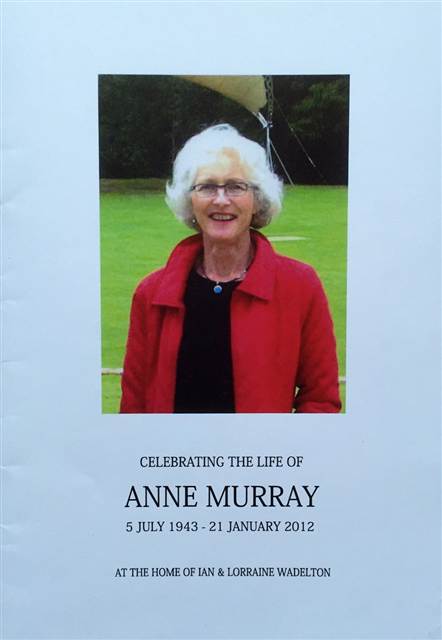
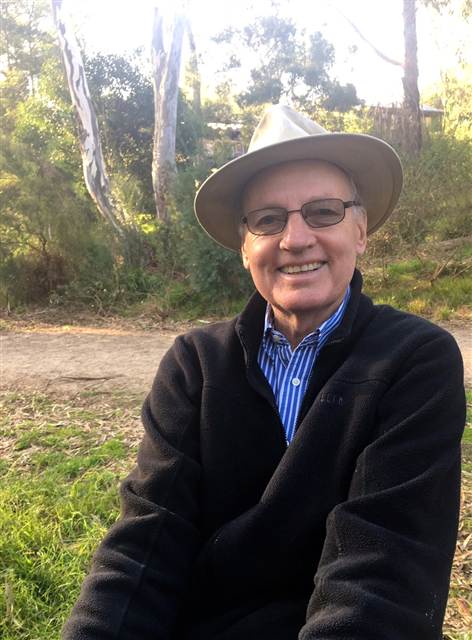
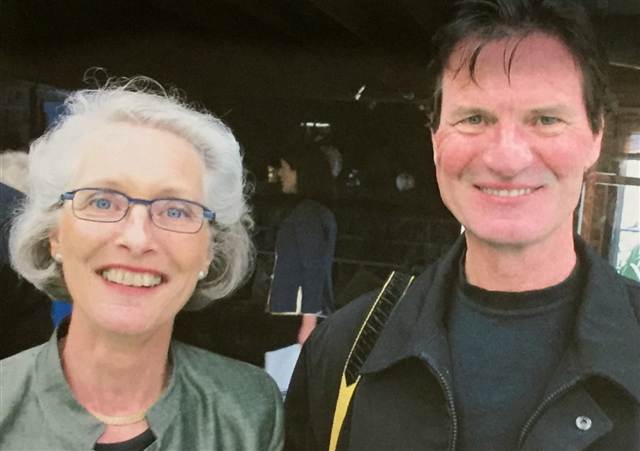
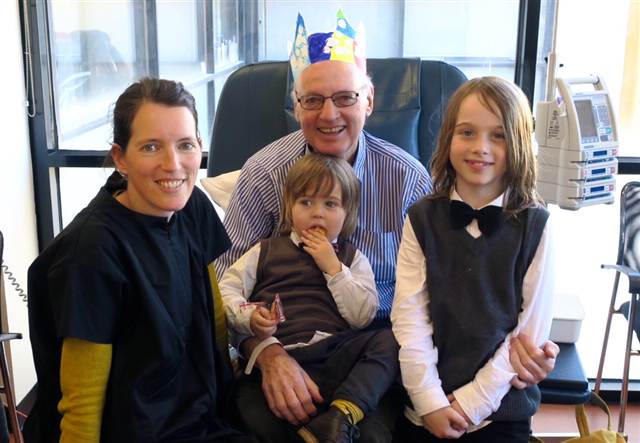
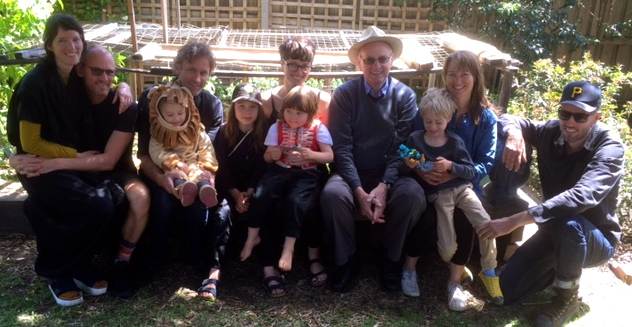
2012 onwards
The week after Anne died was a kaleidoscope of emotion, family bonding, planning, preparation and support from friends. In the course of three weeks Andy had seen the birth of his son and the death of his mother - the Alpha and the Omega. It was tough on Andy. Ewan was hiking with son Aleph in a remote part of Tasmania and was not able to return until the day of the funeral. It was tough on Lisa. Caitlin bore the burden of sharing with me in making funeral arrangements for Friday and preparing for the Celebration of Anne's life on Saturday. It was tough on Caitlin. Ian and Lorraine offered their home for the Celebration of Anne's Life. Ian would give the eulogy and Lorraine took over all catering arrangements. It was tough on them both.
On the night of the day Anne died I decided that I should be on my own at home. It was best to face it immediately or it would get harder. I did two little things to protect myself. I moved Anne's chair to another part of the living room so I was not confronted by its emptiness. I slept on her side of the bed so I was not reminded of her absence.
Rodney Swansborough sent an email the day before Anne died including these words:
Tim, I am prepared, without hesitation to help and respond to you at any level with any request, at any time. You have made a huge impact on my life and I feel so deeply and so strongly about the affinity and connection we have always shared.
Rodney flew down on Thursday and that night we did the circuit calling in to see all the family to lend support, share feelings and memories, and discuss plans for the funeral the next day and the 'Celebration' on Saturday afternoon.
Caitlin had suggested that at the funeral chapel in Lennox Street we sit in a circle and essentially share memories of Anne. It was simple and rather beautiful. Ross played the slow movement of Mozart's Clarinet Concerto. Rodney gave a lovely Reflection. We left Anne there with our hearts full.
Perhaps the best way to describe the Celebration of Anne's Life on the afternoon of Saturday 28 January is quote what I wrote in my diary while flying to Sydney the following Thursday. Some time earlier I had arranged to have lunch with Bernie Coleman and his wife Joyce on that day. I thought it best to go ahead with that arrangement and I felt very privileged to share that time with such a special friend. I don't often fly interstate for lunch! It will almost certainly prove to be the last time I will see him. This is what I wrote:
Well now, let's think about last Saturday and the wonderful Celebration of Anne's Life we shared with over 150 family and friends at Ian and Lorraine's beautiful house at 22 Sebastopol Street, Caulfield North. It was a perfect day - warm and still. It was stunning that we could deal with all aspects of organisation within the family. Ian and Lorraine provided the venue and took on the organisation and management of the catering. This was a huge task. Food and drink were delicious and just the right amount, and we predicted numbers and length to perfection. Caitlin organised the programme, formatting and printing. She did a beautiful job. Andy and Claire sang; Claire read; Ross played and organised PA; David put together a photoboard; Ewan looked after children. It was all quite amazing. We had seating for 150 and all could sit. Caitlin and I greeted everyone and Andrea Keeble played the violin at the start of proceedings - a lovely tribute to a great friend. I began by welcoming everyone and helped create a relaxed atmosphere in which we gave ourselves permission to clap and hug and laugh and cry. Linda Denman spoke beautifully about the Murray/Denman story and then read Joyce Grenfell's Poem:
If I should go before the rest of you, Break not a flower, nor inscribe a stone, Nor, when I am gone, speak in a Sunday voice, But be the usual selves that I have known. Weep if you must: Parting is hell, But life goes on So......sing as well.
Then Claire sang, with baby Arno snuggled to her breast. She sang her own composition Crow's Nest with Andy and Ross. I doubt there was a dry eye anywhere. They were marvellous. Ian then reflected on Anne's life. He knew all the pre 1966 part and I could give him the rest. He did it beautifully and it was wonderfully well received. Caitlin and Lisa then stood up together and combined in sharing memories of their mum, generally with words that began with the letter S. It was a brilliant idea to do it that way. We were conducted through laughter and tears and they were there for each other if one faltered. Sue Grieve spoke and found it so hard but Rob was by her side to support her and he read the last sentence or two. Then it was time for Lindy, our great friend and Anne's cello teacher. She played Handel's Aria Laschia ch'io pianga on Anne's cello. It was so good having them to stay for most of the week before Anne died. What good friends.
Then Rodney gave his most beautiful and poignant reflection. What a tower of strength he was for us all over those three days. That led on to two readings. Richard Smallwood was stunning reading Ecclesiastes 3 - 'To everything there is a season....' Our friendship goes back to 1946! Claire said she would like to read my poem Life which she did so poignantly and beautifully while nursing Arno. Not many dry eyes. I had written this poem on 5 January:
In the midst of life's endless movement let me be still;
in the midst of life's constant noise let me be silent;
in the midst of life's strain and stress let me be calm;
in the midst of life's uncertainty and doubt let me be true;
in the midst of life's sickness and dying let me be strong;
in the midst of life let me be.
Roger Hayward then spoke of the Hayward/Murray connection and led us all in sharing this wonderful prayer:
God, grant us the serenity to accept the things we cannot change, the courage to change the things we can, and the wisdom to know the difference.
This prayer was so key to Anne's approach to life.
Then it was time for Mozart's Ave Verum Corpus. How often that was played on cello days at CGS and in our home. To have Lindy playing it on Anne's cello with Alto Mary Tatchell and Baritone Michael Tatchell singing was breath-taking. And so it was time for the Irish Blessing led by Rodney.
I asked Rodney to give me a copy of his reflection and I quote it in full so that it is not lost!
Family and friends of Anne - good afternoon.
My name is Rodney. Tim in December 1988 appointed me as Associate Chaplain at Canberra Grammar - where I remained until March 1997, some eight years. They were wonderful years, with Tim as Headmaster. Those years allowed me to experience education at its best, and to work with a truly great Australian Headmaster......thank you Tim!
Tim and I have kept in some contact over the years, and more recently over the last 12 months, where we have maintained almost weekly contact by email and some phonecalls - sharing poetry, art, philosophy. It has been the very recent phonecalls which gave me the opportunity to speak with Anne directly, sometimes at length, and I treasure those conversations even more today.
Tim, you and your lovely family have kindly invited me to be part of your "grieving days" for Anne. You have all welcomed me so generously into your hearts, into your homes. This for me is truly an honour and privilege. Tim, your journey with Anne through the years of her failing health have shown to us all your absolute dedication to her wellbeing and your untiring commitment to attending to her every need. Your love for your lovely wife has had to experience the agony of seeing her so unwell, and at the same time sharing the rich and precious moments of your life together. As you have said, at times "it ain't been easy."
Tim, we as your friends and family, deeply appreciate your steadfastness and commitment. The journey and experiences of these last few days have been deeply moving.
Tim invited me to do a "family crawl" on Thursday evening (of which Tim said 'I could make a habit of this') where he wanted to re-introduce me to the family. We called in to see all of them, in each of their homes - Lisa and Ewan, Andy and Claire, Caitlin and Ross. I have become a part of your families these last few days, and my standing here today is so much easier and real because of your welcoming embrace.
A few days earlier, before I arrived, Caitlin came up with the idea for the private family funeral of "I remember", where the family in the past with grandparents sat together to reminisce.....tell stories. At the service yesterday at 10.00am we all sat "in the round" in the Chapel and simply, spontaneously and conversationally shared our memories of Anne,
Yesterday, in those reflections was a profound sense of sacredness and deep reverence which was not 'religious', but real, relevant, poignant and powerful as memories were shared, communal, family, individual. So when we came together in that lovely intimate chapel, family not formality set the tone, where openness and sharing became 'the liturgy', where quietness and reflection became 'the prayers', where the unassuming presence of Anne's coffin, simply set, became the altar symbolising the sacredness of her life and the eternal love all felt for her, Anne's coffin reminding us of her journey now ended, the pervading absence of her 'living presence', no longer in her frail body, but in our hearts, in our thoughts......in your hearts......in your thoughts.
In all my years in ministry as a priest, I had never experienced a private funeral like this moving moment we shared yesterday. It was just right. As I walked into the chapel I noticed the marks on the carpet where the pews had been moved, so that we could face one another. What a lovely arrangement. The intimacy and feeling of a family gathering this created was striking.
As the service yesterday came to a conclusion we stayed, talking, sometimes with some laughter, sometimes noisy, with Anne's coffin so near, easy to touch, easy to honour, so real. We all could acknowledge the painful reality of her death in this family way simply because Anne, in her own way, with her own inimitable attitude to life, to sickness, to death, had prepared us and given us permission to embrace her death, in all its nakedness and starkness with a reverence, not dressed up in awkwardness but in the living embrace of the true vicissitudes of life......the paradoxes.......the contradictions......."a time to be born and a time to die".
Last year, in July 2011, Tim wrote this poem while on holidays with Anne in Port Douglas, Queensland.
On That Day
On that day, when the jagged palms stood stark against the pink glow of morning light, and the birds slept; when the drained tide could recede no further and grey seas chopped and rolled before a final froth-edged spreading; when the smooth-washed beach curved and merged with the distant brooding hills; when silvered leaves and shells lay bedded snug with piled pearls of glistening sand crabbed from the world beneath; when the full moon welcomed the first shafts of light that would soon shape the rim of the world: on that day, when the sea sang its song of hope and renewal, mine was the first footprint in the sand.
Today, we all take new steps, on fresh sand.
Thank you, Anne, for walking with us, and leaving the footprint of your life in our hearts.
After the Irish Blessing the final words in the Order of Service were 'THANK YOU - Family'. We had not planned anything for this moment and I said 'I think this simply calls for a Family Hug' and that's what we did. There was nothing more to be said.
There were lots of family hugs during 2012. There was a lot of grief. There were lots of tears - together, privately, in the middle of the day, in the middle of the night. Tears often caught us unawares. They were very near the surface for a long time. I was so fortunate - and I still am so fortunate - that all members of the family are such good friends and so supportive of each other. Added to that they all live in Melbourne and so my whole family was, and is, close in both senses of the word.
In those early months after Anne died we all had to deal with her loss in our own way while helping each other at the same time. During the last few years of Anne's life we had agreed that both of us needed to be able to manage all aspects of our domestic and business affairs to be prepared for the inevitable time when one of us would be left alone. For quite some time I had been cooking my own meals since Anne's vast range of medical issues meant that she and I had been eating entirely different food. I described her menu as essentially 'weeds and seeds'! I didn't fancy them. Anne had done the tax for many years but for the last couple of years I had been doing more and more so that I understood where everything was and what I needed to do. This was a blessing. It was, and is, by no means the case with many of my contemporaries, the husband often keeping control of financial affairs which can make it very difficult if he is the first to go.
I had about 200 letters to write and I got together photographs of Anne over the years and compiled several corkboards. Caitlin and Lisa made their own 'shrines' to Anne. I think Caitlin started writing a diary dedicated to Anne comprising the things she couldn't tell her any more. Griffin was grieving too, of course. He kept me at arm's length for quite some time since he and 'Anna' had a special bond so it couldn't have seemed right to him that I was still around and she wasn't. There were numerous things of special significance, including jewellery, to be identified and shared among family and special friends. All these things take time and are part of the grieving and 'letting go' process. It took us five years before we were all ready to 'let go' of Anne's ashes.
Somehow as the year unfolded we all had to get on with life. Against the background of loss and grief Caitlin and Ross were a great strength but they had their health and employment challenges. The 'Rag Trade' is a tough and precarious existence and Caitlin was looking at options. She did a short course at RMIT in web designs and considered the possibility of teaching. She worked with CK Clothing and did work for Coles and K Mart and Target. She took the initiative to curate a splendid 'This Is Melbourne' exhibition of prints at the Bella Union at the Trades Hall in September for the Fringe Festival and somehow survived the perverse machinations of the person in charge. Throughout the year Caitlin was wonderfully creative through her Pesky Blog and that continues to this day.
Ever since that first miraculous introduction to Claire on 27 January 2010 Lisa had been working towards having another child carried by a surrogate. They were pioneers. Victorian law was being written at the same time. In 2010 and part of 2011 they were with Melbourne IVF but then moved to Monash IVF which they found so much better in all respects. In February 2012 they decided to have 'one more go'. By May eggs were harvested. By the end of May Lisa heard that 'none of our embryos made the long journey to the freezer.' Grief! However Monash IVF were so helpful and thoughtful that Lisa and Ewan decided to try once more. In August more eggs were harvested. By the end of August three embryos had reached the freezer and a three-month period had been approved for embryo implant. Hope! What a 'roller-coaster'. But as Anne said to Lisa once when Anne was suffering and Lisa was sympathising 'You ain't seen nothing yet'!
Andy and Claire were looking after their lovely little Arno. Andy was working hard at his combined Landscaping Business with Julie. Claire was keen for them to visit her mum and famly and friends in Canada and introduce them to Arno and they were also keen to look at the possibility of buying their own little house. Andy had been renting in Harper Street, Northcote, for a long time. In June they all went to Canada. Andy came home after a month to get on with work while Claire and Arno stayed for another couple of weeks. This was such a lovely time for Claire. House-hunting focussed on Preston and on 22 December Andy's was the final bid of $387,000 for 7/393 Gilbert Street.
So 22 December was a big day being Lisa's 42nd birthday as well as Andy's big investment day. Lisa and the family had just returned from a few days in Tasmania finishing up in a swish hotel by the harbour and a tour of MONA which they loved. The whole family came to Lisa's birthday and I loved seeing my two little grandsons together. Three days later we had the traditional celebration breakfast for Caitlin's 44th birthday and all moved on to a happy Christmas Dinner at Ian and Lorraine's where Ian proposed the toast to absent friends.
Earlier in the year, in April, the whole family, including Ian and Lorraine, David, Lois and Lucy, gathered at Cherokee at the invitation of Sue and Rob Grieve to plant a tree in memory of Anne. It was a most generous, heartfelt gift from Sue and Rob. They agreed that Andy could select and bring a Canadian Maple. We all contributed to the planting and I slipped some of Anne's ashes in with the earth. We gave Sue some Anne 'treasures' that we thought she would like. Claire, Ross and Andy played and sang in front of the fire in the sitting room afterwards. The garden looked a picture and it was one of those special moments. When I arrived home I decided that I would write a letter to Griffin and Arno describing the day. I wrote another letter the following week. For several years I wrote a letter to my grandchildren every Sunday - two letters, then three letters, and then four letters. Sadly illness got in the way of the habit and I became much less reliable.
There was, of course, plenty for me to do but when evening came and I pulled down the blinds I felt very much alone. I had one companion that was always with me which was a very good listener - and that was my diary. I wrote a fairly typical entry at 7am on 28 February. Part of it included the following:
As I sat in 'my' chair last night I've never seen Anne's chair look so empty. It yawned black emptiness - once such a warm and welcome refuge for her tired and aching body, now a bleak reminder of her utter absence. Her spirit - and what a spirit - was almost a palpable presence touching my heart but achingly out of reach. Everything I saw around me told a story about our lives together - a reminder of what we had done or heard or seen or been together. For a few minutes I allowed myself to dwell in that yearning twilight of remembering and wishing and momentary self-deception that all was as it had been. But the black chair remained a black chasm of reality and I turned away from the starkness of my loneliness.
When I was staying with Rodney Swansborough in Murrurundi in August I found myself sitting next to Karen Adler at breakfast. She describes herself as a 'Transpersonal Art Therapist' - a believer in the inherent healing qualities of the arts and keeping a journal. She's just the sort of person you might expect to meet at Rodney's house at breakfast! I told her I kept a diary and she asked me if I would write an article for her about the purpose and benefit of the process. She was probably surprised to receive the following a few days after I returned home - but she was pleased too and emailed 'This is a beautiful piece of writing, simple and eloquent and heartfelt and does indeed get at what I see as the beauty and usefulness of both journalling and seeing life as a journey.'
Living with a Diary
I have just finished writing Book 92 of my diary and it now sits on the shelf in my study joining about two metres of similar volumes! They may never be opened again and that really doesn’t matter. The process is the thing.
I started keeping a diary (apart from those January false starts) on the first day of the last year of my working life thinking that it would be interesting to have a record of my experiences, thoughts and feelings over the complete cycle of a school year. I was Head of quite a large school at the time. By the end of the year I was hooked and I’ve been keeping a diary ever since – more than 15 years.
From time to time I revisit the diary and process words on various themes that have interested me and I share these with long-suffering family and friends, self- publishing with the assistance of Officeworks.
For example, extracts from the day’s reading – books, newspapers, computer and other sources – often find their way into my diary. Late in 2008 I made a selection for an Anthology – a selection from the writings of others chosen for their wit or wisdom, beauty or special significance and which I recorded during the first decade of my retirement, 1998 – 2008. Somehow you make the words your own when you write them down.
Another volume I put together I called Connections 2009 – No Man is an Island. In the Introduction I wrote the following:
'On New Year’s Day 2009 I read the obituary of William Ellis Green in The Age. When I realised that the man I was reading about was WEG, the famous cartoonist, I felt a sense of connection that went back more than 50 years. It then occurred to me that in the course of the year in which I was to turn 74 I was likely to find all sorts of fascinating links with people whose lives were being celebrated in this way, and so I had the idea for Connections – 2009. John Donne’s famous Meditation immediately came to mind. I did not want to dwell on the tolling bell and being diminished by each man’s death. Rather I was much more conscious of being enriched by each person’s life. And so this volume began to take shape. The process has been a fascinating one and has lent a unique dimension to the start of every day. Sometimes, of course, I saw no obvious connections but it is extraordinary how often the connections were there – connections of friendship, common background, shared experience, mutual interests, sources of influence and inspiration. The process has highlighted how much my life has been touched by the lives of others and how much I owe to people that, in many cases, I have never met or have not known well. It has been an enlightening and enlivening experience.'
Recently I compiled a volume which I called Fine thank you, and you? My wife’s response to ‘How are you?’ was almost always ‘Fine thank you, and you?’ Occasionally when she was feeling in desperate pain it would be ‘a bit ordinary today.’ How she contended with all she had to bear I simply don’t know. Certainly courage and serenity and a total lack of self-pity and a hugely positive attitude and an ‘optimistic realism’ and a stoicism and a fierce independence were all part of the mix. Naturally I wrote about her often in my diary and I extracted many of these references in the context of her illness over the last two years of her life. I did not find the editing process painful. Rather I found it inspiring. It was not painful because she was not suffering any more. The pain was over. What we were left with was the wonderfully positive legacy of her character and spirit.
So my diary has been a key part of my life for the last 15 years. Not only has it been a focus for reflection day by day but it has also provided a longer-term perspective on themes that have been important in my life. It‘s part of my journey and we enjoy travelling together. When my journey is over my journal will have served its purpose and it can rest in peace!
At the time of writing the number of volumes has grown to 135! They will make quite a bonfire.
In 'life after Anne', as well as my regular contact with the family, I had to ensure that I had projects and things to look forward to. Art Class every Thursday morning was a lifeline, not only because of the painting and drawing but because of the lovely group of people with whom I kept in contact. Colin Johnson and Tim Blashki had become special friends but the whole group was a delight and I always looked forward to being in their company. The Australian National Academy of Music (ANAM) continued to be a great source of musical pleasure as Australia's finest young performers played for us at countless recitals in the South Melbourne Town Hall. The Wheeler Centre and the Melbourne Writers Festival gave many opportunities to hear talks and discussions on interesting themes. One of the most outstanding was Bishop Richard Holloway, one time Bishop of Edinburgh, whose journey reminded me of the journey of Bishop John Selby Spong. I read two of Holloway's inspiring books, Leaving Alexandria, A Memoir of Faith and Doubt and Between the Monster and the Saint. I actually entered into an email correspondence with him. I liked his observation that 'The opposite of faith is not doubt, it is certainty. Where you have certainty you don't need faith.'
I also built in a few trips away including the one to Murrurundi! In March I drove to Hamilton to stay with the Brians having been invited to attend the opening of the Kantor Family Centre for Performing Arts. It is a most beautiful complex within which the Murray Hall has become the Murray Room. The whole venture cost over $6 million and the Proncipal of the day, Bruce Simons, proudly told me that they did not have to borrow one cent! They received $1 million as a Government Block Grant, $2 million as a Rudd Stimulus Package, more than $1 million from the Kantor Family, $1.2 million from Geoff Hanbury and the balance from a number of other donors. What a contrast to the School we inherited in 1978 where there was a significant debt to the Presbyterian Church and two lots of Government Emergency Funding served to keep us afloat.
In April I spent time with the Mulfords at Red Rock where Anne and I had been on a number of occasions. Red Rock is where David relaxes. It is where he 'does nothing well.' It was relaxing there for me too, rather more relaxing than being driven back to Sydney in the back seat of David's car while Menieres threatened, bum numbed, knee ached, cramp loomed and bladder filled. The following month I flew to Canberra for the Chamber Music Festival where I stayed with Lindy and Jan. The Bach B MInor Mass was an absolute highlight and reminded me of that special farewell occasion in the Llewellyn Hall some 15 years earlier. The Head of CGS, Justin Garrick, invited me to lunch and the planting of a tree in memory of Anne. Quite a lot of old friends came for the ceremony, and with George Hyder's help I planted a Crepe Myrtle outside the window of the Head's study. We had afternoon tea in the Administration Building. I did not enjoy that. It was the home in which we had lived. It was a home no longer but a house for bureaucracy. Support teams now feathered their own nests in rooms that were once warm and familiar. Someone is full time 'Publications'; someone is full time 'Outreach'; another is full time 'Functions/Events'; someone 'Community Relations'; someone else 'Development'. A big part of 'Events' is the Fete which used to be run by parents. A good deal of the profits goes in salaries.
In June a copy of Geelong Grammar's Light Blue arrived. I remained interested in the School's welfare but I was becoming tired of their constant indulgence in singing their own praises. Their latest focus on 'Positive Education' was beginning to get under my skin, not because of the self-evident concept that a good education should be positive, but because the jargon of 'Pos Ed' was permeating so much of what they wrote and was becoming more and more incoherent. When the September edition arrived it seemed worse than ever and I was moved to write a letter to the editor on 12 October. I tried to be restrained since my purpose was to effect change rather than get people's backs up:
The Editor of Light Blue
Thank you for the September 2012 edition of Light Blue. It gives many glimpses into the dynamic life of the School which are interesting and often inspiring. As an Old Boy, former member of the teaching staff and former Head of two AHISA schools for more than 20 years it is a delight to see the vitality and strong sense of purpose of those lucky enough to be influenced by this fine school.
I do have one serious concern, however, that grows with each edition of Light Blue that I receive. It relates to Positive Education, not to positive education as such – how could anyone interested in education not be totally behind such a philosophy? – but to the way it is presented and promoted. I encourage you and those responsible for Light Blue to re-read the articles about Positive Education that have appeared in your publication over recent years. The articles are regularly characterised by jargon and ‘eduspeak’. They make complex what is simple. They constantly quote from obscure publications which dress up common sense in pretentious language, if, indeed, it is possible to work out what lies behind expressions like ‘eudaimonic conceptualisations of wellbeing’, 'conceptualisations of the self-actualising individual’ and ‘how the constructs are defined and operationalised’.
You kindly ask for feedback. My plea is that those responsible for telling us about Positive Education do so in simple, compelling English. News about Positive Education should be read with interest and understanding but I suspect there could be many like me who respond to it with a degree of cynical bewilderment.
With best wishes for the next stage in the development of the School and for the promotion and communication of your Positive Education philosophy.
I did not receive a reply but noted that, while the next edition continued to write fully about Positive Education, there was no jargon or reference to multiple American authors. It was written in clear simple English. Dick Johnson and John Nixon noticed it too. Was it coincidence or had they heeded my letter? Interestingly three years later when I was serving on the Tommy Garnett Scholarship Committee the Editor of Light Blue had to call me and he began with an apology for never having replied to that letter, even though, ironically, his brief included 'Communications'! It had been on his conscience all this time and it was clear that I had actually made them sit up and take notice. I was rather pleased about that!
On 5 July 2012 Anne would have turned 69. Andy and the family were still in Canada but the rest of us had an early lunch together at Caitlin's in front of their new pot belly heater before Lisa and the family headed for Byron Bay where they had rented a delightful house and I joined them a few days later. On Anne's birthday I sent an email to the family which included the following:
So today Anne would have turned 69! If she had somehow been able to struggle on without being dealt the deadly streptococccal hand she would have been in a ghastly situation by now and it could not have been a happy birthday and there would have been no prospect of a happy return. Given everything, that infection determined a quick end - only 48 hours in hospital and half that sedated. That was a mercy and in thinking about Anne on her birthday we don't mourn her death or her absence but we rejoice in her life and the memory of her strength and courage and character and resilience and example and willpower and the interests and skills she had and her humanity and serenity and wisdom and all those qualities that made up the unique Anne - the unique daughter and sister and wife and mother and grandmother and friend. The impact of her love and faithfulness and positive attitude and inspiration lives on in all of us. So we have no birthday presence - except most importantly in our hearts - but we have a birthday present, and that present is from her to us - a love and legacy that will never die and for which we can all be eternally grateful.
Late in August I joined Len and Vada Nairn in Hervey Bay where Len was engaged in one of his many temporary headships, this time of Fraser Coast Anglican College. He never seemed to tire of it. His task was always to rescue the school from financial crisis, shattered morale, plunging enrolments and a disastrous Head! He always achieved his mission with flying colours, leaving a thriving institution in perfect shape for the new regime - or so he led me to understand. Len and Vada were very kind to me and I enjoyed my time there in their very comfortable apartment including a day trip to Fraser Island and a whale watching expedition.
Late October saw me heading to Adelaide. Mary and Michael Tatchell very kindly invited me to attend son Jeremy's wedding. I shared an apartment and a car with Jan and Lindy and we enjoyed both the wedding and some good times in and around Adelaide. I managed to include a very pleasant dinner with Simon and Patsy Murray in their magnificently restored Headmaster's House at St Peter's. At both Canberra Grammar and St Peter's they got quite a reputation for sparing no expense in the upgrading of the Headmaster's residence!
The following weekend Caitlin and Ross arranged for the whole family to stay together at the comfortable seaside house they have access to from time to time at Aireys Inlet. It was lovely being with them all and getting to know Arno rather more. Ross was on the surfboard and Ewan in the kayak and Andy a bit of both. It was a blessing Ewan had his kayak because a man got into trouble in a rip. Someone on a surfboard tried to help but also got into difficulties which left Ewan to kayak out and save them both. Bravo Ewan! I wrote and drew and walked and enjoyed the family and there was a lot of laughter - and we all missed Anne - and there were tears too.
My final venture for the year was both unexpected and well out of my 'comfort zone'. Gera Tonge invited me to join her and her friends Tracy and Alisdair on their 40 foot yacht Four Seasons sailing in Pittwater after Christmas. I could have gone to the cricket as I always did or I could have a new adventure. I decided on the latter. It was a wonderful experience. It included sailing down the coast and in through the Heads. I never thought I would get that sort of perspective on Sydney Harbour, nor did I ever think I would sail under the bridge and around to the Fish Market. While there I visited Peter and Jenny Pockley in Glebe. I'm so glad I did. It was the last time I saw Peter, a friend since 1949.
So ended our first year without Anne. We had all faced our challenges and tried to get on with life as best we could. Arno turned one and the new year dawned - a year that proved to be both 'annus mirabilis' and 'annus horribilis'. It is probably best that we don't know what lies ahead in life.
As the new year unfolded there was plenty happening in the family. It was a delight to have the Rekstens and the Tatchells staying for the first week of the tennis. Caitlin and Lisa came over to see them and I ensured that they had time alone with Lindy to talk about Anne and the special relationship Lindy had with her, and those last days 12 months earlier.
In the middle of February Andy and Claire took possession of their Preston home and had a month of frenetic preparation work before leaving Harper Street to move in. Ross came and knocked down the leaning brick wall between us and number 42 and Andy introduced me to his fencer, Ron, who did a great job installing a new fence. Caitlin headed for LA on a mission for Jeans West. She loved it but Rag Trade demands are utterly unreasonable. They chew you up and spit you out. Despite giving her rave reviews they put her on another six months probation. Somehow she kept meeting unreasonable demands but it was very stressful. Very sensibly she resigned in April.
I was supporting David Odling-Smee daily by email. He had undergone surgery in England and was in the depths of depression. Somehow he got through. Michael had a lump removed from beneath his eye and I was dealing with 'floaters' in the eyes with black spots and things like wet cobwebs impeding vision. After a while the brain told the eye to pretend they weren't there! Arno began to walk and Andy and Claire did a beautiful job upgrading their Preston home, with Andy designing and creating a delightful paved courtyard. Caitlin and Ross celebrated their tenth wedding anniversary.
In February I visited my old friend from Hamilton days, John Williams. He and Barbara had retired to Geelong and John was now very unwell. I knew it would be the last time I saw him. We had a long chat and tears were often near the surface. When I got home I sent him one last limerick:
It seems that in life there's no knowing when we'll find ourselves to-ing, when fro-ing. At the end of the day I think the best way is to have no regrets and keep going.
John died on 23 April and I was privileged to attend his funeral in Geelong.
Meanwhile Lisa and Ewan were enjoying Hepburn and Griffin loved Preshill. All of this was happening against the backdrop of the Surrogate process that had officially begun on 27 January 2010 when the stars aligned and Lisa and Claire found themselves in contact with each other. Three years and two days later Claire came to Melbourne for another 'transfer'. This was followed by an agonising wait with emotions heading off in all directions. It must have been a desperately difficult time for Lisa. Late on the afternoon of Friday 8 February Lisa rang me to say she had just heard from Monash IVF that Claire was pregnant!. I wrote in my diary:
We shared tears of joy. Oh my goodness! Now we must hope that the next days, weeks and months go well until, presumably, an early October birth - a miracle (birth) inside a miracle (IVF) inside a miracle (Claire). A Russian Doll of Miracles!
A week later Monash IVF contacted Lisa to let her know that all looked really good after Claire's next blood test. Lisa was finding all aspects of the Monash IVF approach so much better than earlier experience with Melbourne.
5 April was a big day in Lisa, Ewan and Griffin's lives. On that day Claire and Jamie flew in from Adelaide and Claire had her scan. The result was reflected in Lisa's email which she called It's Official:
Dear Family and Friends
In 2009, following the birth of Griffin, I was told by my cardiologist, in no uncertain terms, that if I attempted a subsequent pregnancy it would most likely end on the operating table in need of a heart transplant and so began an incredible journey with a remarkable woman named Claire. We are excited to say that Claire is currently pregnant and the baby in her belly is ours!
Griffin has been across the whole process and can tell you how it's done.. 'You just get the eggs from the Mama and the fish from the Papa to make seeds. The doctor puts a seed in Claire and we hope it grows into a baby.'
That short sentence has taken four years, two fertility clinics, endless medical procedures, a lot of jumping through legal hoops and a number of setbacks to bounce back from in order to pull off. What began as the first surrogacy case in Victoria, all going well, may result in the first surrogacy birth in Gawler, SA. Claire is hoping this will build awareness in her community and ultimately help to open minds there.
We feel privileged to be a part of Claire's pregnancy and, of course, welcome her in having an ongoing relationship with a special baby who will share her belly button and who couldn't be here without her. Claire has always said to me - if Nicole Kidman can do this, so can we! Her unwavering support and stamina has played a huge part in this process for us.
The baby is due on October 19th and, even though I won't have a growing belly this time round, we'd love for you all to feel like you can talk openly about this and check in with Claire's progress from time to time!
We couldn't be more excited. Lisa, Ewan and Griffin x
I felt now that I could write to Claire and express my gratitude and wonder. This is what I wrote:
21 April 2013
Dear Claire and Jamie
I have delayed writing until after the 12 weeks tests have been done and things look very positive. What an extraordinary gift you are giving to Lisa and Ewan and Griffin and Freia and Aleph and our whole family. Birth is surely the ultimate gift of Nature - utterly commonplace in one sense but utterly unique - a mystery - a gift. For some babies to be born, however, the miracle of nature has to be complemented by the wonders of modern medical science. IVF has made the gift of birth accessible to many people who, as a result of chance or fate, would otherwise have been denied it. For Lisa to have another baby, however, there had to be the miracle of a third gift - your gift to her.
I'm sure Lisa has explained in a whole variety of ways what your gift means to her - and she'll do it many more times yet! I cannot find the words to describe the beauty, joy, generosity, selflessness, altruism, spirituality of what you are doing. None of those words can get close to the nature of your gift - essentially Claire's gift, of course, but Jamie's too. All I can say is that I am deeply grateful as Lisa's dad since I know what this means to her. From a very early age her ambition in life was to be a mother. You know what a good mother she is and how devastating it was for her to be told that she must not risk being pregnant again. Her dreams for a larger family seemed to be shattered - and then she met you!
Already it has been a long road - an 'emotional roller-coaster' for all of you. There is a long way to go before 19th October. I will be thinking of you a great deal between now and the birth and afterwards. I'm only sorry that Anne is not here to share in it all. She would have written to you in her own special way. I want to express my heartfelt thanks and deep respect. You are both remarkable people.
With love and best wishes for the next months and for a safe and joyful birth.
Sincerely Tim - and Anne
Meanwhile there seemed to be a good deal on. I had decided that it would be rather fun to organise a reunion of those who had been on the staff at Geelong Grammar School before Amalgamation with The Hermitage and Clyde took place in 1976. With the help of the OGG Office at Corio I was able to track most people down and was hopeful that I might get about 15 to come to lunch at the Malvern Vale Hotel on 27 March. In the end 49 came and it was a great success. Many others would like to have come but couldn't make it. I sent them a letter describing the occasion and that letter is Appendix 1 to this chapter. I also wrote this poem which I included with the letter and also sent to all those who came.
The Survivors
Thoughts on a Reunion 40 years on
What was it that we shared so long and short ago that tugged us back together fleetingly across the years to tell and show and know that something utterly defining happened there? What was it then? A spirit certainly, a sense that we belonged, inspired as we were by youth - our own and theirs - the young with whom we worked who kept us young in heart and head. An easy reuniting, defying years, at one together.
Ian Collier, who had not been able to come from Canberra, wrote a delightful letter of appreciation and I loved this comment on the poem:
The poem was a splendid thing for you to do, Tim. I know it has been a part of our work to foster the appreciation of verse, and with some satisfaction, but as we age has there not been a keener understanding, or a yearning for it, or a gratitude? It has to do with the compression of thought in an age of frenzy, with people saying more, and speaking faster, with consequences for judgement and comprehension.
We had hoped that we would have another reunion in due course and I was in the early stages of organising one when the spotlight was turned onto Geelong Grammar School in the Royal Commission into Institutional Child Sexual Abuse. The times were out of joint.
Soon after the reunion I spent a long weekend in Canberra staying with the Denmans and Gera. The main purpose was to visit the Turner exhibition but I was able also to visit Ian Collier. We talked about poetry again and we both enjoyed this little six liner that he gave me:
Streemin
(Roger McCough)
Im in the botom streme which meens im not brigth dont like reading cant hardly write
but all these disishns arnt reely fair look at the cemtery no streemin there
I continued to enjoy Gera's company and getting to know some of her many friends, all unusual, interesting people, often with backgrounds of considerable hardship but with great talent and inner resources. Gera's own story was anything but plain sailing, with her parents having been part of the Dutch Resistance during the War and then coming to a dairy farm in Australia where Gera spent her early years. Her life experiences have made her independent and resilient. She is very artistic and she was looking forward to retiring from her full time position as Registrar at Melbourne Girls Grammar School to give more time to her creativity and her family. Gera's friendship with the Denmans began when Ian and Bruce Tonge were young, single and adventurous. Ian was hitchhiking through the Northern Territory and was broke. He was thumbing it on the side of the highway when Bruce and some University friends drove by and Bruce picked him up. They kept in touch and the friendship has remained to this day although Bruce's marriage has not.
On 5 July Lisa hosted an extended family lunch at Alphington Street to 'celebrate' Anne's 70th birthday. It was becoming more and more clear that to die at 68 is to die far too young. Two of Anne's greatest friends, Sue Grieve and Sue Mackey, both remembered and sent messages that day, even though they were both facing medical challenges and imminent operations. Early in July I stayed with Len and Vada Nairn at Broadbeach and enjoyed a bit of warmer weather and on 6 August Michael and Rosalie headed off on their big adventure which was to take them to Belgium, a pilgrimage to the World War One Battlefields and a cruise on MS Pushkin from St Petersberg to Astrakan.
Early in August Pam Guilfoyle came to stay for a few days and so Tuesday 13 August dawned - a day which added the 'Horribilis' to the 'Mirabilis'. I knew that Lisa was having various tests and a biopsy the day before and we were all very apprehensive about the outcome but nothing quite prepares you for the sledgehammer of harsh reality. I was at the NGV with Pam when I received the news that Lisa had advanced breast cancer. I started shaking and couldn't stop for a long time. From that moment my head and my heart and my diary were dominated by this news and the necessary sequence of events and the uncertainty and the fear and the speculation. As Lisa wrote in an email that night:
I have a whole load of treatments ahead and, of course, a baby due in 8 weeks so it's best for me to take this step by step otherwise I find it all too overwhelming. The next step is to find out how much it's spread. I will be having bone scans and other tests tomorrow and a mastectomy on Friday.....
It is best not to relive what followed in great detail. The juxtaposition of the grief of the cancer and the joy of the imminent birth of their baby being carried by another played havoc with the emotions. I was reminded of the words of the Player King in Hamlet:
Where joy most revels, grief doth most lament. Grief joys, joy grieves on slender accident.
All members of the family were immediately wonderfully loving and supportive. It was not easy for any of them with their own health issues, commitments and responsibilities to be juggled in order to do everything they could to help. Caitlin said, 'We'll be OK. Lisa has a will of iron and we all love each other.' Ross said, 'When we all really know our roles we will speculate less and be effective within them.' Strong, wise, loving and positive.
The remarkable 'Surrogate Claire' immediately decided to come over for the weekend. Another huge gift. I wrote this in my diary:
How beautiful it is of Claire to want to come over to comfort Lisa by her presence and the presence of the baby to be born in two months time. She understands Lisa. She knows that her presence will symbolise for Lisa purpose and love and a total reason to fight on in the knowledge that her life is important in the years ahead in the nurturing of her family. It is beautiful, poignant, extraordinary symbolism. I imagine it is a first. Surely never before has a surrogate mother sat with the mother of the baby she is carrying as she emerges from an operation to remove her breast and save her life. The surrogate mother will radiate love and serenity and calm. Lisa will be exhausted and weak and sad but she will know.
I wrote this to Lisa that morning:
I will be thinking of you all day today and you know that all my and mum's love will be overflowing in your direction as the day unfolds. I think we have a wonderful family and while we are pretty good when it's plain sailing we're state of the art when the waters get rough. We'll all come through this together, Griffin included, stronger than ever. I'm inspired by your example, - and Ewan's. Caitlin has shouldered the load and Andy is being very supportive. Surrogate Claire is an extraordinary still strong voice of calm and her presence will lend a serenity to the days ahead. I'm sure things will go very well this afternoon. Caitlin and I will keep in touch and we will be there when you emerge from a quiet sleep. All our love - Dad.....and Mum
I tried to find some strength by remembering these words:
Life isn't about waiting for the storm to pass, it's about learning to dance in the rain.
It soon became clear from various tests that Lisa had a very rare and aggressive form of breast cancer. There were five boxes the oncologists told her you really don't want to tick and she ticked all five. There was one particular treatment that had been recently developed that was very effective but it was cardio toxic which was incompatible with Lisa's cardiomyopathy, the very reason Lisa was not carrying her own child. Consequently cardiologist and oncologist were at loggerheads. Cardiologist didn't want to use it: oncologist said they had no choice.
The Herceptin was used - every three weeks for 18 sessions - and chemo and radiation and hormone therapy. It was a crazy balancing act.
Soon after the first chemo Caitlin posted a picture and poem on her Pesky site. The picture was of a building with cracking paintwork behind a tangle of electric wires. She called it Cracked Spirit and it was 'For Lise':
When your spirit is so cracked that it's peeling
and the wires wrap so tightly that they cut
remember that one day
sometime later
when the paint has all peeled away
it will be smooth and new underneath
Beautiful.
Sue Mackey was Lisa's Godmother. She felt for Lisa deeply and, in Anne's absence, sent a most generous gift to Lisa. I was most moved and began my letter to Sue with these words:
Dear Sue. I can't tell you how much your extraordinary generosity means to Lisa. I know she has left a phone message (incoherent through the tears surely) and written you a heartfelt email. Your letter was waiting for her after a particularly shitty day among all the shitty days (and Lisa can really be shitty!) and it left her speechless with gratitude and humility that you would do such a thing for her - and for Anne.....
Lorraine organised a substantial fund from family and friends to finance someone to clean the house for the next year and thoughtfulness and kindness abounded. At the same time Andy was very busy and desperate to get on with paving his courtyard. Claire was completing her course to become a music teacher for little children and Arno was a delight. Caitlin was freelancing and exploring options, unsure how her career would develop - and, of course, she and Ross were being a wonderful support to Lisa as she somehow coped with her treatment.
On 7 October Lisa had an anaphylactic reaction to one of the drugs. She couldn't breathe. She thought she was gone. Thank God the nurses had an antidote on hand which they administered within seconds and she pulled through. Next day she, Ewan and Griffin were driving to Adelaide for the arrival of their baby.
On the morning of Thursday 17 October Caitlin flew to Adelaide to join the family and look after Griffin. At 8pm ESSI HONOR MURRAY-JOHNSTON was born weighing 3.9 kg. He was born under water. Lisa held him as he emerged. Ewan held Lisa. Jamie held Claire. Two hours later Lisa and Ewan drove Essi back to where they were staying while Claire and Jamie drove home - empty-handed. I found it - and still find it - impossible to get my mind round that.
'Essi' means 'Star' in Finnish coming from a Persian word! Lisa and Ewan chose the names Essi Honor 'in honour of Claire and in memory of mum.' All quite beautiful and remarkable.
On 21 October Lisa and the family drove back from Adelaide while Caitlin flew. Between us we ensured that they returned to a warm, well-stocked and welcoming home. Lisa clearly needed significant help with the addition to the family and the debilitating treatment. She had worked towards having this new baby for nearly four years. The last thing in the world she wanted to do was hand him over to the care of a stranger for most of the time. Mercifully Caitlin and Freia were able to step in. Caitlin's freelance work allowed her to support Lisa 16 hours a week while Freia's university vacation allowed her to provide support for 24 hours a week. What a blessing it was to be able to keep all of this within the family. It was undoubtedly the best arrangement as far as Lisa was concerned.
This is the moment for another quotation from Hamlet, this time from King Claudius:
When sorrows come, they come not single spies But in battalions.
Ian and David were both having to deal with prostate cancer. Since August I had been quietly concerned that I may have heart problems. I had symptoms that made me concerned that I may have angina, based on my memory of Anne's heart condition and my consultation with 'Dr Google'. Once Essi was home I determined that I must see Dr Allan which I did on 24 October. Things moved quickly from that moment. The next day an angiogram revealed significantly blocked arteries and the need for a quadruple bypass. Alas I was to be part of the 'problem' for a while having tried to be part of the 'solution' for as long as I could. My cardiologist was Ron Dick and he arranged for the Cardiothoracic Surgeon, Peter Skillington, to do the operation which I was told would last about four and a half hours! I had not been a patient in a hospital for some 30 years. Given everything that had happened over the last four months I was beginning to see a new dimension to the concept of an 'extended family'! I still had time to breakfast at the Westin in the city with our lovely English friends Martin and Heather Penney, go to Claire's gig at Wesley Ann, dine with the Newsomes, support Lisa after her third chemo, go to Tim Blashki's exhibition, see Andy's terrific work on his courtyard and many 'normal' things like that but just below the surface, and sometimes not as deep as that, my apprehension lurked.
The operation took place on Saturday 9 November. By then Caitlin had been in red alert organisational mode and had 'Team Tim' lined up - 'Caitlin and Ross, Andy and Claire, Ian and Lorraine, Lisa and Ewan (where possible), Denmans, Sue J, Gera, John Pascoe, Smallwoods, Dick, Michael and Rosalie.' I made no further entry in my diary until 21 December when I wrote:
There's not a lot I want to remember about the last 6 to 8 weeks! Intensive Care must be forgotten and the grand total of 23 days (Hospital and Rehab) drift into a no-man's-land world, and that world can essentially remain unrecorded except to say my surgeon and his team were brilliant, my friends were generous, my family was a life-line and I have survived - so far!
The day after I got home from Rehab the Denmans flew down from Canberra and stayed in the house with me for a week. What wonderful friends. When they left, Ewan's mum, Sue J, came and stayed for a further week so by the end of that, if I remember correctly, I was in a position to be self-sufficient. Family got together over birthdays and Christmas and the MCG beckoned for the Test Match. On 30 December I attended Barbara Tunbridge's funeral. She was 95 when she died and had been 'away' for many years. Very sad. I knew that Anne and John Tunbridge would have wanted me to be there.
In my Christmas letter to friends I included the poem I wrote on the first night after returning home after 23 days. It was an attempt to be positive and see beyond the 'battalions' of sorrows of the last few months:
BEYOND
Beyond the familiar furnishings of my room and mind, confines of security and domesticity; beyond the windows blurred with the year's smears of good intentions too long delayed; beyond the paling fence, confident and strong but weathering already; beyond the red brick wall deceptive in its solid certainty; beyond the tiles of neighbouring rooves mossed with ageing, mortar crumbling; beyond the loopy lifelines of sagging wires; beyond the looming shapes merging at the edge of the world; beyond the doubt and fear so near and palpable - I see the light - the marvellous light - and the light will prevail.
Glimmers of light began to appear early in the new year. On 6 January Lisa had her final session of chemotherapy. This was essentially the end of the beginning and at least the awful side effects of chemo would gradually recede. There were still 13 lots of Herceptin ahead as well as radiation. These treatments would continue for another 19 months. However it was certainly a key landmark and they decided to celebrate by going to Flinders Island for a week. I'm not convinced of the wisdom of this decision given the isolation from medical support but that's what they did and they survived.
In the same week that I had my heart surgery Colin Johnson had a heart attack and immediately underwent a quadruple bypass. Join the club! His recovery was slower than mine and he didn't teach our art class in first term. Nevertheless the group continued to meet as it does to this day with Colin back in the saddle and teaching with as much enthusiasm as ever. We share the same birthday so we feel quite a bond and the Art Class nearest 3 March is always accompanied by bubbles and a 'hearty' toast.
The tennis groupies descended for the first week of the Australian Open with Lindy and Jan Reksten, Mary and Michael Tatchell and Jeannine Keenan all here. It was quite a challenge to my stamina - a challenge compounded by a heat wave when the temperature hit 44 degrees on several consecutive days. It was lovely having everyone here but I was tired and lonely when they left and the second anniversary of Anne's death was looming. On that day the family gathered at Alphington Street and walked the river circuit between Chandler Bridge and the Fairfield Boathouse Footbridge, stopping at some of Anne's favourite places. Most of us were struggling one way and another in relation to jobs or health or morale. I have no doubt that I was depressed.
I had this in mind when later in the year, on the strength of a visit to St Mary's Cathedral in Sydney, I wrote a poem which I called Renewal, and which I quoted in my Christmas letter. This is the poem:
Renewal
I enter the cathedral a welcome refuge from the driving rain, my flimsy brolly futile in the circumstances, and soggy road-map dangerously limp. I settle quietly in an obscure pew. Some kneel religiously mouthing words, a ritual to appease the gods perhaps or maybe springing from a deeper source of pain or grief, remorse or gratitude. They all seek solace of some kind - blessing, comfort, strength, promise of redemption, the will to carry on, peace - Who knows? I wonder at their faith, their seeming certainty. Others simply sit, absorb the beauty, history, atmosphere, the sense of something more, the stillness. Too soon the spell is broken by bells and busy feet. I place a lighted candle in the sand and stand awhile , memory's shadows dancing hauntingly. The rain has stopped and I consult my map. It is a little stronger at the edges now and I am grateful.
Yes, early in the year my road map was soggy and dangerously limp. At least I had the capacity to acknowledge my problem and I decided that I must do something to feed body, mind and spirit. I ensured that I 'filled my diary'. I did not want inactivity staring me in the face. I started Pilates in Toorak. I joined a Philosophy class that met every Monday night. I continued my Art class. I wrote poetry, got to the Wheeler Centre, often went to Evensong at Trinity College and generally did everything I could to be active and purposeful. Of course there was always plenty I could do to support the family as well. Gradually I became part of the solution again.
Vicki Steggall had started research for her History of the introduction of coeducation at Geelong Grammar School and she jumped at my offer to become her research assistant in relation to staff memories of the process. For much of the year I met with staff, including Anne Fisher (Hetzell) in Adelaide, and recorded interviews with them so that by early in 2015 I was able to send Vicki 130 pages of transcript from those interviews. Much of this took place just in time since some have died while others are losing their memory. It was a fascinating process for me and I regard those 130 pages as 'life lines'.
Late in March 2014 I drove Anne Hetzell to Corio for the Centenary Celebrations of the School's move to Corio in 1914. As I recorded earlier I took a lead in the Jubilee Celebrations in 1964. With all due modesty I would claim that our celebrations then were infinitely more imaginative and cost far less than what we attended that day. If you weren't prepared to pay $150 for a gourmet lunch in the marquee - and I wasn't - then you were left outside and, quite simply, nothing happened. I was pleased to meet up with Jim Darby who was selling his book at a stall under the oak - Light Blue Generations, A History of the Old Geelong Grammarians. Since I had served on the Committee during the introduction of coeducation the book was of some interest to me. I was grateful to Jim for inscribing my copy with the words 'To Tim Murray. A great teacher of English and History. If this is any good, it's thanks to you. Jim.' Utter nonsense, of course, but despite knowing it is flattery, some of it sticks! Actually Jim was in some of my dramatic productions and I think they probably did make an impact
During the year I had several short trips away. A few days in Hamilton with the Brians allowed me to attend Marjorie Keeble's ordination as a Deacon. An attack of menieres encouraged me not to drive so I made the trip by plane, a very expensive tribute to Marjorie! The service in Warrnambool invoked every saint known to man, and presumably God, to support the three candidates - a couple of manly women and a rather effeminate man! A good compromise I guess. It was the culmination of a lifetime of Christian devotion for Marjorie and I was glad to be there to support her.
In April it was time to stay with Roger and Jean at Pretty Beach and we revelled in the production of Madama Butterfly on the Harbour. What a setting! It took millions of years to create with finishing touches in the last 200 years with CBD one side and Bridge and Opera House the other! Just before the show began a massive liner slowly headed out to the rip and the open sea. I thought of when we had sailed in through the rip not long before. The following year I joined Roger and Jean again for Aida. Two utterly memorable theatrical experiences.
In August I returned to Sydney, this time to stay with Jenny Pockley, and we enjoyed Hugo Weaving in an unusual production of Macbeth. Earlier in the year she had stayed with me and I had taken her to Peter's beloved Trinity College to discuss Peter's bequest. The following month it was time to spend a few days in Canberra since my dear friend George Hyder was in the last desperate stages of the ghastly motor neuron disease. I was able to visit George on each of the three days I was there. We both knew it was goodbye. On one of those days I wrote this:
George
HE lies marooned in the darkened room,
dependent,
dead-weight;
flimsy life-lines tease his nostrils;
his eyes moisten as words respond slowly to his
racing mind;
his hand inches over and rests
on mine.
SHE hovers quietly, alert, exhausted,
torn,
knowing she must hold on
and let go.
I prompt memories of
times shared,
moments of laughter,
comradeship and
creativity.
WE bond in silent acceptance of what is
and is to be
and see
that what has been
is still
for all
eternity.
On the day of George's funeral I wrote this tribute:
George
A big man, George,
big frame,
big heart
exuding warmth and
generosity.
His smile was big and beamed across his
ruddy face, friendly,
mischievous.
A proud man, George,
with no pretence,
who saw through sham and
self-aggrandizement.
A skilled man, George,
who loved and fashioned wood,
a master of his craft,
perfectionist.
A good man, George,
a friend both wise and true
and sentimental too
and no less vulnerable
than the rest of us.
A good man,
George.
Earlier in the year another Canberra Grammar friend, Adrian Town, had also died of the same dreadful disease. I was able to write to them both quite often in the months before they died and family or friends could read them my emails. I hope it gave them a little cheer in the depths of their agony.
Throughout 2014 Lisa was continuing to undergo treatment, of course, with all its physical, emotional and psychological scars. In March she suffered awful migraines and a terrible reaction to radiation - and then viral meningitis. Mercifully her final radiation was on 2 April. Early in June Ewan and the whole family decided to go overseas despite the fact that herceptin would not finish for nearly four more months and despite complexities over Essi's birth certificate and passport! Somehow these things were resolved at the eleventh hour and they flew out to Venice which was followed by Ewan's big 'surprise' - a health resort in the Dolomites reached by cable car! Thence to friends at Lake Como and relations in Edinburgh. It must have been a massive effort for Lisa but it was a real tonic.
Lisa's final herceptin was in September and this was cause for celebration. Her heart function was less than 40% for that final treatment. It was touch and go. About 80 family and friends, adults and children, gathered by the river for a celebratory lunch and we got 'Paul' to cater. It was a massive landmark but it would have been too easy for people to think that things were now plain sailing. That is not the way these things work. Later Kate Oliver, who had faced similar challenges that year, wrote a most insightful essay which she called Cancer, PTSD, and the Unexpected Teachings of Drag Racing.
Early in the year I had met Robin Grimwade at a dinner party at the Smallwoods. We were seated next to each other and we enjoyed talking about our interest in writing. We agreed to share some of what we wrote and this gradually led on to a special friendship that continues strongly to this day. As the year unfolded Robin met all the family and I think the friendship has enriched everyone's life. A brisk 20 minute walk got me to Robin's house in Armadale and I often enjoyed days down at their Mount Martha house until it was sold in 2017.
Caitlin was constantly taking initiatives having an exhibition at No Vacancy in Federation Square and it was in 2014 that her employment with Tiger Tribe began, a partnership that has gone from strength to strength and which is now four days a week, half working from home. Alas towards the end of the year we were shocked by the news that Ross's mum had breast cancer. An operation went well but complications have not made life easy for Rita since then.
Andy and Claire and Arno were enjoying their Preston home and doing a wonderful job in making it warm and homely. Their lovely news during the year was that Claire was pregnant so in January Arno would have a little brother or sister, they didn't want to know in advance. Keep it as part of the beautiful miracle. They were both hugely busy. Claire didn't drive so getting places was not easy. Andy had some big jobs on and he was also working on paving their courtyard which he completed before Claire's mum, Aliette, came to stay. It was lovely for Claire to have Aliette with them. Aliette didn't want to overcrowd their little house so she slept in a tent in the new courtyard!
Early in the year it seemed to me that it would be rather lovely to give some money to the Arts Centre and have a plaque in memory of Anne on the back of one of the seats in Hamer Hall. On 7 May all was in readiness and many of the family gathered in the Hall to view the plaque which simply reads:
Anne Murray
1943 - 2012
Cello Lover
I subscribe to the ACO Concert Series and my regular seat is P20. The plaque is on the back of the seat in front of me so I see it every time I go to a concert and we all like the idea of Anne's name being remembered in a place where beautiful music washes over it - especially if it's cello music! Before one concert in 2017 Vihra, who sits in P19, casually said to me - as you do - 'You don't happen to have a spare cello do you?' I asked her why she asked and she said that her 'honorary' grandson was married to Leonie Wollersheim, a German girl, and they lived in Fitzroy. Leonie was a fine cellist but she couldn't afford a good cello. I said 'Well as a matter of fact I do!' Anne's cello stood behind the door in the sitting room and ached to be played. I have lent the cello to Leonie and she plays in the Heidelberg Orchestra. She is thrilled and I know that Anne would be thrilled too - and it's a German cello being played by a young German cellist.
In the course of 2014 Ewan started working full time at the NGV and he has gone from strength to strength in his important role there as Senior Curator of Design and Modern Architecture. Design at the Gallery has received a much higher profile there under his influence as has activity that is children and family friendly. Early in 2014 Griffin was part of the publicity for a strong emphasis on Kids' Art and the bigger than life-sized banner featuring Griffin was absolutely delightful. He was in dramatic pose - and his interest in drama grows daily.
As if Lisa's own health issues were not enough she was faced with an emergency with Essi after a Hypospadias procedure in November. Together they spent nearly a week in the Royal Children's Hospital. In fact Essi had a urinary tract infection but different medical opinions had to be resolved and Lisa made some very astute and courageous judgements during that time, all the while with another herceptin treatment ahead of her and her heart function very low. I think that Anne would have been very proud of her that week.
Towards the end of the year I was invited along with others of my vintage to the home of Penny McBain for a lunch to discuss the prospect of launching a scholarship to honour Tommy Garnett. Early the following year I was invited to join the Scholarship Committee which I was happy to do since I felt I owed Tommy a debt of gratitude. I was on the staff at GGS for the whole of his headmastership and he influenced many of us more than we really understood at the time. Early in 2018 the scholarship was launched at Corio along with Andrew Lemon's brilliant biography of Tommy which he called The Master Gardener. As I have already described I was privileged to be master of ceremonies at that occasion held in the SPACE (School for the Performing Arts and Creative Education). What a space it is! I attended the opening in May 2015. It cost more than $20 million. Even so I rather liked the old wooden space that I almost called my own when I taught there and which I have also referred to earlier. In the end the SPACE you need is The Empty Space which is the title of Peter Brook's book on the theatre. That empty space may be in the open air or simply the 'wooden O' to which Shakespeare refers in the Prologue to Henry V. You can't buy creativity: you have to inspire it. 'On your imaginary forces work.'
I have also referred to my concern about the jargon the School indulged in when describing some of its policies, not least in relation to Positive Education - 'Pos Ed' as they insist on calling it. I thought I had succeeded in encouraging them to write intelligible English but in the June edition of Light Blue I was horrified to read these words:
The GGS model of Positive Education establishes a number of avenues we can take to get to the 'thriving' end of the wellbeing continuum.
Tommy Garnett never used one word of eduspeak jargon - and I hope I didn't either, except in some quite irreverent satirical pieces which I only shared with close friends!
On the last day of 2014 I received in the mail a book by Niall Rudd, TE Page, Schoolmaster Extraordinary. I enjoyed this small poem called The Current of Life:
A baby fountain springing from the earth, bringing new joys and sweet unconscious mirth: a tiny rivulet tottering on its way, with infant murmurs lisping in its play: a full brook leaping on mid golden hours, noisily jubilant in its youthful powers: a calm clear stream majestically strong, rolling with deep-toned utterance along: a weary current gliding peacefully through level meadows slowly to the sea: so runs our life away; so on the breast of time's broad ocean sinks at last to rest.
A fortnight later the first two lines of that poem were fulfilled for Claire and Andy. At 3.30pm on Wednesday 14 January I received a text message from Caitlin 'It's a girl' and then Andy rang from the hospital car park. He had taken Claire in at 1pm and two hours later Iris Djebali Murray arrived. An hour before I received the news I had taken a lot of Anne's clothes to the Op Shop! Comings and goings. The current of life! It was so good that Claire's mum had been out here just before Christmas. The plan was that Claire and Andy and the family would go to Canada during the year so that Aliette could meet her new grandchild. Late in June Claire, Arno and Iris flew to Montreal and on 11 July Andy joined them for a month. It was so lovely for Claire and the family to have that time with Aliette and family and friends. They all returned in the middle of August. Alas late in October it became clear that Aliette had inoperable cancer. The whole family immediately flew back to Montreal getting there in time for Claire to spend a few cherished days with her mum - days in which to remember and share and - yes - laugh - before Aliette died. They had a special gathering early in November - 'Pot Luck' - when family and friends could celebrate Aliette's life. She was the same age as Anne - 68. Too young. They returned to Melbourne at the end of November - a sad and difficult 'homecoming' for Claire - and , in a sense, a long way from home.
Early in March that year I was going to turn 80. My plan was to pretend that this wasn't happening and to let the whole wretched event slip quietly by - 'a weary current gliding peacefully'! Caitlin and the family had other ideas and suggested that we should have a party. Ian and Lorraine 'volunteered' to have it at their home and plans quickly got under way. Lindy and Jan Reksten stayed with me in January for the first week of the Australian Open Tennis and were quick to agree to come down and play at the party, and Jeannine Keenan would come and play, and Mary and Michael Tatchell would sing and 'perform' and Andrea Keeble would play and we would have a singalong and write limericks and Claire suggested that she set one of my poems to music and sing it accompanied by Ross. Lorraine and Ian took on the catering and stage management. Caitlin designed the invitation and quickly a great party was shaped up.
This is the poem I suggested to Claire and she set it to music and sang it beautifully. We gave everyone a copy and I guess it brought back plenty of memories to my ancient friends.
HOW TERRIBLY YOUNG WE WERE WHEN WE WERE YOUNG
a poem by TIM MURRAY
set to music by CLAIRE JENKINS
performed by CLAIRE and ROSS McFERRAN
A couple of years ago I read Portrait of a Friendship – Letters of Barbara Blackman and Judith Wright 1950 – 2000. The exchange of letters between these two remarkable women is a real treasure trove with so many delicious descriptions and turns of phrase. Barbara's letter of 4 July 1975 included this observation:
Charles seems much more at one with himself, which isn’t to say that he isn’t terribly restless, doing all sorts of runabout busy things rather than get quietly down to painting. I am rendering the great gesture of assistance in having taken delivery of some twenty tea chests to help clear his studio and am unstowing their cargo from Pre-Paris packing, which involves all we have kept and stored for ever, all those old photographs that roll round one’s life and surface just every seven years or so. How terribly young we were when we were young.
That final sentence struck a chord with me and I couldn’t get it out of my head. So I wrote a poem!
When we decided that we would have a party to celebrate my 80th birthday Claire said she would like to set one of my poems to music and sing it at the party. I was thrilled at this suggestion and I am very grateful to Claire and to Ross
Inventing our own worlds in air raid shelters; billy-carting all round Fawkner Park; laughing, crying, gasping at Wirth’s Circus and hiding under bedclothes in the dark. Luna Park slides, penny tram rides. How terribly young we were when we were young .
Playing down the bend and catching yabbies; playing battington or grab or bobs; shadow plays for threepence on the verandah and every sip sip sip of Mrs Obbs. Bags of lollies, teddies, gollies. How terribly young we were when we were young.
Bicycling to Queenscliff or the You Yangs; British bulldog, flying home-made kites; midnight feasts and birthday study parties and listening to crystal sets at night. Loaves and fishes, Nunc Dimittis. How terribly young we were when we were young .
Cooking jaffles round the winter fire; being all devout in Sunday suits; blubbing at heroic schoolboy stories and nailing stops into our football boots. Cricket, sailing: passing, failing. How terribly young we were when we were young.
Salad days at College in the fifties; programme dances at the College Ball; passionate embraces before curfew and playing bowls outside the Dining Hall. So witty and clever, the best intake ever. How terribly young we were when we were young.
Tennis days and all-night New Year parties; playing cricket almost everywhere; halcyon days in London and in Oxford; rapturous without a single care. Night Clubs in Soho, waking just so so! Oh how terribly young we were.
It couldn’t last for ever, we moved past our prime; the cause of the problem was Old Father Time. We started to realise the song had been sung and how terribly young we were when we were young.
The theme for the party was 'a touch of colour'. Rodney Swansborough wore an outlandish tie which nearly took the prize but Griffin was already a seasoned fancy dress campaigner and won the day. There must have been about 90 people present and I would dearly love to have asked others as well but there was a limit. Since then I have been to a number of 80th birthday parties but none to compare with this one!
Throughout 2015 there were various regular 'life lines' that kept me going. I always enjoyed my monthly lunch with Don Marles, Dick Johnson and Richard Smallwood. Alas by 2015 Fay had moved some distance 'away' with dementure and Don was more and more confined to the house so I regularly went there for morning tea, often with Dick. Fay sometimes joined us and enjoyed the company. The whole situation was becoming more and more difficult for Don to manage and his health was suffering. It would have broken Don's heart to see Fay move to a nursing home and it was something of a blessing that he didn't have to. Don died in April 2017. I was honoured when son Richard, my Godson, asked me to give one of the eulogies at Don's funeral. I have included what I said as Appendix 2 to this chapter.
A regular lifeline is the time I spend with Mary and Bernard Newsome. About once a month for some years I have joined them for afternoon tea or champagne or both and shared words that we have chosen. They may be things we have written ourselves or words written by others. Robin Grimwade joins us when she can and it is always interesting to choose and hear what others have chosen. On several occasions this has extended to a full play reading over dinner with others and plays have included The Importance of Being Earnest and Faith Healer.
I was very glad to be able to help Lisa and Ewan by doing a regular pick up of Griffin from Preshill. The family was, and is, of course, my main lifeline. In November they finally convinced me that I needed to upgrade my mobile phone from the old Nokia which was very limited and uneconomical, to an iPhone 6. Caitlin helped me buy it at Telstra in Northlands and I now touch base with the family with a text message every morning. It is so good to say 'good morning' and it's a useful security check.
My correspondence with Roger Hayward continues and it is always an interesting challenge to put together a letter of some substance and a great delight to read what Roger has to say. He is a wonderfully capable, versatile and creative person. He has been most hospitable and generous to me. A faithful friend.
It was my good fortune to be seated next to Robin Grimwade at that dinner at the Smallwoods in January 2014. Our friendship has strengthened over the years. In July 2015 we went to Mooloolaba together for a week staying in the Newport Apartments. On numerous occasions we headed for the Grimwade beach house at Mount Martha, a delightful escape for a day or a few days. Lisa and the family enjoyed some time down there too but the time came for the Grimwades to sell and so that special dimension to life came to an end. I talk with Robin every day and we enjoy plenty of activities together not least going to films and theatre, including some brilliant productions by the Australian Ballet. We enjoy sharing our writing and reading aloud. Laurie Lee is undoubtedly our favourite so far. I feel so fortunate to have this very special friendship with Robin. Such a lifeline.
I started writing weekly letters to Griffin and Arno after the tree was planted at Cherokee in memory of Anne. In October 2013 Essi's arrival meant that I wrote three letters a week and from January 2015 there were four. This continued until early 2016 when health issues intervened. I hope I will write a few more letters to my grandchildren that can provide little time capsules which could be a source of interest in the future.
My writing of poetry was a constant source of interest and at the end of 2015 I put much of it together in Train of Thought - and Other Poems. My friend Tim Blashki also writes poetry and in the course of the year he gave me a collection that he invited me to read. He then asked me if I would read some aloud to him since he seemed to like the way I read poetry. I enjoyed that and it led on to his asking me to record his anthology. I did that on my little digital recorder on which I had recorded those memories of coeducation a year or two earlier. After that Tim put his poems together in a publication and had my recording professionally transferred to a CD. That was a very happy and enjoyable process for me. I always think that poetry should be read aloud and I enjoy doing that.
Throughout the year the family was very busy. Andy is passionate about his landscaping work and he had some big contracts in 2015 in the midst of increased and demanding family commitments. Ewan was very busy at the NGV taking significant initiatives with new ventures along with several overseas trips. Lisa had constant health issues to balance, treatments to juggle and get through, children to care for and a home to run. It was no easy task for her. They had sold Hepburn and given some thought to buying a studio apartment nearby but wisely decided against it. It was too small. Caitlin was flat out at work and taking lots of initiatives publishing and exhibiting as well as supporting Ross and Rita during her chemotherapy and being the family rock. Ian and Lorraine had family in several different parts of the world whom they visited. They were very busy at home and very supportive of all the Murrays. I really appreciated their friendship which included a roast dinner there every second Sunday night.
In 2014 I had decided to invest in Foxtel. The process of getting it installed was quite a drama but it has been a great blessing ever since. I tend mainly to watch the Sport and the Arts channels. The recording process is so simple that even I can get it right most of the time and I am always delighted to be able to watch what I want at a time that suits me, generally from about 7pm onwards.
By September 2015 the Royal Commission into Institutional Responses to Child Sexual Abuse was focussing on Geelong Grammar School. I watched some of the proceedings of the Commission on line. I was horrified that some of my friends and colleagues had now been found guilty of perpetrating such abuse. One is still serving a gaol sentence. I was horrified to think that the school I loved working in during most of the 1960s and 1970s was now being characterised to the public as having a culture of sexual assault, bullying, cover-up and silence. To me it had a culture of friendship, creativity, care and trust - service and responsibility. People I trusted and liked had betrayed the culture that I believed in and enjoyed. I felt empty, sad, confused, angry. I felt violated and betrayed. Three years later the whole process has a long way to run and there is still a lot of pain to come.
In August 2015 I accepted an invitation to a service at Canberra Grammar School to celebrate the 50th anniversary of the foundation of the Chapel of Christ the King. I enjoyed the service and was rather thrilled that my drawing of the chapel was on the invitation and the cover of the Order of Service. The drawing was dated 2001 and had been part of the exhibition I had held at the School soon afterwards. I confess I was delighted to see the Peace Window again and the wonderful stairs that George Hyder designed and constructed - the 'Stairway to Heaven'. I met up with many old friends that day and the Head, Justin Garrick, showed me over the Terry Snow Centre - all $8 million of it! I enjoyed seeing Hugh Dakin that day and loved his observation that religion is rather like golf. He likes so many aspects of golf - the pleasant walk, the outdoors, the birds, the beauty, the company, the nineteenth hole and all those sorts of things but it's all mucked up for him by having to hit a ball with a stick. Similarly he likes so many aspects of religion - the architecture, paintings, music, community, social welfare and so on but it's all mucked up by the ludicrous concept of God! Bravo Hugh Dakin!
A couple of months later Justin Garrick, Head at Canberra Grammar School, very thoughtfully telephoned me to let me know that he was about to announce that the School would be going fully coeducational over the next few years. I was delighted. As I have already explained, early in my time as Head I had explored this possibility very carefully but for various reasons the time was not right. In fact the whole staff had devoted one full day to discussing the issues and options in relation to coeducation and in principle it had received strong support. Sadly such a move would have been premature then whereas the timing seems perfect now. They are presently in the midst of the transition and I have no doubt that it will prove to be a very wise decision. I hope the process is as harmonious as it was at Geelong Grammar School in the early 1970s.
While in Canberra in August I stayed with the Denmans and on a walk from their home to the Curtin shops I quite suddenly became tired and breathless and my legs felt pretty feeble. It was the beginning of significant health issues starting with fluid in the bottom part of each lung. Late in September an echocardiogram revealed some muscle deterioration round the heart and some leakage round the valve and soon kidney issues were identified. I soldiered on as best I could through Christmas and into 2016 with the Tatchells staying here for the first week of the tennis in January. I got to Hamilton for the commissioning of Andrew Hirst, the new Principal of Hamilton College. David Mulford was there since Andrew had been David's Deputy at Newington. A couple of weeks later I enjoyed a visit to Geelong Grammar School with Tony Llewellyn-Jones for him to visit the SPACE and to spend time with Michael Collins Persse. On the way back to Melbourne (Tony was playing in North by North West at the time) Tony said he had auditioned for the part of Colonel Pickering in Julie Andrews' 60th Anniversary Production of My Fair Lady. He said he was 'hopeful'. I asked if he had received a 'call back' and he confided that he had! On 2 March I received a very excited and exciting text message from Tony which essentially said 'By George I've got it!' In due course Tony was to play Pickering in nearly 400 performances. Robin and I went to see the show in Melbourne and were delighted to catch up with him afterwards. It is surely one of the great highlights of Tony's outstanding theatrical career which he has pursued for the whole of his life.
In April I added Bronchitis to my woes and could not fight it off. Foolishly I went to Sydney early in May to stay with Jenny Pockley for a few days and see Tony Llewellyn-Jones in Hay Fever. I found it a real struggle to keep going but somehow managed and even kept my sense of humour by writing the following on the strength of the general state of Jenny Pockley's domestic situation and her advice in relation to various appliances that didn't work! It was Mother's Day:
A Shaky Business
The jug is there so feel quite free to make yourself a cup of tea. It doesn't always work I fear so just give it a shake.
You'd better have the front door key; there's the lock as you can see. It doesn't always work I fear so just give it a shake.
There's the toaster: help yourself, the bread and jam are on the shelf. It doesn't always work I fear so just give it a shake.
The shower screen's meant to slide away; I made it work the other day. It doesn't always work I fear so just give it a shake.
The toilet button's double speed, I think you'll find it's all you need. It doesn't always work I fear so just give it a shake.
The mobile phone is rather old, it needs recharging so I'm told. It doesn't always work I fear so just give it a shake.
I have TV as you have seen; push red to start - or is it green? It doesn't always work I fear so just give it a shake.
The clock is useful on the wall; it helps to keep me on the ball. it doesn't always work I fear so just give it a shake.
The microwave I like a lot, so quick to use to get things hot. It doesn't always work I fear so just give it a shake.
I may doze off from time to time, I'm not - let's face it - in my prime. If I'm asleep when next you call just give me a shake.
One of the joys of having my iPhone 6 was to be able to keep in touch with the family, Michael and Robin by text message and some of the family through Instagram. On Mother's Day I was moved when I read this from Lisa:
Mum, I have so much to be grateful for. You never raised your voice, not once; you never compared us with our siblings, ever; you never complained about anyone or anything. How extraordinary you were, how lucky I am. I wish you could see my beautiful boys today.
We all missed Anne so much that day and our thoughts were also with Claire as she thought of Aliette and her family and friends back in Canada.
After my return home from Sydney health issues developed pretty quickly. Tests showed that I was suffering from Anaemia and I underwent a blood transfusion. Further tests showed that I had Multiple Myeloma - not a good thing to have. An Oncologist was recommended but delays in getting an appointment led to my getting a referral to Professor Miles Prince from Dr Andrew Allan. The delay was undoubtedly a huge blessing in disguise and I was always keen that I should go to him. His reputation clearly demonstrated that he was at the cutting edge of this branch of medicine. I had read about him in the Geelong Grammar School Publication 100 Exceptional Stories, and I had a personal connection since he had been a boy in Allen House when I was Housemaster and he had even played the part of Piggy in my production of Lord of the Flies! I remembered him and his sister, Kim, with great affection and admiration, Within two hours of Miles reading my paperwork on 4 June I was having a consultation with him and his wonderful Haematologist nurse, Alicia Snowden. Caitlin accompanied me and some of the first words Miles said to us were 'This is very treatable'. Everything about Miles inspired total trust and confidence. What a blessing it was that the Oncologist recommended coudn't see me in reasonable time. Only many months later when I was in remission did Lisa tell me that she had telephoned that oncologist's rooms to give them the benefit of her views and this oncologist had told her, never having met me, that 'your father has terminal myeloma.' Let's face it, the limitations reflected in that mindset would have resulted in a totally different outcome.
Miles got things moving immediately and next day I was admitted to Epworth Freemasons for three days of tests and the beginning of treatment. Caitlin had "Team Tim' reconstituted and reconvened and I felt so fortunate and confident in the treatment and care I was receiving. I made an entry in my diary on 8 June and the next entry is four months later! This summary of those four months is based on what I wrote when I returned to the diary on 3 October. I simply didn't have the energy or mental focus to write so there was no diary, no letters to grandchildren, no poetry and little more than brief text messages - but what a boon it was to be able to keep in touch in that way. I had a couple of stints in Epworth Freemasons largely as a result of infections and my poor immune system. After the second stint I had nine days at Epworth Rehab in Camberwell. For the first few weeks at home after rehab I couldn't manage things on my own. Caitlin orchestrated everything and everyone and the Denmans once again came down for a week to stay with me. What gems! After leaving Rehab I had eight weeks as an outpatient. After that I enrolled in a Rehab they recommended nearby and stuck with that until Christmas. From early June I had treatment every Monday - chemo drip, chemo injection and steroids. I quickly lost weight and strength, my weight going down from 85 to 70 kgs. One Sunday in late July I was so concerned I sent a text message to Miles who had kindly given me his mobile number and said I was to contact him any time if I was anxious. He replied within five minutes giving me clear guidance and saying I should see him the next day.
A pattern developed and I knew which part of the week was likely to be my worst time. I suffered from 'chemobrain' which meant it was very difficult to focus and concentrate and it tended to play havoc with the capacity to see things in perspective. Gradually progress was made and after seeing Miles on 15 September I could report as follows to 'Team Tim':
Caitlin and I met with Miles Prince today at 1pm for a progress report and the way forward. The main message was that I am doing very well. In fact he said 'you have responded magnificently' and going 'brilliantly'. The original offending Protein blood reading was 70+. By 19 August it was down to 2. Miles said that they would consider the optimum response to be a 90% reduction from the original and I've done a bit better than that so he says it's a 'great result'. Of course we want to reduce it to zero.
During my 'diary silence' Andy and the family travelled to France and Italy for five weeks. Sickness and exhaustion contributed to a difficult start but they shared a very special time with friends and family in a villa outside Florence where they were together for Aliette's birthday. This was a very special part of the grieving process for Claire. Caitlin and Ross had two great weeks in New York where Caitlin took some wonderful photographs that inspired an exhibition at Port Jackson Press in Collingwood. Robin had trips to Uluru, Canberra and Perth. Lisa and the family were very busy with Ewan spending some time overseas, mainly in Italy and Holland, with Lisa continuing her own health battle while being an outstanding mother to her two boys.
A month later, on 13 October, Miles gave me the news that the offending Protein reading had now reduced to zero. He said that only one in 20 gets a complete response with the amount of treatment I had received up to that point. My challenge was to keep it that way as I entered the 'maintenance phase' which would continue until the following May once I had reached 35 lots of chemo!
By early November the protracted and distasteful build up to the American Presidential Election was reaching its climax. On Election Day, 9 November, I wrote in my diary that all indications were that Clinton would win but Trump was unpredictable and anything could happen. Paul McGeough wrote an article in The Age under the headline 'What will Trump do after he loses?' predicting he would be vindictive and dangerous, identifying some of his anti-leadership qualities as ' selfishness, a lack of discipline, vindictiveness, intellectual sloth, mendacity, greed, bigotry, misogyny and racism.' History has shown that McGeough was right about the Trump 'qualities' but he was wrong, like so many others, about the election outcome. Trump won. Who knows where Trump will take the world. A new language and a new 'morality' have taken over since that fateful 9 November.
Meanwhile on the home front Andy was preparing to sell their Preston house on 12 November. Together they had made it into a beautiful little home but they were anxious to get something a little bigger, hopefully in the Northcote area. There was a lot of interest with about 80 people attending the auction and about seven serious bidders. Lisa couldn't get there because Griffin was not well so I kept her informed by text. The house went on the market at about $590,000 and finally the 'sold' hammer came down on $664,000 - a very good result. It was, in fact, vision and hard work rewarded. Settlement was 120 days and they needed every one of them. They really needed to buy before Christmas. A very traumatic and unsettling period lay ahead working out finances, getting unreliable and inaccurate advice from Westpac, inspecting, going to auctions, prices going beyond their limit. On 10 December they purchased 156 Separation Street Northcote. The process was not plain sailing and various negotiations had to take place before the deal was finally resolved. There was a vast amount to be done and once they took possession in the new year they worked massively hard to renovate and make the place habitable before they moved in during March. I kept a photographic record of the transformation they made culminating in 'Day 47' on 15 March 2017. In house and garden they worked desperately hard and it was an exhausting process. Vision, hard work and patience have been rewarded and they are very happy there. The location is in so many ways ideal for access to all they want - kindergarten, school, shops, park, work, family, friends - especially since Claire doesn't yet drive.
On 9 December there was an obituary to George Witynski in The Age. George was a brilliant and unusual man. He was a member of the Salon Players being a fine cellist and pianist. Lindy gave the eulogy at his funeral. I was very moved when he came from Canberra with Lindy and Jan to attend the Celebration of Anne's life. He bore his final illness with a remarkable fortitude - just like Anne. Anne would have been so moved too that George came to farewell her. Anne would have done the same for him given the chance.
David Odling-Smee came to stay over Christmas and New Year. It was good to have his company. He had been through a huge amount in the previous couple of years leaving Timor, prostate cancer, depression and much trauma. I had done my best to be supportive, at one stage writing to him daily for many months. He was trying to be more positive and enjoy a six weeks 'tour' of friends in Alice Springs, Ocean Grove, Toorak, Bright and Tasmania but he was still depressed. He came the following Christmas as well and his morale seemed to have improved considerably. I value his friendship enormously going back, as we do, to the early 1960s. He joined the whole family at Caitlin's for birthday breakfast and Ian and Lorraine's for an extended family lunch. It was a really hot day and Michael and Rosalie sensibly decided not to travel down from Geelong in the heat. The Christmas party consisted of the following: Ian, Lorraine, Justin, Jon, Zoe, Sarah, Volker, Eleanor, Hannah, Louise, Paddy, Tim, David, Lisa, Ewan, Griffin, Essi, Aleph, Freia, Caitlin, Ross, Andy, Claire, Arno, Iris, David, Lois, Lucy.
I entered the new year in 'stringent complete remission' but with four more months of treatment ahead and all the physical and emotional fluctuations that went with it. The day after our 51st wedding anniversary Caitlin sent the following email to Ian, Lorraine, David and Lois:
Saturday 21st January marks 5 years since Mum died.
The Murrays would like to invite the four of you to get together with our immediate family to scatter Mum's ashes and make a wish in her memory. It's taken us a really long time to arrive at this stage. Every year up until now we haven't been ready.
Now, 5 years on, Mum's grandchildren have all arrived and are old enough to enjoy playing and picnicing together - and after many trials and tribulations health wise our family are all doing well. So it seems a good time to have a dust scattering picnic in her honour.
During the 10 days leading up to this all the family spent some time together at Wilsons Promontory while I enjoyed having Lindy and Jan and Jeannine here for the first week of the tennis. During that week Michael and Rosalie rode their bikes from Geelong to Melbourne to celebrate Michael's 85th birthday. A brilliant achievement. Michael really works on all aspects of his health and fitness and deserves to be well.
Then on the afternoon of Sunday 22nd we gathered along the river near Kate's garden - a spot Anne loved. Caitlin had put some of 'Anna's magic dust' in special envelopes for everyone with the following words beautifully printed surrounded in a circle of flowers;:
Scatter me
in the garden
and
make a wish
in memory
of Anna
xox
We all found our special place and scattered the magic dust and thought our own thoughts and made our own wishes. Here's my memory of Caitlin's description of a conversation she had with Essi:
Essi: I've run out. Can I have some more? Caitlin: Sorry, Essi, there's no more. Essi: Why not? Caitlin: Well Anna had only one body and that's all there is. Essi: Why? Caitlin: Well, when the body is burnt that's all that's left. Essi: Does it explode? Caitlin: Possibly. Essi: Oh. Can I have another vanilla slice?!
I love it!
I came home to a house that I knew would seem very hollow and silent and lonely. You can't be happily married for 46 years and 11 days and not have moments when you feel alone and sad - even if you can have another vanilla slice! You can't have friends staying for five days filling the house with joy and fun and laughter - and not miss them when they leave.
March 3 was my 82nd birthday and the whole family did their stuff by gathering at Caitlin and Ross's for a barbecue. What better present can one imagine than being with the whole family?! It was so good of them to take time out from their busy lives. Andy and the family were spending every moment they could preparing to move in to 156 Separation Street the following week. I asked Ewan if he could give me a birthday present by fixing my phone which refused to send emails. It stumped him for a while but suddenly he saw the light, went in to 'Settings' and discovered the problem. Job done!
On 14 March Geelong Grammar School announced that their next Principal would be Ms Rebecca Cody who would take up the position in April 2018. She was Principal of MLC in Perth and before that had been Principal of Woodford House in New Zealand. She was Tasmanian and simply held a Bachelor of Education from the University of Tasmania. She was still only 44, younger than all my children! She was clearly a remarkable person and it looked to be a very exciting appointment. I took the liberty of writing to congratulate her and received a charming letter back. The School has been coeducational for 45 years. It is time!
On 26 March the Grimwade Clan gathered in Irvine Avenue, Mount Martha, for the auction of number 26-28. I think it had been in the family since the 1970s so it was very much the end of an era. Anthony did the auctioneering and after a slow start it became clear that a couple of people wanted it so it sold well. It made good sense to sell. Robin was very accepting of this and was ready to 'move on'.
In various ways we were all having to 'move on', accept and adapt as best we could. Constantly I was being reminded of earlier times and old friends that I would see no more. For my April sharing of poetry with the Newsomes I chose to read a beautiful poem by Clive Sansom. The fact that I had shared those beautiful days with Anne in Innsbruck added poignancy to the poem and by including it here I dedicate it to her:
Innsbruck Bells
There are moments - So intense, so beautiful - They pierce through space, And hang poised forever Beyond the clutch of time.
One such moment I remember, Under moonlight in Innsbruck, When startled from sleep By a carillon of cattle-bells across the river, I thought that I awoke in Paradise.
I would have died that moment, Willing to surrender To the crystal tide of those bells, Knowing my spirit safe In the immortality of their music.
I lived; and time returned. The world's chains held my heart, Obscured its knowledge. The moment drifted away Like the sound echoing and fading among the mountains......
Drifted, but never died: and some day When the world's grip weakens, When the spirit struggles finally to be free - I will re-enter that moment, And the bells will ring for me across the river.
On Wednesday 5 April I lunched with Don and Richard. Dick was on Safari in Africa! I wrote in my diary afterwards that I thought Don was looking much better - and I even underlined the word 'much'. Four days later Richard Marles telephoned and said 'Dad died last night'. I did a lot of thinking and writing and talking with old friends over the next few days as well as going round to see Vicki, Jen, Liz and Richard at the house in Gipps Street. Fay was there quietly looking at photographs and occasionally asking 'Where's Don?' I sent a copy of my eulogy to Bill Hayward and I loved these words that were part of his reply:
Before going on to be Master of Corio and Acting Headmaster, he was such a vital and effective beacon of sanity in the classroom, in Perry House and around the School at large.
Yes, Don was a 'beacon of sanity'. I miss him enormously. Claire knew that I missed him and a few days later sent me a lovely email including these two verses written by a German poet, Ludwig Uhland, in the first part of the 19th century:
So on those happy days of yore Oft as I dare to dwell once more Still must I miss the friends so tried Whom death has severed from my side.
But ever when true friendship binds, Spirit it is that spirit finds; In spirit when our bliss we found, In spirit yet to them I'm bound.
There was much to focus the mind and the emotions at this time. On 3 May the whole family gathered at 156 Separation Street to celebrate Andy's 42nd birthday. It was remarkable how much they had achieved there both outside and inside and it had taken its physical toll on Andy. That date also had another family significance. Exactly 100 years earlier my uncle, Frederick Wilson, had been killed on the Western Front. I wrote this little poem in his memory.
A Tribute
Who can imagine what it was like? Who in their darkest nightmare can imagine what pain he bore, what hell he suffered before that final agony when, his body shattered, he splattered the pock-marked valley of the shadow of death and that was that, drowned in the blood bath of Bullecourt one hundred years ago today. - Frederick William Wilson Rest in Peace.
At about this time I finally made contact with David Maude-Roxby. David and I were in Barwon House together in 1947 and 1948. He was a brilliant artist and I had often wondered what had become of him. In 2009 I googled his name in the hope that by now his artistic talents would have been shared with the world. I discovered that they had and he was now David Maude-Roxby Montalto di Fragnito, the 13th Duke of Fragnito. He has created some of the most delicate and beautiful glass engravings in the history of art. I sent him an email but had no reply. Eight years later I was contacted by Katie Rafferty, Alumni Manager at Geelong Grammar School, saying that David Maude-Roxby was trying to contact me and could she give contact details. David had mislaid my original email and had finally been able to track me down through the School. Since then we have corresponded and I have been delighted to renew my friendship with this quite remarkable man. That correspondence is listed in the Bibliography in the 'On My Computer' section.
Monday 22 May was a 'red letter day' for me. It was the day for my 35th and final chemotherapy treatment in Oncology. Just as the nurse was poised with the needle around the corner came Lisa, Griffin and Essi bearing a crown for me to wear and an orange cake for the children to offer all those around me plugged into their life and death lines. The children had been well briefed by Lisa. Who could have been better equipped to advise them on how to approach people there? It was a special moment. That evening the whole family gathered at Caitlin and Ross's for dinner to celebrate the beginning of my emergence from the year-long tunnel. Caitlin also organised a family weekend at Aireys Inlet a couple of weeks later which was very special.
What a constant delight it is for me to be with them all, if, at times, a little tiring! The four children all get on so well together, full of fun and life and creativity. What imaginations they have - and what memories! I loved doing my drawings of them in 2017, thinking of each of them in turn as I studied their lovely faces - Griffin then Essi then Arno then Iris. Those four portraits comprise the final page of pictures - 'Lifelines' in every sense of the word.
As well as being very thoughtful about her 82 year-old father Caitlin was preparing for her New York City Exhibition. I liked the words on her striking invitation:
In this latest body of work, PESKY lends her distinctive creative vision to the urban jungle of New York, using it as a playground to explore her fascination with line and architectural abstraction. Through the lens of her unique vision, the well-documented cityscapes of this bustling city are seen in new ways.
I loved her pictures and they were very well received. The exhibition went from 23 May to 7 June.
Soon after the exhibition closed I spent a few days on the Gold Coast staying at South Pacific Plaza next to the very familiar Plaza Shopping Centre. I wanted to catch up with Len and Vada Nairn. Len is suffering from Muscular Myesitis which involves a progressive wasting of the muscles. It is not a happy condition but they both soldier on uncomplainingly. They were very hospitable and I particularly enjoyed the trip down to Tweed Regional Gallery and Margaret Olly's chaotic apartment and studio.
In the middle of July Lisa and the family decided to have a week's holiday in New Zealand. They rented a lovely house and 'had fun in the snow'. Just before they were due to fly to New Zealand Griffin broke his nose. The doctor said they could do nothing until the swelling went down so they went away as planned. The desperate frustration was that Griffin had already broken his nose a few weeks earlier and had it straightened under general anaesthetic and then within a few days had broken it a second time and had a further operation. So this was the third time and he had a third operation when they returned from NZ. I felt so sorry for them all - especially for Griffin.
I remember mum saying in here latter years that one of her sadnesses was that all her friends were dead. While I am now 15 years younger than mum was when she died it has been very sad to farewell friends sometimes going back 70 years. While I have referred to some already in these pages there have been many others that I often quietly remember with affection and gratitude. On 1 July 2017 I wrote to the Panckridge family on the death of their father Bill. I have included this letter as Appendix 3 to this chapter, largely because of the family links to which it refers. I am glad I wrote such a substantial letter and it clearly meant something special to the family. I appreciated Susie's reply which began with 'Impossible to do justice to your beautiful, very moving letter and your wise words.' Bill's wife, Marie, who had been suffering from dementure for many years and to whom Bill was so utterly faithful and caring, died six weeks later.
For the first half of the year our Art Class had gone into abeyance not having been able to continue in the Studio at Seniors Art Supplies. We met occasionally en plein air and were delighted when Colin negotiated use of the facilities at the Camberwell RSL. I had been there for a number of workshops run by the Australian Guild of Realist Artists of which I was a member. We resumed regular activities in August and it was, and is, a delight to be back together again. I greatly enjoy doing tonal drawing and working quickly in paint and the camaraderie of this lovely group of people.
Important though this was, the most important thing that month was undoubtedly Lisa's news reflected in her email to the family on the 11th:
So, today kind of took me by surprise!
I should have known it was my four-year health check but I've trained my mind not to live in fear of possibly having cancer so well that I must say I thought only of having a routine check up at the Melbourne Breast Unit. However, I just passed my FOUR year milestone with flying colours. My surgeon was so reassuring and positive about the results of today's tests and can professionally conclude that there is no sign of any reoccurring cancer or of anything new whatsoever.
I am so utterly grateful for my health and for the love and kindness all of you share with me every single week. Big love. Lise
Such a relief. All I could write in my diary was 'HOORAH! HOORAH! HOORAH!'
It was fun having my old friend David Odling-Smee staying for a fortnight in September. This coincided with David's 80th birthday which he was not keen to 'celebrate' in Darwin on his own. We could have a special birthday lunch here with Janet Potter, the Sutherlands, the Bedggoods, Michael and Rosalie. David's great mate from Timbertop days, Andrew Maclehose, telephoned from Wales and I gave David a pencil drawing I did of him which seemed to capture his unique smile and warmth.
In the latter part of 2017 I joined the Hawthorn U3A so that I could be part of a play-reading group for ten weeks. There were about a dozen of us and most could read pretty well. I was delighted to be given the challenge of reading Mark Antony in the famous Funeral Oration scene of Julius Caesar. Poetry and plays are meant to be read aloud and I confess that quite often I read aloud at home with no one to listen. I enjoy our occasional evening play readings, reading aloud to Robin and sharing regularly with Mary and Bernard Newsome.
On 15 November I was on the train to Geelong to see the Archibald Prize Exhibition at the Geelong Gallery when the Bureau of Statistics announced the result of the Same Sex Marriage Postal Vote. 79.5 % of those eligible voted and of those 61.5% voted 'yes'. Many argued that the people's vote was unnecessary and Parliament should have decided but I was of the view that such a ringing endorsement from the people buried any prospect of future dispute and disruption. The way forward was clear. The 'way forward' was not always clear and I had written an essay a month or two earlier to establish in my own mind what I thought and how I would vote. I have included that essay as Appendix 4 to this chapter. How quickly assumptions change about what is deemed to be self-evident. I wonder what will be 'self-evident' to my grandchildren in 30 years time when they will all still be in their 30s.
While as usual we celebrated Caitlin's birthday with a family breakfast at their house we saved an extended family Christmas until the 27th when we had a happy party of 25 people. Ian and Lorraine have been quite extraordinarily hospitable over the years and most Christmas celebrations have been at their house since 1998, the first year of our retirement. Just before Christmas on 15 December Lisa accompanied Ewan to the official opening of the Triennial at the NGVI. Next morning Lisa was ecstatic and part of her text to me that day read:
Dad, it was utterly brilliant! What an incredible man my husband is. He just curated the biggest show the NGV has ever shown and it's utterly brilliant. World-leading, mind-blowing and brilliant!
Lisa was not wrong. Well over a million went through the doors to visit at least some of the exhibitions of the Triennial. Over the last few years the character and atmosphere of the NGV have changed substantially. It is now a hive of activity for families and people of all ages without undermining what those of more traditional taste may be looking for. That may just be harder to find and the chairs in the members lounge may not be as comfortable as they used to be! Certainly the announcement made by the Victorian Government in June 2018 that they are contributing $208 million to support the construction of a new world-class, one billion dollar 'NGV Contemporary Gallery' and Arts Precinct adjacent to the NGVI is a vote of confidence in what is happening there.
At my great age I had expected that my public speaking days were well and truly over but as 2018 unfolded I found myself having to sing for my supper twice. The first was at the Hamilton College staff and council beginning of year dinner in what was now 'The Murray Room'. I was invited because this year marks Neil MacLean's 40th year on the staff and he was the first person I ever appointed. I enjoyed the occasion and found myself emotionally much more connected to Hamilton College than I am to Canberra Grammar School. The speech I gave that night is Appendix 4 to this chapter.
The other occasion was at Geelong Grammar School in the SPACE on the evening of 2 March when I was Master of Ceremonies for the Corio launch of Andrew Lemon's brilliant biography of Tommy Garnett which he called The Master Gardener and the launch of the Tommy Garnett Scholarship. My credentials for being chosen were that I had served on the staff throughout Tommy's Headmastership, I was a member of the Tommy Garnett Scholarship Committee and Andrew and I had been friends for over 50 years. I enjoyed that occasion too.
Every year I have enjoyed Christmas letters from friends. I have always looked forward to John Mazur's wife, Corola's, letter with its wisdom and wit. Last Christmas her letter ended with these words:
So watch this space. The Gods of Change and Chance have us in their sights and may they have compassion and give us the grace to manage what comes our way.
As the new year unfolded the family had a great deal to be thankful for and a good deal to contend with. Everyone seemed to have at least their fair share of health or work issues and Lisa's bicycle accident on 4 April was a cruel blow. Her immediate motherly instinct to protect her little four-year-old Essi meant that she took the full impact herself. Griffin who was following behind did a man-sized job in protecting Essi and seeking help and the whole family immediately moved into gear to support Lisa and her boys as Ewan made his way back from Bangkok. Two months later Lisa's progress was remarkable both in terms of her facial injuries and her concussion. Furthermore the complete scan she had to have proved to be completely clear. The Gods of Change and Chance had played both cards simultaneously.
***
In the Preface to these reflections I identified seven themes that have been my Life Lines. One way and another most of these themes permeate most of my story most of the time. At the top of the list is 'Family and Friends'. They are the heart and soul of the matter.
I am profoundly grateful.
***
Appendix to Chapter 11
Appendix 1
Letter sent to all those who couldn't come to the GGS Staff Reunion Lunch on 27 March 2013
What a great occasion it was! Bill and Alison Hayward and James and Adele Mackay-Sim came down from Sydney; Boz and Barb Parsons flew back from Sydney in the morning having been to Carmen on the water the night before; Ann and John Herbert came on the bus from Mansfield, Penny Garnett on the train from Castlemaine and many others from Geelong and along the coast. There was a strong feeling it should happen again and Penny recommended that the group be known as The Survivors. So be it!
Here’s the full list of those who came: Glen Bechly; John and Robbie Bedggood; Derek and Marian Berney; Jane Britton (Crole); Les and Helen Christie; Neville and Lorna Clark; Bill Clydesdale; Frank Covill; Ian and Roma Edwards; David Endean; Penny Garnett; Ian Good; Claire Hanley; David and Jenny Happell; Jonathan Harvey; Bill and Alison Hayward; John and Ann Herbert; Dick Johnson; Maggie Kelly; James and Adele Mackay-Sim; David Mackey (pre lunch only); Richard and Robin Maddever; Don and Fay Marles; Roger Morton; Tim Murray; David and Jenifer Nicholls; Bill Panckridge; Boz and Barbara Parsons; Janet Potter; Judy Roberts Wray; Betty and Don Watson; Dick Weigall; Margaret Winchester. Andrew Lemon who is writing a biography of Tommy Garnett came and so did Katie Rafferty, Alumni Manager from the Community Relations Office at Corio.
After all the noise, excitement and disbelief of seeing each other again (for some it has been nearly 50 years!) and after a fairly chaotic distribution of food we called the gathering to ‘order’ and shared the following four stages:
1. I ‘called the years’. Starting with the year 1945 I asked people to stand when the year was called in which they joined the GGS staff and to remain standing until the calling of the year after they left. Bill Panckridge, Frank Covill, Dick Weigall and Don Marles were the first four to stand while Judy Roberts-Wray lived at Corio in the 1940s, her father, Stan Cook, being on the staff in those days, and Boz joined the School as a boy in 1931.
2. Don Marles then proposed a toast to absent friends and we all thought of many friends and colleagues who had enriched our lives and for whom we felt particular respect and affection. Don then paid tribute to eight who have died whose husbands or wives were present at the lunch. They are Jill Bechly, Tommy Garnett, Mike Hanley, Eleanor Maddever, Anne Murray, John Potter, Chris Roberts-Wray and Jim Winchester.
3. It was then time to identify those who couldn’t get to the gathering but had sent their apologies and messages. I asked eight people to read extracts from letters and emails and I’ve identified them in the list below. Distance, health challenges or other commitments meant that 25 couldn’t come, but you were all certainly there in spirit and I know those present were thinking of you too. Here’s the list: John Anderson; Joy Butler; Ian Collier (Ian’s letter was read by John Bedggood); Michael Collins Persse ( Neville Clark read Michael’s letter); Chris Davidson; Jane Davison; Jenny Eyre-Walker; Jan Graham (letter read by Marian Berney); Max Guzelian; Anne Hetzel (Fisher) (Anne had an Easter family reunion and was very disappointed not to be able to come. Her letter was read by Ann Herbert); John Ince; David Inman; Margaret Jasper; Malcolm John; Tibor Korn (Claire Hanley read some of Joan’s letter); Harriet Lester; Bill Mappin (Extracts from two letters from Bill were read by Penny Garnett); Adrian Monger; Roger More; David Odling-Smee ( Glen Bechly read extracts from David’s letter); Elaine Renney; Ivan Sutherland; Hubert Ward (Boz Parsons read Hubert’s email); Jerry Wells.
4. The last half hour or so provided opportunity for people to share memories or reflections with the rest of us. We all enjoyed them immensely including
* Dick Johnson’s memory of the 2am ‘coeducational’ showering saga in Linden which hit the front page of Truth;
* Penny Garnett’s perspectives, her encouragement to share memories with historian Andrew Lemon, the fact that when she and Tommy ‘retired’ from GGS she was only 47, and their determination to move on to something entirely different;
* Les Christie’s description of playing hide and seek (the Garnett traditional family game of Sardines) on their (the Christies) first day at the School having just arrived from England and finding himself hiding under the Garnetts’ bed with one other – Tommy himself! They hid very successfully and they were there for quite some time. Les wondered what on earth he had let himself in for;
* Bill Hayward and Ann Herbert’s description of their arrivals at Corio and the warmth of their welcome and the unique character of the community – although they didn’t find themselves under the Garnetts’ bed;
* Frank Covill’s challenge to identify the origin and purpose of a three centimetre square piece of masonite painted in different colours that he has had for nearly 50 years. I suddenly remembered! It was the Frank Covill piece of the John Bechervaise timetable jigsaw that he used to determine our teaching destiny;
* Richard Maddever’s memories of the removal of the old BWH further up the road and the construction of the new Science Block. He photographed both processes.
* Andrew Lemon’s perspectives on his school days and the biography of Tommy that he is writing.
We brought things to a close at 3.20pm. Some of us lingered on in the pub while most headed off to catch buses, trams and trains, miss the worst of Melbourne traffic, put their feet up and think about what they had just shared. It was, of course, a reflection of a remarkable community (I am thinking particularly of Corio). Most of the boys and girls were there seven days a week and we all lived where we worked. There was the Common Room, the Morris Room, the Billiard Room, the Creche, the Community Centre. It all made for special friendships and a unique spirit and it was all palpable at our reunion on Wednesday.
In due course there will be an article and photographs in the next edition of Light Blue. Katie Rafferty will also put photographs on the GGS website so you should be able to recognise some old friends.
The Survivors will meet again – don’t know where, don’t know when!
Thank you for your interest in the reunion and for your contribution: I’m sorry you couldn’t be there.
With all good wishes. Keep well. Keep going. Tim
***
Appendix 2
DON MARLES (Tim Murray's eulogy 18 April 2017)
Fay, Don and I have been friends for 60 years - so Vicki, Jen, Liz and Richard - thank you for inviting me to say a little about the Geelong Grammar School phase of Don's life - a hugely significant period of 24 years. For 17 of those years we taught there together. We said to each other more than once that Geelong Grammar was our spiritual home. It is that important.
Don served with three Headmasters - James Darling for 7 years, Tommy Garnett for 12 and Charles Fisher for 5. The 27 year-old Queenslander arrived with Fay and daughter Vicki at the beginning of 1955 - the year Albert Einstein and Alexander Fleming died, and Rosa Parks was arrested for refusing to move to the back of a bus and give her seat to a white passenger. Robert Menzies still had 11 years to go as Prime Minister and it would be another 20 months before Bruce Gyngell looked out from a fuzzy black and white screen and said 'Good evening and welcome to television.'
Don's interview for the job was unusual. He took the train to Corio. When he entered the Headmaster's study Dr Darling was looking out the window. He turned to face Don and exclaimed 'Thank heaven. I thought you were going to look awful!' and proceeded to drive Don into Geelong where they went to a film together.
Don was appointed to teach Mathematics which he loved and clearly did supremely well. Throughout his career as schoolmaster and headmaster he always ensured that he taught at least one Mathematics class. People who were taught by him or who taught with him tell the same story. Don really understood how young people needed to go about the mathematical process. He was a logical thinker and he had a good sense of how to take students through the logical steps involved. He loved it and he rejoiced in their success. When Don left Geelong Grammar Tommy Garnett wrote
My first memory of Don Marles is of him as an embarrassment. So great was his reputation as a teacher of mathematics among boys and their parents that it was sometimes difficult to fill other mathematical sets.
As part of his appointment in 1955 Don negotiated overseas leave and, with his growing family, he spent 1956 and most of 1957 at St Edward's School in Oxford where Frank Fisher was the Warden. Don loved his time at Teddies and he made many friends. 16 years later Don returned, this time to teach at Wellington College where Frank Fisher, whom he greatly admired, was now Master.
So by late 1957 Don and the family were back at Corio where he was a tutor in Francis Brown House under the guidance of Housemaster Barney Hutton and with fellow house tutor H.W.Eyre-Walker - Eyre. Wonderful people. Wonderful friends. Great schoolmasters.
Don loved sport. For a rugby-playing Queenslander he quickly became a very capable coach of Australian Rules Football. But his greatest coaching success was in cricket. I think he took over the 1st XI in 1959 and he had some team building to do. The previous year in one game the school had been dismissed for 6, extras top scoring with 4! In 1961 Don's team won the APS Cricket Premiership. I had just returned from England and I wrote about the great event to my brother who was still in England, and part of that letter goes as follows:
It last happened in 1925 - GGS has finally won a cricket premiership. Perhaps 11,000 miles away this doesn't seem momentous news but I can assure you it is a remarkable event! All credit to Don Marles who, with an excellent captain, Michael Landale, moulded a group of mostly average cricketers into what must be the most determined, good fielding, hard working team ever. The Headmaster (it was Dr Darling's final year) was of course delighted and celebrated for a long time drinking whisky on the road outside his house with tears rolling down his cheeks!
Don's team won the premiership the following year as well. Don knew how to get the best out of boys - to make them disciplined and competitive while having a lot of fun. "Put a price on your wicket" and "As you practise so shall you play" are still indelibly imprinted on the minds of members of Don's sides - and they are now in their early seventies! He was a good cricketer himself and we enjoyed playing together in a very active staff team. Don bowled medium pace and could dip it in late to the right-hander. He was pleased when I told him that he was Alec Bedser to my Godfrey Evans. (You need to be pretty ancient to understand that!)
Don had quickly become a highly respected member of staff. It was inevitable that he would soon take on more responsibility. In 1963 he succeeded Vic Tunbridge as Boarding Housemaster of Perry House, a position he held for the next 9 years. As you would expect Don was an outstanding Housemaster. He knew his boys, encouraged them and gave them confidence. A positive spirit and sense of purpose became synonymous with Perry House. Fay's support and involvement were crucial. Running a boarding house is a family affair. Don's Perry boys are well represented here today.
Nine years. That's enough. 1972 saw them rewarded when they joined Frank Fisher at Wellington College in the UK. In choosing that year they missed the first year of coeducation at Corio in Years 11 and 12. 1970 and 1971 had seen the 'experiment' of about 25 Year 12 girls from The Hermitage having all their classes at Corio. Daughter Vicki was one of those girls.
Don returned in 1973 to succeed Bill Hayward as Master of Corio and Deputy Headmaster and he worked closely with Tommy Garnett in what Tommy chose to be his final year. Don's loyalty, insight, energy and diplomacy - his common sense and balanced judgement helped to ensure a smooth transition to Charles Fisher's arrival in 1974 and the decision in that year that the School would become fully coeducational, a decision consolidated in 1976 by the Amalgamation with Clyde and The Hermitage. Busy years! Transforming years! Exciting times!
Charles Fisher took five months of well-deserved leave in 1978 and Don was Acting Headmaster. Finally, with compassion and deep understanding, he held things together after Charles' tragic death when driving back from Timbertop on the 5th of December that year.
By then Don had accepted the Headmastership of Trinity Grammar School from the beginning of 1979. He had loved life at Corio - the atmosphere, the spirit, the creativity, the opportunities, the sense of service and community - and he and Fay had contributed enormously to all of that. But he knew it was time to move on. If ever a man was ready to take on a school in his own right it was Don - then. He and Fay had given so much to Geelong Grammar as it developed, adapted and matured - but it was time for the next phase of their lives. Thank you Fay - and thank you Don.
***
Appendix 3
Letter to Bill Panckridge's Family, 1 July 2017
Dear Susan, John, Michael and Hilary
I was very sad to learn that your wonderful father died last Saturday. So many memories. So much love and devotion. Such integrity and humility.
Bill's final year as a boy at Corio, 1946, was my first! I remember as a boy in Barwon House in the Junior School sitting on the edge of the main oval watching our heroes in the Senior School playing cricket and football, and I remember Bill as one of my heroes! It was in 1961 that I returned to the School on the staff and, of course, Bill was an established and respected master by then soon to become Housemaster of Barrabool. We shared an interest in cricket and theatre, playing in many staff matches together and directing plays. I left at the end of 1977 to go to Hamilton College as Michael knows, and Bill retired about ten years later. It is so good that the Middle School Library is named after Bill.
It was only in 2012 that I became aware that Bill had written his Memoir Young Faces Young Lives when a friend of mine gave me a copy. I loved reading it and wrote a long letter to Bill afterwards which included the following:
Your book evokes so many memories, not only of Corio but of Geelong. I think it was in 1937 that my mother's father, Alfred Wheeler, retired from All Saints and went to live at 10 Stephen Street, Newtown. I have many memories of him on our many visits to number 10 until his death in 1949. I caught that Newtown tram, generally all the way to Eastern Beach and back, many times. I played cricket on the Stephen Street hill in front of number 10. I watched my grandfather composing music at his piano which my son, Andy, now plays. Grandfather Wheeler was a bit of an absent-minded legend in Geelong and he was a lovely man.
Your tribute to your Uncle John is heartfelt and memorable. How you would have enjoyed each other's company if the war hadn't dealt such a cruel blow.
As I think of that now I realise that had the war gone on another year Bill himself would probably have been caught up in it. What a big role chance and fate play in our lives.
Bill wrote a most beautiful reply to that letter and enclosed some of the poetry he had written many years before since I had sent him three poems I had written recently, two relating to my wife Anne's death a few months before. I particularly liked The Truth of It and Beside the Valley Road.
He stood, fond youth, hands reverent to her hips, beside the Valley Road. And she, so lightly on a stone, half-scorning his proud words, his pleasured tone, yet knowing all his care - his boyhood stretched to man before her there - paused, watching him, much as a bird drawn down of no necessity to some chance limb from the exclusive air.
In that letter Bill reflected on links between our families, particularly in this paragraph:
And your lovely grandfather, the Canon. I remember him well, and by rights he should be in the book. I told you long ago, I think, that our mothers were friends. From 1914 to 1920 my grandparents lived at No. 7 Stephen Street, just down the hill a few steps from No. 10 from where you, and presumably Michael, played cricket. They then moved to Talbot Street, fetching up next door to the All Saints vicarage. In no time the good Canon Wheeler had recruited Miss Sylvia to assist Miss Cynthia in teaching Sunday School. It's very comforting to think of our mamas coming together in this way. My mother always spoke very fondly of your mum, and I'm sorry I never met her, though I think I may have seen her one day sitting at the edge of the Main Oval. In later years, when we were living in Hermitage Road, the Canon would frequently call on my mother. The first time I happened to be near and he said, 'You must be Sylvia's boy.' And dipping into a pocket, he produced a threepence. 'There you are.' On subsequent occasions I would cheekily accost him, till finally he said to my mother. 'Sylvia, why is the boy always asking me for threepence?' I was duly admonished, and rightly so. While at Bostock, John was in the All Saints Choir....
There was much else besides and I treasure that letter. It reflects so much about your father - something entirely civilised, self-effacing, generous, loving, humble and good - so utterly consistent with those beautiful words he quoted from Laurie Lee at the beginning of Young Faces Young Lives:
What indeed was that summer if not recalled? That journey? That act of love? So any bits of warm life preserved by the pen are trophies snatched from the dark, are branches of leaves fished out of the flood, are tiny arrests of immortality.
Think of Bill's journey, his acts of love (and what love and devotion for your mother), the bits of warm life preserved. You will be sad but the price of love is grief and the love will prevail. I am thinking of you all and send my sincere sympathy. With many happy memories.
***
Appendix 4
An Essay on Same-Sex Marriage in Australia ,August 2017,
by Tim Murray
In this essay I try to examine some of the issues involved in the debate on same-sex marriage and find where I stand on the matter. I do this because next month I will (High Court permitting) be given the opportunity to express my support for, or opposition to, the proposal that marriage should be as available to members of the same sex as it is to members of the opposite sex. The result of the voluntary survey will give the government guidance on whether to introduce a Bill inviting a conscience vote. The Labor Party has promised that it will introduce such a Bill within 100 days should it gain office at the next election. It has claimed it will do this regardless of the result of the government's proposed voluntary postal vote.
It has often been pointed out that in the last 20 years the world has come a long way towards same-sex marriage equality. The first laws in modern times recognising same-sex marriage were enacted in the first decade of the 21st century. Today same-sex marriage is legal (nationwide or in some parts) in at least 22 countries including Canada, Denmark, France, Ireland, New Zealand, The Netherlands (the first country to introduce such legislation in 2001), Norway, South Africa, Spain, Sweden, UK, USA.
To say we have 'come' a long way to a large extent begs the question about the moral argument. 'Come' suggests 'come to our senses' and implies that we have progressed and moved forward to a more reasonable, fair, equitable and moral position. If we were to say we have 'gone' a long way then the implication would be that things have gone backwards , regressed, 'gone down hill'. So we must be very careful in our choice of language.
What are we talking about when we talk of 'marriage'? I can't begin to understand the whole range of different approaches to marriage that have existed in various cultures over thousands of years. I can simply try to focus on the situation in Australia now as it has emerged through the Western intellectual tradition.
Essentially there is marriage within the 'Church' and marriage within the 'State'. Let us consider the Church first. The traditional Catholic position for many centuries has been that marriage is one of the seven sacraments which, according to Catholic Theology, were instituted by Jesus and entrusted to the Church. From my school days I remember that a sacrament is 'an outward and visible sign of an inward and spiritual grace'! The seven sacraments were in three groups:
1. The Sacraments of Initiation (into the Church - the body of Christ) constituting Baptism, Confirmation, Eucharist.
2. The Sacraments of Healing constituting Penance and Anointing of the Sick.
3. The Sacraments of Service constituting Holy Orders and Matrimony (mutually exclusive).
Matrimony was 'The Covenant by which a man and a woman establish between themselves a partnership of the whole of life and which is ordered by its nature to the good of the spouses and the procreation and education of offspring.'
In the 16th century at the time of the Reformation the new Anglican Church had to define its position. By 1571 the 39 Articles had done this and two rather than seven sacraments were identified (Baptism and Eucharist). The nature of Matrimony remained much the same but it was not seen as an 'outward and visible sign of an inward and spiritual grace'.
In England in 1836 the requirement that the marriage ceremony take place in a religious setting was removed and registrars were given authority to register marriages not conducted by a religious official. Anne and I were married in January 1966. We had the choice between being married in a church or a registry office. We chose a church although Anne very sensibly chose to omit the word 'obey' from her promise to 'love, honour and obey' her husband!
In Australia the first Civil Celebrant was formally appointed in July 1973 by the Commonwealth Attorney General, Lionel Murphy, in the face of widespread opposition. The first Civil Celebrant was a 26 year old woman, Lois D'Arcy. Two years later The Family Law Act established the principle of no-fault divorce, so by the mid 1970s getting married and getting un-married were becoming much simpler and moving away from the domination of the Church. Our three children were married by a Civil Celebrant in various secular settings.
At the same time the movement towards greater equality in many aspects of life in the Western World was gaining momentum, especially towards racial equality and gender equality. Gender equality not only meant equal opportunity for men and women but also sexual equality, particularly acceptance of the homosexual on equal terms with the heterosexual and progressively embracing the whole LGBTI world. Incredibly in Victoria the death penalty for sodomy remained on the statute books until 1949. South Australia was the first state to decriminalise male homosexuality (lesbianism was never an issue) under Premier Don Dunstan in 1975. Progressively this occurred in other states and territories with Tasmania finally legislating in 1997.
As many countries began to legalise same-sex marriage in the early years of the 21st century Australia made its position clear in August 2004 when Prime Minister Howard extended the Marriage Act to include these words
Marriage means the union of a man and a woman to the exclusion of all others voluntarily entered into for life.
Nevertheless from 2003 civil unions of same-sex couples were beginning to be recognised and in March 2009 De Facto relationships were granted similar rights to married couples. According to the 2016 census there were about 46,800 same-sex couples in Australia.
No Federal Government has yet tried to legalise same-sex marriage. The Federal Labor Opposition supports same-sex marriage legislation. The Coalition Government went to the last election promising a plebiscite on the matter. It holds power by the slender margin of a single seat and that may soon be deemed invalid by the High Court. It does not have a majority in the Senate which has twice rejected a plebiscite. The Government is now proposing a voluntary postal survey promising to introduce a Bill to change the Marriage Act to include same- sex couples if the survey results in a 'Yes' vote. The constitutional validity of this postal survey is being challenged and is presently before the High Court. Meanwhile on the assumption the survey will go ahead the 'Yes' and 'No' vote advocates are marshalling their resources and putting their arguments.
As I understand it the essence of the 'Vote No' argument is some combination of the historical religious teaching on the nature of marriage; the tradition of the nature of a family being a father, mother and children; and a view concerning what is perceived as 'natural' (heterosexual) and 'unnatural' (homosexual).
The 'Vote Yes' argument, on the other hand, relates to human rights - equality of opportunity, recognition and status; the view that being homosexual is as natural for some as being heterosexual is for others; and the view that same-sex marriage is not incompatible with Christianity or family life.
It is worth adding here that
the official positions of faiths are not necessarily shared by their membership with a 2005 Study finding that along with members of the Anglican and Uniting Churches, Catholics were among the least homophobic people in Australia in spite of their church leaders' teachings. Australia's peak Buddhist and Hindu organisations have expressed support for LGBT rights such as same-sex marriage. (Wikipedia, LGBT Rights in Australia)
In looking at the issues I find Bishop Richard Randerson's views very compelling as expressed in his book Slipping the Moorings published in 2015. On page 174 he writes of the national debate in New Zealand in 2012 when the Government introduced the Marriage (Definition of Marriage) Amendment Bill which would make it clear that a marriage is a
union of two people regardless of their sex, sexual orientation or gender identity.
Human rights were seen as the essential rationale for the Bill with marriage being seen as a fundamental human right. Randerson argued that just as the Church's understanding of marriage has changed over the years so, he believed, it could now be modified again to be inclusive of gay and lesbian couples.
So, given that traditional attitudes to many issues are constantly being challenged and changed; given that homosexuality is a genetic predisposition for many and as 'natural' as heterosexuality is to others; given the proper emphasis in society on human rights including equality of opportunity; given the view of respected churchmen I admire that marriage can properly be open to gay and lesbian couples; and given that the opportunity to marry does the couple good while doing no one else any harm, I believe Australia should move to accept same-sex marriage as soon as possible.
Having a plebiscite on the subject seemed to me a reasonable approach when it was first put forward. Tony Abbot as Prime Minister advocated this: he will vote 'No'. His successor Malcolm Turnbull adopted the same position: he will vote 'Yes'. On 15 August 2017 Tony Abbot wrote the following in an article in The Australian.
Same-sex marriage is a tough issue. It divides families; it splits political parties; often enough, it tears at individuals, too. It was definitely rending the Liberal Party in mid 2015 between those sure that the institution at the heart of our society must not be redefined to suit a politically correct minority, and those worried that our stance was unfair and standing in the way of history. We needed to find a way forward that would not just decide the issue but would reconcile the public with the result.
The conclusion I came to (and that Malcolm Turnbull has respected) was that a plebiscite was most likely to reassure people that their views had been taken seriously and that the outcome was fair. It would ensure that the issue had been carefully weighed and the best possible decision made.
This seemed to me to be a reasonable position. However, as already noted, the Plebiscite Bill has been rejected twice in the Senate. The Government is seeking the next best available option by the proposed postal expression of view which is now awaiting decision by the High Court.
There are those who argue that Malcolm Turnbull should have gone straight to a conscience vote in parliament when the Plebiscite plan was rejected in the Senate. I was immediately of this view at the time. However Paul Kelly demonstrated in an article in The Australian on 9 August that this would have been political suicide. It would have
violated an election promise, alienated wide sections of the conservative vote, weakened the Prime Minister's hold on the leadership, prejudiced the Coalition with the Nationals, reduced it to a minority government and unleashed so many hostile forces that the government would have been doomed.
Had Labor stuck with its original support for a plebiscite or had some independent senators behaved differently we would be moving steadily towards resolution. All Independents and Parties have played politics and contributed to the present farcical situation.
If the postal vote is ratified by the High Court and goes ahead debate could become nasty and hurtful and the result, whatever it is, will be deemed illegitimate by some. If the postal vote is deemed unconstitutional and does not go ahead then the farce will become even more farcical.
One thing seems certain. Same-sex marriage will become part of the Marriage Act sooner or later. Let us hope it is sooner and further hurt is minimised in whatever processes are involved.
Postscript
At the beginning of this century when same-sex marriage legislation was just beginning to be enacted in various countries around the world I remember saying to my daughter, Caitlin 'I can totally accept long-term relationships between same-sex couples but I can't accept the final step of same-sex marriage.' Caitlin replied, 'You will, dad, you will.'
She was right
***
Appendix 5
Hamilton and Alexandra College
Talk by Tim Murray at Dinner for Teaching Staff and Council 29 January 2018
Good evening everyone.
Returning to the College after all this time is rather like visiting the grandchildren. They give you a smile and a hug and show you things that they have been doing. You are hugely interested in their development and progress and you tell them how clever they are. Quietly you think to yourself that you can see qualities and features in their appearance and behaviour that remind you of earlier generations but their lego creations and the latest technology are beyond you. Before too long they get on with their own thing and you are happy to leave them to it and slip off quietly home.
Thank you, Andrew, for inviting this grandfather back tonight. You are my successor's successor's successor's successor. How fortunate we both are to have been appointed Principal here. You were fortunate because the School was in great shape when you arrived. I was fortunate because when I arrived the School was in rather a mess.
I well remember the day of my interview. Anne and I drove up from Geelong and parked in front of the main building. We walked up the steps beneath the tower and tried the front door. It was locked. We peeped through a gap in the faded green curtains to see a shabby dark space with a couple of old church pews and a table tennis table. Nothing happening there. We walked along to the side entrance and were greeted by name. Unfortunately it was the name of one of the other short-listed applicants. To this day I'm convinced the Council thought they had appointed someone else!
We were given a guided tour which in those days had to be a masterpiece of diversion and deception. It was like one of those real estate advertisements - 'Great Potential, Renovator's Dream'. After the joys of the purple, yellow and light blue walls of the upstairs rooms in the old building, the Victorian toilet under the stairs and the broken bitumen of the back courtyard we were taken across McPherson Street to a cream brick building which was the Junior School. This didn't look much better - but then we met Ann Scott and things began to get exciting. Everything was exciting for Ann who was Head of the Junior School and she was a dynamo.
We headed for Myrniong feeling a little more encouraged, especially when we saw the Myrniong Homestead. "Oh no, the College doesn't use that,' we were told, 'It's let out to the Hamilton Education Centre.' It didn't take us long to change that and make the decision to move the Junior School to Myrniong. My interview took place in the Common Room of the Girls' Boarding House. Mark Brian was Chairman and his wife Helen looked after Anne. They had been at Morongo together and Anne remembered Mark when he was the heart-throb School Captain of Geelong College. Tyrrell Evans was on the Council: I was meeting some great people.
The previous Principal, John Shilliday, had left earlier in the year. In the time between my appointment and arrival nearly half the staff left. I remember on one of my visits the Principal's Secretary came rushing out to greet me saying, 'Oh Mr Murray, thank goodness you're here, Mr X has just hit another student.' Mr X was one of those who left.
Mercifully the incomparable Olive McVicker and Dot Orton and Ann Scott and the Bursar, Peter Wallace, didn't leave but I had the opportunity to appoint half the staff before I even got here.
Well, my first interview for staff took place at Geelong Grammar School where I was teaching. It was a Saturday morning and there was plenty of activity. The applicant drove down from Melbourne and he was probably as nervous as I was. Black-haired, fresh-faced, he looked about 15. Yes he would like to be in the Boarding House. Yes he would like to coach cricket and hockey. Yes he would like to be involved in music and drama. He seemed to know what Independent Schools were all about and he liked the idea of living in a country town. I offered him the job - one of the best things I ever did. He accepted - probably one of the best things he ever did. That was 40 years ago. He's still here. I see he is Associate Principal, Operations. Sounds more medical than educational. I refer, of course, to Neil MacLean and I will return to Neil in a moment.
At the service Andrew said that seven of you are new to the staff this year. Congratulations. Good decision. Don't forget to invite Andrew back to your 40th anniversary in 2058.
I'm very glad you begin the school year with a Service and Dinner for Staff and Council. We did that from the very beginning. I think Anne Murray and Helen Brian did most of the catering.
I have a special memory of the service at the start of the 1981 school year. We held it in the Entrance Hall under the Tower which we had opened up and renovated early in 1978. It was a hot night on the 1st February. While I was giving a particularly compelling address I was rather surprised at the reaction of some staff and even some Council members. They seemed excited - then anxious - and then almost incredulous. It was only when Tyrrell Evans told me afterwards that I realised they had been tuned in to the One Day International against New Zealand at the MCG when New Zealand had six runs to make off the last ball and Greg Chappell ordered his brother to bowl underarm along the ground. Good thing this dinner wasn't held last night.
I suggested that I was lucky to be appointed because the School was in rather a mess. In one sense that's true. There had been a serious downturn in the economy and enrolments. The School had a substantial debt owing to the Presbyterian Church. The buildings and grounds were run down and there was no money to do anything. But in the fundamentals the School was in great shape - lovely families, strong loyalties, good simple values, a willingness to roll up the sleeves and get things done.
Our family loved being here for those eight years. We made many friends and it was FUN. Sadly Anne died in January 2012 aged 68. She would have enjoyed tonight. She made a great contribution to this place. She was a country girl. She felt very much at home here.
Thank you, Andrew, for inviting me back tonight. Congratulations to you and to everyone on what you are doing at this lovely school. Did you watch The Australian of the Year Presentations last Thursday night? The Local Hero Australian of the Year is Eddie Woo, creator of WOOTUBE. What a fine young man. His final words in his acceptance speech were 'I am proud of every teacher round the country. We know the power of giving a child the priceless gift of an education'. 'Bravo' I say.
Finally, Neil, congratulations on your remarkable contribution to the College. I have so many memories of you in those early years - on paddocks playing hockey, on matting playing cricket, singing in choirs, on stage in Oliver and Joseph,,,,, behind the scenes in Lord of the Flies, coping with strange antics and unusual people in the boarding house. You have been a tower of strength and I'm so pleased that you have been honoured with your very own all-weather hockey field. You dug enough hockey balls out of cow pats to deserve that!
Well, grandfather can now slip away quietly and you can get on with it but before I do..........(Presentations for staff who are celebrating 5, 10, 15, 20, 25 and........40 years of service.)
***
BIBLIOGRAPHY
For many years my brother, Michael, and I have kept diaries. We have also compiled various volumes that focus on themes and episodes in our lives, some drawing on letters that have been written by family members and kept over many years. What follows is a bibliography of the volumes that relate in some way to Life Lines.
In Print
Michael Murray: A Family Story - The People and the Walnut Trees. A History of the Murray and the Wheeler Families through to the death of our father in 1950 and our mother in 1996.
Tim Murray: Childhood Revisited, Parts 1 and 2. My letters to family between 1942 and 1948 from the Golf House, Healesville in 1942, from Hay and from the Junior School at GGS Corio 1946 - 1948.
Tim Murray: Childhood Revisited, Perry Years. My letters home from GGS 1949 - 1951.
Tim Murray: Fragments left Over. Letters to my brother, Michael, from the AOC Cricket Tour and the UK 1959 - 1960.
Tim Murray: Letters from Corio 1961. Letters to brother, Michael, on my return to teach at Corio in 1961.
Tim Murray: Tim Murray's Diary. Geelong Grammar School Visit to Papua-New Guinea, 27 August to 9 September 1964.
Tim Murray: Double Vision. 1968 was the first of our two years at Dean Close School. 1 July 1997 to 30 June 1998 was my final year as Headmaster of CGS. These are the diaries I kept during those two years.
Tim Murray: Timnandy go Walkabout. In January 1992 Andy and I went to Singapore on a father and son bonding trip. This is the diary I kept.
Tim Murray: Four Glimpses of Murray Life in the early and mid 1990s. 1. Abroad Thoughts from Home. Letters from Ma to Tim and Anne, 30 April - 22 June 1991. 2. Brief Encounters in Korea, Hong Kong and Singapore in the Cause of International Education. Tim's Diary 11 - 21 April 1993. 3. A November Interlude in Japan. Tim's Diary 12 - 20 November 1994. 4. Fax of Washington and Boston Life. Facsimiles from Tim to Anne, Ma, Michael and Gina 26 March - 26 April 1996.
Tim Murray: Silly Verse for CFM 1977 - 1996. When Ma turned 80 I wrote a few silly verses to mark the occasion. From time to time over the next 20 years I added verses on special occasions. This is the final collection of 125 verses. They give some angles on Ma's final 20 years.
Tim Murray: Headlines - Things that seemed worth saying at the time: twenty years of Headmastering. 2003.
Tim Murray (Ed): Anthology 1998 - 2008. During my first 10 years of retirement I often quoted extracts in my diary from books I was reading that struck me as particularly interesting or memorable. This is a collection of those extracts.
Cynthia Murray: God's Waiting Room, Volumes 1, 2 and 3. These are letters written by Ma to Michael from the Eventide Home in Hamilton and the Goodwin Home in Farrer, Canberra.
Tim Murray: Telling Tales. Glimpses of School Life in the Immediate Post-War Years. (Illustrations by Caitlin Murray) 1999.
Tim Murray: Get a Life, Dad. This is so-named because before I retired Andy said to me once, 'Why don't you retire, Dad, and get a life?' This is the life I got as reflected in my diary for the first 18 months of my retirement.
Tim Murray: Dear Daphne 2005. When I heard that Daphne Fullagar was ill I started writing her emails to show my support. These are the emails.
Tim Murray: PIP: In Search of an Identity 2009. My 'voyage of discovery' searching for the identity of the artist who signed himself Pip, many of whose paintings were discovered by John Tunbridge in the family home.
Tim Murray: Connections 2009 - No Man is an Island.
Tim Murray: Passing Parade, Verse and Prose 2010.
Tim Murray: Just Joking. A Miscellany of writings - funny strange and funny ha ha, composed from time to time over 50 years. 2013.
Tim Murray: Train of Thought and Other Poems. 2015.
Charles Murray: Haunts of His Youth. (3 volumes). These are the letters and postcards written by our father to his mother and father during his three years overseas 1924 - 1927, mainly from Christ Church, Oxford. Edited by Michael.
On my Computer
Tim Murray: More than Magic, Study Leave Diary, 30 April - 22 June 1991.
Tim Murray: Dear Adrian, Letters to Adrian Town 22 December 2013 - 24 April 2014.
Tim Murray: Dear George, Letters to George Hyder, 18 August - 29 September 2014.
Tim Murray: Fine Thank You, And You? Extracts from Tim's Diary relating to Anne's illness, 24 November 2009 - 22 January 2012.
Tim Murray and Roger Hayward: Conversation by Email from 2010.
Tim Murray, Dear Griffin, Dear Arno, Dear Essi, Dear Iris. Letters to my grandchildren.
Tim Murray, Trophies Snatched from the Dark, Correspondence with Roger Hayward and David Maude-Roxby 2017.
***
.'